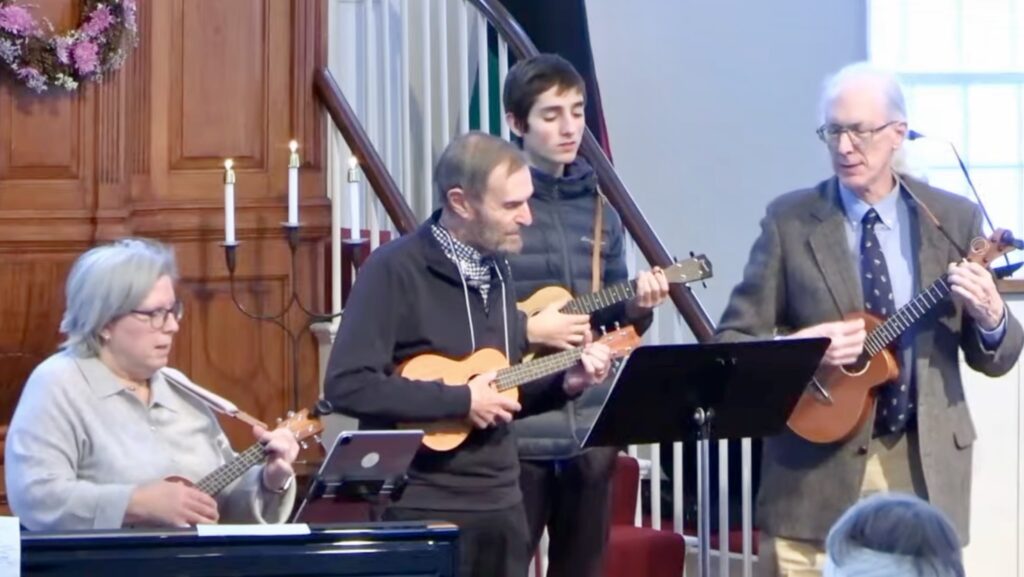
Actually, February 2 is World Ukulele Day. But Mary Beth, our music director, decided we would celebrate it today, by accompanying the first hymn in our Sunday service. We had maybe two minutes of rehearsal, which is why the photo below shows us all looking at the song sheets on the music stands. But we played it through, we didn’t totally suck, and we had fun.
Screen grab from the livestream. L-R: Mary Beth, Steve, Micah, me.
Mike Lynch, who organized the first World Ukulele Day, said the goal was simple: “Take your uke out of its case and play it.” Beyond that, he said you could use your ukulele to bring some fun and joy into the world. I don’t know how much joy we brought into our Sunday service, but we certainly brought some fun. Besides, Mike Lynch often played uke at his church, so what we did was very much in the original spirit of the day.
The real World Ukulele Day is tomorrow. Plan now to take your uke out of the case and play it….
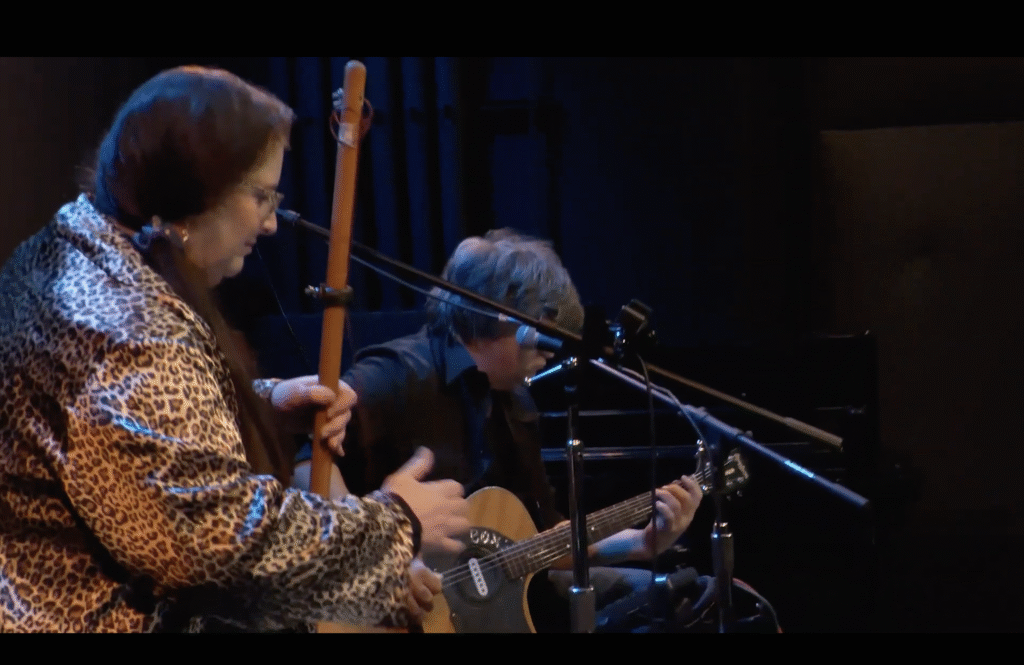
As a follow up to a previous post on tumbaderos — a tumbandero is the washtub bass that’s played in the Caribbean and Central America — tumbandero player Axel D. Rodríguez sent links to some fabulous videos. If you’re interested in tumbanderos or washtub bass, you’ll be fascinated by these videos, both to hear the varied playing styles, and to see helpful visual cues for making your own instrument.
Thank you Axel! (Find Axel and his band on Spotify — and on Youtube.)
Tingo Talango — Cuba 1 — A must-watch video showing a musician building a Cuban version of the earth bow, called a “tingo tualango” or a “tumbandero.” The earth bow was the African instrument from which the washtub bass and the tumbandero are derived. Skip ahead to 2:50 to watch the building of the instrument, and then watch it being played both by plucking the single string, and playing rhythm on the soundboard. The musician frets the string rather than adjusting the tension on the bow.
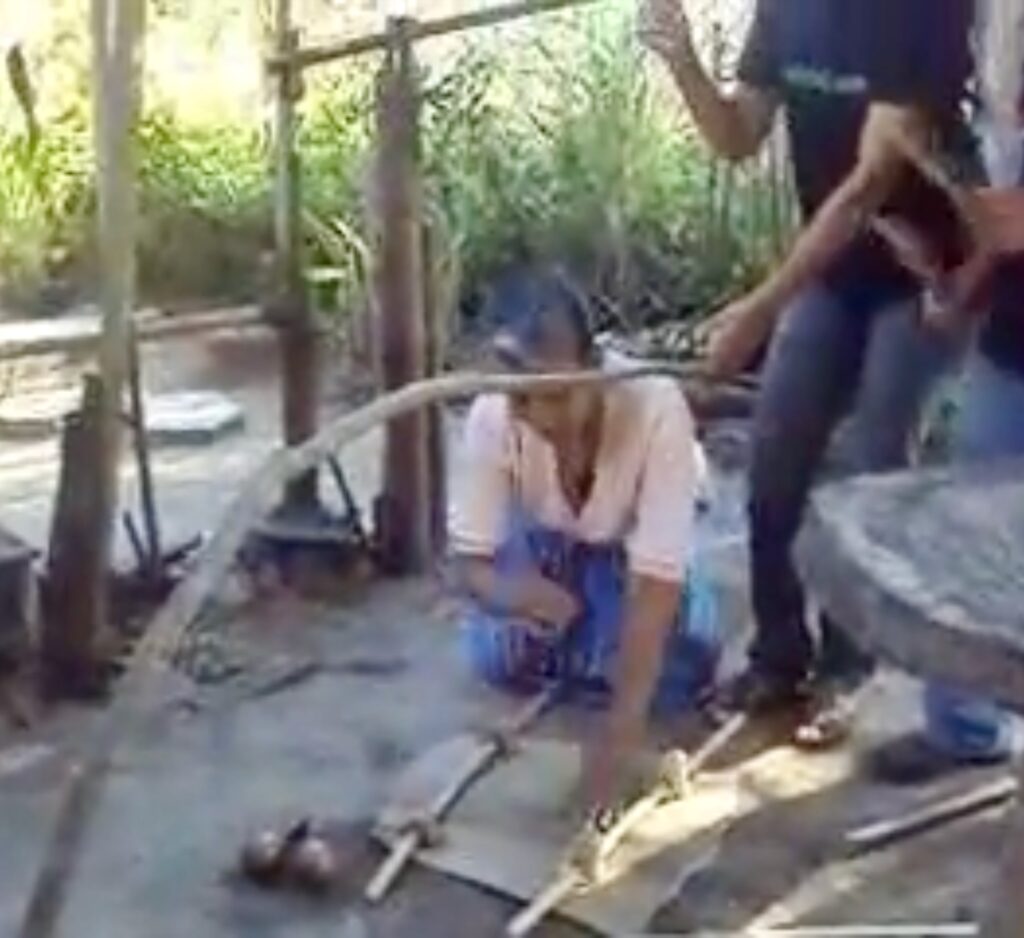
Tumbandera or Kaolin — Cuba 3 — Another traditional Cuban earth bow. These musicians adjust the string tension by moving the bow, and get different notes. In the short demonstration of playing, it seems the instrument sometimes requires two musicians — one to play, and the other to adjust tension to keep the instrument on pitch.
Screen grab from the 3rd Cuba video. You can clearly see the bow which provides tension for the string.
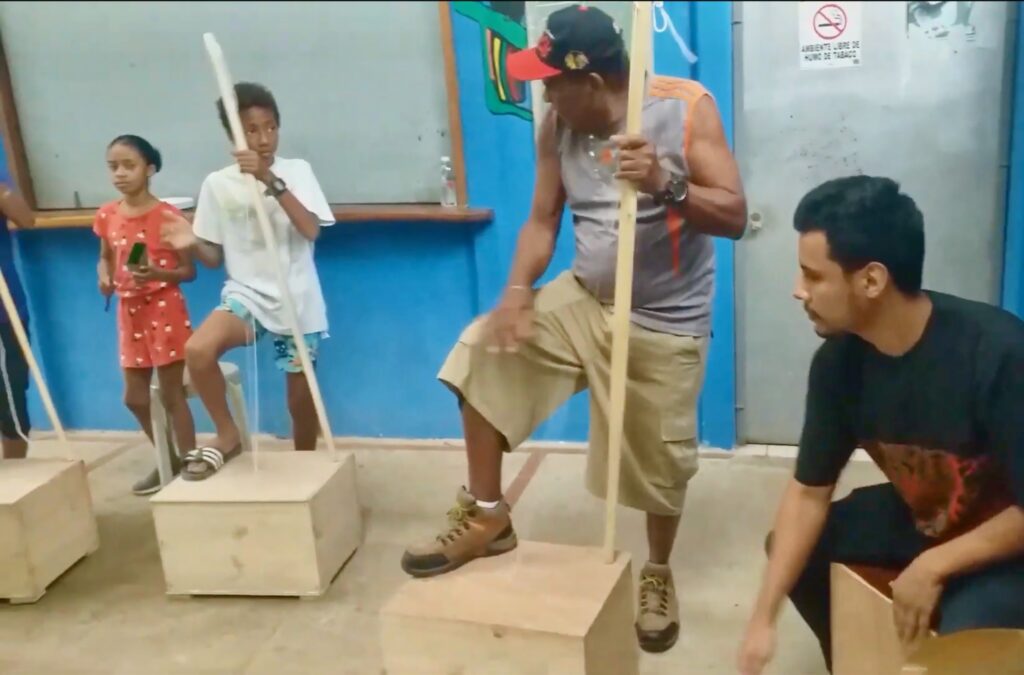
Quijongo Caribeño — Costa Rica — The visuals show some adults showing kids of about middle school age how to build an earth bow-derived instrument out of a wood box, a string, and a neck. (The audio isn’t coordinated with the visuals.)
Screen grab from the Costa Rica video. The kids are learning how to play the instruments they just made.
Marengwen — Haiti — An earth bow-type instrument, but the string tension is fixed, and pitch is altered by fretting. In addition, rather than plucking the string, the musicians strike the string with a stick. A must-watch video.
Screen grab from the Haiti video. The stick used to hit the string is blurred in this image.
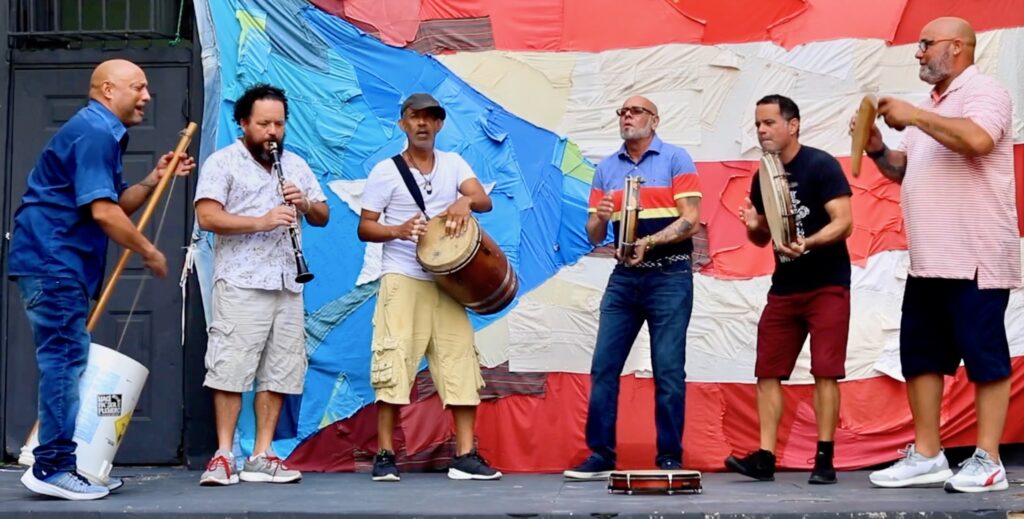
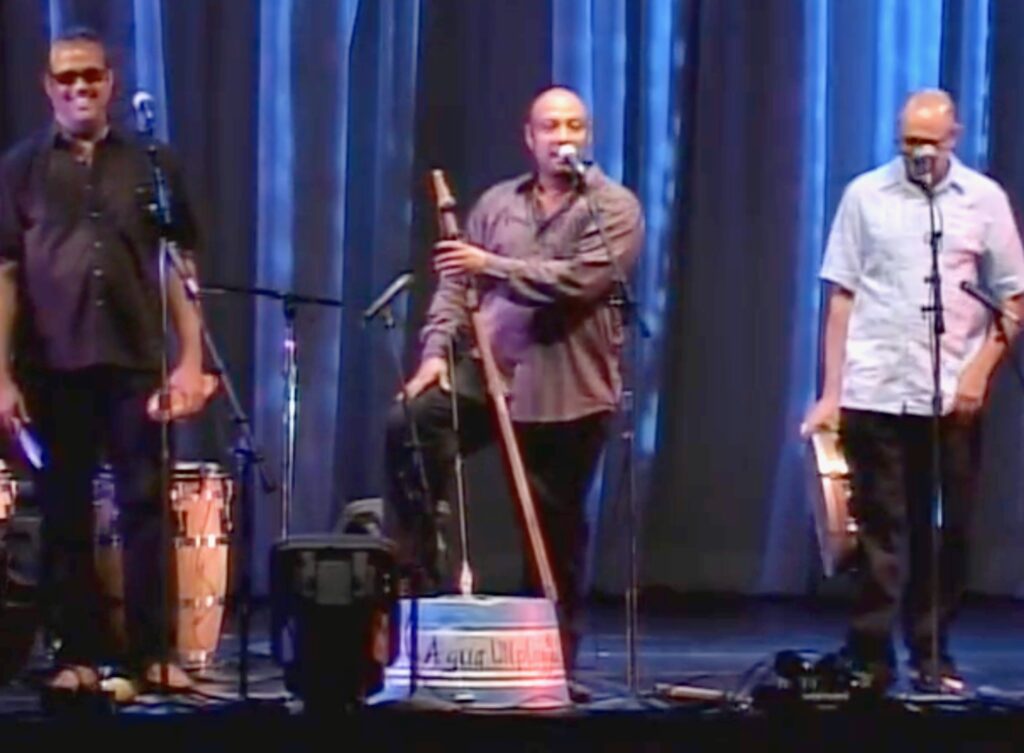
Tumbandero or Bajo De Palangana — Pureto Rico 4 — Tumbandero made with a plastic five gallon bucket. Once again, the tumbandero functions more like tuned percussion than a bass. You can hear the tumbandero from 0:00 to 2:45; and from 6:15 to the end.
Screen grab from the 4th Puerto Rico video. The tumbandero (at far left) is made out of a 5 gallon plastic bucket.
“Wherever the African diaspora is, you are going to find some sort of instrument similar to this one. In the case of [the musical genre] la plena, it’s an instrument that is complementary to the traditional panderetas [frame drums] and guiro [hollow gourd played with wire brush]. And it sounds close to a bass [in range]. But the pitch isn’t perfect, so it’s basically another percussive instrument.”
Screen grab from the 6th Puerto Rico video. This tumbandero, made from a metal washtub, looks like a classic American washtub bass.
Axel also sent some photos he found online — since I don’t know the source of them, and whether they’re copyrighted, I decided not to include them in this post. But if you do an image search for “tumbandero” you should turn up some interesting images.
A final note: I really want to make the Costa Rican instrument. I like the sound of the wood, I like the looks of it, and it would be fun to make. But we don’t have room for such a large musical instrument in our tiny apartment.
A comment by Axel D. Rodríguez, a musician and cultural researcher from Puerto Rico (his band on Spotify — Youtube), recently appeared on one of my old posts about the washtub bass. He gives some interesting information about the washtub bass that I wanted to highlight:
“For the past few years [he writes], I’ve been studying a Puerto Rican one-string bass known locally as the tumbandero. It appears historically in the northeast of the island — Loíza, Canóvanas, Río Grande, and Fajardo — and shares a clear lineage with African earth bows and the broader family of one-string, tension-controlled basses found across the Caribbean and the Americas.
“Through workshops, fieldwork, and conversations with older musicians, I’ve documented several Puerto Rican variants — the traditional washtub with stick and string, also a 5-gallon pail version used by plena musicians, and an older earth-bow-type form described in ethnographic literature. I’ve also traced connections with related instruments such as the Haitian mosquito drum (karolín/kalori-n), the Dominican gayumba, the Cuban tingo talango, the Makalapo y Seychells Islands, Gayumba Dominicana in the Dominican Republic….”
Since the washtub bass derives from the earthbow, an African instrument, it should be no surprise to find related instruments throughout the African diaspora. Nevertheless, I was fascinated to learn about the tumbandero.
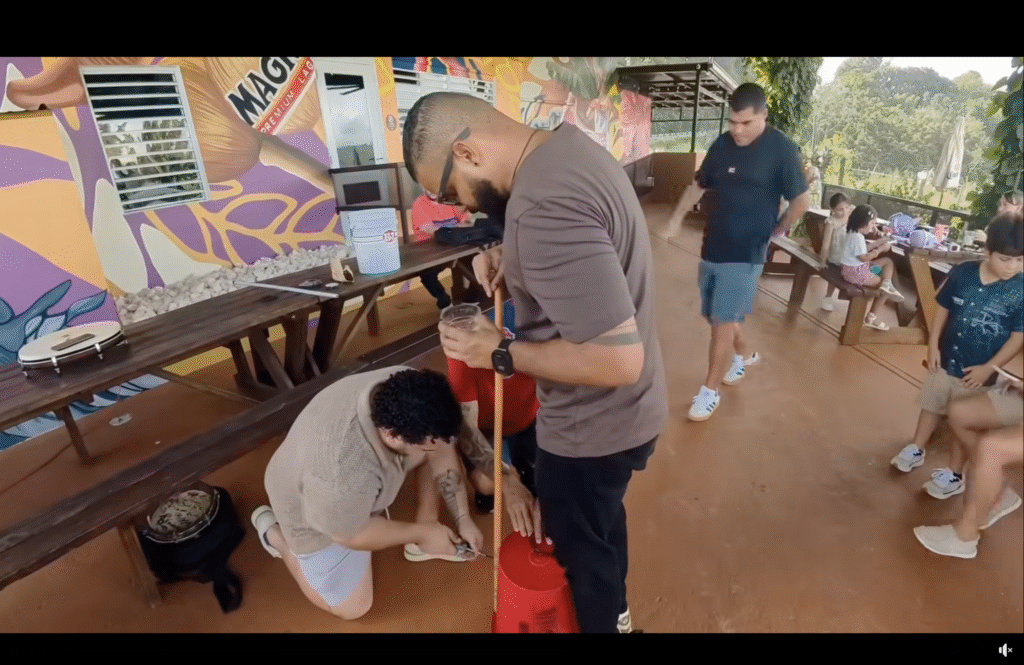
Screen grab from the Facebook video. They’re attaching the neck to the bucket.
This summer, a couple of people whom I knew and liked and respected have died; one of them was quite a bit younger than I. The news of their deaths really brought me down. On top of that, there’s the national and international news, which has also been bringing me down. Plus today I started feeling under the weather — I hate being sick in the summertime.
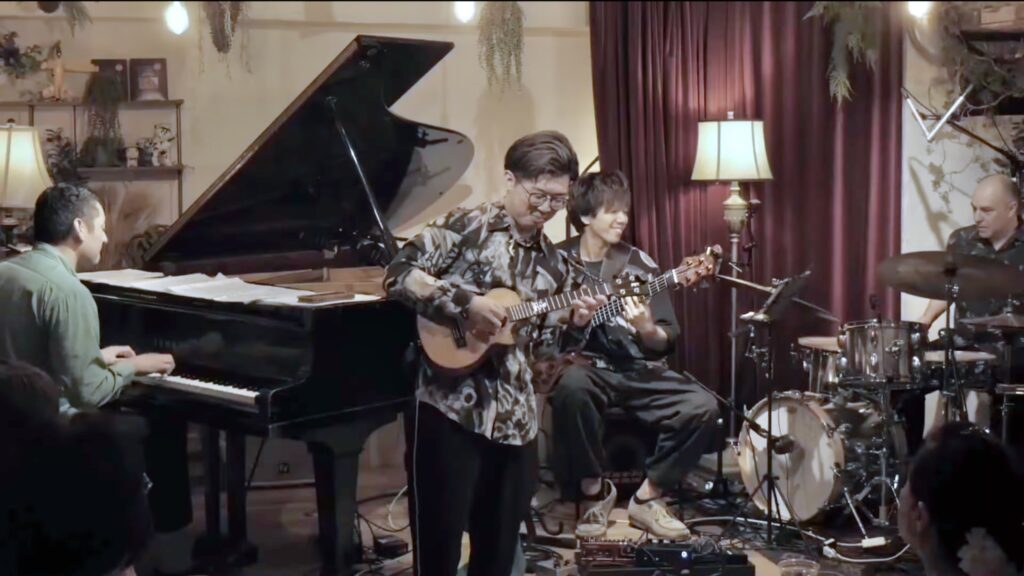
I needed something to pick me up. So I looked for music by Rio Saito, a young ukulele virtuoso who has been playing some hot jazz. And I found a Youtube video of the Rio and Dani Brazilian Jazz Trio, recorded last November, playing “Aquelas Coisas Todas” by Brazilian jazz great Toninho Horta. I recognize Rio Saito as the ukulele player and band leader, but since I don’t read Japanese I can’t tell you the names of the pianist, bassist, and drummer. All I can tell you is that they are all fabulous musicians who put across eleven minutes of bright, uptempo, very accomplished jazz that made me smile.
One of the reasons I love jazz is because of the international connections. This performance is a perfect example — a Japanese ukulelist playing a Brazilian composition that comes from the American tradition of jazz. In a world filled with hot wars and trade wars and cultural wars, it’s good to remember that we can build connections across our differences.
Screenshot from the video. Click on the image above to view the video on Youtube.
Back in 2012, I posted a game board and rules for playing “Quaker Checkers.” Photocopies of that game had been passed around for years between Unitarian Universalist Sunday schools. I decided to create a clean copy, and put it online where maybe more people could access it. And if you read the comments on that 2012 post, you’ll see that Quaker Checkers has been played with great success in Unitarian Universalists Sunday schools (and maybe in one or two Quaker First Day Schools as well).
This week, I received email from Sally Q Campbell, who invented the game. Sally said she’s currently talking with a friend of hers about developing an online version of Quaker Checkers. Actually, I would have loved to have an online version during the pandemic when Sunday school had to meet online.
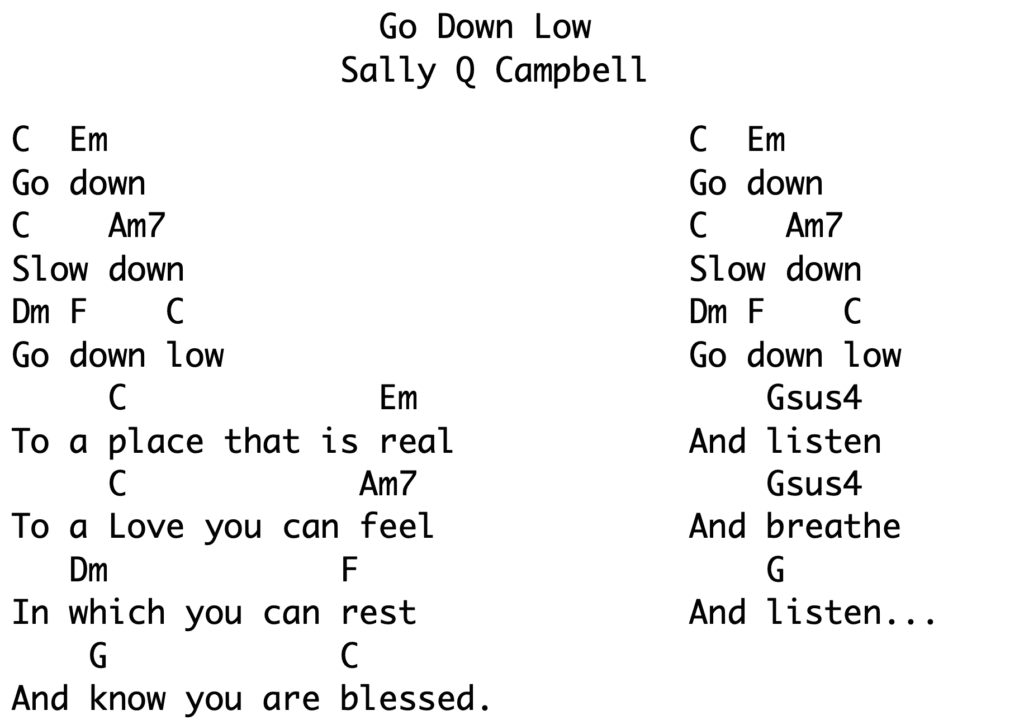
It appears that Sally is one of those endlessly creative people. She is also a songwriter, with a number of songs about peace and spirituality to her credit. On her her Youtube channel, she writes: “I’m a Quaker Singer/songwriter. Many of my songs are given to me in the silence if I will S l o w D o w n.” In fact, I especially like her song “Go Down Low,” which is all about slowing down and centering down. She hadn’t come up with chords for it, so I did. Here’s the standard warning for online chord/lyrics sheets: this is my interpretation of someone else’s song, posted here for educational purposes only; the songwriter Sally Campbell retains the copyright.
(N.B.: she sings “Go Down Low” in B flat.)
All the above is by way of digression. My real point in writing this blog post is to correct something Sally pointed out in her email. She said: “You did make one error when you tidied it up. My board does not have dark and light squares, it’s just a grid. Makes it more of a challenge.”
She’s absolutely right. To make amends, here’s a corrected version of the game board:
Click on the image above for a printable PDF of the game.
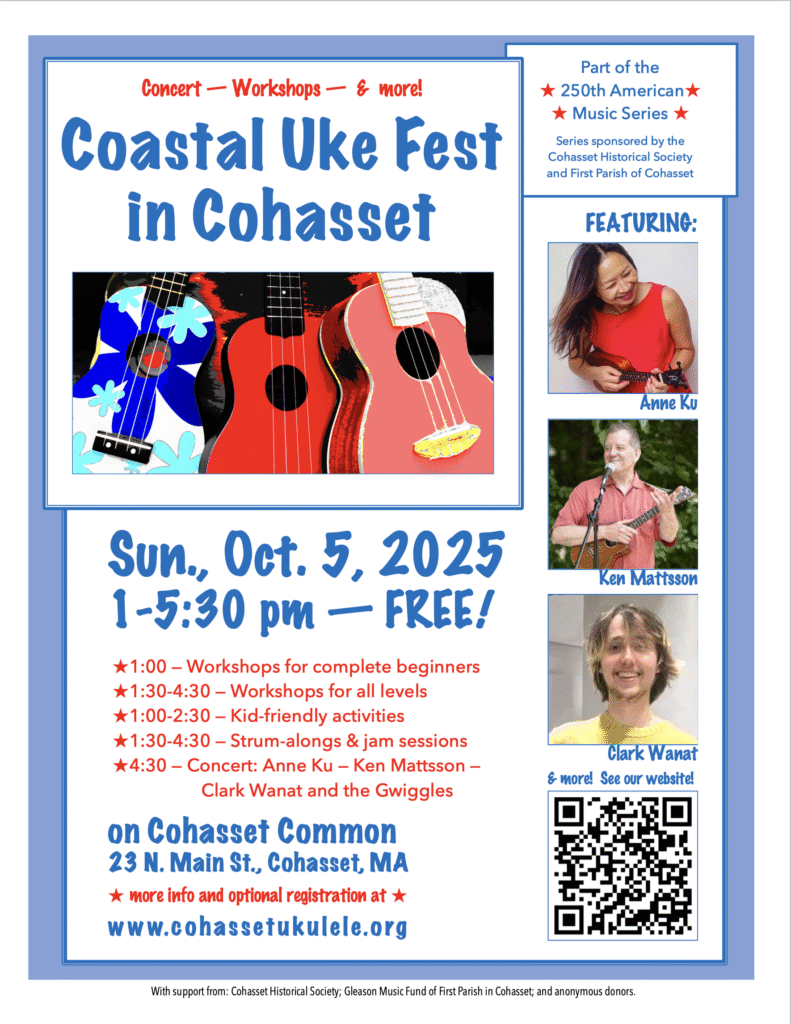
Our twice-monthly ukulele group will be hosting a half-day ukulele festival on Sunday, October 5, 2025. More info here.
This entirely free event is being sponsored by my employer, First Parish in Cohasset, in cooperation with the Cohasset Historical Society. We’re able to make this a completely free event, thanks to a grant from the Gleason Music Fund at First Parish, in-kind support from both First Parish and the Historical Society, as well as a generous anonymous donation. We’re also on a Massachusetts Cultural Council grant application submitted by the Historical Society — if that grant comes through, we’ll be able to increase accessibility with an ASL interpreter for the final concert.
If you’re in the Boston area, hope to see you there. Even if you don’t play ukulele, come join us for the free concert at 4:30.
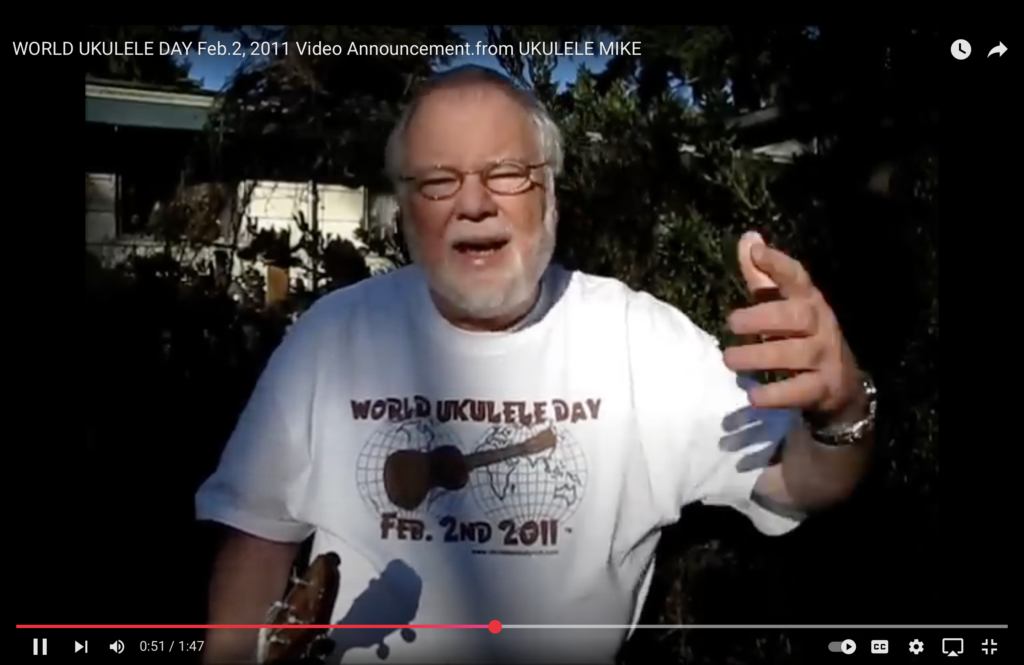
February 2 is “World Play Your Ukulele Day.” This holiday was established in 2011 by Mike Lynch (a.k.a. “Ukulele Mike”; see below). In the original announcement, Mike Lynch kept his expectations low. “Take your uke out of its case,” he said, “and play it.”
Simple enough.
Screen grab from Mike Lynch’s original Youtube video announcing World Ukulele Day. Click the image to see his video on Youtube.
OK. I did that.
What else can I do?
Mike had a suggestion: “Find someone who needs a smile. You might take it to an elder care, you might take it to a shut-in….” In other words, try to make the world a better place by playing your ukulele. But I went on a field trip with teens from our congregation’s youth group, which didn’t leave time for ukulele excursions. Maybe next year.
More about Ukulele Mike
Michael B. Lynch (1945-2018) was a career music educator and an accomplished ukulele player. As a youth, he played in a ukulele ensemble led by the legendary ukulele educator Chalmers Doane. Beginning in 2009, he produced a popular series of instructional Youtube videos under the name “Ukulele Mike.” He also published a number of instructional CDs and books, still available through his website that his wife continues to maintain.
2 p.m.: Fun with Ukulele — for all levels, but especially useful for beginners. 3 p.m.: Common Chord Progressions — what you need to know to play your favorite songs.
Doors open at 1:40 p.m. Be ready to start at 2 p.m. with a tuned ukulele. Need help tuning? Show up early and we’ll help!
Bring your ukulele, music stand (if you have one), and water bottle. Tea and snacks will be provided.
Registration
Please register at the link below. This workshop is customized to workshop participants, catering to all levels. The more you describe yourself, the better the fit.
An entry under the category of Niche Hobbies: handbell change ringing.
If you’ve read Dorothy Sayers’s murder mystery Nine Tailors (or watched the TV version), you know what change ringing is. It’s very English: you have a tower with eight or so bells, and a bunch of people stand around and ring the bells in certain defined patterns. If you don’t have a tower full of bells? Then you can use handbells, and you get handbell change ringing.
One musician describes handbell change ringing like this: “A series of 4-12 bells are rung in a series of mathematical permutations. Remember work with 12-tone tone rows in 20th-century music theory class? This is similar in practice, but with diatonic notes.” Also, to my ears it sounds much better than most twelve-tone music.
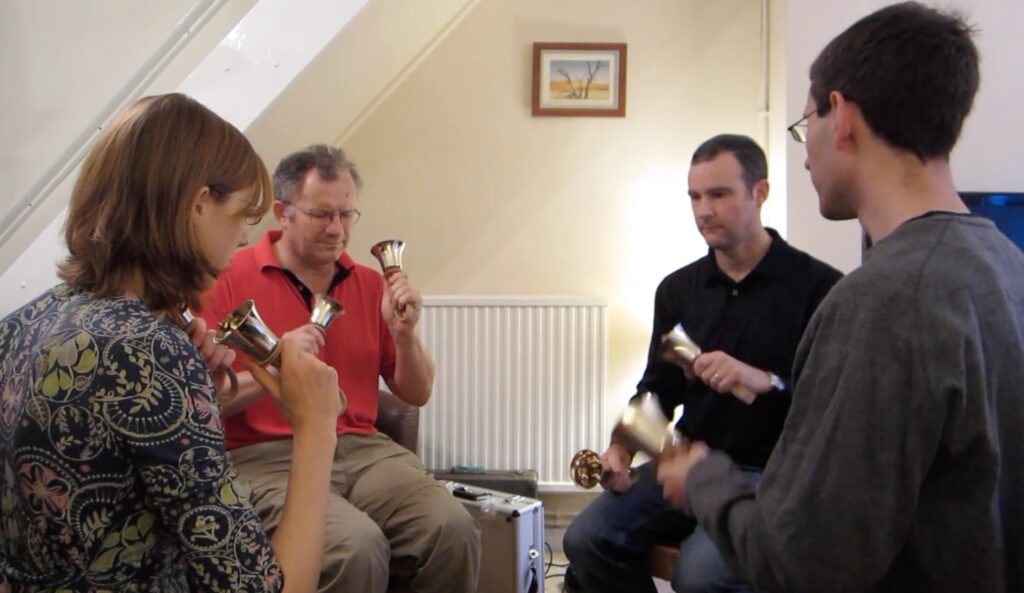
Click on the image below to see a video of handbell change ringing in action.
Screen grab from the video. Note the looks of intense concentration on the faces of the ringers.
This is the kind of niche hobby that’s going to appeal to a certain kind of person: someone who likes mathematical patterns, someone who likes cooperative efforts in small groups, someone who likes the meditative effect of intense concentration, and so on. OK, I admit it: that someone could probably be me. Since the last thing I need right now is yet another niche hobby, I’m fortunate that there’s no handbell change ringing group near me.