Abs introduced me to a new word today:
blepharitis n. an inflammation of the eyelids (from the Greek βλεφαρον, eyelid).
It was worth the introduction just to learn the ancient Greek word for eyelid.
Yet Another Unitarian Universalist
A postmodern heretic's spiritual journey.

Abs introduced me to a new word today:
blepharitis n. an inflammation of the eyelids (from the Greek βλεφαρον, eyelid).
It was worth the introduction just to learn the ancient Greek word for eyelid.
I’ve been experimenting with producing books from blogs, using the Web-based service BlogBooker.
BlogBooker appears to have one or two bugs. First, while blog entries appear in chronological order, comments appear in reverse chronological order. Second, BlogBooker regularly inserts close quotation marks at the beginning of sentences. It does not handle blockquotes particularly well, leaving too much white space above them, and sometimes indenting the first line oddly.
BlogBooker is not perfect in other ways. While BlogBooker captures still images posted on a blog, it will not include the images associated with most embedded videos (e.g., YouTube videos). It inserts an ugly title page. As an option, it can list links in footnotes, which is useful, but it places the footnote at the beginning of the link, not at the end. If a blog post includes internal links within that page, BlogBooker lists those links like any other, which is not very useful. BlogBooker does not retain the italics and bold type of an original Web page, though it does retain strikethrough type. And it will only accept output from three blogging platforms: WordPress, Blogger, and LiveJournal.
One last feature that annoyed me: BlogBooker places static pages within the regular blog chronology. But I feel that static pages should not be included in the regular blog chronology. I chose to edit the dates of each page so that they would not be included in the date ranges which I used to generate the blog book.
Even though BlogBooker is not perfect, it does produce reasonably good output with some customization allowed. It uses LaTeX as its underlying publishing platform, which means the typesetting is attractive. It does offer a number of options: specified date ranges; 5 page sizes, including U.S. letter, A4, 6×9″, 7.5×9.25″, and B4; 6 type faces; and 4 font sizes (9, 10, 11, and 12 pt.). You can choose whether or not to include comments or post author. It will automatically generate a table of contents and number the pages. Layout options include two columns, and starting each entry on a new page.
Best of all, the service is free. You can give them a donation if you want, but it is not required.
Because BlogBooker provides a PDF file as output, it is easy to create a printed book using one of the online print-on-demand Web sites. As proof of concept, I used LuLu.com to generate a printed book in trade paperback (6×9″) size. I added my own title page, and generally spruced up the PDF generated by BlogBooker; this, and fiddling with the time-consuming LuLu.com service, took up quite a bit of time. I have not yet received the printed copy, but LuLu.com has always produced excellent printed materials from PDF files.
As for ebooks: The PDF file generated by BlogBooker can serve as a perfectly adequate ebook. You can also use LuLu.com or other online print-on-demand services to generate an ePub file from the PDF.
In summary, BlogBooker can generate a reasonably good PDF book from a blog. If you’re satisfied with their somewhat quirky formatting choices, you can easily generate a print book or ebook from your blog.
I stumbled on the Web site BlogBooker, which will create a PDF file from your WordPress, Blogger, or LiveJournal blog. From there, of course, you can publish that PDF file as a book using one of the online print on demand publishers like LuLu.com, or you can just treat it as an e-book. BlogBooker could be a useful tool if you had, say, a blog for a class (online or face-to-face class) that you wanted to save as a final project — and right now I’m thinking about ways of doing online religious education, so this may be one of the tools I make use of.
A printer pulling type from a case at Yee Haw Industries Letterpress Printers in Knoxville, Tenn. Yee Haw uses both wood type and metal type, primarily for posters.
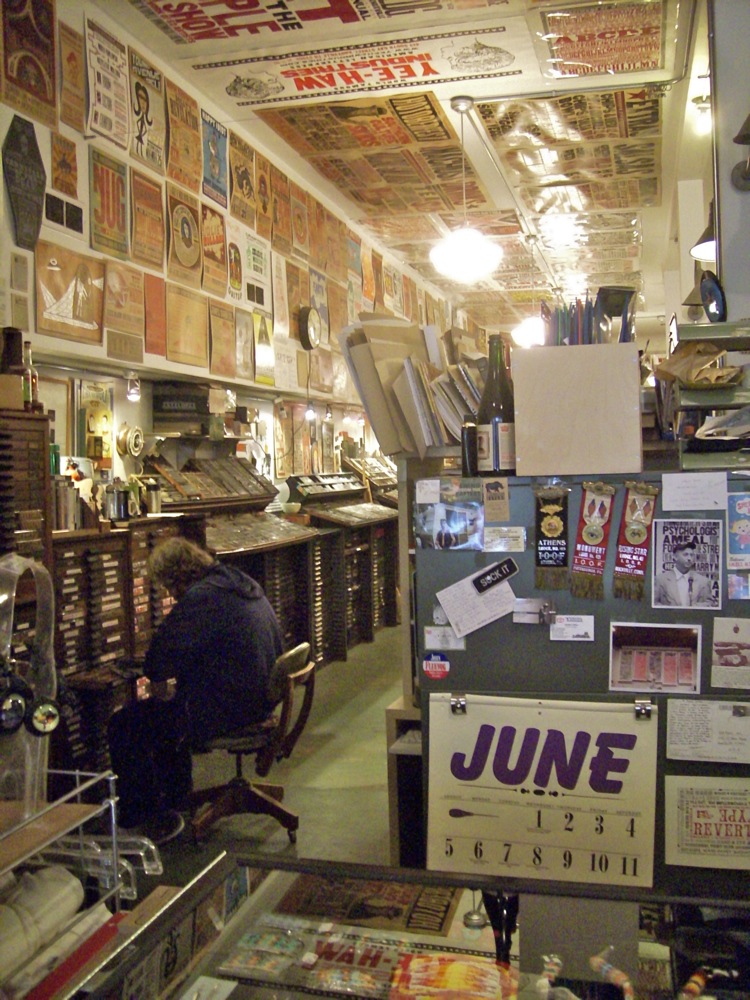
Photo by Carol Steinfeld. Click for larger image.

Carol at work in her office, writing the next great book.
Knopf is going to publish a fiftieth anniversary edition of the classic chapter book The Phantom Tollbooth in October. Sometimes I read aloud to Carol before we go to bed, and we just finished with The Phantom Tollbooth. Carol thought it was a little slow, and she kept falling asleep in the middle of chapters. And I realized that it’s really not a good book to read aloud — it’s a book that’s meant to be read to yourself, so you can stop and appreciate all the word play, and think about the story. I also realized that it’s one of those books that if you read it for the first time as an adult, you’ll never like it as much as if you read it for the first time as a child or teenager — I first read The Phantom Tollbooth when I was ten, when I stumbled across a copy in the Ripley School library.
But whatever you adults think of this book, I maintain that it’s one book that religious liberals simply must give to the children in their lives. The Phantom Tollbooth inculcates some of the highest liberal religious values — there are no discussions of God or religion, but the whole point of the book is that in order to be truly wise, in order to live a truly good life, you need wisdom that goes beyond math and science, you need poetry and delight in language, and you need a sense of wonder at the world. The book also points out that when it is your turn to take on the Demons of Ignorance, you just have to do it, even if it is an impossible task. I won’t go so far as to say that anything else we manage to teach our liberal religious kids is icing on the cake, but I will say that if I can inculcate these values in a liberal religious kid, I will feel as though whatever religious education I’ve done has been pretty successful.
And if you want to read what Michael Chabon says about The Phantom Tollbooth, you can read his essay about it in The New York Review of Books. (Thanks for the link, Carol!)
What is it with religious liberals and Garrison Keillor? So many religious liberals seem to believe he walks on water, even more than they believe that of Mary Oliver. They don’t like him because Keillor is a religious liberal himself, because he obviously isn’t. Is it because so many religious liberals have a strongly ambivalent attitude towards organized religion, and Keillor is notorious for his own ambivalent attitude towards religion? After all, when it comes to religion, Keillor is sometimes mean-spirited, sometimes nostalgic, and sometimes frankly affectionate, just like religious liberals.
Perhaps Keillor’s own ambivalence towards institutional religion makes so many religious liberals like him so much. I don’t know for sure, but I do know that I don’t care for him. Keillor strikes me as misanthropic, he has that weird affected accent, and his Lake Woebegone stories are such shameless rip-offs of Stephen Leacock’s wonderful early twentieth century stories of small-town life in the prairie provinces of Canada,— except Keillor’s stories are not as well-observed, nor as humane, nor are they nearly so funny.
Let me put it this way: the great Groucho Marx admired the comic genius of Stephen Leacock. Groucho Marx did not, however, admire the comic genius of Garrison Keillor. Nothing more need be said.
In an essay in the New York Times Book Review, David Orr provides snide commentary on a special poetry issue of O: The Oprah Magazine. Along the way, he offers the following snarky assessment of Mary Oliver’s poetry:
“Roughly a fifth of the coverage [in O magazine] is devoted to Mary Oliver, about whose poetry one can only say that no animals appear to have been harmed in the making of it.”
Now I know why my fellow religious liberals seem to like her poetry so much: it’s the equivalent of cage-free or free-range eggs.
The Official Diana Wynne Jones Web site reports that the well-known fantasy author died yesterday. She was best known as a “young adult” author, meaning that her books were marketed to early teens, that many of her characters were teenagers, and that her books were actually driven by character and plot rather than literary experimentation. I think of Diana Wynne Jones as an author who was concerned with religion, and not just because of her fantasy series The Dalemark Quartet, which remains my favorite fictional creation story — richer than the thinly-disguised Christian creation story of Narnia, more morally complex than the bombast of Tolkien’s Silmarillion.
Jones herself was confused by the contradictions of ordinary dogmatic Western Christianity. At the age of nine, she had a hard time making sense out of the Anglicanism in which she was raised:
“There I sat [in York Minister cathedral], wrestling with the notion that Heaven Is Within You (not in me, I thought, or I’d know) and of Christ dying for our sins. I stared at the crucifix, thinking how very much being crucified must hurt, and was perturbed that, even with this special treatment, religion was not, somehow, taking on me. (I put it this way to myself because I had baptism and vaccination muddled, like germs and Germans.)” [ Autobiography on Official Diana Wynne Jones Web site.]
By the age of about ten, she cut through the Gordian knot of mid-20th century Anglicanism in a straightforward way: “I settled my religious muddles by deciding that I had better be an atheist.” Yet for all her atheism, religious and moral questions are integral to her books. At the most superficial level, the Dalemark Quartet is filled with a richly-imagined ancient paganism. Others of her books include organized religion as little more than part of the social landscape, but at a deeper level a sense of awe and wonder at the universe, which is the most basic of religious responses, pervades her books. She also wrestles over and over again with yet another basic religious issue — why is there chaos, and why is there order in the universe?
Many religious liberals rave about the atheist fiction of another young adult author, Phillip Pullman. But Pullman has always struck me as heavy-handed and strident in his atheism. I’d much rather read Diana Wynne Jones. Her fictional universes explore what it’s like to live in a universe where there is no god or goddess who’s going to bail us out if we get in trouble. At the same time, in her universes human beings do not stand at the center of everything; that would make things far too simple. In her universes, there isn’t one correct answer to each moral question; moral choices are difficult and often painful; and in her fictional universes one’s moral choices can make a huge difference to oneself and to others. This is the kind of morality that I would like to present to young adults — or to adults, for that matter.
Recently, I’ve been making my way through P. G. Wodehouse’s books. (You know, Wodehouse, the guy who wrote those books about Jeeves, the butler, and Bertie Wooster, the gentleman of negligible intellect for whom Jeeves worked. Yes, they were books before they got abducted by British television, and magazine serials in the old Saturday Evening Post before they were books.)
The real reason I’m reading P. G. Wodehouse is escapism, pure and simple: his books are worlds of delightful fantasy, with no particular relationship to reality, where everything turns out just fine in the end. But if you ask me, I’ll tell you that the reason I’m reading his books is because he’s such an excellent English prose stylist, and I’m reading him in hopes that I can learn to write better. Both are true statements, but the second statement is the kind of truth that’s so faded that it’s barely there at all.
Yet even though there is so little of substance in Wodehouse’s books, once in a great while, to my vast surprise, he actually has something to say that is more than mere gossamer fiction fantasy. When I read the following passage in the novel Picadilly Jim (Arrow Books ed., 2008, p. 85), I had to read it twice, because it actually said something of substance:
“…But his father’s reception of the news of last night’s escapade and the few words he had said had given him pause. Life had taken on of a sudden a less simple aspect. Dimly, for he was not accustomed to thinking along these lines, he perceived the numbing truth that we human beings are merely as many pieces in a jig-saw puzzle, and that our every movement affects the fortunes of some other piece. Just so, faintly at first and taking shape by degrees, must the germ of a civic spirit have come to prehistoric man. We are all individualists till we wake up.”
As I thought about this passage, a strange vision came to my mind: Ayn Rand and P. G. Wodehouse in a sort of literary fight club….
…They come out of their respective corners and meet in the middle of the ring, literary knuckles bared. Wodehouse says, “I published nearly a hundred books.” Rand sneers at this pathetic jab, and replies, “Yes, but they were drivel; my big serious novel has sold nearly 7 million copies.” Wodehouse winces; he feels this blow keenly; but he rallies, saying, “Yes, but I was knighted.” Rand reddens in anger, and replies, “I repeat, you wrote drivel, mindless musical comedies in sticky-sweet prose. Whereas I promoted a serious philosophy, an ethical egoism that rejects the ethic of altruism.” Wodehouse smiles faintly, pauses, and says, “Ah yes; so you did: we are all individualists till we wake up.” It’s a knockout blow: Rand grunts in pain, clutches her head, and hits the canvas, out like a light.