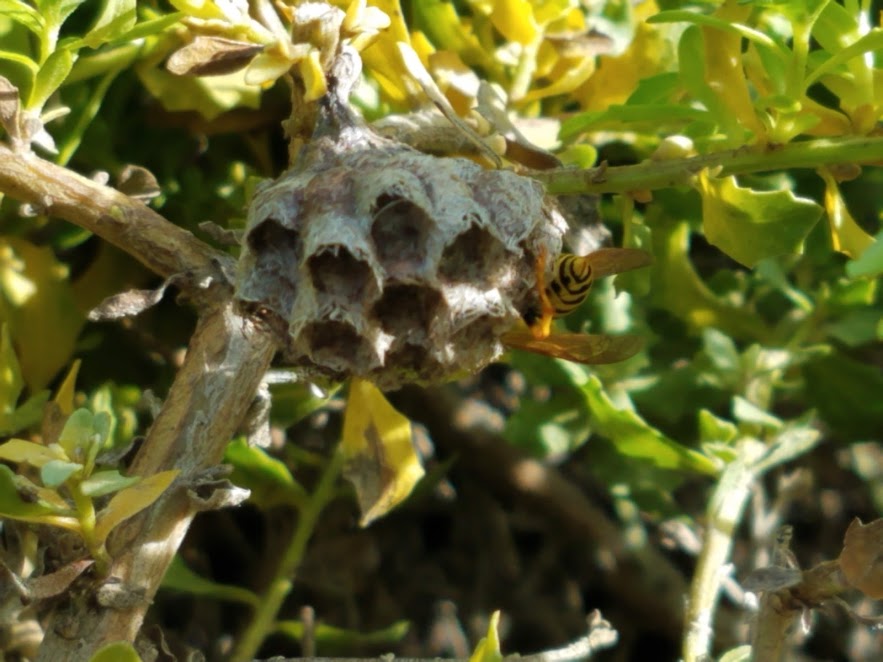
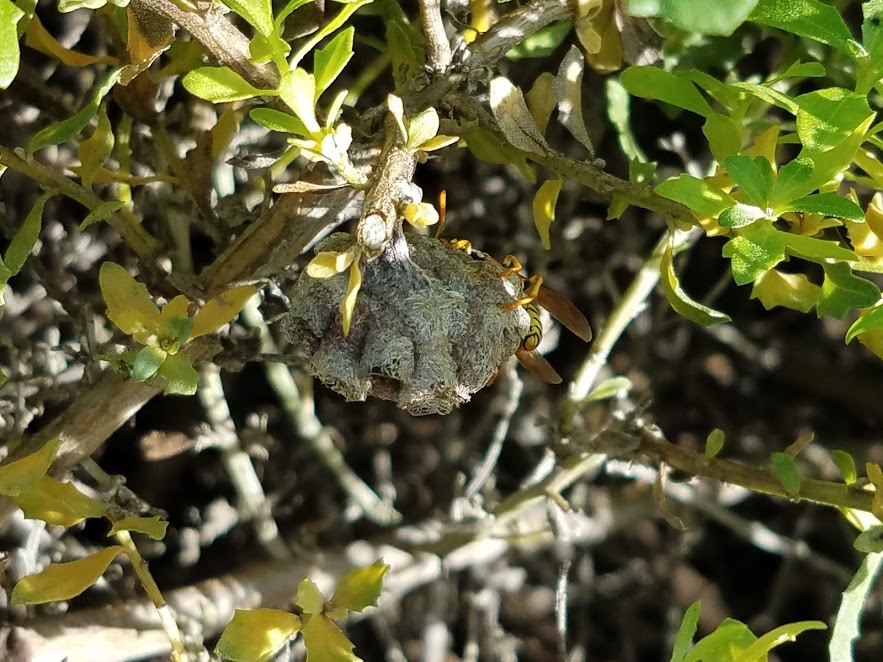
Nancy saw a paper wasp beginning to build a nest. We watched it for a few minutes. The nest is still small, with perhaps 16 cells. We saw one adult, who sat quite still on the nest for more than a minute at a time; then she (presumably it was a female) would fly off and return after a minute or so. I wondered if she were working on building the nest; but she was working on the underside of the nest, and the nest was located where we couldn’t see the underside without disturbing her, we could not confirm my conjecture. I did, however, manage to take two photos with Carol’s phone:
I feel fairly confident assigning this individual to genus Polistes, a genus which includes dozens of species of paper wasps. The online “Bug Guide” of the University of Iowa’s Department of Entomology says of genus Polistes: “Predatory on other insects (predominantly caterpillars) to feed larvae.” Nancy left the nest there so the wasps could serve as a biological control on voracious caterpillars and other herbivorous insects.
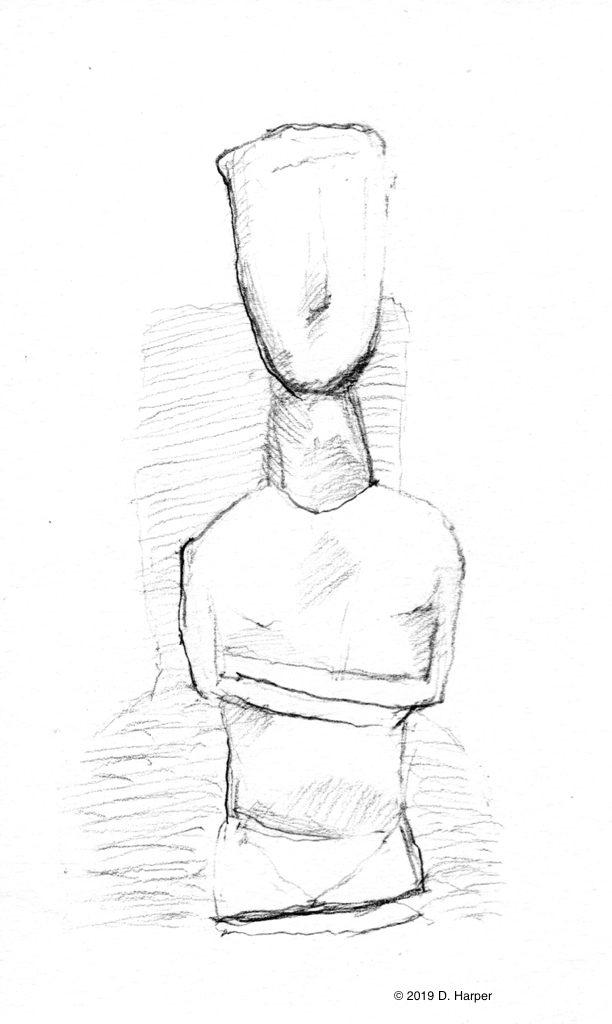
The DeYoung Museum in San Francisco has a number of Cycladic figures made thousands of years ago in what is now Greece. I was attracted to one of these figures, labeled as “Cycladic Figure, Early Cycladic II, Spedos variety,” dating to perhaps 2500 BCE, so I made a quick sketch of it:
This is a typical Cycladic figure of a woman with her arms crossed; it is made of white marble, though originally it would have been “painted with mineral-based pigments—azurite for blue and iron ores, or cinnabar for red.” There are those who assert that this type of figure represents a deity, perhaps the Great Goddess who may have been the chief deity of the ancient Greek world.
But of course there’s really no way to know what this figure represents. Is it a deity, or just a human figure? Or maybe something in between? Perhaps we would tend to call it a deity because the shape is so satisfying to look at; when we like looking at a piece of art it is tempting to think of that art as representing something beyond the mundane.
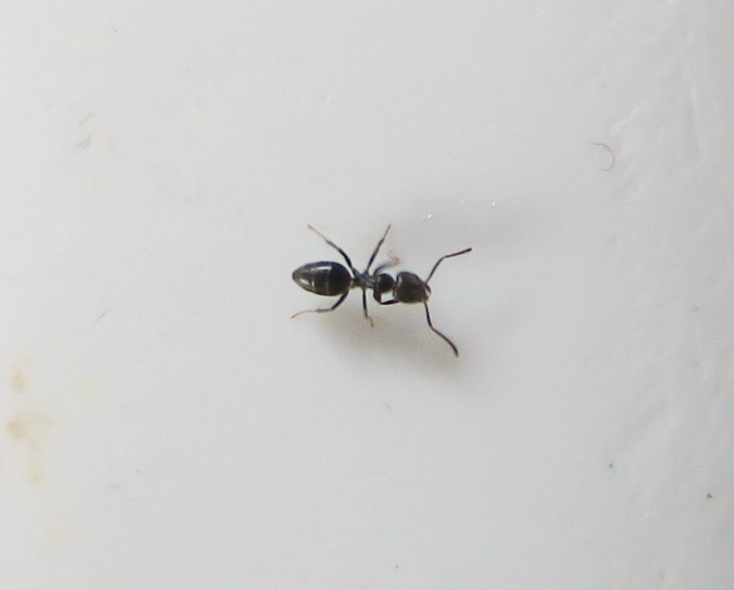
It’s that time of year: the Odorous House Ants (Tapinoma sessile) are sneaking indoors to get out of the rain. At least I think that’s what they are: they’re the right size and shape, and when you crush one it smells vaguely floral (some people describe the smell as being like cocnout sun tan oil). One of the ants paused on the edge of our sink long enough for me to take a photo that’s only slightly blurred:
A new podcast from the University of Macau, featuring philosophy professor Hand-Georg Moeller and doctoral candidate Dan Sarafinas, focuses on “virtue speech,” which is Moeller’s philosophical term for political correctness.
Moeller connects virtue speech to civil religion; in the United States, civil religion begins with the fundamental dogma contained in the Declaration of Independence: “We hold these truths to be self-evident: that all men are created equal; that they are endowed by their Creator with certain unalienable rights; that among these are life, liberty, and the pursuit of happiness.” According to Moeller, this dogma is written so you can’t argue with it; all you can do is interpret it. (Although as Moeller points out, there are all kinds of ways you can argue with this statement; for example, Europeans like Moeller are not likely to believe in a Creator, let alone a Creator who endows human beings with unalienable rights.)
Virtue speech — politically correct speech — starts with this fundamental dogma and interprets it by applying it to specific situations, such as the MeToo movement, or Black Lives Matter. While Moeller says he’s generally supportive of the MeToo movement and Black Lives Matter, to someone who believes in the Enlightenment ideal of the use of reason, virtue speech is going to be just as much of a problem as fundamentalist Christianity: both are founded on dogmas that require you to accept them without reasoning. Moeller points how virtue speech subverts well-reasoned argument:
“Most of these people who are attacking virtue speech, who are attacking political correctness: in the beginning they’re just appalled by this virtue signaling. They’re appalled by this self-aggrandizing moralism or the moralists. But then they start thinking, ‘OK, I’ll prove that their morality is wrong.’ And then they get drawn into a moralistic, dogmatic discourse, because they start talking about the issue. They come up with very indefensible positions, even.”
Moeller’s title for the podcast is “The Issue Is Not the Issue.” He doesn’t want to get involved in moralistic, dogmatic discourse himself. Instead, he wants to point out the problems with dogmatism:
“The point is not to deny the values of liberty and equality, but to understand and critique dogmatic speech, no matter what the issues are. That doesn’t mean that these things are wrong. It’s just to point out the problems of engaging in dogmatic speech.”
While I highly recommend this podcast, I think it will be very challenging for many religions liberals. In their religious life, religious liberals studiously avoid dogmatism, but in their political life too many religious liberals engage in dogmatic speech with little consciousness of what they’re doing; indeed, many Unitarian Universalist congregations, while eschewing religious dogmatism, are hothouses of political dogmatism.
You can listen to the first episode of “The Issue Is Not the Issue” here.
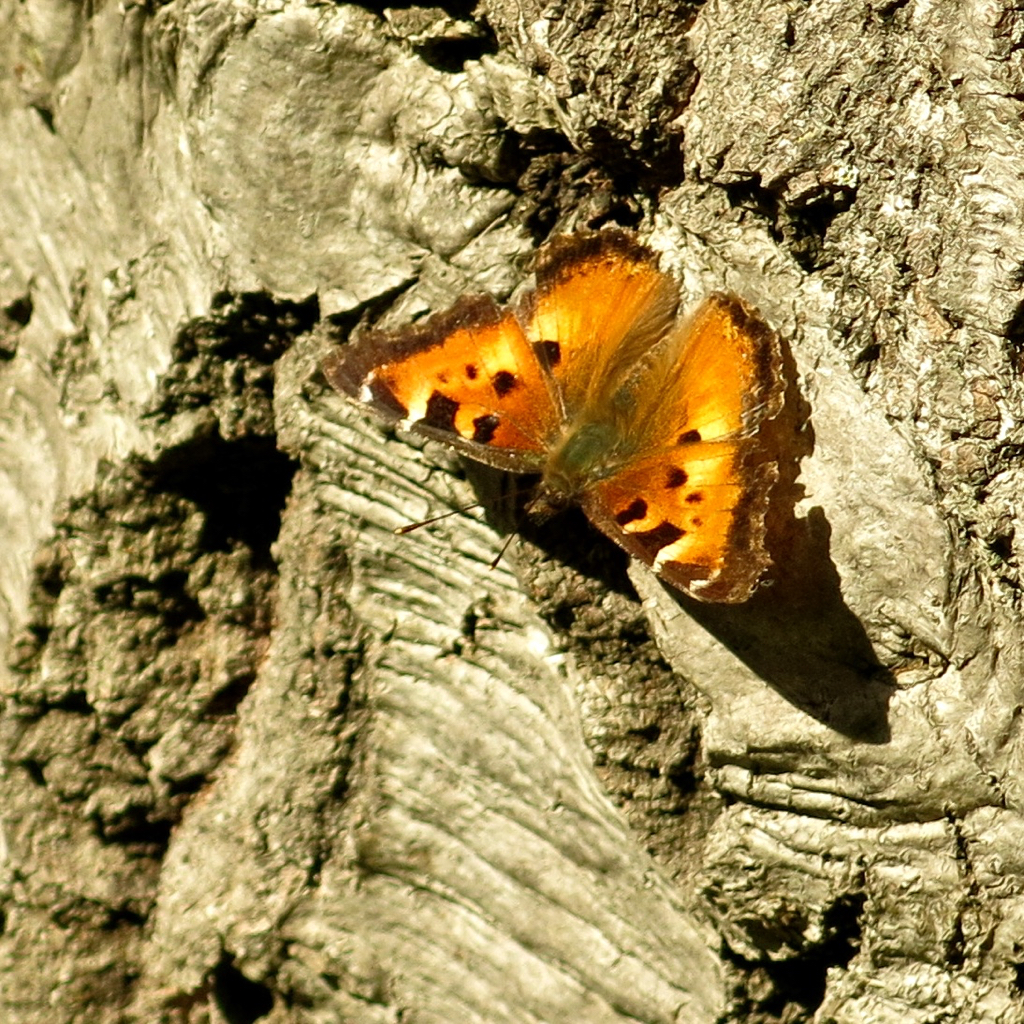
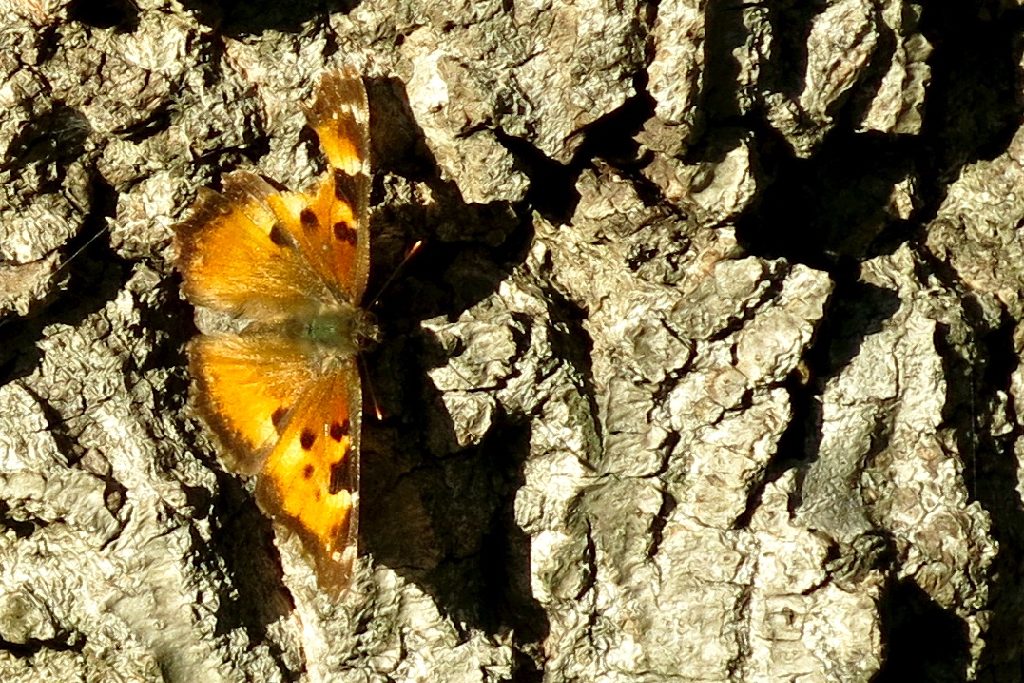
At about 5:30, while wandering around St. John’s Cemetery enjoying the first warm spring day, I saw a number of California Tortoiseshell butterflies flying under some live oaks. I tried to count them but they were moving too fast: at least half a dozen, probably more. They were very active, but some of them settled long enough for me to take their photo. I noticed that the edges of their wings were quite worn.
California Tortoiseshells are migratory butterflies. They hibernate in winter in the foothills of the Coast Range — St. John’s Cemetery could be considered in the foothills of the northern end of the Santa Cruz Mountains . According to Arthur M. Shapiro in Field Guide to Butterflies of the San Francisco Bay and Sacramento Valley Regions: “When they emerge from hibernation in late winter the males are late-afternoon territorial perchers in classic nymphaline style.” Indeed, the butterflies I saw appeared to be patrolling territories, perching in one spot and periodically circling around a small area, sometimes flying at other butterflies in nearby territories.
I went back to the house to get a camera with a better zoom, but by the time I had returned, the sun was almost below the horizon and the butterflies had gone away.
Alex, a friend who works at Health Initiatives for Youth (HI4Y) in San Francisco, told me about their Risk Reduction Resource Kits. These kits contain resources to help teens teens learn about sexuality and safer sex. Alex knows about the OWL comprehensive sexuality education program, and has heard me describe our youth programs, and based on that he encouraged me to put in an application for the last remaining Risk Resource Reduction Kit, and Carol and I went in to JI4Y’s offices to pick up the kit on Monday.
The whole point of the kit is that it’s supposed to be placed where teens can access it without adult supervision, to encourage them to explore the materials on their own. The kit was designed to accompany a sexuality education curriculum developed by HI4Y, but be accessible both to teens taking the curriculum and other teens. So for our congregation, it’s a prefect accompaniment to the OWL unit for gr. 10-12; for those taking OWL the kit will reinforce the curriculum; and it can also serve as an educational resource for those not taking OWL.
The Curriculum Subcommittee of our congregation met the day after I picked up the kit, and we devoted the meeting to talking about the kit. The Curriculum Subcommittee has been exploring ways to be more intentional about our congregation’s implicit curriculum, asking ourselves: How can we structure intentional learning opportunities that are not part of the explicit curriculum, the formal educational programs? We agreed that the kit is a solid addition to our implicit curriculum: Not only does it educate teens about specific sexuality topics, it provides a larger lesson that information about sexuality should be easily accessible and shared without shame or guilt.
Beyond educational theory, we also talked about how best to implement this aspect of our implicit curriculum. Alex had warned us that sometimes the kits get forgotten, and stowed in some obscure corner. So we’re going to provide orientation to the kit for key adults (youth advisors, OWL leaders, ministers, and others) to increase the chance that adults will remember to make the kit accessible. In addition, we’re also going to provide a brief orientation to the kit to teens — both to youth group members, and participants in OWL gr. 10-12 — showing them what’s in the kit, and telling them where it will be located. (When we offer OWL for gr. 7-9 next year, we’ll do another orientation.)
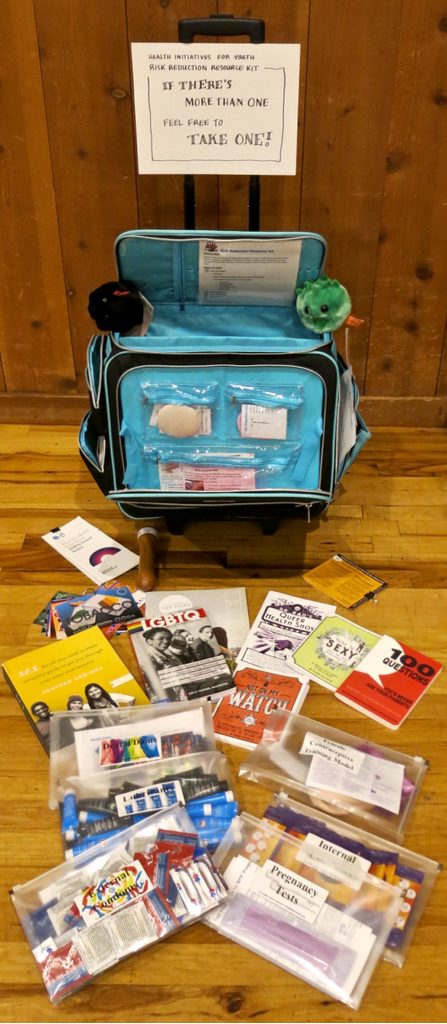
But the real strength of the kit is what it contains. HI4Y came up with some excellent youth-friendly resources, including comics, zines, books, and samples — I’m putting a complete list of what’s in the kit below. The materials are housed in a wheeled nylon case, like airline luggage (actually, it’s a scrapbooking case HI4Y bought from Michael’s art supply). A highlight of the kit is contraceptives samples that youth can examine: condoms of course, but also dental dams, female condoms, and lubricant; HI4Y even has some grant money left to replenish samples when they get depleted. There’s both a penis model (made of wood, not plastic!) for trying condoms, and a vulva/vagina model for trying female condoms. We were able to add one very important thing to this kit: our congregation has a ten thousand dollar bequest that we can use to put books in the hands of children and teens, so we are able to provide copies of the book “S.E.X.” by Heather Corinna that youth can take for their own.
We would not have been able to afford to put this kit together ourselves, and we are grateful to HI4Y for writing the grant and assembling the kit, and to the federal government for providing the grant money. Just in case your UU congregation can find the funding, I’m going to provide a complete list of all the resources in the kit below; at the very least, this list of resources might spark ideas for you.
The Risk Reduction Resource Kit (we added the sign at top).
Here’s what’s in the kit:
Birth control samples and examples: Dental dam samples Female condom samples Female Contraceptive Model (to practice inserting female condoms) Lubricants samples Male condom samples Penis model (to practice with male condoms) IUD model The Ring model The Pill model The Implant info card Plan B info card Birth Control Patch info card “How Well Does Birth Control Work” info card
Home test kits: Pregnancy test kits HIV Home Test Kit information (actual kit is stored separately, per instructions from Health Initiatives for Youth)
Handouts and Miscellaneous: “Pre-Exposure Prophylaxis” handout Individual Drug Fact Cards (handouts) Drug Fact Cards set Chlamydia Plush Toy HIV Plush Toy Youth Clinic Youth Guide to San Francisco and Silicon Valley (list of local clinics that serve youth; includes 1-page summary of California law on youth’s right to treatment) (We also added handouts from the nearest Planned Parenthood Health Center)
Publications: “Dr. Rad’s Queer Health Show: Self Exams & Check-Ups” zine by Rad Remedy and Isabella Rotman “You’re So Sexy When You Aren’t Transmitting STIs” comic zine by Isabella Rotman “Not on My Watch: Bystander’s Handbook for Prevention of Sexual Violence” comic zine by Isabella Rotman “100 Questions You’d Never Ask Your Parents” book by Elisabeth Henderson and Nancy Armstrong “S.E.X.” book by Heather Corinna “LGBTQ: The Survival Guide” book by Kelly Huegel Madrone “Birth Control Top Picks” magazine by Bedsider.org
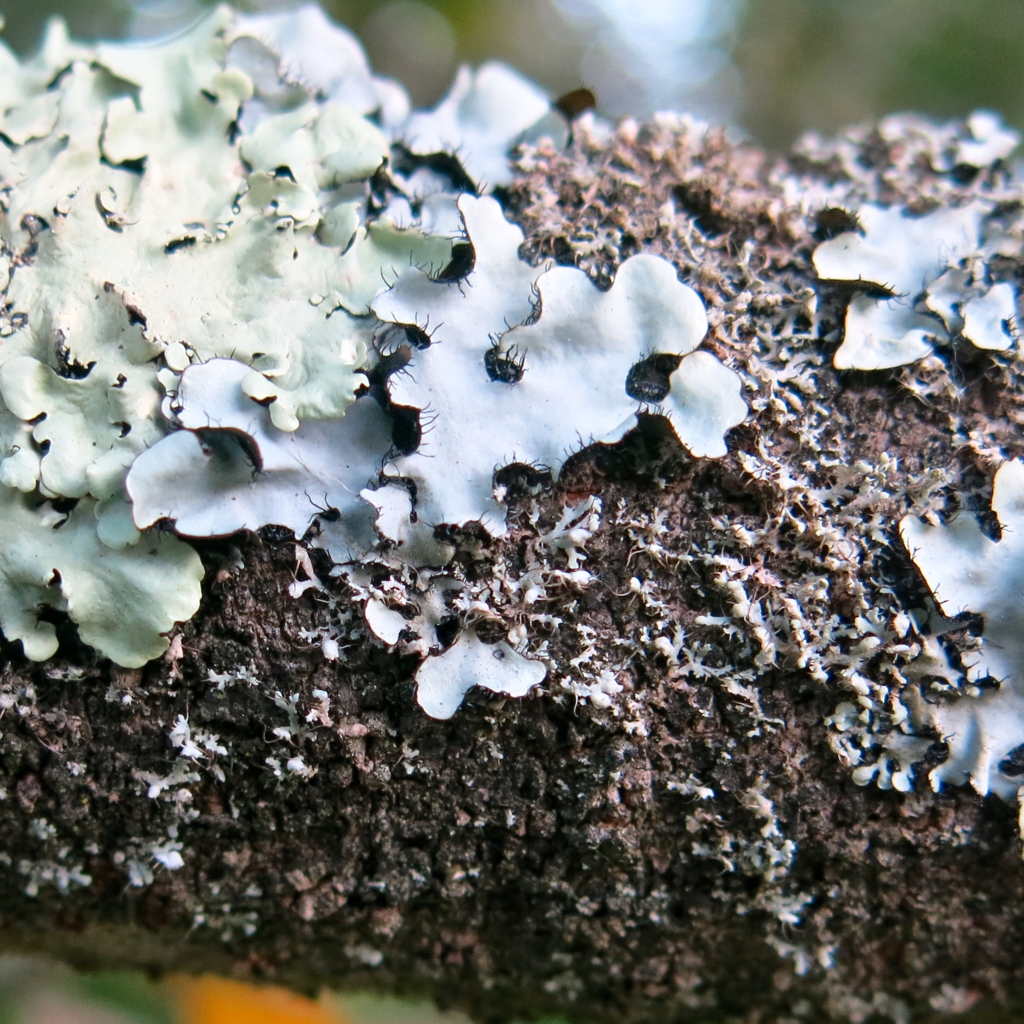
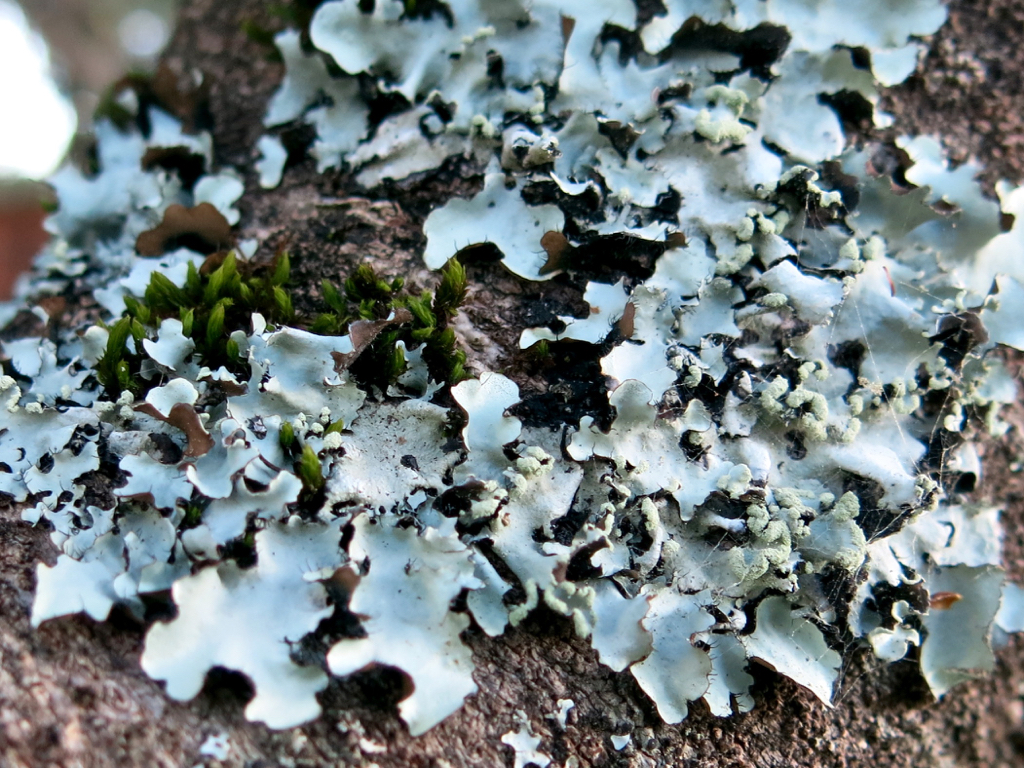
Several of the live oak trees in the older part of St. John’s Cemetery in San Mateo have branches on which grow bluish-gray foliose lichens with ruffled edges lined with black cilia. The thallus appears to be attached to the substrate mostly in the middle, leaving the edges curling up. On some, small round soralia could be seen (a soralium is where a lichen produces soredia, which are small bits of fungal hyphae and phtyobiont that can be released to produce a new lichen).
After consulting Stephen Sharnoff, A Field Guide to California Lichens (Yal Univ., 2014), I’d place these lichens in the genus Parmotrema; without doing any chemical tests, I’d guess P. arnoldii Powdered Ruffle Lichen, or P. perlatum Common Powder Ruffle.
Thomas Commuck (1805-1855) is probably the first Native American composer whose compositions were published. Commuck was a Narragansett Indian who became part of Brothertown Indian Nation — an alliance of Christian Native Americans from different “parent tribes” in southern New England (according to the Brothertown Indian Nation Web site).
Though he was born in Rhode Island in 1805, during the 1820s Commuck joined the exodus of New England Christian Indians to upstate New York, joining the Brothertown Indians near Deansboro, N.Y. Then in 1831, he joined the Brothertown Indians once more in leaving New York to settle in Wisconsin.
Commuck published his Indian Melodies, a hymn and tune book, in 1845. In the Preface, Commuck writes that in 1836 he began “trying to learn, scientifically, the art of singing” through self-study. For hymn texts, he mostly drew on a hymnbook of the Methodist Episcopal Church, and the majority of the texts he set to music are by Charles Wesley. The book was published in New York under the auspices of the Methodist Episcopal Church. The tunes, according to the Preface, are named with “the names of noted Indian chiefs, Indian females, Indian names of place, etc.” The tunebook was published in two edition: one with “patent notes,” what we now call shape notes; and the other with conventional round note heads. As was the custom in much of early nineteenth century American hymn tunes, the melody is in the tenor line.
Commuck had his tunes harmonized by Thomas Hastings. Hastings’ work was completed in less than a month: “For much of the rest of the month of April, Hastings’ attention was focused on readying for publication a collection of original hymn tunes by the Narragansett Indian, Thomas Commuck (1805-1855), for which he had been asked to supply the harmonizations. …an entry in Hastings’ diary on 24 April 1845 indicates that he finished his part of the editing process on that date” (Hermine Weigel Williams, Thomas Hastings: An introduction to His Life and Music [Lincoln, Neb.: iUniverse, 2005].p. 109-110). Why was Hastings chosen to do the harmonizations? No doubt in large part due to his reputation as a composer and musical reformer, who had by then published a number of well-known collections of sacred music. In addition, however, “Hastings had long had a fascination with music that was indigenous to the Americas, as evidenced by the fact that he was among the first in America to publish a few examples of ‘Indian airs'” (Williams, p. 110 n. 24).
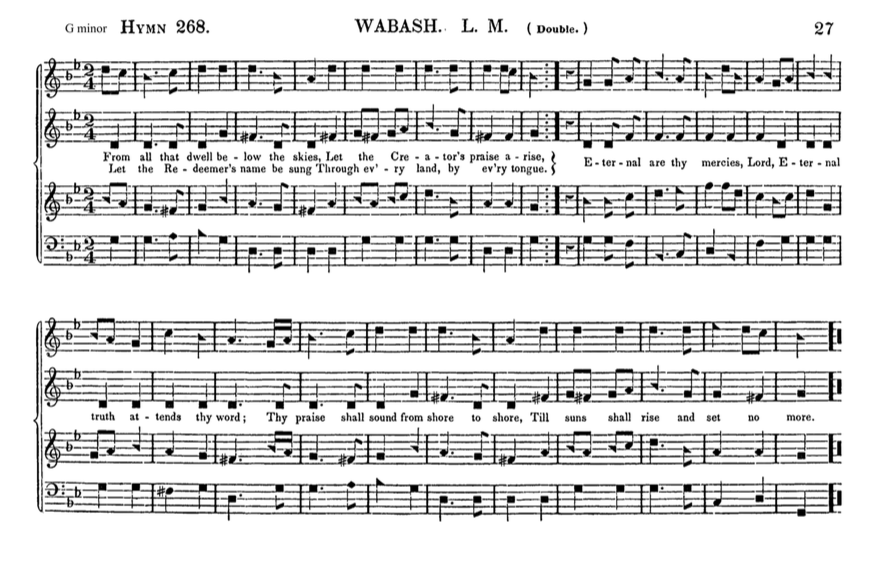
Today, Hastings has a poor reputation as a composer who was a mere imitator of European musicians, while some of the earlier (white) American composers whom he had rejected are now considered favorably; William Billings, for example, is now considered the first serious American composer while Hastings is all but forgotten. Yet while some of Hastings’ arrangements of Commuck’s melodies are entirely forgettable, others come across as sensitive and non-intrusive arrangements. One example is Wabash, on page 27; Hastings’ harmonization supports but neither overwhelms nor distorts Commuck’s minor-key setting of the Isaac Watts paraphrase of Ps. 117 (I have digitally edited the version below to correct a typographical error):
Commuck’s tunes tend to be sunny and uplifting; even though the melody of Wabash is in G minor, the B section begins with a shift to the relative major, and the use of the raised seventh in the A section provides a lighter mood than strict Aeolian mode. Overall, the melody comes across as communicating the awe and power of the God of the Psalms, without an overwhelming sense of fear.
A group of scholars and students at Yale became interested in Commuck’s book, and reached out the the Brothertown Indians. With help from (mostly white) shape note singers and the Yale scholars, the Brothertown Indian Nation has been reviving the use of Indian Melodies. Calumet and Cross, an organization of Brothertown Indians, has published about half the tunes from Indian Melodies in an attractive spiral-bound edition, accompanied by essays about Commuck and the Brothertown Indians; this edition is available for sale via eBay. My one reservation about this book is that a couple of the tunes have been reharmonized to conform with current-day shape note musical tastes — I don’t see what is gained by having Commuck’s tunes reharmonized to conform with an overwhelmingly white musical subculture — but you don’t have to sing those two re-harmonizations.
I would like to see an edition that includes all of Commuck’s tunes. I’m working on creating a provisional version of such an edition, beginning with a digitally enhanced version of the scanned book, and adding additional underlaid verses for most of the tunes to facilitate easy singing. When I’ve done all I’m willing to do, I’ll release my cleaned-up up edition under a Creative Commons Share-Alike license so that other can improve on it further — watch this blog for more information. (Though it might be a bit of a wait: on average it takes me 15 -30 minutes per page to clean up scanning problems and then underlay text, even with my low standards.)
Update, March 14: I’m appending a PDF with two historical sketches, both written by Commuck, which give the early history of the Brothertown Indian Nation; some of Commuck’s own life story can be gotten from these sketches.
Update, March 14: Short bibliography of recent scholarly works that mention Commuck:
Cipolla, Craig N. Becoming Brothertown: Native American Ethnogenesis and Endurance in the Modern World. University of Arizona Press, 2013. Commuck as a historian, pp. 30-31.
Delucia, Christine M. Memory Lands: King Philip’s War and the Place of Violence in the Northeast. Yale University Press, 2018. Commuck in the context of the Great Awakening, pp. 149-151.
Fisher, Linford D. The Indian Great Awakening: Religion and the Shaping of Native Cultures in Early America. Oxford Univ. Press USA, 2012. Brief analysis of Indian Melodies, pp. 207-208.
Steel, David Warren. Makers of the Sacred Harp. Univ. of Illinois Press, 2010. A paragraph biography of Commuck, p. 102.
An authorized biography of singer-songwriter Buffy Saint-Marie came out last year; “authorized” means that it was written with Saint-Marie’s cooperation, and it contains lots of quotes by her. Saint-Marie is a Cree Indian from Saskatchewan, who was adopted into a white New England family, and who later reconnected with her birth parents (probably; the records aren’t entirely clear). She quickly became aware of the ways in which the world was exploitative; this exploitation she identifies this as colonialism. Indeigenous people like herself get exploited, but it goes far beyond that:
“Colonialism doesn’t just bleed Indigenous people; eventually, it bleeds everybody except the jerks who are running the racket.”
I would only add that colonialism is related to capitalism; they co-evolved.
What is a species? In a field ornithology class, I was taught that a species is a unit of biological classification (a taxon), a set of organisms whose members can interbreed with each other; but if one species interbreeds with another species, they will produce either no offspring, or infertile offspring. A species, then, is defined (so my professor said) by the possibility of successful breeding.
There are other ways to define what a species is. In his book The Social Amoebae: The Biology of Cellular Slime Molds (Princeton, N.J.: Princeton Univ., 2009), John Tyler Bonner outlines two other ways of defining a species:
“The tradition for cellular slime molds’ classification is entirely based on their morphology. I can remember way back discussing this point with Kenneth Raper, who himself discovered many of the new species, and he was quite adamant that the classification of the group was for the purpose of making them easy to identify; it said nothing about their phylogenetic relations. This is in the spirit of Linnaeus, who thought each species was created by an act of God, and who has been the basis of taxonomic keys beloved by some (not me!) through the centuries.” (p. 19)
In other words, a species is a conceptual tool for making classification easier for the scientists who study organisms. Or, a species gives us insight into the act of God which created that species; it is a kind of category of theological ontology.
And there is yet another way of looking of species: a species is defined by common ancestors:
“For taxonomists, the ultimate goal is to classify every plant according to clean monophyletic clades, in which each group contains all the descendants from a common ancestor and none from parallel lines.” Thomas J. Elpel, Botany in a Day: The Patterns Method of Plant Identification 6th ed. (Pony, Mont.: HOPS Press, 2013, p. 22).
In other words, organisms within a given species will share a common evolutionary ancestor; and the further classification of that species into genus, family, order, etc., gives us insight into how that species evolved. This helps us understand that a species is not a static category. A species is not, as Linneaus thought, a static insight into the way things were created in the past and always will be in the future. For example, the Iceland gull (Larus glaucoides) complex, comprising subspecies L. glaucoides glaucoides, L. g. kumlieni, and L. g. thayeri may represent speciation in action: subspecies that are evolving perhaps into becoming full species. More broadly, the genus Larus consists of closely related species some of which have only recently evolved into separate species. Thus, sometimes species give us a look at evolution in action.