Another in a series of stories for liberal religious kids, this one from Central Africa. I like this story because of the differences between Nzambi Mpungu and the Christian Jehovah, and the different reasons Spider and Prometheus have for stealing the heavenly fire. The character of Spider is probably related to Anansi the Spider of West Africa myth, and probably to other African tricksters such as Tortoise of Yoruba myth. This story is adapted from Richard Edward Dennett, Notes on the Folklore of the Fjort (French Congo), London: Folk-lore Society, 1898, pp. 74-76 and 131-135.
First you must understand who Nzambi Mpungu is. He is the father of all things, and lives a happy life above the sky, where he has a many wives and beautiful children. He spends very little time thinking about us people here on earth, and since he is a good being there is no use in offering him worship or sacrifices. True, there are lesser gods and goddesses who can hurt us people here on earth, and to them we might offer worship and sacrefice, but Nzambi Mpungu will not mind, for he is not in the least jealous.
Now you may question whether Nzambi Mpungu actually exists. But there is a man still living, near the town of Loango, who says that one day, when it was thundering and lightning and raining very heavily, and when all the people in his village, being afraid, had hidden themselves in their houses, he alone was walking about. Suddenly, and at the moment of an extraordinarily vivid flash of lightning, after a very loud peal of thunder, he was seized and carried through space until he reached the roof of heaven, when it opened and allowed him to pass through to where Nzambi Mpungu lives. There the man met Nzambi Mpungu, who cooked some food for him, and then showed the man his great plantations and rivers full of fish. Then Nzambu Mpungu left the man, telling him to help himself whenever he felt hungry. The man stayed there two or three weeks, and never had he had so much good food to eat. At last Nzambi Mpungu came to him again, and asked the man whether he would like to remain there always, or whether he would like to return to the earth. The man said that he missed his friends, and would like to return to them, and Nzambi Mpungu sent him back to his family. So you see, Nzambi Mpungu does indeed live above the sky.
Nzambi, on the other hand, is Mother Earth. Some say she is Nzambi Mpungu’s first child. She is the great princess, a mighty ruler who governs all on earth. She has the spirit of rain, lightning, and thunder for her own use. She is a stern judge, and a fearsome ruler.
Now we can begin the story of how Spider almost married Nzambi’s daughter.
For Nzambi had a most delightful daughter whom anyone would have wanted to marry. But Nzambi swore that no earthly being should marry her daughter, unless they could bring her the heavenly fire from Nzambi Mpungu, who kept it somewhere in the heavens above the blue roof of sky.
The people all wondered who could ever bring the heavenly fire down to earth.
Then Spider said, “I will bring the heavenly fire to earth, but I will need help.”
“We will gladly help you,” said all the people, “if you will reward us for our help.”
So Spider climbed up to the blue roof of heaven, and dropped down again to the earth, leaving a strong silken thread firmly hanging from the roof to the earth below. Then he called to Tortoise, Woodpecker, Rat, and Sandfly, and bade them climb up the thread to the blue roof of sky.
When they got there, Woodpecker pecked a hole through the roof, and through this hole they all entered into the realm of Nzambi Mpungu, who, as it happens, was very badly dressed. Nzambi Mpungu received them courteously, and asked them what they wanted up there.
“O Nzambi Mpungu of the heavens above, great father of all the world,” they said, “we have come to fetch some of your heavenly fire, to bring it down to Nzambi who rules upon earth.”
“Wait here then,” said Nzambi Mpungu, “while I go to my people and tell them of the message you bring.” But Sandfly followed Nzambi Mpungu without being seen, and heard all that was said. While Sandfly was gone, the others talked among themselves, wondering if it were possible that someone who went around so badly dressed could be so powerful.
At last Nzambi Mpungu returned to them. “My friend,” he said to Spider, “how can I know that you have really come from the ruler of the earth, and that you are not impostors?”
“Nay,” said Spider and all the others, “put us to some test so we may prove our sincerity to you.”
“I will,” said Nzambi Mpungu. “Go down to this Earth of yours, and bring me a bundle of bamboos, so I can make myself a shed.”
Tortoise climbed all the way down to Earth, leaving the others where they were, and soon returned with the bamboo.
Nzambi Mpungu then said to Rat, “Get beneath this bundle of bamboo, and I will set fire to it. If you escape I shall surely know that Nzambi sent you.”
Rat did as he was told, and hid under the bundle of bamboo. Nzambi Mpungu set fire to the bamboo, and lo! when it was entirely consumed, Rat came from amidst the ashes completely unharmed.
“Ah!” said Nzambi Mpungu. “You are indeed sent from Nzambi on Earth. I will go and consult my people again.”
Spider, Rat, Woodpecker, and Tortoise sent Sandfly after him once again, bidding him to keep well out of sight, to hear all that was said, and if possible to find out where the lightning was kept. Sandfly soon returned and told them all that he had heard and seen.
When Nzambi Mpungu came back a little later, he said, “Yes, I will give you the heavenly fire you ask for. But only if you can tell me where it is kept.”
Spider said, “Give me then, O Nzambi Mpungu, one of the five cases that you keep in the hen-house.”
“Truly, you have answered me correctly, O Spider!” said Nzambi Mpungu. “Take this case, and give it to your Nzambi.”
Tortoise carried the heavy case containing the heavenly fire down to the earth. When they got to Nzambi’s house, Spider presented the fire from heaven to her. True to her word, Nzambi agreed to let Spider marry her delightful daughter.
But Woodpecker grumbled, saying, “Surely your daughter is mine, for I was the one who pecked the hole through the roof, without which the others never could have entered the kingdom of the Nzambi Mpungu.”
“No, she is mine,” said Rat. “For I risked my life among the burning bamboo.”
“Nay, O Nzambi, she is mine,” said Sandfly. “For without my help the others would never have found out where the fire was kept.”
And Tortoise complained that he was the one who had to return to Earth to fetch the bamboo, and then had to carry the heavy case down to Earth, so of course the daughter should be married to him.
After listening to them all, Nzambi said: “Nay, Spider was the one who planned how to bring me the heavenly fire, and he has indeed brought it. By rights, my daughter should be married to him. But I know you others will make her life miserable if I allow her to marry Spider. Since she cannot marry all of you, I will not allow her to marry any of you. But I will give you her value” — for the people Nzambi ruled customarily gave presents when one of their children married.
Nzambi then paid fifty bolts of cloth each to Tortoise, Rat, Woodpecker, Sandfly, and Spider.
As for the daughter, she never married, and had to wait on Nzambi for the rest of her days.
Nzambi Mpungu as imagined by an African artist of perhaps a hundred years ago. This artist was a follower of the Kongo religion. The Kongo religion is related to several religions in the Americas including Haitian Vodoun and Brazilian Candomblé. Musée royal de l’Afrique centrale, original photo CC-BY-SA 3.0 Ji-Elle.
While watching the mass of the Abyssinian Orthodox church in Debra Lanos in 1930, during the coronation of Ras Tafari as emperor of Abyssinia, Evelyn Waugh noted that the liturgy was “quite unintelligible.” As a Roman Catholic, he had thought that the “canon of the Mass would have been in part familiar, but this was said in the sanctuary behind closed doors.” This observation led him to reflect on the exoteric (as opposed to esoteric) nature of Western Christianity:
“I had sometimes thought it an odd thing that Western Christianity, alone of all the religions in the world, exposes its mysteries to every observer, but I was so accustomed to this openness that I had never before questioned whether it was an essential and natural feature of the Christian religion. Indeed, so saturated are we in this spirit that many people regard the growth of the [Christian] Church as a process of elaboration — even of obfuscation; they visualize the Church of the first century as a little cluster of pious people reading the Gospels together, praying and admonishing each other with a simplicity to which the high ceremonies and subtle theology of later years would have been bewildering and unrecognizable….”
Parenthetically, I would note that this last observation captures the beliefs of many Unitarian Universalists: that early Christianity, in the days before the Nicene Creed — or Paul, or whomever one believes to be the bogeyman who spoiled true Christianity — was pure and simple. But let us continue with Waugh’s meditation:
“At Debra Lanos I suddenly saw the classic basilica and open altar as a great positive achievement, a triumph of light over darkness consciously accomplished, and I saw theology as the science of simplification by which nebulous and elusive ideas are formalized and made intelligible and exact. I saw the Church of the first century as a dark and hidden thing: as dark and hidden as the seed germinating in the womb; legionaries off duty slipping furtively out of the barracks, greeting each other by signs and passwords in a locked upper room in the side street of some Mediterranean seaport; slaves at dawn creeping from the grey twilight into candle-lit, smoky chapels of the catacombs. The priests hid their office, practising trades; their identity was known only to initiates; they were criminals against the law of their country. … And I began to see how these obscure sanctuaries had grown, with the clarity of Western reason, into the great open altars of Catholic Europe, where Mass is said in a flood of light, high in the sight of all, while tourists can clatter round with their Baedeckers, incurious of the mystery.” (Evelyn Waugh, “A Coronation in 1930,” When the Going Was Good [Penguin Books, 1946/1976], pp. 118-119)
Waugh, in 1930, was a recent and fervent convert to Roman Catholicism, and a good part of what he wrote here may be classed as Catholic apologetics directed at his Church of England readers. And some of what he wrote came from the fanciful imagination of the novelist, which is not to say that it is untrue, but it isn’t careful and dry academic discourse. And there is a core of truth in what he wrote: the mainstream of Western religion tends towards the exoteric, rather than the esoteric. This is as true of Protestantism and newer forms of Christianity as it was of Waugh’s Roman Catholicism. When the Pentecostal receives the baptism of the Spirit and speaks in tongues, it happens in front of the gathered congregation, and videos may be taken of the event and posted on Youtube. When the Unitarian Universalist minister delivers a highly intellectual sermon, everyone is welcome to come and listen to it, though you may need an advanced degree to keep up with the literary allusions and verbal footnotes.
Fifty years ago today I was eight years old, and it was a summer day in Concord, Massachusetts. I have vague memories of watching the moon landing on our black-and-white television set. But did we watch it while it was happening, or did we watch it on the news later on? I think we watched on the news later in the day.
What I do remember is that it was a big topic of conversation among kids my age. Kids in my neighborhood also talked about how we were going to have to leave Alcott school and go to a new school in the fall. We probably also talked about the new split in the American League between the East and West divisions, and my hero Jim Longborn was still pitching for the Red Sox. But the moon landing had the biggest impact on my imagination, by far.
In fact, it would be hard to overestimate the impact the moon landing had on my imagination. I was so sure there would be regular travel to the moon by the year 2000. When I studied physics in college and understood how much energy it takes to lift humans out of earth’s gravity well, regular travel to the moon began to seem far less probable.
These days I am far more cynical. Before I get excited about moon travel, I want to know where the energy is going to come from, and what the carbon footprint of moon travel will be. These days, I’m more interested in how we might reduce carbon in the atmosphere, to lessen the impact of global climate change. Which means that I’m far more interested in the Trillion Tree Campaign that perhaps “could capture 25% of global annual carbon emissions.” I guess you could say that self interest has prompted a greater interest in ecological science than in astronomy or astrophysics.
Since I keep adding new material to this post, I added the internal navigation links on June 4, 2025.
Original post, July 11, 2019: The washtub bass
Steve lent me his washtub bass, so I could take it home and try to learn to play it.
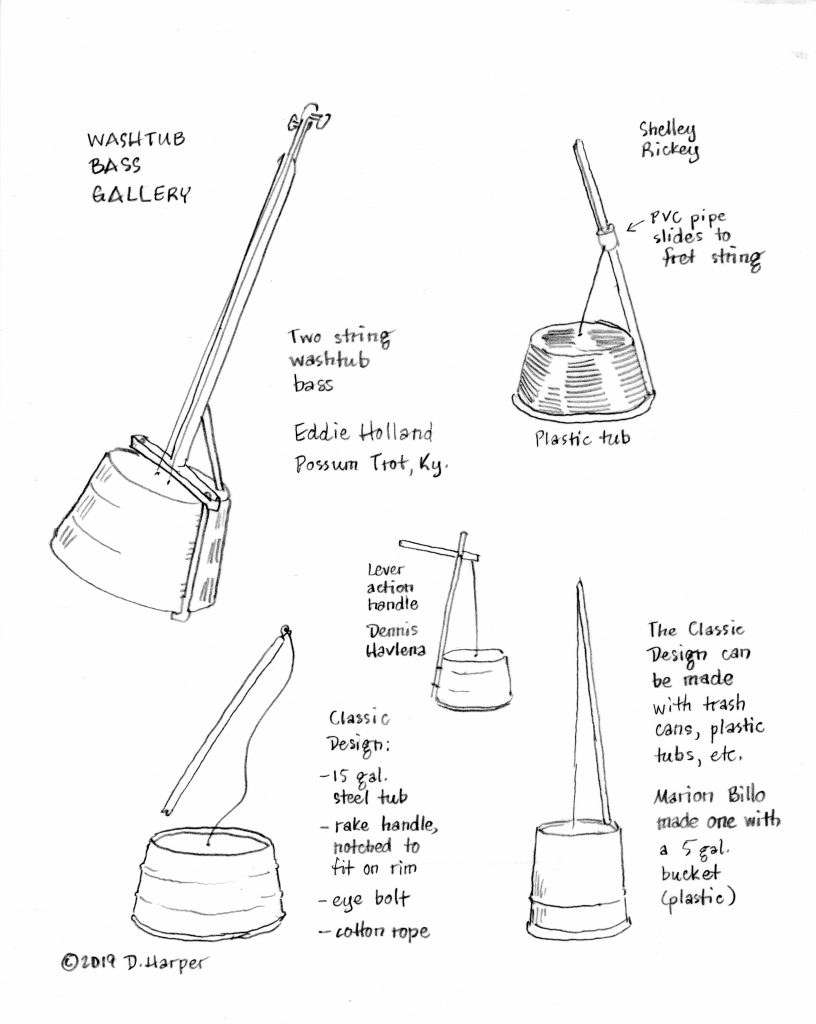
Steve’s washtub bass is simplicity itself: a 15 gallon galvanized washtub with a hole drilled in the center of the bottom; a length of 3/16 inch braided polypropylene rope, and a broom handle with an eyebolt screwed in one end and a slot cut in the other end. Tie a stopper knot in one end of the rope, thread it up through the hole, and tie it to the eyebolt. Place the slot of the broom handle on the rim up the upturned washtub, pull the string taut, and there you are.
Playing the washtub bass is not so simple. You have to put one foot on the rim of the washtub to keep it on the ground. You adjust the pitch by changing the tension of the rope by tilting the broom handle back and forth. The range is pretty limited — I got less than an octave — and it’s a challenge to get exactly the pitch you want. The biggest disadvantage, though, is that playing it took a lot out of me: it’s a real workout to move that broom handle back and forth, and twanging the braided rope is hard on your hands. After half an hour, it became clear that it was going to take more time than I was willing to devote to building up strength and building up callouses.
There had to be a better way. I began researching other ways of building and playing the washtub bass.
Eddie Holland of Possum Trot, Kentucky, built himself a two-string washtub bass with a fixed neck that you play by fretting, not by moving the neck. He’s a heck of a player, and his bass sounds great, but by the time you buy the hardware, the tuning machines, and a couple of strings for an upright bass, his bass probably cost a couple hundred dollars.
Shelley Rickey has a washtub bass made out of a big plastic tub with an arm bolted on the side; the string is fretted by means of a short length of PVC pipe that you slide up and down. She has a video where she plays cigar-box uke and her partner plays the bass, and the bass sounds good. But it still takes a lot of muscle: “I’ve been playing it now for five years,” Shelley writes, “and have developed the arms of a lumberjack.”
Dennis Havlena of Michigan devised a lever-action arm to reduce the muscle strain. Marion Billo shows plans for Joe Birdsley’s five-gallon (plastic) bucket bass with a special attachment for keeping it on the floor. But I don’t see that these offer much advantage over Shelley Rickey’s design.
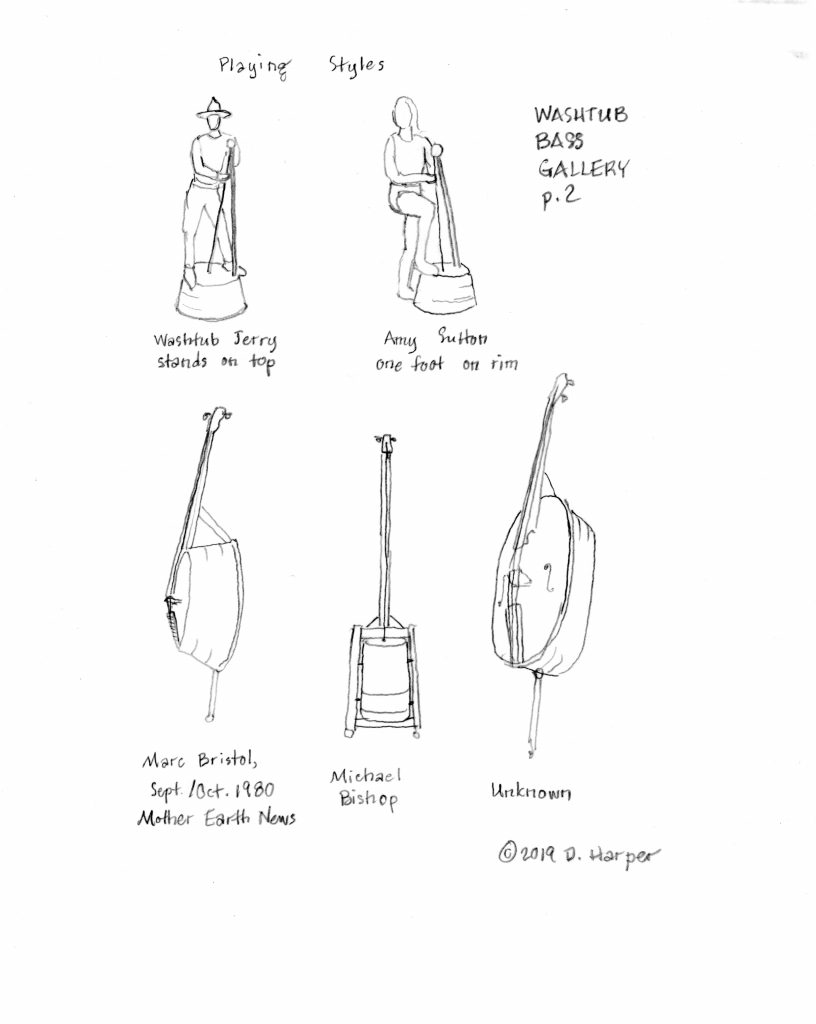
I found different playing styles, too. “Washtub Jerry” stands with both feet on the rim of the washtub; this brings the neck of the bass closer to his body, which might give him better control. I also found a photo of Amy Sutton holding down the rim of the washtub with a bare foot, which seems like it would be painful.
There are also more complicated designs for washtub basses where you don’t tilt the neck to play. Michael Bishop made a hardwood frame with a five-gallon bucket as the resonator, and a fixed neck and tuneable string. Marc Bristol, writing in Mother Earth News, September/October, 1980, issue, describes an elaborate upright bass made using a washtub as the resonator. I found a photo online of bass made on a similar plan, except the oblong washtub supports a wood sound board.
I guess if you really want an upright bass and you can’t afford a wood one, you could make one of these. But these really aren’t washtub basses; these are upright basses made in folk instrument style. The upright bass is an instrument in the violin family from Europe, but the washtub bass has roots in another continent. According to “Afro-American One-Stringed Instruments,” an article by David Evans in Western Folklore (vol. 29, no. 4 [Oct., 1970], pp. 229-245), the washtub bass comes from Africa:
“Two kinds of one-stringed instruments are known to Negroes in America today. One is the familiar one-stringed bass, sometimes called a ‘washtub bass’ or ‘gutbucket’ from the materials of its construction…. Its origin in the African ‘earth bow’ has been pointed out and generally accepted. This African instrument is made by digging a hole in the ground and covering it with a membrane of bark or hide, which is pegged down at the edges. From the membrane a string is led to a nearby sapling or stick placed in the ground. The string is then plucked, the covered hole serving as a resonator. In America an inverted washtub is simply substituted for the membrane and the hole.”
(The other one-stringed instrument is a “jitterbug,” which is a single string played in bottleneck guitar style; the jitterbug derives ultimately from the mouthbow).
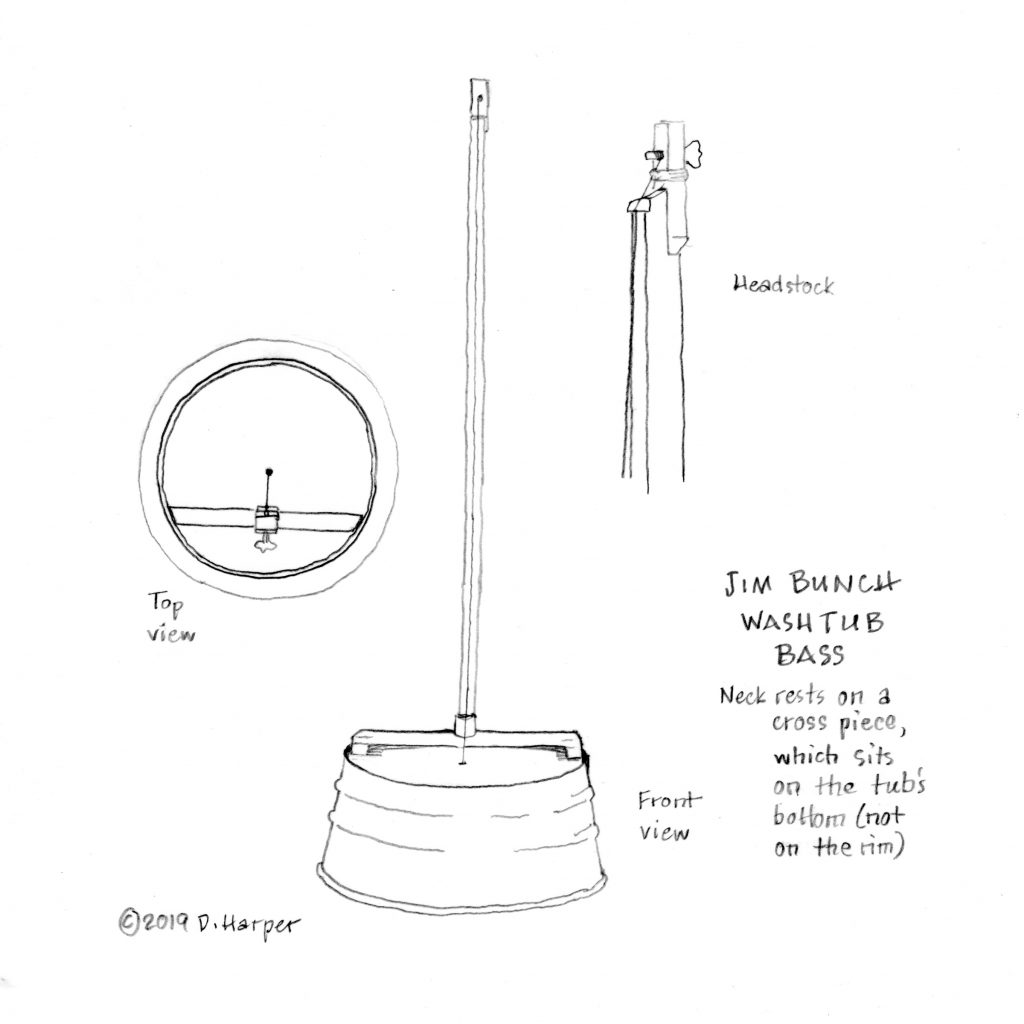
What I was looking for was a version of the washtub bass that didn’t require me to develop the arms of a lumberjack, yet retained the flexibility and character of the American version of the African earth bow. And what I found was the simple yet elegant washtub bass built and played by Jim Bunch. He describes his instrument as follows:
“I have built a cross brace for the pole using a board the width of the tub supported by two small blocks that fit on the rim. This allows you to support the pole closer to the center of the tub and get good notes without putting as much tension on the string and your fingers. [Moving the pole changes the string tension and the pitch, but] you can also move up and down the pole to change notes. I tend to both adjust the tension and finger 5ths when I play. I screwed a rubber table leg cover to the middle of the cross brace that the pole fits in. This allows the pole and brace to be disassembled for the trunk of the car.” (from the Tub-o-Tonia Web site, c. 2005?)
This keeps the simplicity of the instrument; all you’re adding is a cross brace. You can still change pitch by changing the tension of the string, but it requires a lot less arm strength. And you can fret the string up and down the neck (without having to slide a PVC pipe). Using some scrap wood I had lying around, I made my own version of this, and it’s really a joy to play.
Since Jim Bunch first described his instrument on the Tub-o-tonia Web site, he has made a few modifications (see this discussion for some details). He replaced the metal bottom of the tub with 1/4 inch thick Lauan plywood; for strings, he upgraded from a 3 dollar bike derailleur cable to an upright bass woven-core G string (perhaps 50 dollars). Photos of his instrument reveal that he’s added a headstock with a nut to hold the string a bit off the finger board, as well as a tuning machine. These somewhat elaborate modifications make sense for him because he plays a lot, and he plays at a pretty high level, as you can see from his Youtube videos.
I’m not trying to perform at Jim Bunch’s level, but I feel his type of washtub bass — with the neck supported on a cross brace — is the best bet for an occasional player like me. After a couple of hours of practice, I’ve gotten good enough that I’ll be able to play in tune on simple songs at a low-key folk music jam session. And that’s all I want.
Addendum (July 12, 2019)
Details of my additions to Steve’s washtub bass: I took his washtub, replaced the line (it was rough and worn and hard on my fingers), and added a neck with a Jim Bunch style cross brace. I made the neck out of scrap wood (including a discarded floral tripod that I found in the cemetery’s trash). The string is a new piece of 3/16 inch braided polypropylene rope, which I’ve tuned roughly to D, a good tuning for many simple folk melodies. The string is tied off with figure-eight knots (a stopper knot that’s relatively easy to adjust for tuning). And Steve’s original mop handle and string are untouched, so I can return his instrument to him just the way he gave it to me. The photo below gives an idea of the most important dimension for the Jim Bunch style washtub bass — the distance between the neck and where the string is attached to the washtub. And in a comment, Carol has added a photo of the washtub bass in action at our jam session.
Update #1 (Aug. 9, 2019): The Lance Richmond washtub bass
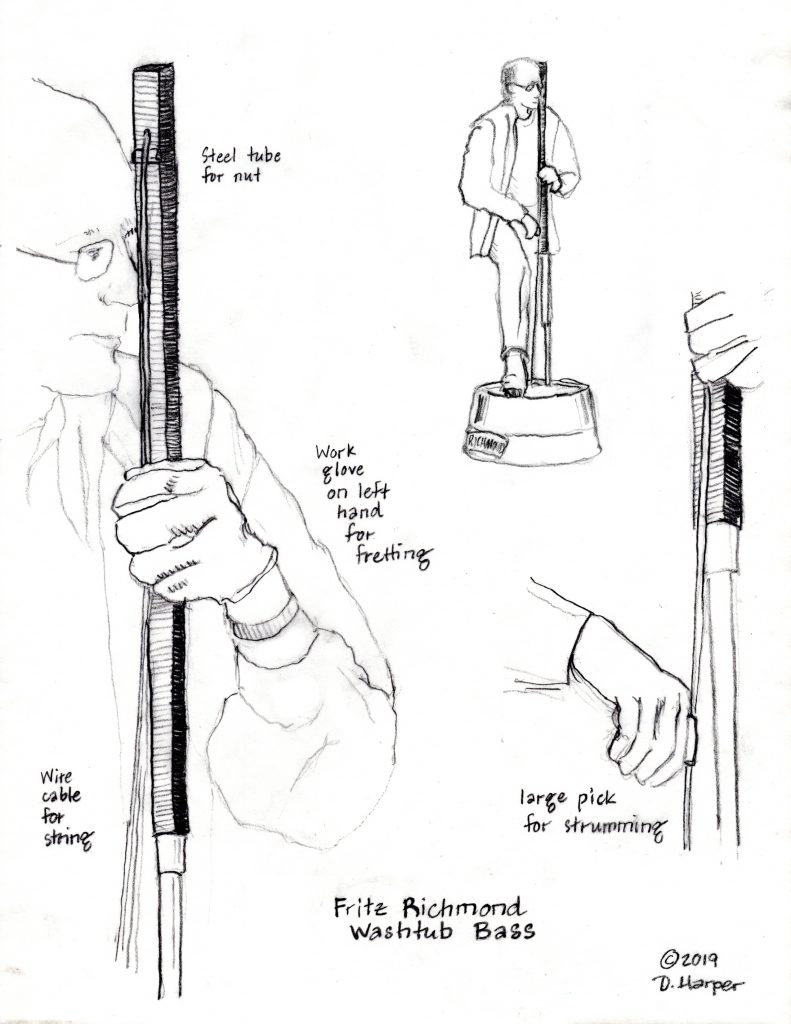
I’m adding sketches of Fritz Richmond’s washtub bass to this post. Richmond played washtub bass in the Jim Kweskin Jug Band, and played washtub bass with popular musicians from Maria Muldaur to Loudon Wainwright to the Grateful Dead. One of his washtub basses is in the Smithsonian. In short, Richmond is probably the most famous of all washtub bass players, so his bass and his style of playing are worth looking at. A few things I noticed: First, the neck of his bass has a metal lower part and wooden upper part; it looks like it can be broken down for easier transport. Second, videos of Richmond’s playing style show that he both moved the angle of the neck and fretted up and down the neck. Third, he uses a metal nut, which in photos looks like it’s a section of a metal guitar slide. It’s also worth noting that Richmond used a special leather-and-steel glove for fretting, and a large pick for strumming.
Update #2 (Nov., 2023): Making a Jim Bunch-style washtub bass
A couple of months after I wrote this post, I built a brand-new washtub bass from the ground up. I used Jim Bunch’s basic plan, as shown above. I decided to spend some money, with a total cost of about $150. (And yes, I returned Steve’s washtub bass to him.)
Materials list, with approx. 2019 prices:
string: steel G string for an upright bass (~$30)
tuner: tuning machine for a bass guitar (~$60 for set of 4)
nut: piece of birch I had lying around, attached to neck with brass screws
washtub: Behrens 15 gallon hot-galvanized tub (~$40)
neck: 2×2 redwood (~$10)
cross brace: birch boards I had lying around (free)
metal angle braces to hold the neck on the cross brace
Construction notes:
While Jim Bunch said he used a bike derailleur cable successfully, the one I tried was not satisfactory. So I bit the bullet and bought an actual bass string.
My first build did not include a tuner. However, after playing once or twice I realized that a tuner would allow me to set the string tension so I could use my preferred neck angle. It’s not necessary, but I felt it was well worth the money.
I cut several nuts before I got one that held the string just the right distance away from the neck — not so far that it was hard to finger the notes, but far enough to get a good clean sound. The brass screws allowed me to experiment with different nuts (as opposed to gluing in a nut).
I chose the Behrens hot-galvanized washtub because it was sturdier. Some of the cheap washtubs looked like they’d crumple after a couple of hours of playing with your foot pressing down on them. It is essential that you remove the handles on the side, because they’ll vibrate audibly when you play (I learned this the hard way).
I made the neck out of redwood because that was the cheapest 2×2 clear, straight lumber I could find at the lumber yard that day. It was actually graded as construction grade, but I found a six foot length that was clear of knots. My only concern with using redwood for the neck is that it can produce massive splinters; I carefully rounded the corners to reduce that possibility.
I used birch for the cross brace because that’s what I had lying around. Any strong wood clear of knots would do equally well.
The hardest part of the build was getting the cross brace to sit the correct distance back from the hole where the string attached. I had to adjust the cross brace several times to get that distance exactly right.
You could build this bass for well under a hundred dollars. First, find a friendly luthier or guitar repair shop that would sell you just one tuning machine. Second, find a used washtub. Third, scrounge the wood rather than buying it new. However, I would definitely spring for the upright bass string; it sounds so much better than anything else I tried.
Playing the bass, and its eventual demise
Once I finished adjusting the cross brace and the nut, this washtub bass played like a dream. Just like Jim Bunch says, you can adjust the pitch by moving your fretting hand up and down, or by pulling the neck back. I got most of my notes by fretting, but pulling the neck back was also useful — not only could I get four or five notes by pulling, I could bend notes or produce accidentals. When the guitarists at the jam session decided to capo up from the key of C to the key of D, all I had to do was put a little more tension on the neck and fret in the same positions for both keys.
The hardest part of using the bass was transporting it. I could remove the cross brace. But the neck was attached to the washtub by the string, so I had to balance the neck on the tub while transporting. To protect the neck from scratching, I wrapped it in old shirts, but I was always worried about damaging the string.
I had fun playing the bass in our twice-monthly jam sessions. I started out just playing the 1 and the 5 of the chord, one or two notes per measure. But gradually I got to where I could add some quarter note bass runs, and even some more interesting rhythms. I used a pencil to lightly sketch in a couple of fret markers on the side of the neck: one at the first octave, and one at the first fifth — the equivalent of fret twelve and fret seven — this proved to be very helpful. Accurate intonation was the hardest part of learning to play the washtub bass. I practiced for hours at home playing along to recordings in order to develop acceptable intonation.
The volume of this instrument was adequate for a non-amplified jam session; to increase the volume, I usually raised one edge of the washtub an inch or so (a piece of firm rubber worked well). After I switched to a real bass string, the sound was quite good: smooth with good attack when plucked. The people I played with tolerated me, and even complimented me once or twice.
Then COVID hit, and I put the bass away. When we moved across the country in 2022, we had to get rid of a lot of stuff, and sadly the bass was one of the things that had to go (mind you, I kept the 2 mountain dulcimers I built or rebuilt, a guitar, a ukulele, and some smaller instruments). Equally sadly, I never took a photo of the bass.
Someday I’d love to have another washtub bass. Alas, our new apartment is too small. But I still have the neck and the cross brace…maybe some day….
Update #3 (June 4, 2025): Two electric washtub basses
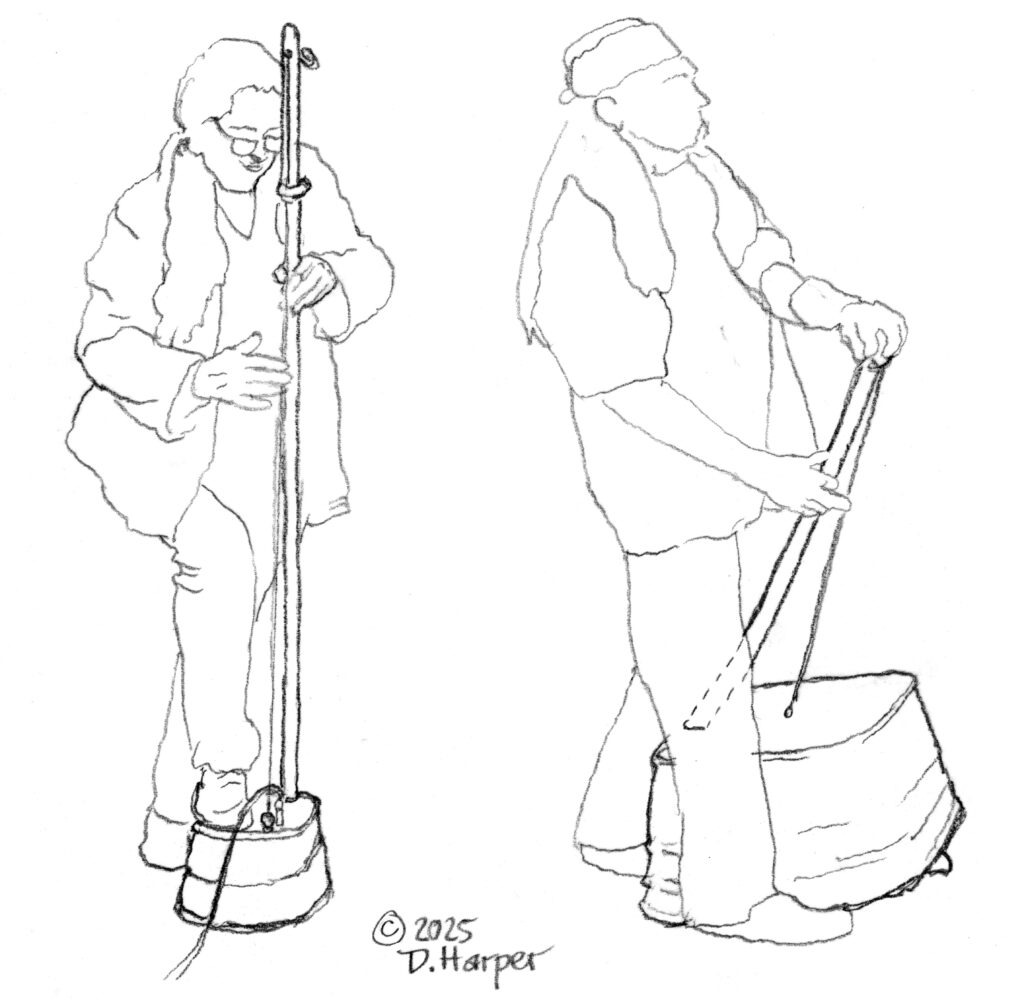
Two washtub bassists have left comments drawing attention to their electrified instruments. I watched them both on Youtube, and made sketches from the videos.
Steve “Boomboom”Brownstein is shown at right. Reading his description of his instrument, then looking at the videos on his band’s website, you can get a pretty good idea of how his instrument works. There’s a bracket (made with a hinge) extending from the washtub out to where he can stand on it, thus securing the instrument. This means he can stand with both feet flat on the ground. The front edge of the washtub is slightly elevated to allow sound to come out. Steve plucks the string with his right hand, and adjusts the angle of the neck with his left hand. He wears a work glove on his left hand.
Steve attached a Barcus Berry pickup to the neck. No details on the type of string used. Steve writes: “FYI the string I pluck is fishing stringer, purchased at Walmart. It costs about $2.79. It is very similar to clothes line in diameter, but has an elasticity that clothes line doesn’t. I thread the line thru a door stopper in the center of the tub. This prevents the string from being cut by the sharp edges of the hole.”
Best of all, the instrument sounds good. (When you check out the videos of his band, it can be tough to pick out his bass from the rest of the instruments; I recommend wearing headphones.). I like the way Steve’s bass reduces the physical strain on the player, while retaining a good sound — the bracket is an idea other washtub bass players might want to look into. And I love the overall simplicity of his instrument, which is very much in the washtub bass tradition.
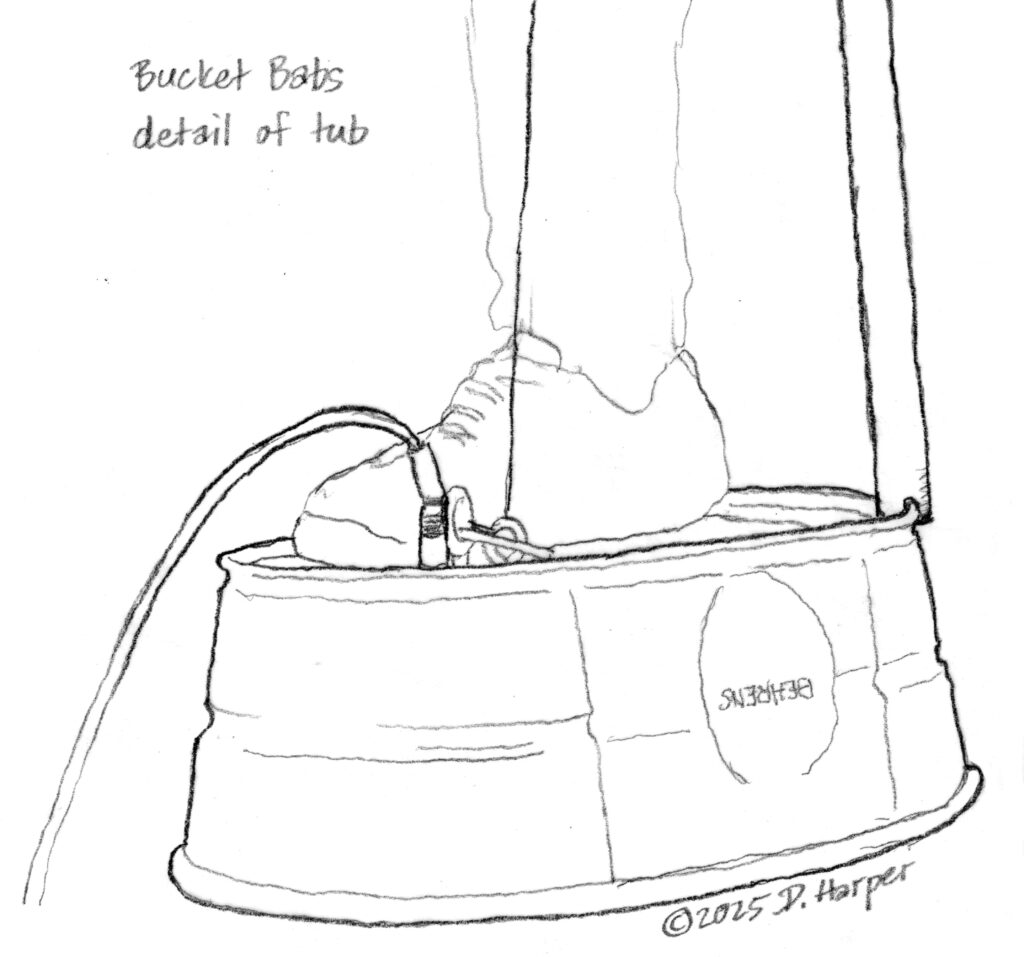
The electric washtub bass made by Barbara LePine, a professional washtub bass player whose stage name is “Bucket Babs,” is shown at left in the sketch. She writes: “I play a Behrens oval tub with guitar jack inputs, vintage Traynor bass head with a set of effects pedals, a simulated cat gut string and high quality broomstick handle.”
Despite the relatively small size of the tub, she gets a nice sound out of her bass — let’s face it, the amplification means she doesn’t need a big tub. And the small size makes the instrument that much more portable. Plus, the amp and the effects pedals allow her to adjust the sound as needed.
This looks like a pretty sophisticated instrument, so let’s dig into some of the construction details. The handle is a broomstick with a conventional notch in the tub end, which fits neatly over the edge of the tub. A bracket clamps the string about four-fifths of the way up the neck — not sure why Barbara does this — then the string goes through a hole and is attached on the opposite side. At the front of the washtub, I can see three fittings drilled into the tub: a connection for the mic jack, and two eyebolts. It looks like the string comes down, runs through one eyebolt, and then is attached to the second eyebolt — but I’m not sure why there are two eyebolts.
On the washtub, notice how the neck, the string attachment, and the mic jack are on the player’s left — leaving the other side for a foot to hold the instrument in place. This makes for good ergonomics. With a pickup, there’s no need to elevate the front edge of the tub to let the sound out, and Bucket Babs keeps hers flat on the ground, thus providing more stability — again, good ergonomics. I have no information about the type of pickup used [see below]. The effects pedals are clamped to a mic stand, and she uses her hand to activate them (obviously, she can’t use her feet).
Watch videos of Bucket Babs playing — here, here, and here — to get a better sense of how this all comes together. Looks to me like Bucket Babs is angling to be the next Fritz Richmond.
Addendum, June 5: Barb LePine sent me email with details of her washtub bass construction (very lightly edited):
“You mentioned my clamp on the string about a third of the way down. I use it to bring the beginning of the string closer to my hand, allows for leverage when playing higher notes, as well as playing with one hand while I push the buttons on the effects pedals. I prefer to play without gloves for best tone. The pickups are simple Piezo discs, carefully embedded underneath near the eyebolts. I cannot take credit for building this bucket — musical partner in crime Guitarist Porter McClister is the mastermind builder of this highly technical instrument. To me, it is the finest electric bucket known to man. I chose the oblong bucket to fit in a carry-on bag, a night before we were to fly to a show in San Francisco last year. It was originally the Little Giant brand, then switched brands to the more sturdy and slightly more compact Behrens tub. The stick travels in a shipping tube 4 inches wide and 58 inches long, sized exactly to airline regulations. Porter is an expert with string tone, he is legendary in Nashville. The double eyebolt is quite effective at keeping the string in angled position to lessen unwanted buzzy tones, cuts down on string breakage from rubbing. This washtub has a range of about an octave and a half of good notes. I also have an extra pickup under my right foot, allows me to play drum taps with my heel.”
June 4, 2025: When I added this update, I also cleaned up the rest of the post, and added two or three small items here and there.
Update #4: The tumbandero
In a comment on this post, musician Axel Rodriguez describes the tumbandero, the version of the washtub bass that he knows from Puerto Rico. I emailed him to thank him for the comment, and in return he sent links to 11 videos of tumbanderos and related instruments.
In Isaac Asimov’s memoir, I. Asimov, published in 1994, he explained why he was a political liberal:
“I wanted to see the United States changed and made more civilized, more humane, truer to its own proclaimed traditions I wanted to see all Americans judged as individuals and not as stereotypes. I wanted to see all with reasonable opportunities. I wanted society to feel a reasonable concern for the poor, the unemployed, the sick, the aged, the hopeless.”
Then, Asimov surveyed the political landscape over his lifetime:
“I was only thirteen when Franklin Delano Roosevelt became president and introduced the ‘New Deal,’ but I was not too young to get an idea of what he was trying to do. … I disapproved of Roosevelt only when he wasn’t liberal enough, as when, for political reasons, he ignored the plight of African Americans….
“Liberalism began to fade after World War II. Times became prosperous, and many blue collar people … turned conservative. They had theirs and weren’t willing to discommode themselves for those who were still down at the bottom….
“And eventually we came to the Reagan era, when it became de rigeur not to tax but to borrow; to spend money not on social services but on armaments. … Rich Americans grew richer in an atmosphere of deregulation and greed, and poor Americans — But who worries about poor Americans except people branded with the L-word that no one dared mention any more?
“It makes me think of Oliver Goldsmith’s lines: Ill fares the land, to hastening ills a prey, Where wealth accumulates, and men decay.
“As a loyal American, I grow heartsick.”
Asimov wrote that a quarter of a century ago, and things have mostly gotten worse since then. Perhaps there have been modest gains in people being judged as individuals and not stereotypes, most notably in the legaization of same sex marriage; but we have also learned from Black Lives Matter and #MeToo that far too many persons are victimized because of their race or sex. But when it comes to “a reasonable concern for the poor, the unemployed, the sick, the aged, the hopeless,” we have arguably regressed since 1994: Bill Clinton eviscerated aid to poor people, George W. Bush spent hundreds of billions of dollars in Iraq while cutting social service spending at home, Barack Obama put more effort into bailing out banks during the Great Recession than helping the poor, and Donald Trump now promotes open contempt of anyone who is not wealthy.
I continue to be a deeply patriotic American, but we are growing less civilized and less humane, and we are departing wildly from our proclaimed traditions. As a loyal American, I grow heartsick.
I’m not keen on having anyone know my Web browsing habits; I’ll go into my motivations in the last paragraph of this post. I’ve taken the obvious steps to reduce the risks of being tracked online: using DuckDuckGo in private mode as my primary search engine, and Firefox as my Web browser. But online surveillance is only getting worse, and recently I decided to become more resistant to Web tracking.
I had already enabled private browsing and other privacy and security features in Firefox’s preferences, and I had already installed the Privacy Badger add-on in Firefox. I checked what I had done against a number of online privacy checklists (such as this one). Next step was to change advanced about:config settings based on this list.
Now I was ready to test my browser’s privacy using Panopticlick, an online service of the Electronic Frontier Foundation that checks if your browser is safe against tracking. My browser was blocking ads and invisible trackers, but it was not protecting against fingerprinting. Yikes! fingerprinting made it way too easy to track me online. So I installed the NoScript add-on in Firefox: problem solved. Now my browser runs a little differently from what I was used to, but the inconvenience is minor.
Why should anyone care about their Web browsing privacy? For my part, I don’t want to give my information away to for-profit companies: I don’t need targeted advertisements, and I don’t need them accumulating my data. And, in the increasingly polarized political climate of the U.S., even though a philosophical theologian like me should be reading Karl Marx’s works, or a speech by Fred Hampton, or theology essays byWilliam R. Jones, there’s no reason to let others know about it. In short, I decided to give Big Tech (corporations, the Russians, the “Gummint,” whoever) as little information about myself as possible. You will make your own decision of what to do, from freely giving your browsing data away, to being very privacy-conscious by using something like the Tor browser. I suppose this is really an existential point: you define yourself by how much of your data you give away.
Geographer Richard A. Walker, in his 2018 book “Portrait of a Gone City: Tech and the Dark Side of Prosperity in the San Francisco Bay Area,” writes:
“The Great Recession has been calamitous. The official U.S. government designation of a two-year lapse in growth 2008-2010 minimizes the reality….things are worse than that. The Great Recession won’t go away — regardless of the soaring stock market and falling unemployment. By any measure, recovery from the Great Recession was the slowest from any crisis on record, including the Great Depression of the 1930s [emphasis mine]. U.S. productivity remains poor overall, aggregate demand is weak because wages have barely budged, and corporations are not investing with any gusto. Loose talk of full employment by mid-decade ignores the fact that so many Americans have dropped out of the labor force entirely.” (pp. 64-65).
Two conclusions for congregations: (1) Expect fundraising to be an ongoing challenge, since many households have not recovered from the Great Recession. (2) Expect the need for congregationally-based social services such as food pantries and supporting homeless shelters will continue to be robust. In other words, we will have to continue to do more with fewer resources.
I have found the concept of god to be useful, regardless of whether one is a theist or atheist; God as a concept has a long history in Western philosophy, at least as far back as the ancient Greeks. But in order for the concept of god to be useful, you can’t have an anachronistic understanding of god.
These days, a typical anachronistic understanding of god is one where “god” is equated with the God of conservative and traditional Christians. Christian theologians have used many ancient Greek philosophical concepts to build widely varying theologies over the past two thousand years, and while it is usually clear that someone like Aristotle was not a Christian, it’s easy to forget that Aristotle was also not a monotheist.
Yet in his Metaphysics, Aristotle famously refers to the “unmoved mover,” which Western tradition has typically equated with the Christian God. If Aristotle was not a monotheist, what then did he mean by the “unmoved mover”? Amod Lele explains in a post on his blog “Love of All Wisdom”:
“Some translations of Aristotle have him referring to capital-G ‘God,’ but this is misleading. What these translations render as ‘God’ is to theos, literally meaning ‘the god,’ in lowercase in the Greek. The ‘the’ in ‘the god’ is used here in a generic sense, as classical Greek so often does — a universalized singular to represent the plural class of particulars, as when they might make general statements about what ‘the boy’ or ‘the dog’ is likely to do. Plato in the Laws, for example, said ‘Of all animals, the boy is the most unmanageable’; it is a classical Greek idiom that could also be translated ‘Of all animals, boys are the most unmanageable.’ If we were to render to theos as ‘God,’ then this passage should instead be rendered ‘Of all animals, Boy is the most unmanageable.'”
Thus, according to Lele’s reading, when Aristotle speaks of the something that is often translated “God,” what he really means is “the gods.” To say Aristotle was a monotheist would be an anachronistic assertion; Aristotle was clearly a polytheist who acknowledged several gods and goddesses (Zeus, Hera, etc.). Lele, citing Richard Bodeus’ book Aristotle and the Theology of the Living Immortals, writes:
“Aristotle mentions ‘the god,’ the generic term for the plural gods, only as an analogy to help illustrate his point (against Plato) that the unmoved mover has a real presence in the physical world rather than being an abstraction.”
The useful aspect of the concept of god is not so much in metaphysics, but in ethics. How do I lead the best life? In the Nichomachean Ethics, Aristotle suggests that the highest good is contemplation — not contemplation of the Christian god, but perhaps contemplation of the highest good. Lele reads the Nichomachean Ethics in this way:
“…There is a supreme good beyond the finite, but that good is not to reach a final end identified with the goodness of a single god. Rather it is to be godlike, to live the kind of infinite life that the many gods live — and it is quite questionable how achievable Aristotle intends this goal to be for humans.”
What I find most interesting about this discussion is that “god,” in the Western tradition, need not mean the Christian God. (Even if “god” could be equated with the Christian God, Christianity is wildly diverse with so many different understandings of the nature of the Christian God, that you couldn’t assume that “god” meant what the conservative United States Christians of early twenty-first century mean.) Mind you, it may be difficult for many Westerners to think beyond the confines of Christian definitions of God; but doing so can provide access to the philosophical tool kits of Aristotle, Socrates, Heraclitus, Spinoza, and many others.
People are starting to pay increasing attention to the dangers of plastic waste in the environment. I think children and teens are ahead of many adults in their awareness of the dangers of plastic waste — a six year old of my acquaintance asked for her sixth birthday party to be a plastics clean up on the beach. Now admittedly most of the children and teens that I know are from Unitarian Universalist families, so perhaps they are slightly more aware of plastic waste; but I think while many adults have gotten locked into a narrow focus on stopping further global warming, the children and teens I know seem more aware of the many interlocking aspects of looming global environmental disaster: global warming, plastic waste, toxics in the environment, habitat destruction, etc. And the kids I know quickly make the connection between all these problems and human overpopulation.
On the last day of our church’s Ecojustice Camp, we did a clean-up of the campsite where we spent the last night of camp. This was a well-maintained and relatively clean campsite, yet we found quite a bit of plastic waste:
The campers and counselors found on the order of 200 pieces of plastic waste, along with some degradable trash such as paper and metal. That’s a lot of plastic….
A few years before he died, my father sent me an outline of a talk he gave about his memories of serving in the U.S. Army Air Corps during the Second World War. On this seventy-fifth anniversary of D-Day, here’s an excerpt from that outline, focusing on D-Day:
“Robert Harper: WW 2, My Personal Story
“December 7, 1941: Pearl Harbor attack during my senior year in high school… February 1943: Received draft notice. March 1943: Inducted into the Army Air Corp…. April 1943 to Sept 1943: Trained at Radio School at Scott Field, IL, as Radio Operator Mechanic. October 1943: Assigned to 437th Troop Carrier Group, Fort Bragg, NC. Part of 53rd TC Wing….
“February 1944 to March 1945: Stationed at Ramsbury airfield in England. Part of 9th TC Command, assigned from 9th AF to First Allied Airborne Army. I operated High Frequency DF Station to Communicate with and give radio bearings to radio operators on C47 aircraft during supply, evacuation, and airborne invasion missions. Each plane had a Command Radio used by the pilots within range of 50 miles. For longer distances a CW Morse code radio was used by the radio operator on the plane. The airbase HFDF station had been installed by the RAF and was quite accurate. (The American HFDF station we were issued when we moved to France looked more sophisticated but had poor accuracy.)…
“Memories: On D Day counting the planes returning from a mission to see how many were lost. The 437th flew 3 missions that day — twice towing gliders — once dropping paratroopers at St. Mer Iglese. There were many missions in the following days…. Listening to the rasping sound of approaching V-1 bombs waiting for them to either stop or keep going. A 3 day leave spent in Edinburgh, with a stop in London where a V-2 rocket landed one block away. Seeing walking wounded brought in by plane after Montgomery’s attempt to take a Rhine bridge…. The courage of the flight crews who knew that one rifle bullet could send a C47 down in flames. The gross stupidity of the higher commands whose mistakes were compensated for by troops who won in spite of the odds….
“Summary I was incredibly lucky during that war. I did my assigned job, never heard a shot fired in anger, lost some friends, acquired a distaste for the military and war.”
The above is just an outline; presumably Dad added more details during the actual talk. One of the last conversations I had with Dad, a couple of days before he completely lost the ability to speak, was about the Second World War. At that time he said that even though he’d never heard a shot fired in anger, he thought he probably had some level of post-traumatic stress disorder from his service during the war. I tried to ask him then what events might have triggered PTSD, but he had lost enough control over his words that he was no longer able to tell me. It is unfortunate that he waited a little too long to talk about some things, but his generation talked very little about what they experienced during that war.