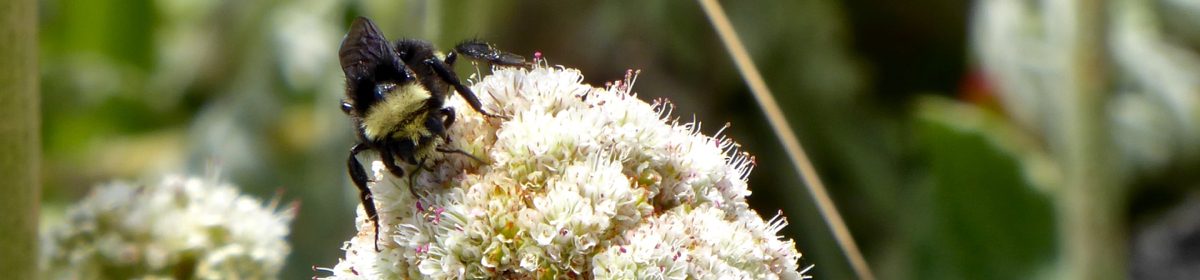
In the 90s today, with a heat index of over 100 degrees F. Walking along the Whitney Spur Rail Trail, I noticed a Red Squirrel (Tamiasciurus hudsonicus) relaxing on a tree branch about 15 feet above the ground. It looked so relaxed, I wonder if the squirrel was enjoying the cooling breeze blowing down the trail. It looked totally relaxed, something that’s unusual for Red Squirrels.
In just two days, it’s time for everyone’s favorite holiday — Pee-on-Earth Day!
When you flush your urine down the toilet, you use a gallon or more of drinking water. From there, your urine enters the stream of wastewater, typically joining human feces to be processed in a wastewater treatment plant or a septic system. By treating urine like feces, our society wastes clean water and energy (energy to purify the drinking water, and energy to run the wastewater treatment plant).
Here in the northern hemisphere, human urine doesn’t spread pathogens. And human urine actually makes a pretty good fertilizer, for plants that want a lot of nitrogen. So instead of flushing urine away, you can spread it directly on plants, although urine is such a concentrated fertilizer you probably will want to dilute it so you don’t give the plants fertilizer burn.
The one problem with human urine as a fertilizer is that First World humans tend to eat way too much salt, and excess salt gets processed out of our bodies through our urine. There are a number of ways to deal with this problem. First, you could eat less salt, which would be good for your health. Alternatively, you can spread urine on a compost pile; some salt will leach out during composting, plus the addition of other compostables will lessen the concentration of the remaining salt significantly. Composting is probably the best alternative, because when you compost urine you can adjust the inputs to the compost to balance the high nitrogen content of the urine.
My spouse, Carol, who writes about ecological pollution prevention strategies, invented the term “peecycling” to describe recycling urine as a fertilizer. She peecycles year round, using urine collection bottles made of used plastic juice bottles (thus turning a single-use plastic bottle into a multiple-use peecycling jug). We’re apartment dwellers, but we have a tiny side yard where we have a compost pile. Then we use the compost to fertilize our tiny eight foot square garden.
However, not everyone can peecycle year round. That’s why Carol has declared June 21, the longest day of the year in the northern hemisphere, as Pee-on-Earth Day. Everyone can save at least some of their urine and return it to the earth on Pee-on-Earth Day. Find or make a peecycling jug now, so you’re ready for June 21!
Learn more in Carol’s book, Liquid Gold: The Lore and Logic of Using Urine To Grow Plants.Order her book online here. UPDATE: Carol’s webhosting service has bonked her website — if you want a copy of the book, leave a comment or email me and I’ll make sure you get one. (If you order it through Amazon, Carol gets almost nothing from the sale, so if possible please order direct from her.)
(By the way, I’m the one who coined the phrase “liquid gold” to describe reusing urine, some thirty years ago. It’s my one claim to literary fame.)
“The companies that make AI — which is, to establish our terms right at the outset, large language models that generate text or images in response to natural language queries — have a problem. Their product is dubiously legal, prohibitively expensive (which is to say, has the kind of power and water requirements that are currently being treated as externalities and passed along to the general populace, but which in a civilized society would lead to these companies’ CEOs being dragged out into the street by an angry mob), and it objectively does not work. All of these problems are essentially intractable.”
What interests me here is how she focuses in on the main ethical problem with “AI” — the huge environmental impact of “AI.” Yes, it is evil that the “AI” companies steal people’s writing and steal people’s artwork. Yes, it is evil that the plutocrats want to have “AI” replace real humans (though as Nussbaum points out, if you factor in the real environmental costs, human labor is cheaper than “AI”). Yes, it is evil that “AI” is a product that doesn’t provide consistently good results. Yes, it is evil that”AI” is another way that the plutocrats can steal your personal data.
But here we are in the middle of an ecological crisis, and “AI” uses huge amounts of energy, and huge amounts of fresh water for cooling. “AI” is an environmental disaster. That is the real ethical problem.
Yesterday, I came across a round-leafed sundew (Drosera rotundifolia). This plant was tiny, not much bigger than the individual sphagnum moss plants amongst which it was growing. I thought I saw some movement on one of the lower leaves.
Drosera rotundifolia
Sure enough, one of the sticky leaves had ensnared several insects, including a small crane fly that was still struggling feebly.
The body of the crane fly is far enough away from the leaf that I suspect the plant’s enzymes won’t be able to digest most of the insect. Not that the crane fly’s corpse will go to waste; something else will decompose it, and keep its nutrients cycling through the interdependent web.
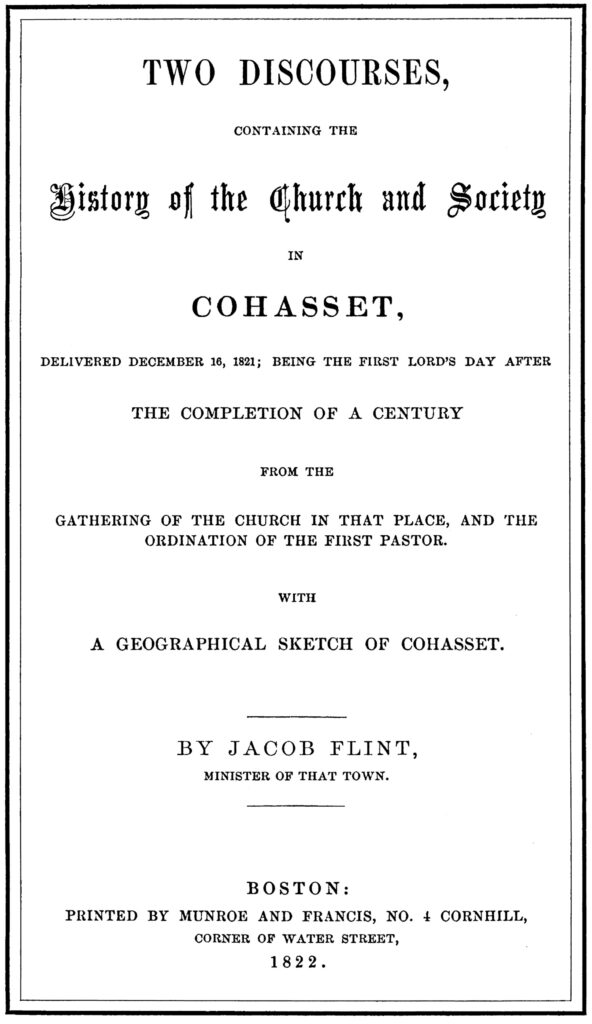
Back in 1823, Rev. Jacob Flint was the minister of the one church that then existed in Cohasset, Mass. He had been ordained in Cohasset in 1798. He was fairly liberal to begin with, but over the quarter of a century he served the congregation he had become an outright Unitarian. So on December 7, Flint decided to preach a sermon on Unitarianism.
I can imagine the scene. He preached this sermon in the Meetinghouse that we still use today, but the old box pews were still in use in 1823. Wood stoves had been put in the Meetinghouse for the first time the previous year, in 1822, so at least people would have been relatively warm for the two lengthy sermons that were delivered each week. Flint would have climbed up into the high pulpit, suspended halfway between the main floor and the gallery. Sadly, he was not a good speaker — John Adams wrote that “his elocution is so languid and drawling that it does great injustice to his composition” (John Adams, Diary, 19 Sept. 1830).
Despite his poor elocution, at least some people in the congregation must have been paying close attention to this day-long Unitarian sermon. Within months the Trinitarians had left in a body to start building their own church just a hundred feet away across the town common. I can just imagine how angry the Trinitarians were after the morning service on December 7, 1823, and how little they looked forward to the second sermon in the afternoon when they would hear even more about how wrong the doctrine of the Trinity was. How they must have steamed and stewed as Flint preached, especially since his preaching seems specially designed to infuriate anyone with Trinitarian leanings.
But this was probably to be expected of Flint, who was an uncompromising man. Years later, Capt. Charles Tyng remembered a time from his boyhood when he had to live in Flint’s house:
“…I was then put under the charge of the Rev. Dr. Jacob Flint, the minister at Cohasset. I soon found that the change was from the frying pan to the fire. Doctor Flint was a large man with a forbidding countenance. He was morose & cross in his family, which consisted of his wife, three sons, and an infant daughter…. I dreaded Sunday, the Dr. was so very strict, made us boys sit in the house, reading our Bibles, or learning hymns…. Dr. Flint was a tyrannical man, and very severe, particularly with his own children. Hardly a day passed without his whipping them. Us Boston boys did not get it so often, although I often felt the effects of the rod. He probably was deterred from whipping those who boarded with him, as his disposition would have induced him, had he not thought our parents would take us away.” (Charles Tyng, Before the Wind: The Memoir of an American Sea Captain, 1808-1833, chapter 1.)
With that preface, here’s the first part of Flint’s divisive Unitarian sermon of December 7, 1823:
Recently I went to a bog here in southeastern Massachusetts, and discovered the pitcher plants (Sarracenia purpurea) were in full bloom. This is the first time I’ve managed to be in a bog when they were in full bloom — I usually mange to show up just after all the blossoms have dropped their petals.
Below is my photo of one of the flowers. Since this is an endangered plant, I’ve carefully stripped out any identifying information (location, date, and other EXIF data).
Brief excerpt from the opening paragraph of a sermon given by Rev. Jacob Flint here in Cohasset, Mass., on 19 October 1823:
“Nature has formed an infinite number of systems, which are parts only of the great whole, connected by a chain which can never be broken without injury to the parts and disorder to the whole…. Being connected, the parts are so constructed that … they are mutually dependent on each other for their support, general utility, beauty, and order. This is true of what is called the natural world, as well as of the moral.”
The text he chose for this sermon was Romans 12:5, “So we being many are one body in Christ, & every one members one of another.” Two months later, Flint precipitated a split in the Cohasset congregation by preaching a sermon in which he attacked the doctrine of the Trinity. I can’t help but wonder if he wrote the October sermon having already observed the beginnings of a split in the congregation, and hoping to persuade people that they were still part of a unity; then by December, he gave up preaching unity and went on attack.
Regardless of the historical background, I find the above passage to be still relevant. It is reminiscent of what 20th century theologian Bernard Loomer called the interdependent Web of Life.
There’s a stereotype that all the old colonial-era meetinghouses in New England were covered with white paint both inside and outside.
Not true.
According to Peter Benes, in his definitive book Meetinghouses of Early New England, there was a wide range of exterior colors, ranging from unpainted to blue to green to orange. The Cohasset Meetinghouse was built in 1747; the first record of its exterior color dates to 1812, when it was pea-green with white trim.
As for the interior color, an architectural consultant hired for the 1986 renovation found what he thought was a bit of the original interior paint color under the pulpit. When the steps to the pulpit were remodeled c. 1837, a board was left behind with pale yellow paint marking out where the former steps were. The architectural consultant believed this was the original color. While he didn’t give his reasoning, the layer of paint is quite thin, thinner than you’d expect if it had been recoated at some point.
Pea-green outside, and pale yellow inside, not stark white. How tastes have changed over the years.
I plan to attend the online General Assembly as a delegate. I received an email with the subject line, “Retrieving Your Delegate Credentials for UUA General Assembly,” which directed me to a web page where I carefully followed the straightforward instructions. I then received an email with the subject line, “Your Delegate Credentials for GA,” which brought me to a web page titled “Welcome to the GA Delegate Participation Platform.” At that page, I once again carefully followed the straightforward instructions. Almost immediately, I received another email with the subject line, “GA Delegate Platform Access Link.”
Which sent me back to the web page titled “Welcome to the GA Delegate Participation Platform,” where I received the same instructions as before: “If you are a GA Delegate but have not received your link to the Delegate Platform, please enter the email address associated with your delegate credential. An email with your new login link will be sent immediately, but may take up to 10 minutes to be received (please also check your email’s spam or junk folder).” This is followed by a box where I can type in my email address again.
I typed in my email address (since there was no other possibility on that page). Nothing happened.
I’m still recovering from COVID — still feeling woozy and strange — but taking walks outside makes me feel better. (Vitamin D? exercise? partial cure for COVID-boredom? who knows….) And today was one of those perfect June days that we still get sometimes here in New England despite climate change — cool, dry air, puffy white clouds in the sky, gentle breezes to blow the black flies and gnats away. Carol and I walked for nearly two hours in Whitney Thayer Woods. Since we were walking slowly, I had plenty of time to look at the forest floor for spring wildflowers.
Sometimes it was an exercise in close observation, since some of the flowers I saw were quite small, like these tiny blossoms on a Narrowleaf Cow Wheat plant:
Narrowleaf Cow Wheat (Melampyrum lineare)
Don’t ask me why this plant is called “Cow Wheat.” I have no idea.
Then there were the tiny flowers that came in clusters. These are easier to see, like the blossoms on this Solomon’s Plume:
Solomon’s Plume (Maianthemum racemosum)
I think this plant is called Solomon’s Plume, first because the flowers are in a plume, and second because the leaves sort of look like a different genus of plants known as Solomon’s Seal (Polygonatum spp.), which are called Solomon’s Seal because some of the plants in the genus have tubers that when broken are said to resemble the Seal of Solomon of the mystical traditions of Judaism and Christianity. The common names of plants often seem nonsensical. Actually, this plant is closely related to the Canada Mayflower, so perhaps a better common name for it would be “Mayflower Plume” or something like that.
Another plant that was in bloom today also had tiny flowers in clusters — Mapleleaf Viburnum:
Mapleleaf Viburnum (Viburnum acerifolium)
At least it’s obvious where this plant’s name comes from: it’s a viburnum that has leaves that are shaped like the leaves of maple trees.
We were also lucky enough to see two or three Pink Lady’s Slippers, one of our native orchids:
Pink Lady’s Slipper (Cypripedium acaule)
You’d think that it would be easy to see such a showy flower, but I’ve found it’s actually quite easy to walk right past them.
Some flowers that were impossible to miss were the rhododendrons that Whitney Thayer Woods are known for. The wealthy people who owned the land in the 1920s had various kinds of rhododendrons plants along one of the woodland paths. Descendants of those original plants still bloom each year. Several of the plants were covered in blossoms that you simply could not miss:
Rhododendron sp. (possibly R. maximum)
Even if you’re not paying attention, you’d find it difficult to miss a shrub taller than you are, covered with big clusters of light pink blossoms growing right at eye level.
Also hard to miss, though much shorter, was the iris growing next to a boardwalk over a stream:
Iris spp. (possibly I. versicolor, Northern Blue Flag)
While the soft pink of the Pink Lady’s Slipper can blend in among the warm brown leaves on the forest floor, the brilliant purple color of the iris does not blend in to the predominant colors of the woodlands.