This page has summaries of Perry Mason novels from the 1930s.
1. The Case of the Velvet Claws
Morrow: Mar., 1933
Recurring characters:
1. Perry Mason is described for the first time in the opening pages of this novel:
“Autumn sun beat against the window. Perry Mason sat at his desk. There was about him the attitude of one who is waiting. His face in repose was like the face of a chess player. Only the eyes changed expression. He gave the impression of being a thinker and a fighter….”
2. Della Street, Mason’s secretary, appears soon thereafter:
“Della Street was slim of figure, steady of eye; a young woman of approximately twenty-seven, who gave the impression of watching life with keenly appreciative eyes and seeing far below the surface.”
In chapter 16, she says she has been working for Mason for five years. In the second half of the novel, Della expresses doubts in the way Perry is conducting his defense, the only time she expresses serious doubts about his work as a lawyer.
3. Paul Drake, who runs the detective agency that Parry Mason always hires, also makes his first appearance:
“Mason was still standing there when the door to the outer office opened and a tall man, with drooping shoulders and a head that was thrust forward on a long neck, came into the outer office. He regarded Della Street with protruding glass eyes that held a perpetual expression of droll humor, smiled at her, turned to Mason and said, ‘Hello Perry.’”
4. The police officers in this story, detective Sidney Drumm and Sergeant Hoffman, never appear in any other books.
Plot devices:
Legal matters:
No courtroom scene in the book.
Other notes:
By comparison with later Perry Mason novels, this book is long and bloated. The prose sounds more like the hard-boiled style of pulp magazines like Black Mask, and seems more dated than the later novels.
2. The Case of the Sulky Girl
Morrow: Sept., 1933
Recurring characters:
1. Perry Mason’s law clerk is Frank Everly. In this book, he takes on the role of doubting Perry’s defense, but Della tells him that she has already bet half her paycheck with Paul Drake that Perry will win the case (thus revealing that Paul had doubts about Perry’s abilities).
2. For the first time, Paul Drake assumes his favorite position in Mason’s office:
“He sat in the big high-backed leather chair in Parry Mason’s office, and turned sideways, so that his long legs were crossed over the right hand arm of the chair. A cigarette was in his mouth, hanging pendulously from his lower lip.” (Chapter XII)
3. Police officers and police detectives have only minor roles. The prosecuting deputy from the D.A.’s office is Claude Drumm (the D.A.’s name is not mentioned). Drumm will appear in a few subsequent books.
Plot devices:
Legal matters:
This book contains Perry Mason’s first trial scene.
3. The Case of the Lucky Legs
Morrow: Feb., 1934
Recurring characters:
Plot devices:
Legal matters:
4. The Case of the Howling Dog
Serialized: Liberty Magazine, Jan.-Mar., 1934
Morrow: June, 1934
Recurring characters:
1. In chapter 19, law clerk Frank Everly returns to serve as a foil for Perry Mason, so that Perry can offer his philosophy of conducting a powerful defense. This is his last appearance in the Perry Mason books.
2. Claude Drumm is again the prosecuting attorney. Perry Mason seems to get along well with the D.A.’s office in chapter 2, but by the end of the novel he winds up making Claude Drumm look foolish.
3. In this novel, Della Street is still addressing Paul Drake as “Mr. Drake” (in the later books, she calls him “Paul”).
Plot devices:
1. Chinese culture: A somewhat unsatisfying subplot involves Ah Wong, an illegal Chinese immigrant. Wong’s employer tells federal immigration officers that Wong is in the country illegally, so that Wong will not be able to testify in the murder trial. Perry Mason subpoenas Wong, but winds up not needing his testimony; we never learn what happens to Wong in the end. Gardner was capable of portraying Chinese characters and Chinese culture with interest and affection (e.g., in the Terry Clane novels), but Ah Wong is little better than a stereotypical figure in this novel.
Legal matters:
In this novel, the defendant is quite apparently guilty of committing murder, but Perry Mason gets her off through clever legal stratagems. In some later books, Perry will claim that he doesn’t want to get an acquittal for a defendant who is guilty, but in this early novel he shows no such compunction.
5. The Case of the Curious Bride
Serialized: Liberty Magazine, July-Sept., 1934
Morrow: Nov., 1934
Recurring characters:
Plot devices:
Legal matters:
6. The Case of the Counterfeit Eye
Morrow: Apr., 1935
Recurring characters:
1. In this sixth book in the series, Hamilton Burger finally makes his first appearance. We first hear about him when Perry Mason tells Della Street that “This is the first murder case that’s come up since he’s been in office.” Mason and Burger first meet in Mason’s office: “Della opened the door and stood to one side. Hamilton Burger, a broad-shouldered, thick-necked individual with a close-cropped mustache, walked into the room and said affably, ‘Good afternoon, Mason.'” (Chapter 10)
The trial in this book is Hamilton Burger’s first ever murder trial, so he conducts the preliminary hearing himself. At the end of the book, after some courtroom theatrics, Mason tells Burger who the real murderer must be while they are meeting with the judge in the judge’s chambers (chapter 17). Burger is worried about looking foolish: “‘How the devil am I going to square it with the [news]papers?'” But Mason solves his public relations problem:
“Mason waved his hand in a generous gesture.
“‘Take it all,’ he said.
“‘All of what?’
“‘All of the credit. Figure it was an act you put on with me for the purpose of trapping the real murderer.’
“A gleam of quick interest showed in Burger’s eyes….”
2. In chapter 18, Perry Mason reveals that he doesn’t hate Sergeant Holcomb, although he does find Holcomb’s “stupidity … irritating at times.” In spite of Holcomb’s stupidity, Perry Mason says that he respects and admires Holcomb’s courage.
Plot devices:
1. Glass eyes: This will not be the last time that Mason has to deal with counterfeit eyes, as they will feature in one or two later Perry Mason novels.
Legal matters:
The trial scene is a preliminary hearing. But the case is solved in the judge’s chambers.
7. The Case of the Caretaker’s Cat
Serialized: Liberty Magazine, June-Aug., 1935
Morrow: Sept., 1935
Recurring characters:
Jackson the law clerk appears.
Plot devices:
Legal matters:
8. The Case of the Sleepwalker’s Niece
Morrow: Mar., 1936
Recurring characters:
1. Two scenes where Perry Mason and Della Street indulge in a passionate kiss.
2. Jackson the law clerk has a larger role than in perhaps any other book. Mason sends him out to shadow a client, and to take care of filing an action in another court. Jackson comes across as dynamic and competent, albeit somewhat inexperienced.
3. Paul Drake appears as usual. The prosecuting attorneys are Sam Blaine, assistant D.A., and Hamilton Burger.
Plot devices:
1. Sleepwalking: The plot centers on sleepwalking (as you’d guess from the title). Towards the end of the story, it is revealed that there were two sleepwalkers in the same household — both the uncle and the niece — a whimsical touch that keeps it from being quite so hackneyed a plot device. Still, not one of his better plots.
2. Scheming adventurers: The plot includes three characters who are scheming adventurers or adventuresses who either married or are trying to marry someone who is wealthy: Doris Sully Kent, George Pritchard, and Jerry Harris.
3. Glasses and eyesight: A minor plot device involves a “pettifogging lawyer” who has bad eyesight, and makes an appointment at an “oculist” [optician] for new glasses immediately after having told his story to the district attorney’s office.
Legal matters:
1. Two legal actions drive the plot. The first, obviously, is the murder charge against Peter Kent. The second is the attempt by Doris Sully Kent to get her divorce action set aside by the court, so that she can take control of Peter Kent’s money. Doris files her action after the completion of the one-year period following the interlocutory decree, but claims Peter made fraudulent representations to her.
Because of the divorce action, Mason feels compelled to rush the case to a full jury trial. Mason winds up revealing the case’s solution to the judge and Burger in the judge’s chambers, not in the courtroom. In describing the scene to Della, Mason tells how annoyed Burger was:
“‘Was the district attorney flabbergasted?’ she asked.
“‘So damned flabbergasted he listened to me explaining the clews [sic] in the case to him in the Judge’s chambers and stuck his cigar back in his mouth wrong end to, and burnt his mouth all out of shape,’ Mason said, chuckling delightedly as he recalled the spectacle.” (chapter 22)
2. Gardner uses this plot twist to show a weakness of California divorce law, in this conversation between Perry Mason and Della Street:
“[Mason said,] ‘She had a restraining order issued late yesterday afternoon, preventing him from disposing of any of the property She’s made an application to have a receive appointed. The restraining order is effective until a hearing can be had on the receivership.’
“‘But that — why, Chief, that would even keep him from paying you an attorney’s fee.’
“He nodded.
… “‘How can she get an injunction without putting up a big bond?’
“‘Our Code Section. Look it up sometime. Section 529 provides that there’s no necessity for a bond whenever a court grants an injunction against a spouse against an action for divorce or separate maintenance.'” (chapter 17)
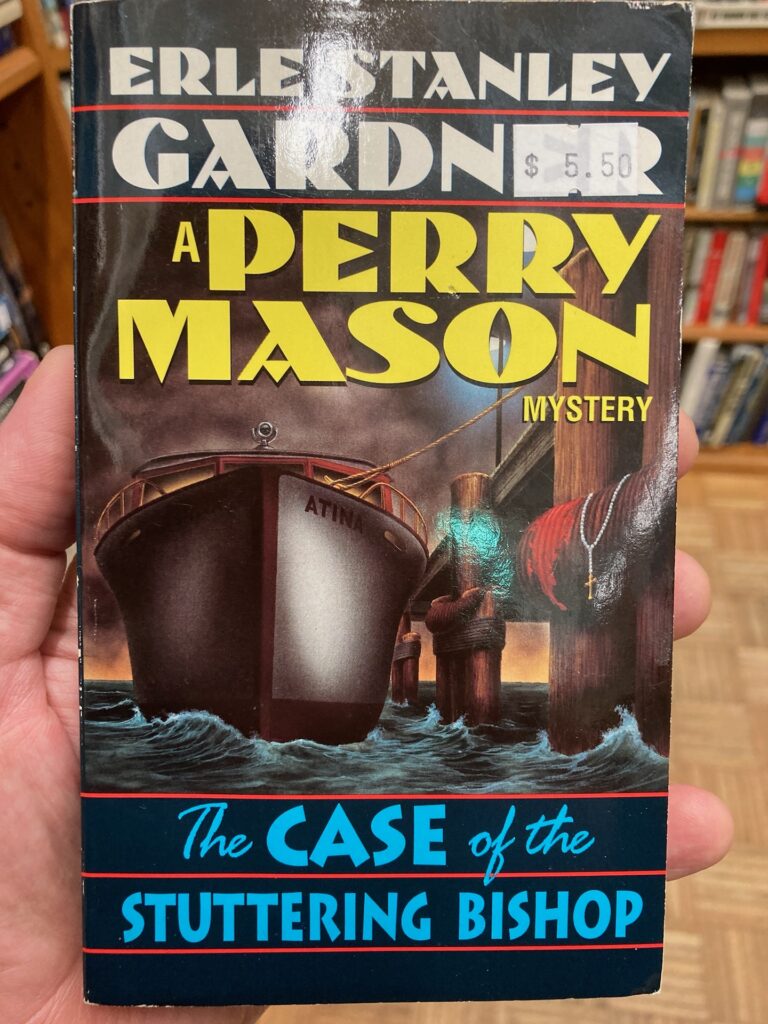
9. The Case of the Stuttering Bishop
Morrow: Sept., 1936
Recurring characters:
Plot devices:
Legal matters:
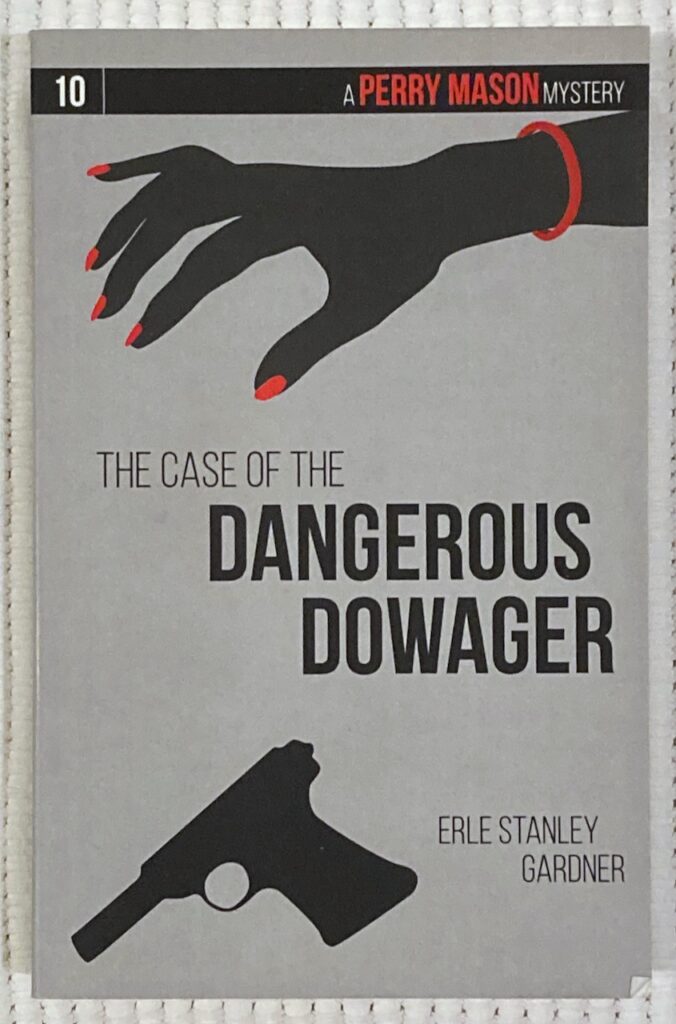
10. The Case of the Dangerous Dowager
Morrow: Apr., 1937
Recurring characters:
1. The only recurring characters are Perry Mason, Della Street, and Paul Drake. Since the case winds up in federal court, none of the regular Los Angeles prosecutors or police make an appearance.
2. Paul Drake makes a pass Della Street; she adroitly turns him down.
3. We meet the U.S. Marshal for the region, who remains nameless; he is a “tall, raw-boned individual with a lazy drawl in his speech, a black sombrero on his head, and a manner of calm unhurried efficiency…” (ch. 8). He seems a worthy match for Mason, and we can only regret that he never appears in another Perry Mason novel.
Plot devices:
1. Gambling: The murder takes place on a gambling ship anchored beyond the twelve mile limit, thus placing it in federal jurisdiction.
2. Locked room mystery: This is a classic one-entrance-to-the-room mystery: with only one entrance to the room, and with that entrance watched by multiple witnesses, it seems clear that the attractive female defendant must be guilty of the murder. However, there is a walk-in safe in the room, and the murderer hides in that until his accomplice lets him out.
3. Boats: In another layer to the one-entrance-to-the-room plot device, the murder takes place on a ship with limited access via speed boat. However, this limited access proves illusory, since the crew lets people get into speed boats out of sight of the police, for a suitable bribe.
Legal matters:
The murder takes place on the high seas, outside the territorial limit of the state of California. Therefore, it becomes a Federal case.
The case is about to go before a federal Grand Jury. Mason is not only subpoenaed, he is also accused of being an accessory after the fact. Before going into the Grand Jury room, the federal District Attorney has Mason and various other interested parties in his office; Mason solves the case in the Federal D.A.’s office.
11. The Case of the Lame Canary
Serialized: Saturday Evening Post, May-July, 1937
Morrow: Sept., 1937
Recurring characters:
Plot devices:
Legal matters:

12. The Case of the Substitute Face
Morrow: Apr., 1938
Recurring characters:
1. Perry Mason and Paul Drake appear as usual. Since the trial happens in San Francisco, Drake has to join Mason and Street in that city; we don’t get to see the offices of either Mason or Drake.
2. In one plot twist, Della Street goes into hiding without telling Perry Mason or Paul Drake where she’s going. Needless to say, this worries the two men, though when Paul Drake tracks her down, it turns out that she had been a witness to the alleged murder, and hoped to avoid the attendant newspaper publicity.
3. Jackson appears in this book, promoted from law clerk to “office lawyer” (chapter 3). Jackson is described as having “studious eyes” and “tortoise shell glasses,” and Mason criticizes him for “not being a fighter” (chapter 9).
Plot devices:
1. Ocean voyage: The plot hinges on a murder allegedly committed on an ocean liner traveling from Honolulu to San Francisco.
2. Faked murder: It turns out that shots were fired into a dummy, which was then thrown overboard from the ocean liner. Carl Moar, the man who was supposedly murdered, then takes up a role as an invalid with a broken neck, many bandages, and dark glasses, who is wheeled about in a wheelchair; presumably the dummy that was thrown overboard was wheeled on board in the wheelchair (though this is never really explained; one of several plot holes).
3. Romantic subplot: In a subplot, a wealthy-but-essentially-good young man is sought after by two women: the wealthy-but-scheming young woman, and the middle class-but-essentially-good young woman. In the end (of course), the essentially good young woman and the essentially good young man wind up getting married.
Legal matters:
The most interesting legal matter is Mason’s adroit cross examination of the key prosecution witness. The case is quickly brought to a preliminary trial, during which Mason shows, through some adroit cross examination of a key prosecution witness, that the prosecution cannot prove the corpus delicti. But after the ocean liner docks, and everyone gets ashore, Carl Moar is in fact murdered, his body taken out to sea, and placed in a life ring “which had been tossed overboard from the steamer the night before.” (This plot device does not stand up to close scrutiny: the various elements of the chronology don’t quite mesh; finding the appropriate life ring in the vastness of the ocean seems improbably at best; etc.)
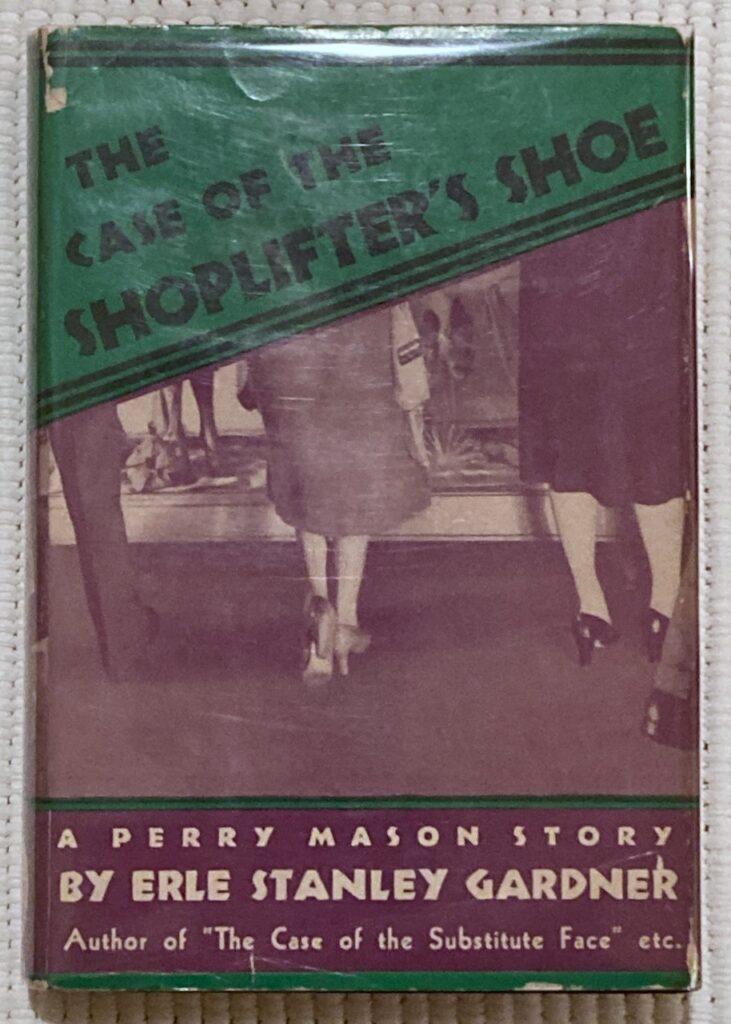
13. The Case of the Shoplifter’s Shoe
Morrow: Sept., 1938
Recurring characters:
1. Perry Mason and Della Street have a bit of a romantic scene on the last page:
“‘You mean she was mushy over the telephone?” Mason asked incredulously.
“‘Well, she was pretty sugar-coated, and just before she hung up, she…’
“‘She what?’ Mason asked.
Della Street laughed. ‘I couldn’t tell you,’ she said, ‘it would be betraying a sacred confidence.’
“‘Could you you,’ Mason inquired, ‘show me?’
“She paused long enough to make certain there was no one else on the driveway.
“‘Well,’ she conceded with a throaty laugh, ‘I might. Bend over so I can reach….'”
2. At the beginning of the book, Della Street makes a passing reference to “beetle-browed” Jackson, the law clerk.
3. Sergeant Holcomb gets into a fight in a hospital room (of all places) with the Sampson, the deputy district attorney:
“‘Shut up!’ Sampson said. ‘Can’t you see that you’d be playing right into their hands?’
“Sergeant Holcomb said, ‘I’ll show you,’ and swung.
“Sampson jumped back. [Dr.] Gifford said, ‘Gentlemen, I’m going to order hospital attendants to clear the room. This is a disgraceful scene, and it’s having a most harmful effect on my patient.'”
Plot devices:
1. Hiding, concealing, or confusing the evidence: For once it’s not Mason who juggles the evidence, but the police. See Legal Matters below.
Legal matters:
Sergeant Holcomb mixes up two key pieces of evidence — two bullets from two different guns. Mason, knowing that Holcomb would never admit to botching the evidence, brings out the truth of the matter through skillful cross-examination of another witness.
14. The Case of the Perjured Parrot
Morrow: Feb., 1939
Recurring characters:
Plot devices:
Legal matters:
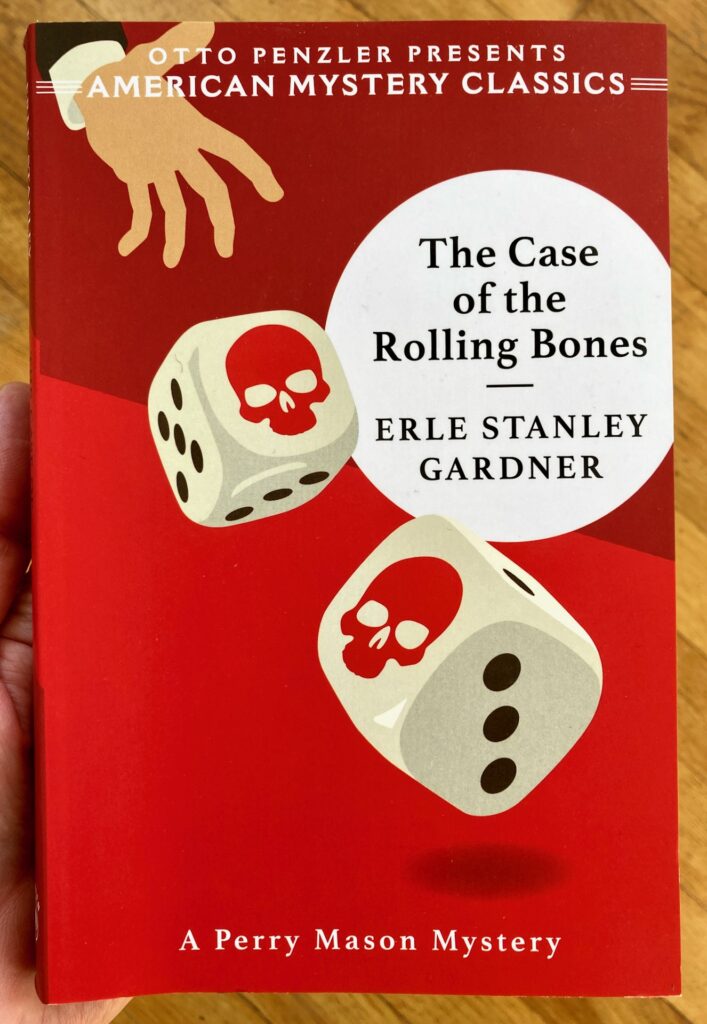
15. The Case of the Rolling Bones
Morrow: Sept., 1939
I consider this one of the best of the Mason novels. Fast action, fun dialogue between regular characters, interesting background. There are the usual holes in the plot and loose ends at the close of the novel, but the strengths makes up for the weaknesses.
Recurring characters:
1. Gertie, the receptionist, is introduced in this novel when she sets a fire in a wastebasket to help Mason get out of a speeding ticket. Here’s how she’s described on her first appearance:
“Gertrude Lade, tall, thin as a rail, her figure angular, her face plain, too the glass of whiskey Mason handed her, grinned at them, and said, ‘Here’s regards.’ She tossed off the whiskey in a single swallow…. She turned and walked with long-legged strides through the door to the outer office.’
(In later books, Gertie is described as overweight.) Later in this book, Gertrude Lade makes an appearance in the courtroom, as Perry Mason cross examines a witness to test his recollection.
2. Perry Mason and Della Street have a romantic interlude while waiting late at night in the apartment of a key witness. Mason (sort of) proposes marriage to Street:
“They sat together by the little fireplace talking in low tones and waiting for the phone to ring. Perry Mason’s hand unconsciously sought Della Street’s, gently imprisoned the fingers. ‘Gosh, Della,’ he said, ‘I’m getting sentimental. It almost seems as though this place had been made of us.’
“She moved her other hand to gently stroke the back of his well-shaped, strong fingers. ‘Nix on it, Chief,’ she said softly. ‘You could no more live a domestic life than you could fly…. You might like a home for about two weeks, and then it would bore you stiff. At the end of four months, you’d feel it was a prison.’
“‘Well,’ Mason said, ‘this is part of the first two weeks.’
“It seemed but a few minutes before they heard the click of a key in the lock…. Della Street, with a quick intake of breath, said, ‘I don’t want her to see me until I powder my nose,’ and dashed for the bathroom.”
3. Neither Hamilton Burger, Arthur Tragg, nor Sergeant Holcomb appear in this book.
Plot devices:
1. Mining: Several of the characters in the story had been in the Tanana gold rush — not the Yukon gold rush, as they repeatedly have to explain, although a dance hall in Dawson, Yukon Terr., features in the story.
2. Mistaken identity: The plot hginges on mistaken identity. Is Alden Leeds really Alden Leeds, or is he Bill Hogarty? Mason has to find out what happened in the Tanana to finally unravel the mystery.
3. Gambling: The “rolling bones” in the title refer to loaded dice. One of the minor characters starts a company selling crooked dice, through which Mason and Paul Drake track down a woman who turns out to be an important figure.
Legal matters:
1. The doctor serving as the state’s autopsy surgeon determines the time of death to within a 45 minute period, based on when a meal was eaten by the deceased. On cross examination, Mason forces the doctor to admit that based on what he knows from doing the autopsy, he cannot fix the time of death that accurately — since the doctor does not know, of his own knowledge, when the deceased at that last meal:
“‘But all you know of your own knowledge, Doctor, is that you performed an autopsy on a body, that death had occurred from eight to fourteen hours prior to the time you made your examination and within approximately two hours of the time the deceased partook of a meal consisting of certain specific articles of food?’
“‘You can put it that way if you want to,’ the doctor snapped.
“‘Thank you, Doctor,’ Mason said with a smile. ‘I want to….'”
As it turns out, the doctor fixed the time of death incorrectly. Here again, Erle Stanley Gardner makes the point that circumstantial evidence can be misinterpreted.