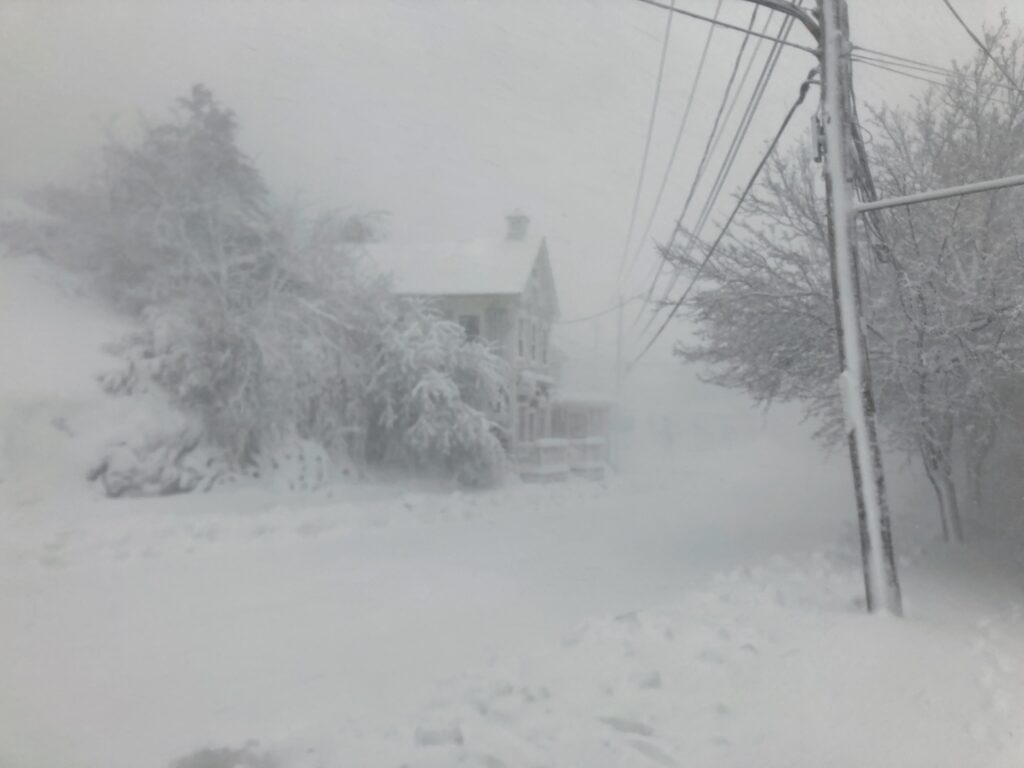
Blizzard clean-up

My best guess is that we had between 24 and 30 inches of snow (see note at end of post). Today the temperature got above freezing, and the snow settled down some. But there is still a lot of snow on the ground. Some of the snow piles left by plows along the streets towered five or more feet above the road surface.

Our neighborhood, known as Cohasset Village, is a business district with on-street parking. The huge snow piles lining the streets took up much of the parking. So tonight, town employees and contractors are here in the Village with one large tractor with a bucket loader, three medium-size bucket loaders, one of those little mini bucket loaders, several police cars, and a long line of dump trucks. The little bucket loader climbs up on the sidewalk and pushes the snow into the street. The medium size bucket loaders carry the snow to a central collection point, the junction of Elm and Main streets, two doors down from our apartment. Then the big bucket loader scoops the snow into the waiting dump trucks, as one by one they drive up, get loaded, and drive off again. Our second floor apartment is the perfect place to watch the action.

Carol watched a murder mystery on TV. I thought it was more fun to watch the snow being pushed around and loaded in dump trucks — showing that I still haven’t gotten over my preschool fascination with heavy equipment at work.
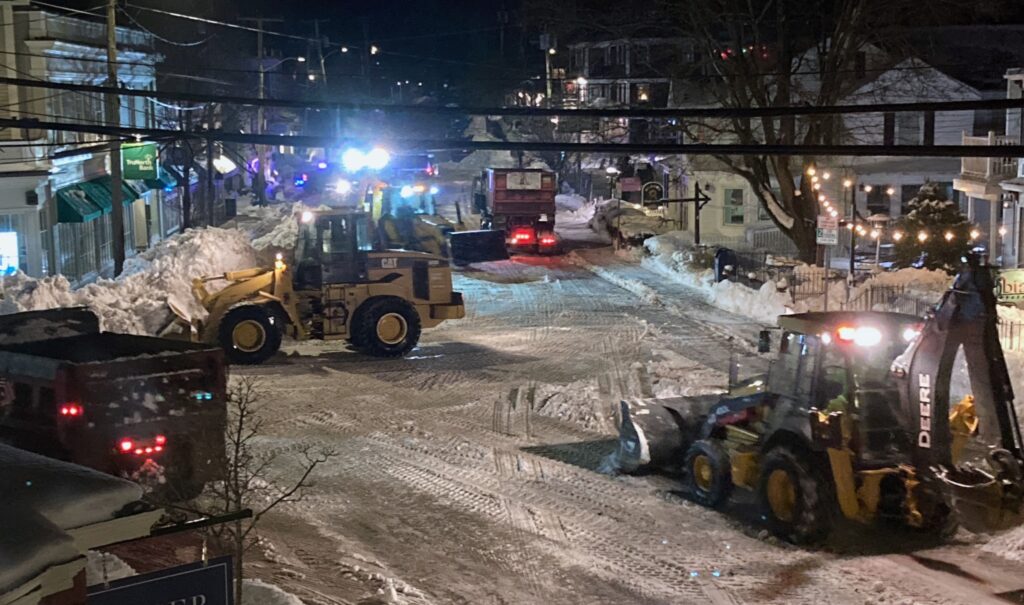
Looking south down Main Street — Elm Street is to the left, just out of the photo.
Continue reading “Blizzard clean-up”

Elizabeth Tarbox biographical information

Recently, I used something written by Rev. Elizabeth Tarbox as a reading in a Sunday service. I realized I knew next to nothing about her, so I decided to look up her obituary in the Unitarian, Universalist, and UU Yearbooks (now digitized and online). She died in October, 1999, which means her obituary would be in the following year’s Yearbook — except that was the one year when the UUA decided not to publish minister’s obituaries in the Yearbook. I found no other obituary or life summary for her online.

With a little bit of research, I was able to generate the timeline below — which tells me most of what I want to know:

  • 5 March 1944, born Elizabeth Irene Peck to William and Irene Hard Peck in St. Albans, Hertfordshire, England, United Kingdom (birth record)
  • 1963, married Charles E. Tarbox (1938-2016) in St. Albans; she and Charles later had a child (marriage record; Charles Tarbox obituary in Boston Globe)
  • 1968, she and Charles immigrated to the United States; applied for Social Security card (Social Security records; Charles Tarbox obituary in Boston Globe)
  • 1986, B.A. in philosophy, Bridgewater State College (Bridgewater State yearbook for 1986)
  • c. 1980s, congregant at First Parish Duxbury, Mass. (mentioned in FP Duxbury newsletter)
  • c. 1986, began studying at Harvard Divinity School
  • c. 1988-90, served as student minister, First Parish Norwell, Mass. (mentioned on FP Norwell Facebook page)
  • 1990, graduated Harvard Divinity School (UUA Yearbooks)
  • 1990, ordained (UUA Yearbooks)
  • 1990, settled at First UU Society of Middleboro, Mass. (UUA Yearbooks)
  • 1993, publication of Life Tides: Meditations
  • 1997, settled at First Parish in Cohasset, Mass. (UUA Yearbooks)
  • 1997, publication of Evening Tide: Meditations
  • 1999, resigned from First Parish in Cohasset due to ill health (First Parish Cohasset records)
  • 31 Oct. 1999, died in Duxbury (Duxbury Annual Report; Social Security records)

I’m mostly satisfied with this timeline, though I wouldn’t mind finding answers to a couple of questions. First: When did she become a Unitarian? — it’s even possible she was raised Unitarian, as there was a small Unitarian fellowship in St. Albans in the 1950s, according to Alan R. Ruston, Unitarianism in Hertfordshire (Watford, Hertfordshire, U.K., 1979), p. 26. Second: What was she doing between marriage in 1963 and starting college in the 1980s — which includes a subsidiary question: Why did she come to the United States?

Continue reading “Elizabeth Tarbox biographical information”

Blizzard, part 2

8:15 p.m. — Power went out two houses down from us, but so far we still have it. We’ll see how long it lasts.

Latest National Weather Service (NWS) reports show more than 30 inches of snow from Rhode Island up through southeastern Massachusetts. The nearest trained NWS spotter is in North Scituate, which is about 3 miles from here; that observer recorded 29 inches of snow as of 5:00 p.m.. Carol and I shoveled at about 5, and another couple of inches has fallen since then, so I’m pretty sure we have more than 30 inches at this point. And it’s still snowing.

Early to bed tonight. Beginning at seven tomorrow morning, we’re both volunteering with Cohasset Emergency Management to help staff the warming center for people who have lost power.

Blizzard conditions are defined by the NWS as visibility of 1/4 mile or less and wind speeds (sustained or frequent gusts) of 35 mph or higher, for 3 hours or more. These conditions were officially reached throughout eastern Massachusetts, from Providence, R.I. and Martha’s Vineyard, west to Worcester and north to Beverly, Mass. I guess we start calling this the Blizzard of ’26.

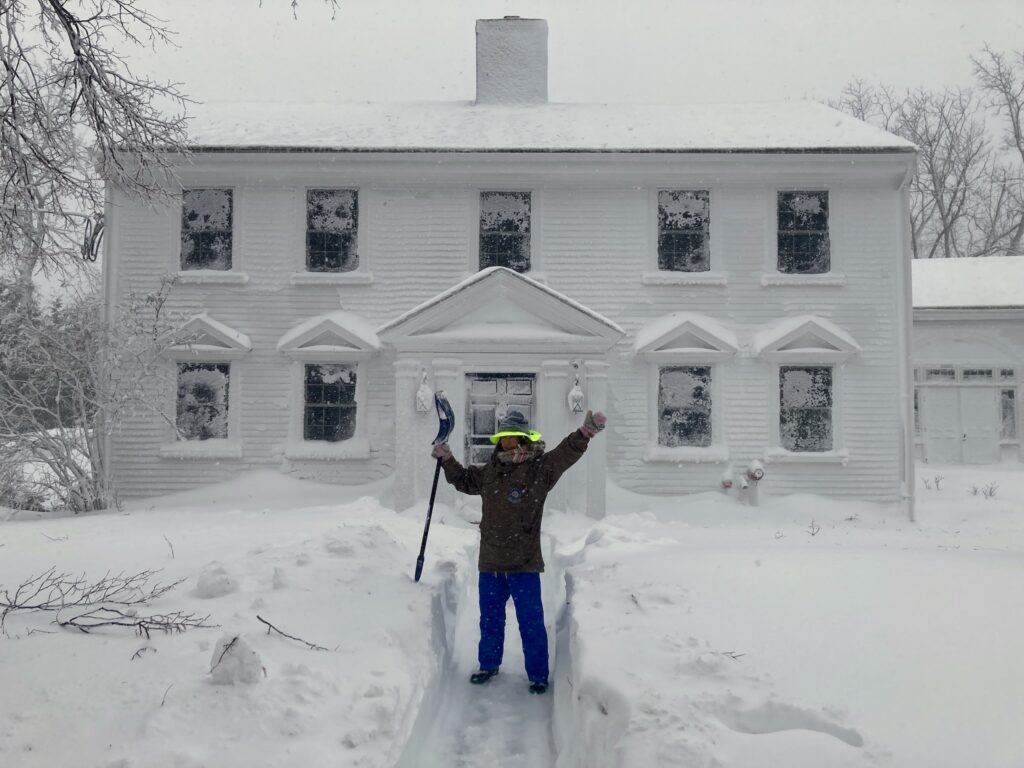
Woman standing in front of a snow-covered house.
Carol and I shoveled a path to the front door of the church’s Parish House. Carol is wearing the anorak that her father had when he wintered over in Antarctica. The snow wasn’t very deep where we were shoveling, because the wind had scoured it away. A friend with an anemometer saw 60 mile an hour wind gusts this morning.

Another MFC notice

A couple of weeks ago, I got one of those emails from the Ministerial Fellowship Committee of the Unitarian Universalist Association. The key paragraph read as follows: “The Ministerial Fellowship Committee voted at its December 2025 meeting to remove the Rev. Benjamin Meyers from fellowship with the Unitarian Universalist Association for violating the terms of ministerial probation, as related to acts of plagiarism.” When I was in the Bay Area, Ben served at the Berkeley Fellowship and the congregation in San Mateo.

This raises a question for me:

Does using generative AI to write a sermon count as plagiarism?

Technically, it’s not plagiarism. At the same time, it’s not your own work. It’s an interesting ethical question.

Is napping necessary?

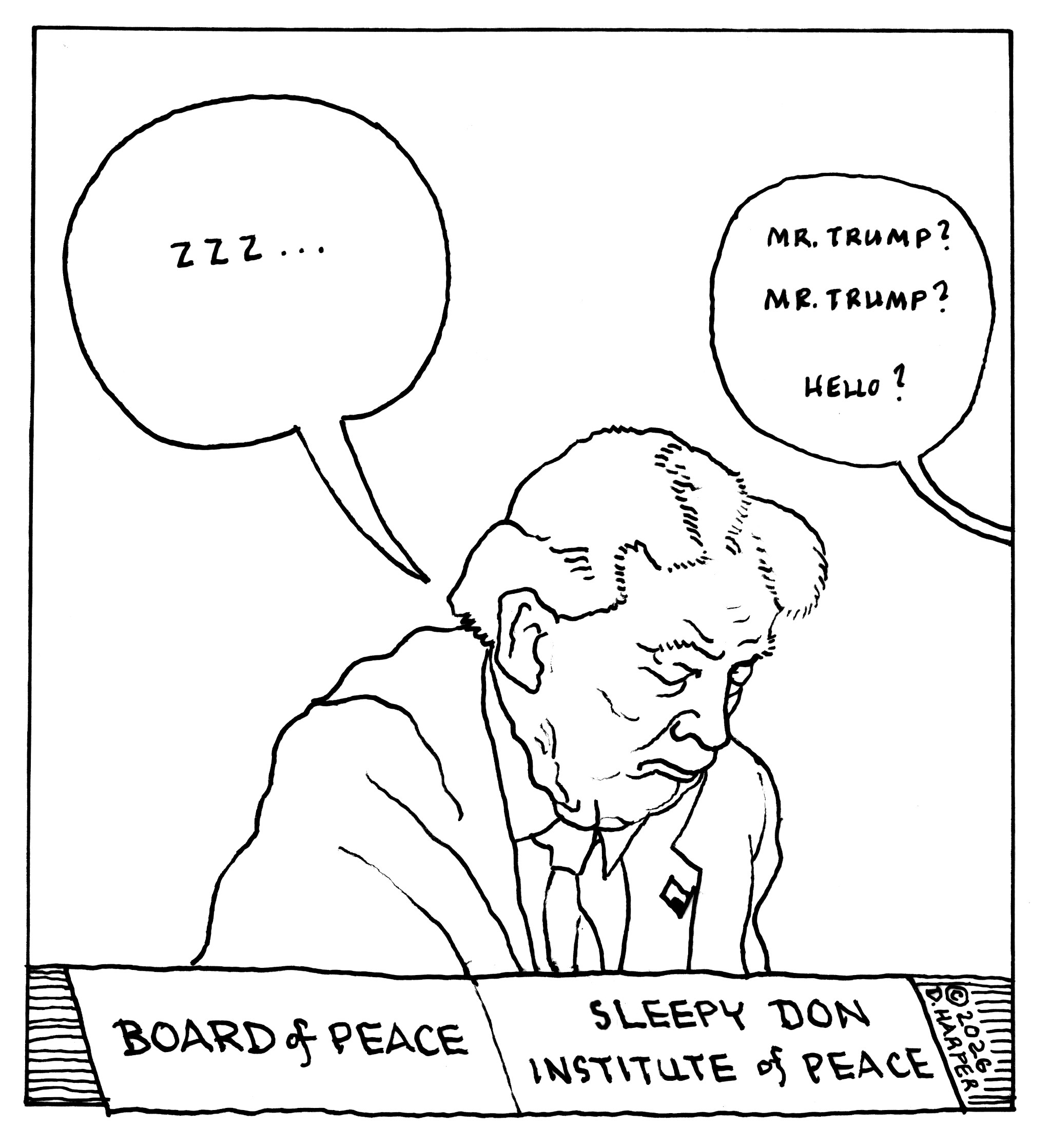
News item: “President Trump has once again dozed off on camera at his own event. Footage shows Trump looking extremely drowsy at his inaugural ‘Board of Peace’ meeting on Thursday at the U.S. Institute of Peace in Washington, D.C.”

As usual, those who oppose Donald Trump will make fun of this, but many health care professionals advise that napping is beneficial. Take, for example, a webpage titled “Is Napping Necessary?” found on the St. Louis Children’s Hospital website (I’ve adapted it slightly):

How the pandemic and the ICE crackdown are similar

“Exploring the Pandemic Impact on Congregations” (EPIC) is a research project that has been — you guessed it — exploring how the COVID pandemic affected congregations. Recently they published a short blog post by Rev. Miluska E. Silencio, a self-described Latina church planter. She finds some interesting parallels between her past experience as a clergyperson during lockdown, and her current experience as a clergyperson during ICE crackdown:

Read the entire piece.

My alma mater

After I received my undergraduate degree, I came to realize that I had not gotten a very good college education. In addition, I felt that although the college I attended claimed to abide by Quaker morals and ethics, in actuality the Quakerism was merely a cosmetic veneer. As a result, I decided never to give money to the college.

Fast forward to 2024, when Donald Trump chose Howard Lutnick to be Commerce Secretary. I vaguely remembered Howie Lutnick from college. About all I remembered about him was hearing from one of my college friends that Lutnick had become class president, in charge of raising money for the college from his classmates.

Today, the BBC reports that Lutnick had previously lied to Congress by claiming he had cut all ties to pedophile Jeffrey Epstein in 2005. Lutnick now admits, in testimony given to Congress today, that he visited Epstein’s infamous island in 2012, accompanied by his wife, his four children, and his nannies. No one is accusing Lutnick of molesting underage girls. But Lutnick not only lied to Congress about his ties to Epstein, he also retained his ties with Epstein even after the latter’s conviction of soliciting prostitution for a child. And knowing that conviction, he brought his own children to Epstein’s island. Yuck.

This was the president of my college class. He does not make me want to give money to my alma mater.

Update, Feb. 19: Apparently, I’m not the only alum disgusted by the fact that Lutnick lied to Congress. A few years back, Lutnick gave a shit-ton of money to the college and they named the library after him. Now other alumni are requesting that his name be taken off the library. A fellow graduate of the college forwarded me a recent email sent out by the president of the college, in which she responds to these requests to rename the library. It is a very mealy-mouthed email. Consider, for example, these two sentences:

These two sentences are essentially meaningless. My guess is that she has consulted the college’s lawyers, and they have instructed her to say nothing substantive, and she has complied. Now, supposedly the college is founded upon Quaker principles, and supposedly the entire college is governed by an honor code — but this makes it clear that speaking plainly and speaking the truth and openly talking about ethics mean less to the college administration than avoiding lawsuits and holding on to money. What a horrible lesson they are teaching their students.

No wonder more and more Americans despise elite colleges.

Groan

The OWL grade 7-9 class met this afternoon. OWL is the comprehensive sexuality education course for early adolescents developed by the Unitarian Universalist Association and the United Church of Christ, and beloved by parents; the initials stand for “Our Whole Lives.”

Class ended in time for Superbowl parties. One parent, as he picked up his teen, made a joke that I can’t believe I’ve never heard before. He was taking his child to the Superbowl from superb OWL….

It doesn’t seem so funny when I put it down in cold print, but it was definitely funny at the time.

Perry Mason

Over the years, I’ve written blog posts on several obscure topics. Some of those obscure topics — making your own burial shroud, washtub bass, composer A. B. Windom, etc. — result in some interesting correspondence.

Most recently, Don O. was looking through my collection of information about the Perry Mason books (not the TV show, mind you, but the books). I have a complete listing of the Perry Mason books, and have gradually been adding notes to each book about recurring characters, plot devices, and legal matters. Turns out Don is a professor of physics, and he sent me email pointing out how Erle Stanley Gardner, the author of the Perry Mason series, used some pretty good science in one of his novels. Thank you, Professor Don!

While I was updating that Perry Mason information with Professor Don’s contribution, I wound up rebuilding that corner of my blog, and I was able to add notes for several more of the books. If you’re a Perry Mason fan, check it out.