Rev. Mr. Fenn weighs in on “Rev.”

Researching this Sunday’s sermon found me going through the church archives to look up an obscure point, and in the process I found a letter dated October 31, 1944, from Reverend Dan Huntington Fenn, then the Director of the Department of Ministry at the American Unitarian Association. It appears that Reverend Orval Clay, a brand-new Unitarian minister just settled at North Unitarian Church in New Bedford, had sent along a church newsletter, asking Mr. Fenn for his advice and comments.

As is still the case in smaller churches with no office staff, Mr. Clay was writing, typing, and printing the entire newsletter himself. No wonder he, a brand-new minister, wanted an older, experienced minister to look it over and offer advice. However, I’m not sure he got quite the advice he wanted. In the first paragraph, Mr. Fenn compliments Mr. Clay on the many activities reported in the newsletter. But the second paragraph offers this advice (which, by the way, directly contradicts the current advice given by the Unitarian Universalist Association):

I recognized the frequent typewriter slips but one which caught my eye was where you referred to yourself as Reverend Clay. That is one thing which always does bother me because it should either be Reverend Orval Clay or Rev. Mr. Clay, or just Mr. Clay, but it is not accurate to say Reverend Clay. I have always fought with every newspaper in every community I have been in trying to get them to give up the practice but they have a persistency which I haven’t been able to yet break down. This has become, therefore, a little pet obsession of mine but it is founded upon the requirements of accurate and good English.

The current practice of the Unitarian Universalist Association is to refer to ministers as “the Rev. Firstname Lastname,” upon first reference, and then as “Lastname” alone (with no honorific) for subsequent references. I have never liked this practice; I see no need to include a direct article prior to the word “Reverend.” Now I have the weighty Mr. Fenn weighing in with a different formula which he says is “founded upon the requirements of accurate and good English.” Of course, that’s basically what the advocates of “the Reverend” claim.

As is so often the case with the English language, there is no right answer. You pays your money and you takes your choice.

Stranded seaman

Carol has been working down on Fish Island recently, borrowing some office space in an unused building there. She has gotten to know a seaman living on a boat moored nearby. He’s a captain of a small merchant ship, living aboard the boat and waiting for his business partner to straighten out some financial affairs in another country. But it now appears that, due to various delays overseas, and due to possible skulduggery in New Bedford, that the Captain may get kicked off his boat and temporarily stranded here.

In case he has to get off the boat fast, Carol told him about the Mariner’s Home, two blocks up the street from where we live. A big old clapboard building right next to the famous Seamen’s Bethel, the Mariner’s Home looks like just another tourist attraction from the outside, but it is still maintained by the New Bedford Port Society to provide overnight lodging for stranded mariners. A mariner who is far from home can be pretty vulnerable. Good thing the Port Society still provides this service.

“Voices of a Liberal Faith”

In the mail today, our church received one of the best marketing tools I’ve seen in quite a while. The Unitarian Universalist Association has just released a DVD with a ten-minute video called “Voices of a Liberal Faith.” Every Unitarian Universalist congregation received a couple of copies of the DVD, so it should be easy to get a look at it.

The video is definitely worth using. It’s not boring, it’s got high production values, good camera work and editing, so we’ll feel good about having it running on a TV during social hour here in New Bedford. it’s a DVD that’s cheap enough that I’m planning to buy them in bulk so that we can have enough to loan them to newcomers and not worry when some of them never get returned. Full disclosure — I make a brief appearance in the video (mercifully brief; and more mercifully, mostly they don’t show me, they show a bunch of my favorite kids from Ferry Beach) — actually, I would have been more likely to use the DVD if I weren’t in it. The real point is that while I was watching it, I immediately saw how I could use the video to give newcomers a good sense of who we are as a religious faith.

Now comes the real fun:– the “Voices of a Liberal Faith” competition. Quite a few Unitarian Universalist church buildings are shown in the course of this short ten-minute video. How many of those churches can you identify? (I lost count, so I have no idea what the total is.) Next, in how many of those congregations have you attended (or led) worship services? My answer was seven, but I’ll bet some readers of this blog can top that number with ease.

Update: In a comment, Philocrites says: “RealVideo and WindowsMedia versions of the film are now available for online viewing at UUA.org.” Thanks for the tip!

Now, what do you think of this?

In an earlier post, I asked about whether or not you would welcome “outside” teens, that is, teens whose parents were not part of your church. Now, here’s a more specific question along these same lines. In the most recent issue of Interconnections, the newsletter for church leaders put out by the Unitarian Universalist Association, someone writes in to ask:

“A 16-year-old girl whose parents do not attend our church is attending our Exploring Membership class. She assures us that her parents are OK with this, however I am concerned about allowing someone under the age of 18 to sign our membership book without our knowing what the parents think about it. How do other churches handle these situations?”

I won’t include the answer printed in Interconnections — instead, how would you answer this question? And if you immediately say that you would let a 16-year-old girl sign the membership book, how young would you go — if she were ten years old, would that make a difference, and why?

Notes on our theological boundaries

These notes are addressed to my fellow Unitarian Universalists, although they may be of some interest to other liberal religious persons. I’ve been thinking about this question: Where do we draw our theological boundaries? Having some sense of where our boundaries are will help us to answer another questions: whom do we keep out, and whom should we be seeking out to welcome in? Mind you, these are just notes — which means your thoughts, reactions, and comments will be most welcome. Continue reading

25,000 for Peace — 100,000 for Peace

Rev. Bill Sinkford, the president of the Unitarian Universalist Association (UUA), and Rev. John H. Thomas, the president of the United Church of Christ (UCC), will be headed to Capitol Hill in Washington, D.C. on October 10. They’ll be visiting the offices of elected representatives to deliver the message that religious liberals want to end the war in Iraq. Continue reading

Of tug boats, birds, and quahoggers

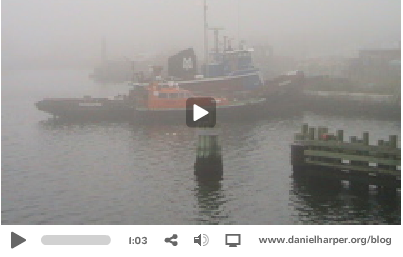
On my afternoon walk yesterday, I was heading along Route 6 towards Fairhaven when I faintly heard someone yelling at me over the traffic: “Hey, Dan!” I looked down, and there was Carol near the future site of the Fish Island Yacht Club, standing and talking with the Tugboat Captain.

I slipped down past a fence or two, and Carol introduced me to the Tugboat Captain. Here’s the back story:

The Tugboat Captain is from Barbados originally, and he and his Haitian business partner came up to New Bedford to buy a tugboat and a barge to use down in the West Indies, for such things as hauling fill from Haiti to some of the smaller islands. Carol met the Tugboat Captain when she was looking in to renting office and storage space on Fish Island: an office for her writing, and storage for the composting toilets she imports from Sweden.

Tugboat Captain’s business partner has run into difficulties moving money from Haiti to the United States, and so Tugboat Captain has been stuck here for two months (so far), keeping an eye on the tugboat they bought. Carol got friendly with him, and as the weather got cold, we found him a hat and some other warmer clothing. Carol also got Tugboat Captain some work weeding at an organic farm in South Dartmouth, which gets him a little cash and (more to the point) a chance to get away from the tug for awhile, and which also gets some much needed help for Carol’s friend the organic farmer.

Thus ends the back story.

So there we were standing there, chatting about this and that, when the Ornithologist’s small orange boat appeared in the distance, coming up the harbor. The Tugboat Captain turned to watch them critically as they came in. “You see their radar,” he said, in his soft Barbados accent, “You know how radar goes around like this…” — he demonstrates, and we nod — “Well, his can go like this…” — he showed us the axis of rotation tilting until it’s parallel to the ground — “so that he can point it straight up, and track birds.”

“Where is he working?” I asked.

“Out the harbor, to the port,” Tugboat Captain said, still watching the boat come in, “about ten miles.” In other words, out in the middle of Buzzard’s Bay.

Carol and Tugboat Captain discussed who was piloting the boat today, and at last they figured out which one of the two men it was who work with the Ornithologist (it was the one they don’t know as well). The Tugboat Captain continued watching as the small orange boat slipped in beside the tugboat, the Ornithologist standing at the bow with a rope ready to tie up. “You see,” he said, turning to us to explain, “most people would bring the bow in first, tie up, and then swing the stern over. But not him. He likes to bring the stern in first, and then swing the bow over.”

The two men from the small orange boat tied up, walked across the tug and onto the little wharf, and came up to say hello. The Tugboat Captain introduced us all around. It turns out the Ornithologist, who lives in Maine, makes his living by working for engineering firms, researching whether wind power installations will damage bird life. He left academia, he said, because he didn’t care for teaching. Carol got into a long discussion with him about the relative merits of various offshore wind power projects.

I turned to the other conversation, between the Tugboat Captain and the pilot of the small orange boat. The swing span bridge was opening to allow one of the deep-sea quahogging boats [*see note below] to pass through and up to the North Terminal. Even I could see that the quahogger was sitting poorly in the water, wallowing as it tried to come about and head up the harbor once the bridge opened. The whole boat tilted towards the bow, and there wasn’t much freeboard. The Tugboat Captain and the pilot were shaking their heads. One of them said something like, “Either you have to be lucky, or you have to have a really good skipper.”

“What’s with that boat?” I asked curiously.

The pilot said, “It looks like the boat was built for something else, and modified for quahogging.”

“He’s got a full load of clams,” said the Tugboat Captain, to clarify further.

“Geez,” I said, “I don’t know anything about boats, but even I can see that’s one boat I wouldn’t want to set foot on.”

They both shook their heads.

I’m always fascinated how people in different professions see the world. All I saw was a boat that looked kind of funny, but they could see far more than I. The Ornithologist and Carol, sunk deep in their conversations of alternative energy and environmental impacts, didn’t even notice the quahogger. As for me, really the main reason I noticed the quahogger is that as a minister, I’ve been trained to watch people — I didn’t see the quahogger per se; I actually saw that the Tugboat Captain and the pilot were seriously interested in something, and followed their gaze.

* If you’re unfamiliar with the term “quahog,” it refers to a species of clam, known in the kitchen as littlenecks, cherrystones, steamers, etc., depending on their size. Here in New Bedford, they pronounce it “ko-hog,” but my mother, whose family was from Nantucket, always said “kwa-hog.” Wikipedia on quahogs.
What do you think of this?

Recently, our tiny little youth group here at First Unitarian in New Bedford has been adding one or two new people, who have come at the invitation of a regular attender of the youth group. These newcomers have no prior affiliation with our church.

Now, in the evangelical church world, this would be considered normal. Indeed, youth groups and youth ministries are often used by evangelical churches to promote rapid growth. Willow Creek Community Church outside Chicago was founded in 1975 as a youth ministry, and now boasts an average worship attendance of 20,000 people each week (Wikipedia on Willow Creek).

By contrast, in the Unitarian Universalist church world — or indeed, in many liberal churches — we may become quite uncomfortable if “outsiders” begin to attend our youth groups. I have heard various reasons for this discomfort, and I’ll give you three such reasons (these are fictional reasons, but based on actual conversations I’ve had):– (1) The church is not able to expend human resources (volunteer or paid) or financial resources on “outside” youth; (2) The church faces legal and/or insurance trouble if “outside” youth are allowed to participate in church activities without written permission, and/or with parents/guardians present on church grounds; (3) The church cannot guarantee that “outside” youth will behave appropriately. That’s what some people say.

Personally, I’ve always supported the right of “outsiders” of any age to participate in the activities of any liberal church, although I do feel that children under 12 should be accompanied by parents or guardians during Sunday school because I think it’s better for the children to have parent involvement at that age. In previous churches I have served, we welcomed “outside” youth, about half of whom became pledging church members — and of course I am continuing that practice here in New Bedford. But I know there’s debate on the topic, and I’d love to hear from you — I’d like both your opinions on if and how your congregation should allow “outsiders” to participate, and whether you think youth ministry could or should be a way for liberal congregations to grow.