A Wikipedia Unitarian

While researching the old Unitarian Church of Palo Alto (1905-1934), I came across someone who is famous enough to be featured on Wikipedia. He’s an entomologist, so he’s not famous famous. He’s not even that famous as scientists go. Still, he’s on Wikipedia so I think it’s worth drawing the attention of today’s Unitarian Universalists to him.

John Merton Aldrich

A renowned entomologist, he was born January 28, 1866, in Rochester, Minnesota. In 1870, he was living with his parents L. O. and Mary, and his older brother and younger sister, in Quincy, Olmsted County; his father was a farmer. In 1880, he was still in Quincy with his family, which now included another younger sister and a servant.

In 1881, John’s family moved to a farm in South Dakota. He attended the new South Dakota Agricultural College in Brookings, S.D., graduating in 1888 after just three years of study. It was in his last year of college that he first took a course in entomology.

Following his graduation, he taught school for a term, then went to study at the University of Minnesota. Although there was then no formal course in entomology at the university, John was able to study with Otto Lugger. Station Entomologist at St. Anthony’s Park. Then in the autumn of 1889, John went to Michigan State University to study entomology. It was there he first turned his attention to Diptera; as he later recalled, his professor advised him “to select a single order as a specialty, and to proceed at once to get together a library and collection; he also suggested the Diptera as a large order in which there were but two workers…at the time in the country.” John began his lifelong study of Diptera in the spring of 1890; this was also the start of his massive collection of Diptera which eventually included some 45,000 specimens.

In November of 1890, John traveled east, both to meet other entomologists and to find work. After failing to obtain a job at Harvard, he traveled to Washington, D.C., and worked for several weeks at the Smithsonian Museum on the insect collections there. However, lack of money forced John to return home, and he spent the winter of 1890-91 working on classifying his growing Diptera collection. He moved to Brookings, and worked worked at the South Dakota Experimental Station, making his first major collecting trip that summer. He received his master’s degree from South Dakota State College in 1891, and had an assistantship the following year. Due to faculty infighting, John lost his assistantship, and he went to to the University of Kansas in 1892; he received a second master’s degree there in 1893.

The University of Idaho was founded in 1893, and John was hired to found the department of zoology. He moved to Moscow, Idaho, to work at the university. There he began working on his catalogue of North American Diptera.

Before leaving South Dakota, he married Ellen J. “Nellie” Roe (b. 1870) of Brookings, S.D., in 1893. Ellen had received her B.S. degree from South Dakota Agricultural College in 1889; she and John had first met while they were both students. At the time of their marriage, Nellie was the assistant principal of the Brookings High School. John and Nellie settled in Moscow, Idaho, where they had a child, Spencer, who died the day he was born, May 17, 1895. Nellie died two years later, on December 3, 1897. To cope with his sorrow after these two deaths, John lost himself in his research. He completed his monumental A Catalogue of North American Diptera (or Two-winged Flies) (Washington, DC: Smithsonian Inst., 1905) on January 1, 1904.

Continue reading “A Wikipedia Unitarian”

Obscure Unitarians: Ora Boring

Another excerpt from my long-delayed book on people who belonged to the Unitarian Church of Palo Alto between 1895 and 1934.

Oramanda Boring

An educator and field biologist, Oramanda (Ora) A. Boring was born October 12, 1854, in Carlinville, Illinois. Little is known about her younger years except a few bare facts in the public record. In 1860, she was living in Carlinville with her father John, a carpenter, her mother Mary, her older sister Mary E., and younger siblings Mary Myrtle and William. The family was still in Carlinville in 1870, living close to Blackburn University (called Blackburn College today), a co-educational college affiliated with the Presbyterian church. By this time, Mary E. had died, leaving Ora as the oldest child. By 1880, Ora was working a school teacher, now living with her parents and younger siblings Mary Myrtle (now age 23), William A., Ella L., Lewis H., Blanche M., Frank P., and Florence A. (age 4) in Greenfield, Ill., an unincorporated town just to the west of Carlinville.

After teaching high school in Greenfield, she moved to California in 1881. She was granted a provisional teaching certificate in Los Angeles in January, 1882; the State Board of Education granted her a “life diploma” (or permanent teaching certificate) in 1884. She probably taught in the Los Angeles schools for the next few years.

Ora met David Starr Jordan, the president of newly founded Stanford University, at a conference in Coronado, and he persuaded her to enter college at age 36. She began studying biology at Stanford University as a special student in 1891, the year the university opened, and was reportedly the first woman student. She participated in the first summer session of the Hopkins Seaside Laboratory in 1892.

After a year at Stanford, she returned to teaching school. She had gained enough experience, and enough of a reputation, that she was an instructor in the summer session of the “California School of [Teaching] Methods” in 1892, teaching other teachers about the history of education. After teaching school until about 1896, she then studied at Stanford again more or less full time from 1897 to 1899. In 1899, she returned to teaching school once again, and finally received her A.B. in zoology from Stanford in 1900, at age 46.

Ora had expertise in a wide range of subjects. In the biological sciences, she pursued both ornithology and botany. She became a member of the Cooper Ornithological Club, an early association of field ornithologists. She was also a serious botanist, and Harvard University Herbaria still has her collections of California plants. Although her degree was in biology, Ora taught several other subjects in her long career as a teacher and educator. In the 1893-1894 school year, she taught English, Latin, zoology, and history in the Coronado, Calif., high school. From 1894 to 1896, she was a supervisor in “primary and grammar grade work” in Stockton, in addition to teaching biology at Stockton High School.

Through the 1890s and into 1900s, she published a number of articles in the field of education. To give an idea of her range of interests, her article titled “Nature Study” was published in School Education in 1895; and “Theological Life of a California Child,” co-written with professor Earl Barnes of Stanford, was published in Pedagogical Seminary in 1892.

In her memoir of life at Stanford University, Ellen Coit Elliott witnessed Ora’s field methods for her educational studies:

After her father died in 1893, her mother Mary moved from San Diego to Palo Alto. In 1897, Ora was living in Palo Alto with her mother, her sisters Blanche and Florence, and her brother Frank; both Blanche and Ora were studying at Stanford at this time. Her mother was an active member of the Methodist church; there is no record of Ora’s religious affiliation at this time. Her mother was an invalid by the time she died in 1901, and Ora may have been providing care for her. By 1910, Ora lived at 101 Waverly St. in Palo Alto with her sister Blanche, brother-in-law William Snow, and their children; Ora was working as a high school teacher.

Ora taught in many different school systems across California, so many that it proved impossible to trace them all. In 1899, she was teaching zoology at Palo Alto High School. She was one of the first teachers at the Clear Lake Union High School District in 1901. In 1903, she was teaching in the high school in Riverside. In 1910, she was living in Palo Alto, though it’s not clear where she taught. From April, 1912, to June, 1914, she taught in the Yosemite Valley School, a one room schoolhouse; the school year ran from April through December, and she may have lived elsewhere when the school was not in session, although as a biologist perhaps she chose to live in the Yosemite Valley year round.

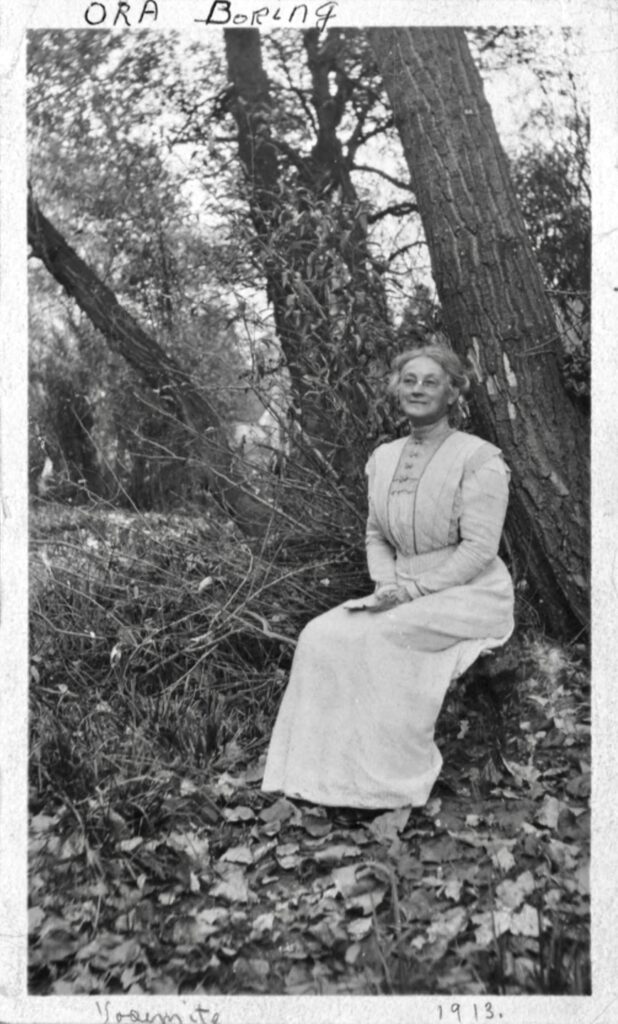
Middle aged woman in early twentieth century dress sitting under a tree
Ora Boring in Yosemite, 1913 (included in “Sunland: A Scrapbook”)

In autumn, 1914, at age 60, Ora began teaching school in Sunland, Calif., then a remote town in the mountains outside of Los Angeles. An unattributed typescript memory of Ora’s tenure in Sunland appears in “Sunland: A Scrapbook,” assembled by Enid A. Larson in 1983:

Continue reading “Obscure Unitarians: Ora Boring”

How the 18th C. British establishment perceived Unitarians

James Boswell, in his Life of Johnson, described how one “Reverend Mr. Palmer, Fellow of Queen’s College, Cambridge,” dined with Boswell and Johnson in 1781. Boswell appended a footnote with some more information about Palmer:

In other words, promoting Unitarianism in late eighteenth century Britain was sometimes considered illegal. Further, you could be sent to the penal colony in Australia for that crime. I guess Unitarianism was perceived as a threat to the establishment — not just to the established Church of England, but to the political establishment as well.

Jacob Flint’s history sermons

Below you’ll find the text of two sermons (with some annotations) published in 1822 by Rev. Jacob Flint of Cohasset, Massachusetts. While these sermons might appear to be of little interest to anyone except students of Cohasset history, they also contain some interesting theological content for those interested in the battles between the Unitarians and Trinitarians in 1820s Massachusetts.

Two years after Flint gave these two sermons, in December of 1823, he preached two sermons stating in no uncertain terms that trinitarian beliefs were supported neither by the Bible nor by human reason. The 1823 sermons precipitated a split in the Cohasset congregation. In the present sermons, preached in December of 1821, Flint claims that a couple of his predecessors were Unitarians in thought if not in name; in addition, he makes it clear that he agrees with his allegedly Unitarian predecessors. Anyone who heard the 1821 sermons could not have been surprised by the 1823 sermons.

Interestingly, the second of the 1821 sermons includes a long footnote in which Flint carefully outlines how the Cohasset congregation had lived in unanimity for most of a century. He must have been aware of the trinitarian leanings of some of his congregants; was this his way of trying to keep them from splitting the congregation?

I also noticed the way Flint erases the Indians from his account of Cohasset history, confining any mention of them to a short section labelled “Curiosities.” He never mentions how there were Indians who were members of the church in the mid-18th century. As it happens, I’ve just been reading Jean O’Brien’s book Firsting and Lasting: Writing Indians out of Existence in New England (Univ. of Minnesota: 2010), which examines the ways in which the authors of local histories in New England created the myth of the “vanishing Indian.” Flint’s sermons are early examples of that myth.

So there’s more going on in these two sermons than just boring local history!

Notes on the text: OCR-generated text found online was checked against a physical copy of the sermons in the archives of First Parish of Cohasset, and a number of corrections were made. Footnotes in the original have been numbered consecutively, with numbers enclosed in square brackets, and moved to the end of each section (Discourse I, Discourse II, and Geographical Sketch). A few editorial notes have been added, enclosed in square brackets. Pages breaks in the original have been indicated by enclosing “page X” in square brackets. One or two long quotations have been placed in separate paragraphs.

The 1823 sermons: Earlier this year, I put Flint’s 1823 Unitarian sermons (the ones which precipitated the split with Second Congregational Church) on this blog: the first sermonthe second sermon.

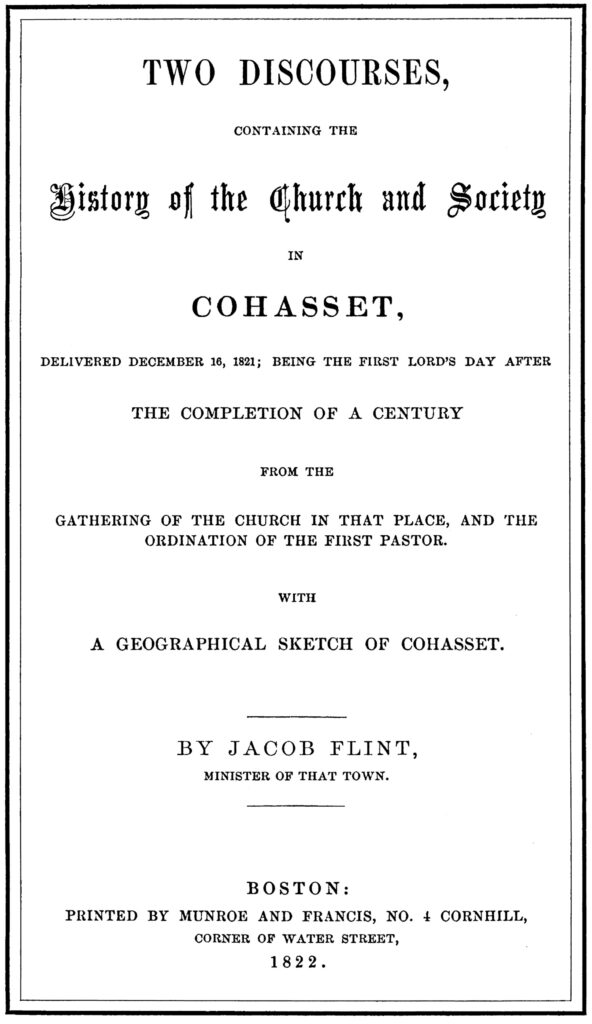
Facsimile of the title page; full text appears below.
Continue reading “Jacob Flint’s history sermons”

The sermon that split a congregation, part two

In an earlier post, I published the first of a series of two sermons preached by Rev. Jacob Flint here in Cohasset in December, 1823. In these sermons, Flint proclaimed publicly that he supported the Unitarian side of the Unitarian / Trinitarian controversy then raging through eastern Massachusetts churches of the Standing Order. Not surprisingly, once their minister openly espoused Unitarianism, the Trinitarian sympathizers in the congregation left to form their own Trinitarian church.

I’m finally getting around to publishing the second sermon, the one that Flint preached in the afternoon. I can’t help wondering how the Trinitarian sympathizers responded after hearing the first sermon, the one in the morning. Did they gather together during the lunch break to talk? Did some of them refuse to return for the afternoon sermon? If they did return, were they angry as they sat there listening to their minister tell them that their cherished theological beliefs were irrational, non-Biblical, and even unchristian? And how did the Unitarian sympathizers in the congregation feel? — were they perhaps relieved that at last their minister came out and stated openly the beliefs that probably everyone in the small town of Cohasset knew he held?

It turns out to be a fairly well written sermon. Today’s Unitarian Christians might even find it to be of mild theological interest.

But I suspect most of the interest this sermon holds today is its historical interest. It’s a sermon that cause an open rupture between Unitarians and Trinitarians in one small town. It is in a sense a microcosm of the larger theological and institutional battle raging through organized religion in eastern Massachusetts. Flint was not arguing about abstract theological issues; he was arguing with people that he knew well, people he saw every day. His sermon might even cause us to reflect on the power of words and the power of thought, and how words and thought can lead to open conflict and (according to tradition) acrimony as well.

Original page breaks are noted in square brackets, like this: [p. 14]. Footnotes from the original have been numbered and placed as endnotes. A few editorial notes have been included, always enclosed in square brackets.

Read Part I.

Discourse in which the Doctrine of the Trinity is examined…

by Jacob Flint (Christian Register: Boston, 1824).

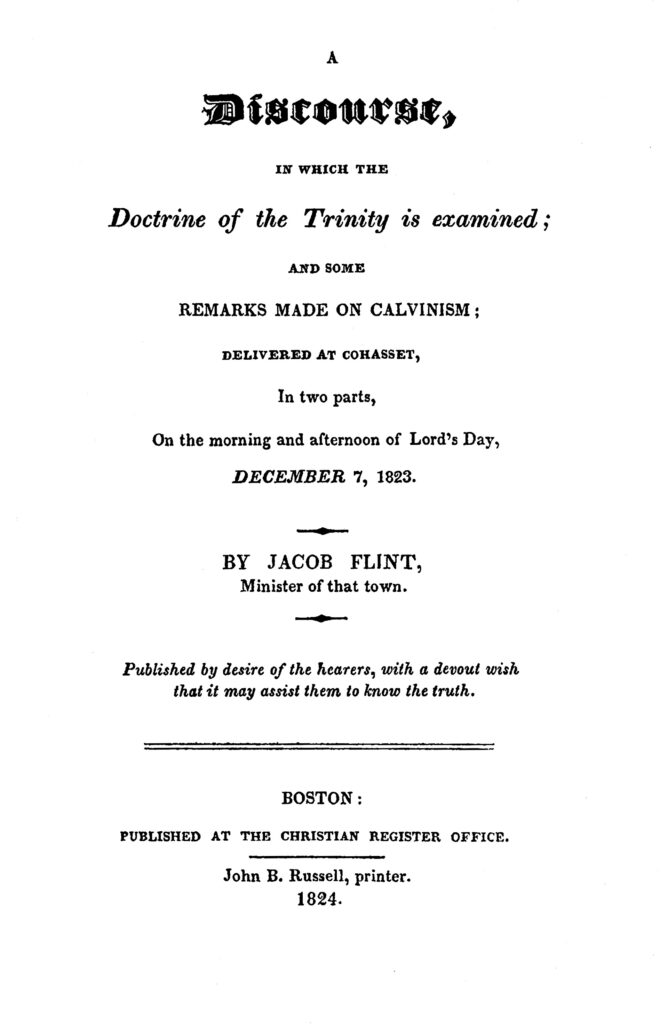
Image of the original title page

[p. 11] PART II

[1] Thes[salonians] v. 21. — “Prove all things; hold fast that which is good.”

The Scriptures, given by inspiration of God, contain, as I attempted to show you in the morning, a system of doctrines and morals admirable for their simplicity and truth, and a most necessary guide for men to faith, duty, and happiness. They are in the highest degree profitable for doctrine, reproof, correction, and instruction in righteousness. But I had to remark, that unhappily for the peace of society, and good will of christians towards each other, these sacred writings had not long been in the hands of fallible and and erring mortals, before they were made to teach, for doctrines, the inventions and commandments of men. These inventions, or spurious doctrines, became the source of almost endless dispute, animosity and persecution among christians. For these dreadful effects, however, there is no blame that can justly be attached to the gospel, because that every where inculcates forbearance, charity, and good will in all men.

Continue reading “The sermon that split a congregation, part two”

A quirky timeline of UU history

Because Yvonne asked me to, I put together a timeline of UU history. Instead of focusing on White male ministers from wealthy urban areas, my timeline includes people and events from outside the mainstream of UU history.

13 October 2025: Updated in an attempt to give at least one entry for every decade

Timeline of Unitarians and Universalists (mostly North American)

Because race is so important in the U.S., racial identities of U.S. individuals are generally given. I note with sadness that there are very few working class people mentioned on this timeline.

18th century

  • 1736 Naomi Isaac, an “Indian” (possibly Massachusett) joins the liberal church in Cohasset, Mass., which later became Unitarian
  • 1773 Caleb Rich (White) becomes minister of a new church in Warwick, Mass., that has a universalist theology
  • 1775 John Murray (White), Universalist minister, serves as a chaplain in the Revolutionary army
  • 1779 The Independent Christian Church (Universalist) organized in Gloucester, Mass., one of the earliest Universalist congregations in the U.S.
  • 1785 King’s Chapel is the first Unitarian congregation in the U.S.
  • c. 1795 The scientist Joseph Priestley (White) holds Unitarian services in Northumberland, Penna.
  • c. 1795 Prince (no last name), a Black man, joins the church in New Bedford, Mass., as a full member

19th century

  • 1823 Mary Rotch, a White Quaker in New Bedford, Mass., is expelled from Quakerism for being too liberal; she joins the Unitarian church, where she later influences Ralph Waldo Emerson
  • 1838 Nathan Johnson, a Black Universalist in New Bedford, Mass., shelters Frederick Douglass on the latter’s first night of freedom
  • 1843 Adin Ballou, a White Universalist, founds the Hopedale community, a utopian pacifist community in Mass.
  • 1859 Elizabeth Palmer Peabody, a White Unitarian, opens the first kindergarten in the U.S.
  • 1860 Samuel Jackson, a Black Baptist minister, asks to bring his entire congregation into the American Unitarian Association, but because he and his congregation are Black, he is ignored
  • 1863 Olympia Brown, a White woman, ordained by the Universalist General Conference, the first woman to be ordained by a denomination (rather than just a congregation) in the U.S.
  • 1871 Magnús Eiríksson, an Icelandic theologian living in Copenhagen, openly espouses Unitarian theology; this eventually led to the Icelandic Unitarian movement
  • 1876-1878 The U.S. government invites Protestant denominations to manage American Indian reservations; the Unitarians receive the charge of Ute tribes in Colorado
  • 1883 Poet William Carlos Williams, a Hispanic Unitarian, is born
  • 1887 First Unitarian service is held in the Khasi Hills of India, led by Kissor Singh (South Asian)
  • 1894 Watari Kitashima (Japanese) ordained by the Unitarian church of Vineland, NJ
  • 1895 Eliza Tupper Wilkes, a White Universalist minister, is the first woman to preach in Stanford University’s nondenominational chapel

20th century

  • 1902 The American Unitarian Assoc. publishes an essay promoting eugenics, written by David Starr Jordan, the White president of Stanford Univ. (Jordan was a member of the Palo Alto Unitarian church)
  • c. 1915 Sylvie Thygeson, a White Unitarian, helps open a birth control clinic in St. Paul, Minn.
  • 1917 Adeniran Adedeji Isola (Black) founds the Unitarian Brotherhood Church (Ijo Isokan Gbogbo Eda) in Lagos, Nigeria
  • 1918 Unitarian minister William Short Jr. is arrested for draft evasion, because he’s doing peace activism; when he appeals to the American Unitarian Association to confirm that he’s a minister, they throw him under the bus
  • 1922 Abigail Eliot (White), an LGBTQ Unitarian educator, brings the nursery school concept to the U.S.
  • 1923 The first Flower Celebration is led by Norbert and Maja Capek, ministers at the Unitarian church in Prague, Czechoslovakia. This ritual is later wrongly called a “flower communion.”
  • 1930s Probably a third of all Unitarian and Universalist churches close due to the Great Depression
  • 1932 Poet Sylvia Plath, a White Unitarian, is born
  • 1935 Utah Phillips is born; a member of the Industrial Workers of the World labor union and a musician, he became Unitarian Universalist as an adult
  • 1937 Unitarians and Universalists cooperate to create a new hymnal
  • 1937 Concerned that Leila Thompson, an ordained Unitarian minister, is running for city council in Berkeley, Calif., as a Socialist, American Unitarian Assoc. officials do their best to disavow her
  • 1942 Unitarian minister Norbert Capek dies in the Auschwitz concentration camp
  • 1947 Stephen Fritchman, a White minister, is forced out of his job editing the denominational magazine due to accusations that he is Communist
  • 1948 Imaoka Shin’ichiro (Unitarian) and Shigetaro Akashi (Universalist) found the Japan Free Religious Assoc. in Tokyo
  • 1950s (date uncertain) UU ministers officiated at some of the earliest UU same sex weddings
  • 1956 Christopher Moore, a White minister at First Unitarian in Chicago, founds the Chicago Children’s Chorus, an interracial chorus which rapidly became one of the best children’s choruses in the U.S.
  • 1950s Religious liberals in the Philippines affiliate with the Universalist Church of America
  • 1961 Unitarians and Universalists consolidate into one denomination; the new UUA bylaws have six principles
  • 1964-1976 Rev. Andrew Yoshinobu Kuroda leads Japanese language services at All Souls Unitarian church in Washington, DC
  • 1965 Year with highest Unitarian Universalist membership in the U.S.
  • 1965 Victor Carpenter, minister in the Cape Town Unitarian church of South Africa, delivers sermon opposing apartheid
  • 1965-1970 Unitarian Universalism loses half its Black members during the Black empowerment controversy
  • 1977 Ysaye Maria Barnwell founds the Jubilee Singers, a gospel choir, at All Souls UU church in Washington, D.C., the first Black-led UU gospel choir
  • 1977 First Unitarian of Los Angeles publishes the first Unitarian hymnal with Black and working class music in it
  • 1980 The first Water Ritual takes place at a feminist gathering of women; later, it was wrongly called a “Water Communion”
  • 1985 The UUA adopts new non-sexist bylaws with seven principles
  • 1991 Cheng Imm Tan, an Asian immigrant, ordained as a UU community minister
  • 1993 The UUA publishes a hymnal containing Black spirituals, the first official denominational hymnal (Universalist, Unitarian, or Unitarian Universalist) with non-White music

21st century

  • 2004 Unitarian Universalist Association of Uganda is formed
  • 2005 Last year of growth in U.S. Unitarian Universalism
  • 2008 Carleton Pearson, a Black Pentecostal minister who became a Universalist, brings his congregation to the Unitarian Universalist church in Tulsa, Oklahoma
  • From about 2010 on, enrollment in UU children and youth programs declines steeply
  • 2017 Peter Morales, the Hispanic president of the UUA, is forced out over allegations of racism

The sermon that split a congregation

Back in 1823, Rev. Jacob Flint was the minister of the one church that then existed in Cohasset, Mass. He had been ordained in Cohasset in 1798. He was fairly liberal to begin with, but over the quarter of a century he served the congregation he had become an outright Unitarian. So on December 7, Flint decided to preach a sermon on Unitarianism.

I can imagine the scene. He preached this sermon in the Meetinghouse that we still use today, but the old box pews were still in use in 1823. Wood stoves had been put in the Meetinghouse for the first time the previous year, in 1822, so at least people would have been relatively warm for the two lengthy sermons that were delivered each week. Flint would have climbed up into the high pulpit, suspended halfway between the main floor and the gallery. Sadly, he was not a good speaker — John Adams wrote that “his elocution is so languid and drawling that it does great injustice to his composition” (John Adams, Diary, 19 Sept. 1830).

Despite his poor elocution, at least some people in the congregation must have been paying close attention to this day-long Unitarian sermon. Within months the Trinitarians had left in a body to start building their own church just a hundred feet away across the town common. I can just imagine how angry the Trinitarians were after the morning service on December 7, 1823, and how little they looked forward to the second sermon in the afternoon when they would hear even more about how wrong the doctrine of the Trinity was. How they must have steamed and stewed as Flint preached, especially since his preaching seems specially designed to infuriate anyone with Trinitarian leanings.

But this was probably to be expected of Flint, who was an uncompromising man. Years later, Capt. Charles Tyng remembered a time from his boyhood when he had to live in Flint’s house:

“…I was then put under the charge of the Rev. Dr. Jacob Flint, the minister at Cohasset. I soon found that the change was from the frying pan to the fire. Doctor Flint was a large man with a forbidding countenance. He was morose & cross in his family, which consisted of his wife, three sons, and an infant daughter…. I dreaded Sunday, the Dr. was so very strict, made us boys sit in the house, reading our Bibles, or learning hymns…. Dr. Flint was a tyrannical man, and very severe, particularly with his own children. Hardly a day passed without his whipping them. Us Boston boys did not get it so often, although I often felt the effects of the rod. He probably was deterred from whipping those who boarded with him, as his disposition would have induced him, had he not thought our parents would take us away.” (Charles Tyng, Before the Wind: The Memoir of an American Sea Captain, 1808-1833, chapter 1.)

With that preface, here’s the first part of Flint’s divisive Unitarian sermon of December 7, 1823:

Image of the original title page
Continue reading “The sermon that split a congregation”

Documents relating to the Ute Indians and the Unitarians

Recently, people in the United States have been taking the month of September to reflect on the wrongs perpetrated against the indigenous peoples by the U.S. government and citizens.

(And yes, the perpetrators of wrongs against Native Americans were nearly all White, which means that Ron DeSantis doesn’t want this material taught in the Florida public schools because it might make some White kids feel ashamed of their race. More than 20 other U.S. states have laws similar to Ron DeSantis’s law in Florida, which means that this blog post is officially and legally banned in schools in more than one third of the U.S. But I digress….)

After the Civil War, various religious groups were assigned to Native American groups. The Christian religion, especially Protestant Christianity, was considered a “civilizing force,” a means by which White settlers could maintain control over Native peoples by forcibly integrating them into White culture. The Unitarians were still considered Christians in the 1870s (we got kicked out of the Christian club after 1900), and as a small denomination we were assigned “the Utes of Colorado,” a group of Native nations then living in Colorado, later forcibly removed to Utah. The Unitarians considered this “mission work,” a way of spreading the Unitarian religion through good works among non-White (and therefore less “civilized”) persons; and they classed it with the Unitarian mission in Kolkata, India, and the mission work done among African Americans in the Deep South.

Apparently, the Unitarians were fairly ineffective at this mission work. Given the history of Unitarianism, I suspect our ineffectiveness was due to our usual lack of organization and unwillingness to provide adequate funding. We established a school for Ute children, which is not listed in the first volume of the Federal Indian Boarding School Initiative Investigative Report, so perhaps it was not a boarding school. Nevertheless, given what we know now about how White-run boarding schools did so much damage to Native children, it seems important that we learn more about how this school operated.

(All this makes me think: The Universalists can be thankful that we were so small and disorganized and heretical during the 1870s and 1880s that the U.S. government never assigned them a group of Native peoples.)

In any case, I’ve collected some documents from the 1870s and 1880s pertaining to the Unitarian mission among the Ute peoples. They make for some pretty uncomfortable reading. Even though the Unitarian Universalist Association formally apologized to the Utes back in 2009, we still have a lot to do to reflect on how the Unitarian religion was used as a tool of colonization.

Scroll down for the documents….

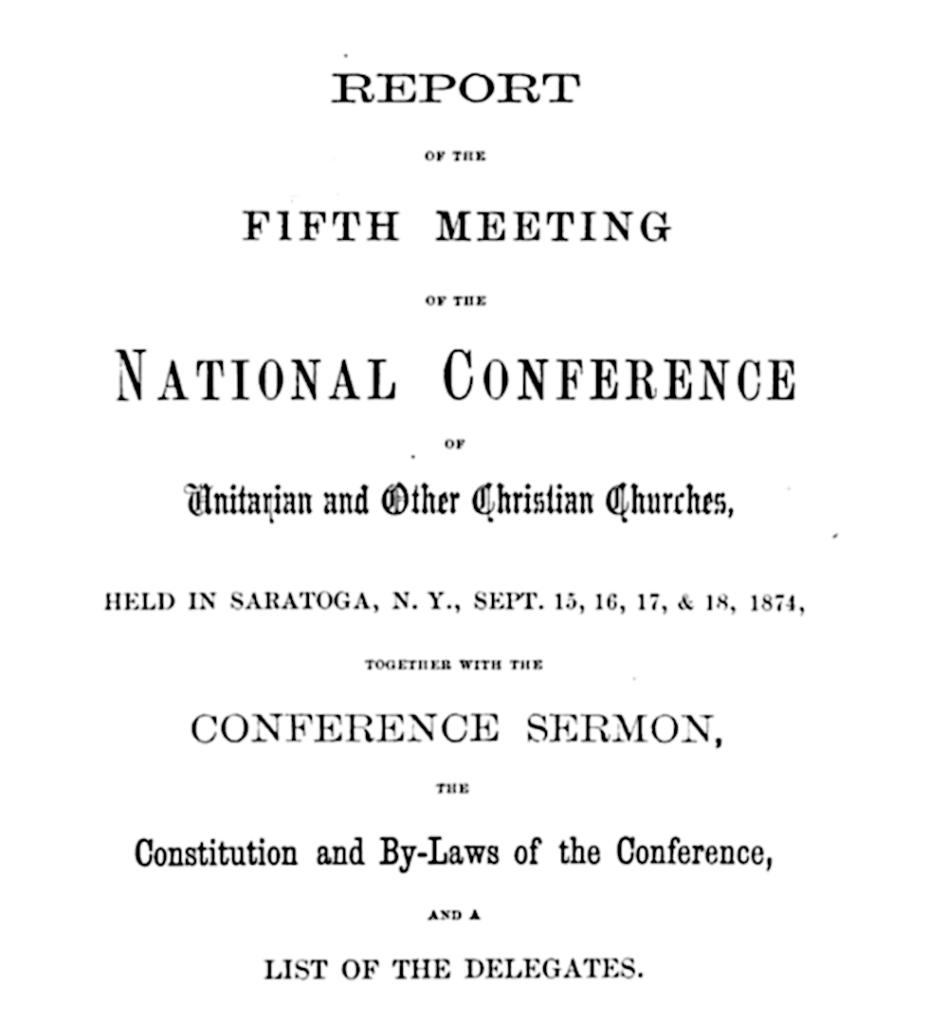
Cover page of the report of the Fifth Meeting of the Unitarians.National Conference
Continue reading “Documents relating to the Ute Indians and the Unitarians”

Deconstructing “covenant,” pt. 2

…My point in the previous post was to deconstruct “covenant.” But why do we need to deconstruct “covenant”?

Unitarian Universalists today love to talk about covenant as if it has a long history. I’m arguing that covenant was a mid-twentieth century invention by Conrad Wright and James Luther Adams. It does not have a long history. And that’s a good thing. The history that Conrad Wright invented for covenant has too many negatives for me to feel comfortable.

When we deconstruct in the Conrad Wright conception of covenant, here are some of the things that we begin to understand:
— Historically, covenant was designed to promote theocracy;
— it was dependent on patriarchy;
— it was rooted in enslavement of Africans and Natives;
— and it supported British imperialism and colonialism.
Plus the Wrightian history of covenant ignores our Universalist heritage.

These are some of the things that Wright either wasn’t aware of or ignored. I don’t think we can remain unaware of these things, or ignore them, any longer. We have to deconstruct “covenant” so we can reconstruct it without quite so many negative aspects.

Since the time of Wright and Adams, others have tried to articulate a vision for Unitarian Universalist covenant, most notably Alice Blair Wesley in her Minns Lectures from the year 2000. But all these visions for covenant start with the assumptions laid out by Conrad Wright and James Luther Adams, and don’t really question those assumptions. I feel that none of these new visions for covenant adequately addresses theocracy, patriarchy, enslavement, or colonialism. And in my opinion, none of the visions for covenant takes Universalism seriously enough. To put it succinctly — none of these new visions of covenant adequately deconstructs the underlying assumptions of “covenant.”

Deconstructing “covenant” in this way has helped me to understand why I’ve been feeling increasingly uncomfortable when Unitarian Universalists talk about “covenant.” When we talk about “being in covenant,” we have to start listening for echoes of patriarchy, colonialism, enslavement, and so on. When we accuse others of “breaking covenant,” we have to start have to listening for echoes of the old Puritan practice of public shaming of church members. When we think of covenant as an organizing principle, we have to ask ourselves why we are ignoring the Universalist tradition.

If we’re unwilling to deconstruct “covenant” — how are we going to reconstruct “covenant” to remove the lingering taint of sexism, enslavement, anti-democratic theocracy, and colonialism? Perhaps deconstructing and then reconstructing “covenant” would allow us to make some much-needed progress in our anti-racism work, our ongoing efforts to get rid of patriarchal structures, and our beginning efforts to understand the role of religion in colonialism

If we’re unwilling to deconstruct “covenant” — how are we going to include Universalism once again in our central organizing principles? I’m afraid the answer here might well be that most of us don’t care about Universalism any more. Perhaps it would be better if we’d openly acknowledge this, because we’re “sitting on the franchise,” getting in the way of other groups trying to spread the happy religion of universal salvation. Or perhaps it would be best if we re-engaged with our Universalist heritage, with its incredible diversity of belief and practice; perhaps that would help us more than an attempt to unify ourselves with a tainted vision of “covenant.”

Deconstructing “covenant,” pt. 1

Unitarian Universalists talk a lot about “covenant.” We didn’t used to talk about covenant. As near as I can tell, our mild obsession with covenant came about during the merger of the Unitarians and the Universalists, a process which began in the 1950s and continued for years after the legal consolidation of the two groups in 1961. We were thrashing about trying to find something that held us together. The Universalist professions of faith weren’t acceptable to the Unitarians, and the Unitarian affirmations of faith (like James Freeman Clarke’s Five Points of the New Theology) weren’t acceptable to the Universalists.

Two Unitarian scholars, James Luther Adams and Conrad Wright, had long been talking about the importance of covenant to their Unitarian tradition. Wright was a historian who interpreted the entire history of Unitarianism in the United States as centering around covenant. This was a problematic interpretation, since by the early twentieth century many Unitarian congregations didn’t have written covenants. I’m not sure, but Wright may have felt that the Unitarians kind of forgot covenant, and that forgetfulness led to the decline of Unitarianism in the 1930s. In any case, he saw the re-establishment of covenant as central to the revitalization of Unitarianism in the mid to late twentieth century.

Wright continued to trumpet covenant after consolidation with the Universalists. While his primary area of expertise was in Unitarian history, he dipped into Universalist history and claimed to find that the Universalists were pretty much like the Unitarians when it came to congregational polity and the centrality of covenant.

I don’t find Wright’s interpretation of the historical facts to be terribly convincing. Covenant was in fact central to most Unitarian congregations that began life as Puritan churches in New England. Covenant was also important to some nineteenth century Unitarian churches which had been founded by New England settlers moving west. But in my research in the archives of local congregations, covenant becomes less important as an organizing principle beginning in the nineteenth century and through the early to mid-twentieth century.

In many eighteenth century New England congregations, there were two parallel organizations, the church and the society. The society owned the real property and managed the finances; the church consisted of the people who signed the church covenant and stood up in front of the congregation and confessed their sins. Membership in the society was typically through buying a pew and contributing annual rental for your pew (often restricted to males, since there were legal limitations about females owning property), and generally speaking only males could take on leadership roles in the society. It appears that on average significantly more women than men signed the covenant to become a part of the church. People of African or Native descent could join the church, but may have been barred from owning pews or serving in leadership roles in the society.

Thus the entire system of covenant was bound up with discriminatory distinctions between males and females, and between persons of European descent as opposed to persons of African or Native descent. Nor is this an accident. Covenant in the New England Puritan tradition was a means for upholding a theocracy that placed white males at the top of the social hierarchy (note that I’m being sloppy here by including the Pilgrims in the umbrella term “Puritan”). Today, some might call this racism or white supremacy, though some historians would argue that these are anachronistic concepts when applied to the seventeenth and eighteenth centuries; a better way to put this is to simply say that the New England Puritan tradition was inextricably linked to enslaving people of African and Native descent. On the other hand, we can say with some certainty that this Puritan social hierarchy was patriarchal and sexist. In addition, Puritan theocracy was also tied in with the larger project of British colonialism; not quite as blatantly as in the resource-extraction economies of the southern plantation colonies, but the British empire clearly say the value of exporting religious dissidents to “tame the wilderness” thus opening up the area to somewhat “softer” economic exploitation by the empire.

In short, covenant was bound up with patriarchy, colonialism, and slavery. This is not to say that covenant is forever tainted by its origins. But these are parts of the story that Conrad Wright passes over. If we’re going to put covenant at the center of our religious tradition, at the very least we need to acknowledge that covenants were part of a theocratic political structure that was rooted in the oppression of the majority of people in the society.

During the nineteenth and early twentieth centuries, the distinction between society and church seems to have slowly been forgotten; along the way, covenants often seem to have disappeared as well. So, for example, when I was doing research for the 300th anniversary of the Unitarian church in New Bedford, Mass., I found evidence for the existence of a covenant in the congregation’s eighteenth century archives, now stored at the New Bedford Whaling Museum. By the late nineteenth century, during the long ministry of William Potter, one of the leaders of the Free Religious Association, I found no evidence for the existence of a covenant. The distinction between society and church continued into the 1940s, since the ministers were not allowed to attend the annual meeting of the congregation — it appears that in the eighteenth century the minister was charged with oversight of the church, the lay leaders with oversight of the society — but with the end of pew ownership in the 1940s, that distinction finally dissolved. By the early twenty-first century, there was no distinction between church and society, or more precisely the church withered away leaving only the society.

In another congregation I researched, the Unitarian church in Palo Alto, Calif., which existed from 1905 to 1934, I found no evidence at all for the existence of a covenant. From the research I’ve done in local congregational archives, I’ve mostly found no evidence for a covenant in the early twentieth century. The only exception is the Unitarian Society of Geneva, Ill., which still maintains the covenant originally written and signed by the founders of that church — who were all emigrants from New England to what was then the frontier. That covenant was substantially revised circa 1900, to shorten it, and to remove all mentions of God or the Bible. The church almost went moribund in the early twentieth century, until Charles Lyttle, professor of church history at Meadville Lombard Theological School, stepped in to rebuild the church for use as a training congregation for his Unitarian theological students. Perhaps it is due in part to Lyttle’s academic influence that the Geneva covenant remained active (and one wonders if the historian Charles Lyttle helped draw the attention of the later historian Conrad Wright to covenant).

Thus covenant appears to have mostly disappeared from Unitarian congregations in the nineteenth century. But Conrad Wright also argued that Unitarian churches were bound to each other through congregational polity, which was another sort of covenant. The most important document here was the Cambridge Platform, a seventeenth century Puritan document that outlined how Puritan churches were supposed to relate to one another. The Cambridge Platform looked to the Bible as revealed scripture (the Word of God) to determine how churches related one to another. The Cambridge Platform was outdated almost as soon as it was written — it called for every church to support both a preaching minister and a teaching minister, which proved to be economically impossible — but it also simply didn’t apply to some Unitarian congregations.

Take, for example, King’s Chapel in Boston, which became Unitarian in 1785. It was originally affiliated with the Church of England, but became independent during the American Revolution; at which point, it removed all references to the trinity from its Book of Common Prayer, and became Unitarian in theology. King’s Chapel came from a tradition of episcopal polity, and the Cambridge Platform formed no part of its history until, at the earliest, it affiliated with the American Unitarian Association sometime after 1825. Or take the Icelandic Unitarian churches of Canada, which came out of Lutheranism, another religious tradition based on episcopal polity. Perhaps we could argue that the Unitarian tradition of covenant in North America is syncretic, taking in various influences, and transmogrifying them.

But I think it’s more accurate to say that twentieth century Unitarian covenant was something that Conrad Wright made up, using historical materials. Covenant is not an old tradition among us, it’s a newly made-up tradition. That being the case, I’m not sure I want to use a made-up kind of covenant based on Puritan theocratic patriarchal concepts rooted in colonialism and slavery.

Furthermore, as someone who thinks of myself as more of a Universalist than a Unitarian, I’m trying to figure out why we should use a made-up kind of covenant that pretty much ignores Universalism. Conrad Wright did extensive research in Unitarian covenant, but it’s clear from his writings that his knowledge of Universalist history was not very deep. James Luther Adams, the other co-creator of twentieth century Unitarian covenant, knew his Unitarian tradition quite well but did not know Universalism nearly as well.

Whether or not the Unitarians were always actually unified by covenant (or if it was something that Adams and Wright invented in the mid-twentieth century), it’s quite obvious that the Universalists were not unified by covenant. The Universalists were unified by a common theology of universal salvation, which was expressed in affirmations of faith. Because the Universalists differed so radically in the details of their universalist theologies, their affirmations of faith had to be very broad, and mostly were quite brief. Unitarian documents, such as church covenants and the Cambridge Platform, tended to be quite wordy — the Cambridge Platform fills up a small book — but the Universalists’ “Winchester Profession” of 1803 comes in at fewer than 100 words. Not that the Winchester Profession, or any later profession of faith, actually served to unify the Universalists; they’ve been an almost anarchistic group from the start; the point is that they did not have covenants in the way Unitarians had covenants. Thus the concept of covenant, as promoted by Adams and Wright, was a Unitarian thing, but it was not important to Universalism.

My point here is to deconstruct “covenant.” More on this tomorrow….