I went for a walk at Black Rock Beach late this afternoon. A large quantity of seaweed had been left behind by the ebbing tide, mostly Sugar Kelp (Saccharina latissima), but also some wrack (Fucus spp.), some Sea Lettuce (Ulva lattuca), and a few other odds and ends.
There were also hundreds of small (2-3 cm long), almost transparent jelly-like objects washed up above the line of seaweed. At first glance I thought they were Sea Gooseberries (Pleurobrachia pileus), a species of comb jellies. But when I put my photos on iNaturalist, user ja-fields corrected me — they were salps.
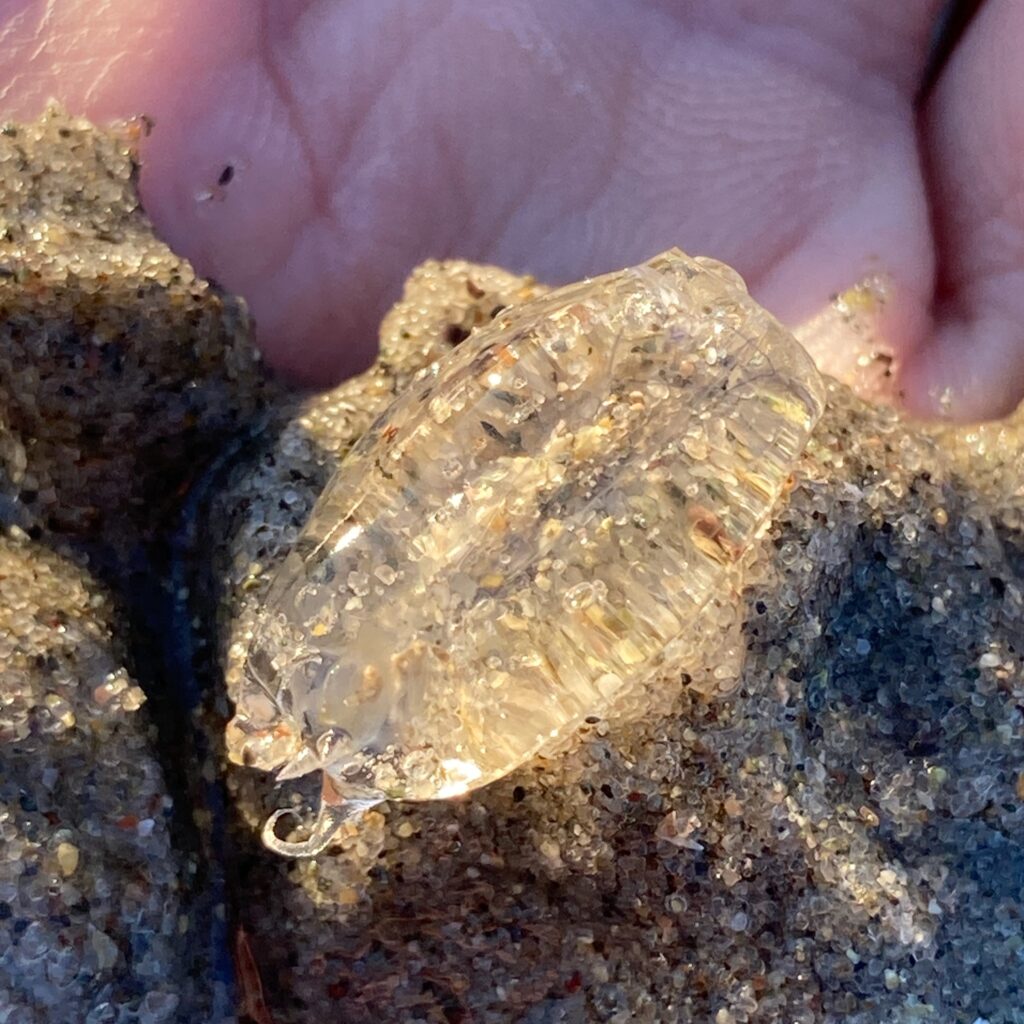
What is a salp, you ask? It’s an organism in Family Salpidae. The Salpidae are in Subphylum Tunicata, which is a part of Phylum Chordata — animals with spinal cords. Human beings are also in Phylum Chordata, so this odd little animal is more closely related to us than are crabs, sea urchins, or starfish.
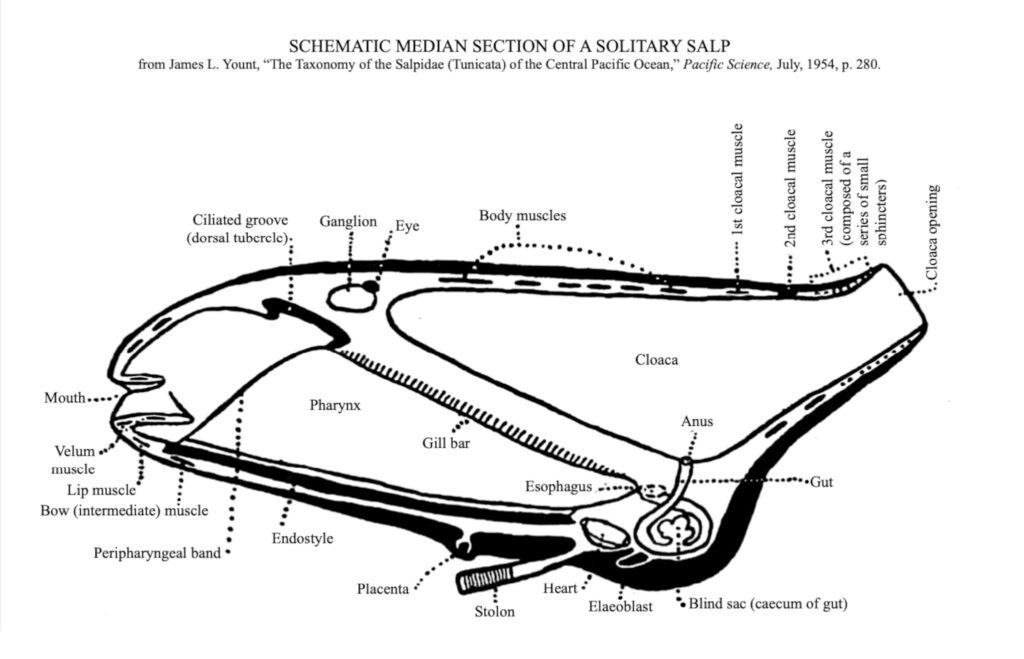
This made me curious — how does one identify Salpidae, if not to species level, then at least to genus? James L. Yount, “The Taxonomy of the Salpidae (Tunicata) of the Central Pacific Ocean,” Pacific Science, July, 1954, has a “Key to world species and reproductive forms of Salpidae,” pp. 280 ff. Identification requires looking at the internal structures, and Yount provides a “Schematic median section of a solitary salp (after Ihle, 1935).” I digitally enhanced his sketch, and identified the body parts in easy-to-read type:
At some point, perhaps I’ll type up Yount’s key. In the mean time, you can find it yourself here.