
This lovely sword guard, made in 1874 by Tozan (no other name given), shows the Japanese deities Amaterasu and Susano-o.
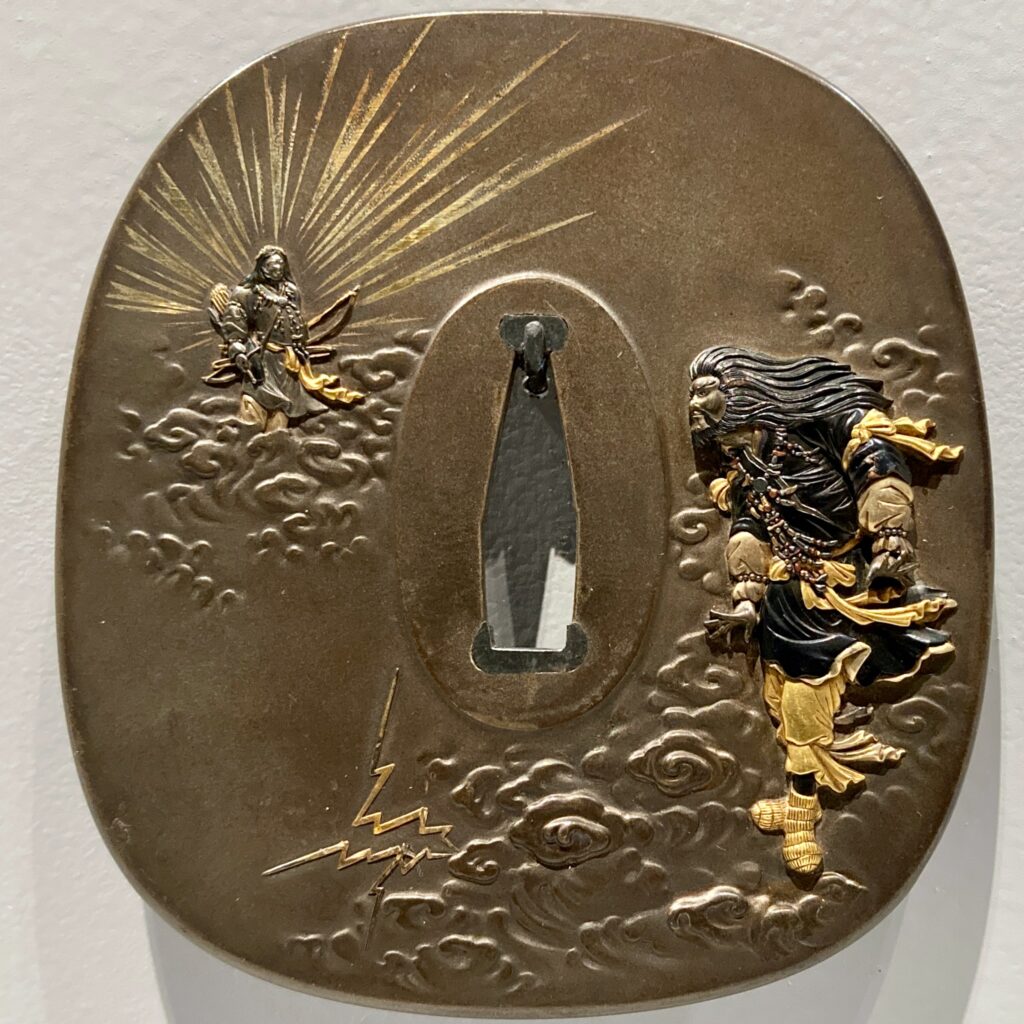
Amaterasu was the Sun-goddess, and Susano-o was the ruler of the Underworld; they were siblings by virtue of both being the offspring of Izanagi and Izanami. Here’s a story about the two of them, adapted from W. G. Aston, Shinto: The Way of the Gods (London: Longmans, Green, and Co., 1905), chapter VI — in the West, this is probably the best known story of these two deities.
Before Susano-o took up his duties as the ruler of the underworld, he asked his elder sister, Amaterasu, if he could come to heaven to take leave from her. She agreed. At first, all went well. But then Susano-o became rude and unseemly.
Susano-o broke down the divisions between the rice-fields belonging to his sister, sowed them over again, and let the piebald colt who lived in Heaven run through the fields, trampling them. Then Susano-o misbehaved in the great hall where Amaterasu was celebrating the solemn festival of the first fruits to be harvested. Finally, Susano-o killed a piebald colt of Heaven, skinned it, and threw the dead body into the sacred weaving-hall where the Sun-Goddess was at her loom weaving the garments of the deities.
Amaterasu was so offended by this last insult that she entered the Rock-cave of Heaven and left the world to darkness.
When Amaterasu hid herself in the Rock-cave of Heaven, the other deities grew worried, for there was no light any more. Everything was in complete darkness. All the other deities met on the dry bed of the River of Heaven to figure out a way to bring Amaterasu out of hiding.
First, Omoikane, the god of wisdom, brought roosters to the cave to crow, hoping to bring Amaterasu out that way.
Then Ame-no-Koyane, whom Amaterasu had put in charge of the divine mirror, and who was in charge of divine affairs in the palace, dug up a five-hundred branched Sakaki tree of Heaven. He hung strings of jewels on its higher branches, a mirror on its middle branches, and on its lower branches pieces of cloth. Then all the deities recited prayers in honor of Amaterasu.
Finally, Ame-no-Uzume, the goddess of Dawn and the Dread Female of Heaven, dressed herself in strange and fantastic clothing. She kindled a fire and pounded on a tub, danced wildly, and spoke inspired words. The Plain of High Heaven shook, and the eight hundred deities all laughed together.
The Sun-Goddess wondered how Ame-no-Uzume and the other gods could be so jolly while the world was wrapped in complete darkness. She peeped out from the half-opened door of the cave. She was at once seized by Ame-no-Tajikarao, or Heaven-Hand-Power. He kept her from slipping back into the cave, to the great joy of all the deities.
After the Sun Goddess was out of the cave and once more lighting up the world, a council of the deities put Susano-o on trial. He was found guilty, and caused to pay an enormous fine. They also pulled out the nails of his fingers and toes, and banished him to the land of the underworld. Finally Ame no Koyane, the ancestor of the Nakatomi, recited his Oho-harahi or “Great purification” liturgy.
It’s not clear to me whether the sword guard depicts a moment in this story, or is merely a depiction of these two deities.