
Numskull and the Rabbit

Another in a series of stories for liberal religious kids. This one is from the Panchatantra, an ancient Sanskrit text that contains many well-known folk tales.

In the forest lived an arrogant lion whose name was Numskull. He only needed one animal a day for his food, but he enjoyed killing for the fun of it. So he would kill any animal he saw, whether or not he was hungry, just because he enjoyed it.

At last, all the other animals of the forest — deer, boars, buffaloes, wild oxen, rabbits, and more — agreed to go to the lion together, to try to stop this slaughter. When they approached Numskull, they got down on their knees to bow to him. Speaking with the utmost humility, they said, “O King of all the animals, we beg you to end this endless slaughter of other animals. For as our sacred book tells us:

“When a fool does evil in this life
For the sake of bliss,
They shall have a thousand future lives
Pass in wretchedness.

“We beg you to think of what will happen to you in your next reincarnation, if you continue to slaughter us willy-nilly. We humbly ask that you simply stay at home, and we will send one animal each day to serve as your meal. This way, you will never be hungry, and for our part we will not have to worry about our families. And you can perform the duties of a king without risking punishment in your future lives. For as the proverb says:

“When a king tastes power like a potion,
Sipping bit by bit,
He will not overload his life,
He’ll fully relish it.”

Numskull listened to the animals, and replied, “You have convinced me. But be warned! If you do not send me an animal to eat every single day, I swear that I will come and kill all of you.”

Relieved, the animals promised to live by this agreement. From then on, the animals were able to roam about the forest without fear. But each day, they had tosent one of their number to serve as Numskull’s midday meal. Each day, it was the turn of a different kind of animal, whether deer or gazelle or boar, to send forth one animal of their species.

Rabbit-day came around, and the rabbits decided on one of their number to send to the lion. As the other animals sent her off to die, this rabbit thought to herself, “Somehow, it must be possible to kill this horrible lion. For it is said:

“In all things wisdom surely can prevail,
In nothing can determination fail,
There is nothing flattery cannot subdue,
Nothing enterprise cannot win through.”

And having repeated this little poem, the rabbit thought to herself, “Perhaps I can even kill a lion.”

She went along slowly, thinking of ways to defeat the lion. She was several hours late when at last she came to the home of the lion. Because she was so late, the lion had become very hungry, and was thinking to himself, “I cannot stand waiting so long! First thing in the morning, I shall go out and start slaughtering all the animals.”

While the lion was thinking these thoughts, the rabbit came up and bowed low. The sight of this small little rabbit, barely a single bite, enraged the lion. “You worthless animal!” he roared. “Not only are you late, but you are too small to make a full meal. I shall kill you first, and then I shall kill all the other animals besides.”

The little rabbit bowed low again, and humbly said, “O great lion, the fault is not mine, nor does it belong to the other animals. If you will listen, you will hear the real cause.”

The lion replied, “Tell me quickly, before I eat you up.”

“O great lion,” said the rabbit, “today it was the rabbits’ turn to supply an animal for your meal. When they saw how small we rabbits are, they sent six of us together so you would have enough to eat.

“Yet as we walked to your home, another lion leaped out of a huge hole in the ground, saying, ‘And where do you think you are going? You had better pray to your favorite god before I eat you up.’ I spoke for the other five rabbits, saying, ‘We are travelling to become the dinner of the great lion Numskull, according to our agreement with him.’ To which this great lion said in return, ‘Well, this whole forest belongs to me, which means that the animals can only make an agreement with me. This Numskull is merely a small-time thief. Go call him and bring him here at once. Whichever one of us is stronger shall be the king of the forest, and shall eat all you six rabbits, and whatever other animals he pleases.’

“So said this great lion,” concluded the little rabbit, “and this is why I am late. As for the rest of it, your majesty shall be the judge.”

Numskull grew angry at this. “Show me where this thief of a lion is, and be quick about it. He shall feel my anger.”

“Yes, your majesty,” said the rabbit. “Yet you should know this other lion lives in a fortress with stone walls, where it is difficult to attack him.”

“Little rabbit, show me this thief,” said Numskull. “I will kill him even though he hides within a fortress.”

“Very well,” said the little rabbit. She led Numskull to a place where there was a well. “You see, your majesty, as soon as he saw you, that thief of a lion crawled into his hole. Come, I will show you to him.”

“Hurry,” said Numskull, “for I grow more and more angry.”

The rabbit had Numskull look down into the well. The lion saw his own reflection in the water deep down in the well. He gave a great roar. Out from the well came an echo, sounding twice as loud. Upon seeing another lion and hearing it roar, Numskull hurled himself down the well to fight his rival, and drowned to death.

The little rabbit brought the good news to the other animals. They showered compliments on her, and they all lived in the forest happily and peacefully ever after. From this comes a proverb:

Wisdom by itself is power, but not where
Power and folly together make a pair.
The rabbit played upon the lion’s pride,
Outsmarting him, and so the lion died.

Source: Arthur W. Ryder, The Panchatantra of Vishnu Sharma: English Translation (Univ. of Chicago, 1925), p. 81-88.
The Blue Jackal

Another in a series of stories for liberal religious kids. This one is from the Panchatantra, an ancient Sanskrit text that contains many well-known folk tales.

Once upon a time there lived a jackal named Fierce-Howl. This jackal lived in a cave not far from a city. Now this jackal felt throat pinched with hunger, and one night he went hunting in the city. But the dogs that lived there snapped at him with sharp teeth, and terrified him with their barking. He ran this way and that in order to escape, and blundered through the door of a house where there lived a man who made his living dying cloth. A huge vat of indigo dye was just inside the door, and in his haste the jackal tripped and fell into it.

By the time the jackal had managed to crawl out of the vat, all the dogs had gone. So he slunk back into the forest. Once he was in the forest, some of the other animals who lived there stared at with astonishment at this strange blue-colored beast. They cried out, “What is this creature whose coat is richly colored with the remarkable color?”

Then they fled in terror, and quickly spread the news through the forest: “Some strange beast has come into our forest! No one knows from whence he came, or what he might be like.” And the animals began to say to each other, “We must flee from the forest!” for they knew the old animal proverb: “When you do not know who someone is, it is wise not to trust them.”

Fierce-Howl saw how frightened they all were, and had an idea. He called out to the animals, “Why do you flee in terror from me? The god Indra saw that the animals of the forest have no king, and he has appointed me as your king. My name is Fierce-Howl. You may rest in safety in my strong paws.”

When they heard this speech, the lions, tigers, leopards, monkeys, rabbits, gazelles, jackals, and all the other animals bowed humbly to Fierce-Howl, saying, “Your Majesty, please tell us what our duties are.”

Fierce-Howl made appointed the lion to be prime minister, the tiger to be lord of the king’s bedchamber, the leopard to be the keeper of the king’s food and drink, the elephant to be the royal doorkeeper, and the monkey he appointed the bearer of the royal parasol, to keep the hot sun off the king’s head. But fearing the other jackals might recognize who he really was, he cuffed them and drove them away.

And so the jackal lived in royal state. The lions and tigers killed food animals for this king, and laid them before him. And King Fierce-Howl divided the food animals, and distributed them among his subjects according to their need and their service to the king, just as all kings do.

One day when King Fierce-Howl was sitting in his royal court, he heard a pack of jackals begin to howl. This brought back old memories of the days before he became king. A tear came to his eyes, and without thinking he stood up and began to howl back. The lions and tigers, upon hearing this, realized that their king was nothing but a jackal. The jackal saw that he had made a horrible mistake, and stood there ashamed and downcast.

Lions and tigers do not care for jackals, since jackals may try to steal their food. The lions and tigers looked at each other and said, “We have been deceived by a jackal. He deserves to die.” And that was the end of the jackal.

Source: Arthur W. Ryder, The Panchatantra of Vishnu Sharma: English Translation (Univ. of Chicago, 1925), pp. 122-124.

The Old Man at the Frontier Loses His Horse

Another in a series of stories for liberal religious kids. Dr. Kate Sullivan, the DRE with whom I work, told another version of this story in the Sunday service two days ago. She based her version on the famous Alan Watts retelling of the story. Today, we tracked down the origins of this story. It comes from the Huainanzi, a Chinese philosophical text from the 2nd century CE. I did some more research on my own, found three or four different translations, and decided to do my own retelling of the story, that hews more closely to the Chinese original.

Many years ago, there was a man who was a Daoist, and he and his father understood how good fortune and bad fortune can turn one into the other. This man lived near the border of China, close to where the land of the barbarians began.

One day, his horse got loose and ran away into the land of the barbarians. The man’s neighbors came to tell him how sorry they were that he had lost such a fine horse. They all knew how expensive it would be to get a new horse. But the man’s father said, “How do we know this is bad? Perhaps it is a blessing.”

Some months later, the man’s horse returned from the barbarian lands to his household. Following close behind the man’s horse came another horse. Horses from the barbarian lands were known as being especially fine animals. The man’s neighbors came to tell him how pleased they were for him. But his father said, “How do we know this is good? Perhaps it will bring misfortune.”

Those two horses had babies, and soon the man owned many fine horses. The man’s son loved to ride all these wonderful horses. Alas, one day the son fell off the horse he was riding and broke his thighbone. The man’s neighbors came to tell him how sorry they were that his son was so badly injured that he would walk with a limp the rest of his life. But the man’s father said, “How do we know this is bad? Perhaps it is a blessing.”

The next year, a large army of the barbarian Hu people invaded China from across the border. Every man who was strong and able-bodied took their bows and went to fight. The fighting was so fierce that nine out of every ten young men from the border lands died in battle. But because the man’s son was lame, he could not go off with the army. He and his father and gradfather managed to protect each other, and so they survived the war.

And so you can see:

Good fortune becomes bad fortune,
Bad fortune becomes good fortune;
Their transformations never end,
So deep we cannot understand.

(And from this story comes the Chinese proverb, or chengyu: “When the old man lost his horse, how could you know that it was not good luck.”)

Sources: Huainanzi, ch. 18:7. Based on several translations: (1) Lin Yutang, The Importance of Understanding: Translations from the Chinese (Cleveland/New York: World Publishing, 1963), p. 385; Yutang’s loose translation is somewhat similar to the more famous version told by Alan Watts, but Yutang keeps closer to the original Chinese; (2) The Huainanzi, trans. John S. Major, Sarah A Queen, Andrew Seth Meyer, and Harold D. Roth (Columbia Univ. Press, 2010), pp. 728-729; a scholarly translation; (3) The Chinese Text Project version of the Huainanzi; this is a scholarly website with bilingual text, Chinese and English https://ctext.org/huainanzi/ren-xian-xun#n3395. Story revised 6 March 2026 with simpler language.

The afterlife, according to Socrates

Another in a series of stories for liberal religious kids.

The great philosopher Socrates, who lived two thousand five hundred years ago, once had a long conversation with another philosopher named Gorgias. And during that long conversation, he told a story about what happens to human beings after we die.

Listen, then (said Socrates), as story-tellers say, to a very pretty tale, which I dare say that you may be disposed to regard as a fable only. But I believe this is a true tale, for I mean to speak the truth.

The poet Homer tells us in his immortal poem The Iliad, how the gods Zeus and Poseidon and Pluto divided the empire which they inherited from their father. Poseidon ruled the oceans, Hades ruled the underworld, while Zeus ruled over everything, including over the other gods and goddesses.

Now in the days of Cronos there had existed a law about what happens to human beings after we die. This law has been in force since the beginning and remains so today. The law decrees that human beings who have lived their whole lives in justice and holiness shall go, after they die, to the Islands of the Blessed, where they will dwell in perfect happiness. On the other hand, human beings who have lived unjust and irreverent lives have to go to Tartaros, the house of vengeance and punishment.

In the time of Cronos, and even into the early days of Zeus’s reign, the judgement was given on the very day on which people were to die — the judges were alive, and the people were alive — and the consequence was that the judgements were not well given. So Hades and the authorities from the Islands of the Blessed came to Zeus, and said that some of the people who had died had found their way to the wrong places.

“Well, first of all,” Zeus said, “we must put a stop to human beings knowing the time of their death; for this they at present do know. However, Prometheus, the god of foresight, has already been given the word to stop this in them.

“Next,” said Zeus, “human beings must be stripped of their clothing and indeed of their very bodies, and stripped of everything else before they are judged. In other words, the human beings must be fully dead when they are judged, and not alive as they currently are. Furthermore, whoever judges them also must be dead and covered over with no clothing nor a body, nor with their wealth and families or other fine array. In this way, the judge’s naked soul will be able to perceive the truth of the other naked souls. If the judgment is carried out in this way, then it will be just.”

Zeus then decreed that three of his own human children should become judges, once they died. These three were Minos and Rhadamanthus from Asia, and Aeacus from Europe. When they died, they were assigned to stay in the “meadow at the parting of the ways.” Two roads left this meadow: one road went to the Islands of the Blessed, and the other road went to Tartaros. Rhadamanthus judged all the humans who died in Asia. Aeacus judged all the humans who died in Europe. And Minos served as the final court of appeal, if either of the others had any doubt about a human being who came before them.

Brief commentary

[A couple of points you might want to mention if you talk about this story with actual children:] This “fable” was written nearly half a millennium before the Christian era. And it’s worth remembering that Socrates spoke a different language from us, and his word for truth — aletheia — meant something more like “revealing” or “disclosing.” Aletheia was not the opposite of falsehood, but rather the opposite of forgetfulness. Aletheia was also a goddess.

Source:

Plato, Gorgias 523a – 524a, trans. Benjamin Jowett (1871), with reference to the translation by W. R. M. Lamb (1925).

Tortoise and a man named Tela

Another story for liberal religious kids. This one is from the Yoruba tradition. While this story has a mythological elements — it tells how Tortoise got the joints in its shell — it is also a morality tale. Tortoise is another animal trickster figure who is featured in many stories — sometimes he gets the better of others, but sometimes, as in this story, his greed gets the better of him. Another Yoruba story about Tortoise.

Once there was a shortage of food throughout the land. Àjàpá the Tortoise, who was a very sensible animal, was friendly with a man named Tela. Tortoise was sick with hunger, because he didn’t know where he could get food. But Tela knew where he could get food. Now and again Tela went to this place, and got food and ate it there.

At last Tortoise said to Tela, “You look well-fed, but I get nothing to eat. You are my friend, yet you never show me where you get food.”

“I thought of taking you,” said Tela, “but I know you to be very clever. I fear that you will go to my place without my permission. Because of that, I have not told you.”

Tortoise kept asking, though, and at last Tela promised to take him to the place. When they got to the place, Tortoise saw it was just a rock. But Tela sang:

“This rock must open because I, Prince Tela, the owner of the house have come!”

Then the rock opened and Tela and Tortoise went inside. They found plenty of food, and they ate until they were full. After they had finished, they left the place, each going to his own home.

The next day Tela was away from home. So Tortoise went all around the countryside, inviting all the people to come to Tela’s place to get food. When everyone arrived at the place, Tortoise sang:

“This rock must open because I, Prince Tela, the owner of the house have come!”

The rock did not know that it was not Tela who sang, but Tortoise. So the rock opened, all the animals went inside, and they finished all the food in the store.

When they had finished eating, Tortoise said, “I will be the last to go.” But just as Tortoise was leaving, the rock closed and trapped him, half in and half out.

Just then, Tela felt hungry. When he got to the rock, he saw the head of Tortoise sticking. Tela said, “How is it that I find you here? When I brought you here the day before yesterday you promised you would not come, but now you have come, and from all the footprints in the dirt it looks like you brought friends with you.”

But Tortoise was in pain, and said only, “Get me out and don’t talk.” Tela, being hungry, commenced to sing:

“This rock must open because I, Prince Tela, the owner of the house have come!”

Just as before, the rock opened. Now Tela was very hungry, and because of the food he thought lay before him, did not stop to talk with Tortoise. But when Tela went in, he saw that all was eaten, and nothing was left.

Tela was so angry that he caught Tortoise up and was about to crush him. “Have patience and I will tell you all,” said Tortoise, and he told the entire story. And Tortoise added, “I have to admit that there is something that always makes me tell things I ought not to tell.”

“I have no time for this sort of thing,” said angry, hungry Tela. He dropped Tortoise on the rock and smashed his shell all to pieces.

Then the big ants and other insects gathered round, and tried to put Tortoise together again. They did the best they could, but they could not mend his back properly. So it is that the joints where the insects mended the Tortoise show on his back to this day.

Source

John Parkinson, “Yoruba Folk-Lore,” African Affairs, vol. VIII, no. XXX, January 1909, pp. 180-181 doi.org/10.1093/oxfordjournals.afraf.a098993

For a different version of this story, see ?gb??n ju agbára on The Yoruba blog.

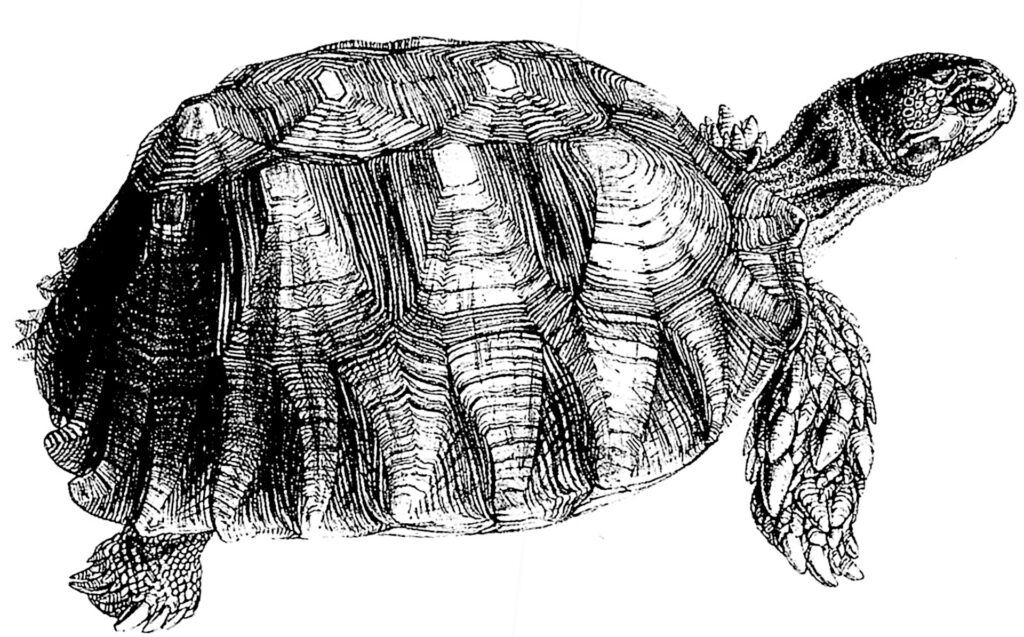
Line drawing of a tortoise
Centrochelys sulcata, from Tortoises, Terrapins, and Turtles (London: Sotheran Baer & co., 1872).

Tortoise and Elephant

Another story for liberal religious kids, this time from the Yoruba people.

Tortoise one day told the other animals that he would ride Elephant, the way humans ride horses. But all the other animals said: “No, you can’t ride Elephant.”

Tortoise said, “Well, I will make a bet with you that I will ride Elephant into town.”

All the other animals agreed to the bet.

Tortoise went into the forest and met Elephant. He said, “Elephant, all the animals say you are too fat and too big to go into town.”

Hearing this, Elephant grew angry. He said, “The animals are fools. I do not go into town because I would rather stay in the forest. Besides, I do not know which path leads to town.”

“Oh, if that’s all,” said Tortoise, “you can come with me. I will show you the path that leads to town, and you can put all the other animals to shame.”

So Elephant followed along, and when they were near to town, Tortoise said: “Oh, Elephant, I am tired. Will you kindly allow me to get on your back?”

“Of course,” said Elephant. He knelt down, and Tortoise climbed up on his back. Then they continued along the path to town.

Then Tortoise said, “Elephant, you need to put on a good show when you get to town. So when I scratch your back, run. When I knock my head against your back, run faster. Then you will impress all the other animals.”

Elephant agreed that this sounded like a good idea.

When they came near the town, Tortoise scratched Elephant’s back. Elephant began to run. Next, Tortoise knocked Elephant’s back with his head. Elephant ran even faster.

The animals, when they saw this, were frightened. They went into their houses, but they looked out of their windows. And Tortoise called out to them: “Did I not say I would ride to town the way humans ride horses?”

“What do you mean that you ride me like humans ride horses?” said Elephant, growing angry.

“I am only praising you,” said Tortoise.

But Elephant saw the other animals laughing, and grew more angry. “I will throw you down on the hard stones here, and break you to pieces,” he cried.

“Yes, yes, that is right,” said Tortoise. “Throw me down here. That will be all right. Then I shall not be hurt. If you really wanted to kill me, you would carry me to a swamp. If you threw me in a swamp, I would die at once, for the mud and water would drown me.”

So Elephant ran to the swamp, and threw Tortoise into the mud. Then Elephant stretched out his foot to kick Tortoise, but Tortoise dived in the muddy water, and came up in another place.

The other animals were there, looking on, and Tortoise called out to them, “Did I not say I would ride Elephant the way humans ride horses?”

When Elephant found that he could not catch Tortoise, he ran back to the forest. There he said to the other elephants, “Do you know what Tortoise has done to me?” And he told the other elephants the story.

But the other elephants only said, “You were a fool to carry Tortoise to town.”

Since then Elephant has not come to town any more.

Source: Alfred Burdon Ellis, The Yoruba-speaking peoples of the Slave Coast of West Africa : their religion, manners, customs, laws, language, etc : with an appendix containing a comparison of the Tshi, Gã, ?we, and Yoruba languages (London: Chapman and Hall, 1894).

Prince Gotama and the Four Sights

Another story for liberal religious kids — well, maybe. I find this to be a challenging story. Buddha walks out on his wife and baby? I’ve known families where one parent walked out, ostensibly to “find themselves,” not unlike what the the Buddha did. But we should tell such a story to kids? Maybe like fairy tales, which put into words some of the things children fear most, this is in fact the kind of story we should share with kids. Another argument for telling this story to liberal religious kids: Sophia Fahs included her version of this story in her book From Long Ago and Many Lands, aimed at middle elementary grades, and Fahs had plenty of insight into the developmental capacity of children to understand difficult stories. Unfortunately, Fahs only included three of the four sights, so I wouldn’t use her version. That’s why I came up with my own version.

For this story I didn’t go back to one original sources, because this story is told and retold so often in the Buddhist tradition. I did the best I could to synthesize what I knew of the story. Consider this a provisional retelling of this tale. Leave any corrections in the comments.

Once upon a time, a prince named Gotama lived in a royal palace in the land of Kapilavastu, which was on the border between the countries we now call India and Nepal. Gotama’s family was very wealthy. As he grew up, the prince had everything money could buy. He had servants to take care of every need. He had the finest food. He had all the toys he could wish for.

The story is told that while Gotama was still young, a sage came to visit his parents, the King and the Queen. This sage was very wise. He looked at the young boy and said, “This child will grow up to be either a great king, or a great spiritual leader.”

Now his father wanted Gotama to become king after the father died. Therefore, the King decided that the young prince must never see anything that might raise spiritual questions in him. The King instructed everyone in the palace that Prince Gotama must never be allowed to go outside the palace grounds by himself, lest he fall into conversation with a wandering spiritual person. The King also ruled that Prince Toama must not see anyone who was ill, or disabled in any way, nor anyone who was old. The King also ruled that if someone died, the prince should hear nothing of it. Thus the King hoped to keep the prince from asking any spiritual questions.

To keep Gotama happy, the King and Queen gave him everything he could want, so that he would want to stay inside the palace grounds. And when he was old enough, they found the kindest and most beautiful young woman in all the kingdom to marry the Prince. Both the prince and his new wife were vary happy, and they became even more happy when they had their first child together. The King and Queen hoped that the prince had forgotten his wish to leave the palace on his own.

One day, when he was twenty-nine years old, Gotama went out of the palace to go hunting, accompanied by his servant Channa. As they were riding along on their two horses, they came upon a man lying beside a rock, groaning in pain.

“What is wrong with this man?” asked Gotama.

“He is ill,” said Channa.

“But why is he in such pain?” said Gotama.

“It is the way of life,” said Chana. “It is just what happens when people are ill.” And they rode on.

When he was back at the palace, he tried to ask the wise men there about illness, but they would not answer his questions.

Gotama and Channa went out hunting again. As they rode along, they passed a woman whose hair was white and whose skin was wrinkled, and who used a cane to walk.

“What is wrong with this woman?” asked Gotama.

“She is old,” said Channa.

“But what do you mean by ‘old’?” said Gotama.

“It is the way of life,” said Channa. “It happens to anyone who lives a long time.”

Back at the palace, Gotama tried to ask the wise men there about being old, but they would not answer his questions.

Gotama and Channa went out hunting again. As they rode along, they came across man lying as if asleep. But Gotama could not wake him.

“What is wrong with this man?” asked Gotama.

“He is dead,” said Channa. “This is the way of life, people must one day die.”

Gotama and Channa went out hunting a fourth time and saw a wandering holy person. Gotama asked Channa who he was.

“He is a wandering holy person,” said Channa. “He wanders around the world begging for his food, and seeking spiritual enlightenment.”

This was something Prince Gotama had never heard of before. That night, Gotama could not sleep. He remembered both the suffering he had seen, and the holy man seeking enlightenment. Gotama realized that he himself would one day face illness, old age, and death.

“I must leave the palace where I’m always protected,” he thought to himself. “I must find answers to my questions.”

He got up, and told Channa to saddle his horse. The he looked in at the bedroom where his wife and their child lay sleeping. If he left the palace, he worried that his his wife and son would not be safe. He didn’t want to make them go with him.

He stood looking at them, wondering what to do. Should he stay? Or should he go?

As it happens, we know what Prince Gotama did. He left his wife and child behind, went out into the wide world, and after many hardships he became the Buddha, the Enlightened One, one of the greatest spiritual leaders the world has ever known. Knowing that, what would you do? Would you stay and become a great king, or leave and become a great spiritual leader? Would you give up the chance of being enlightened to stay with your family?

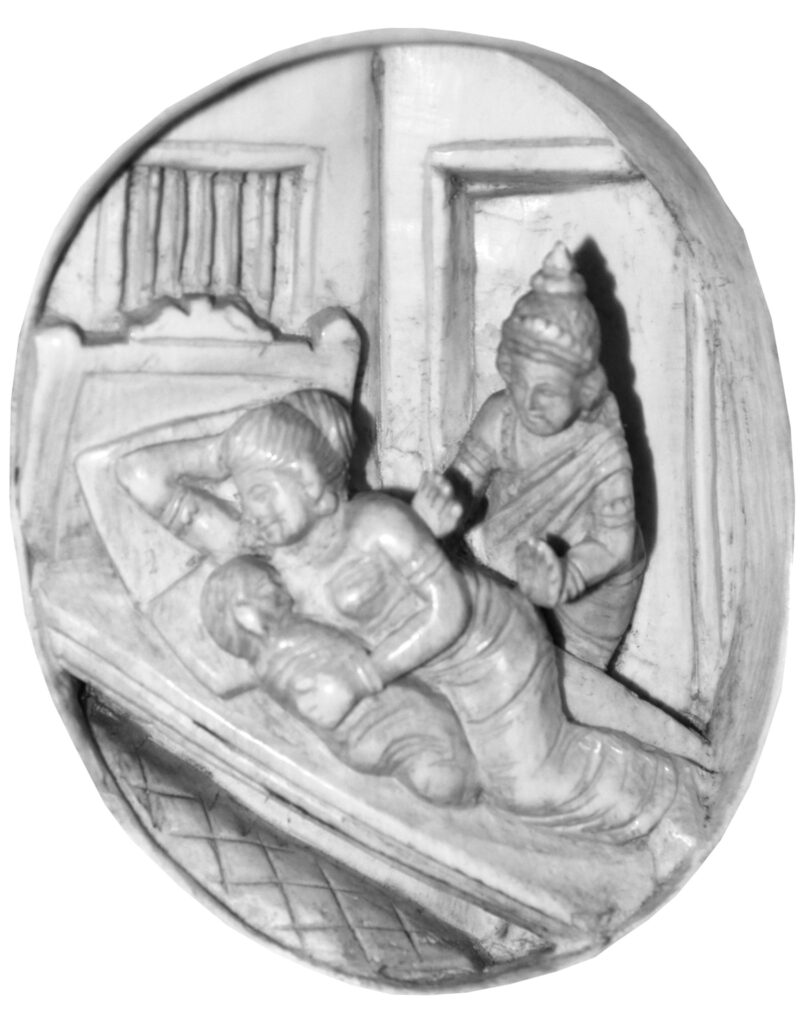
Siddhartha Gotama taking leave of his wife and baby.
(CC-BY-SA 3.0 Nomu420; modified by me.)

The Rabbi and the Basket of Grapes

Another story for liberal religious kids.This story comes from Babylonian Talmud, Kethuboth 105b.

The Rabbis taught that if you are going to judge a case between two people, you must not accept any kind of money or gift from either person, you must not accept anything that might look like a bribe. You must show everyone that you will remain completely neutral, and completely honest.

Obviously, a judge should not accept money from either person in a lawsuit. But the rabbis taught that a judge must be so honest that he or she does not accept anything, no gifts, no favors, not even a kind word.

To show what they meant, they told this story:

Once upon a time, Rabbi Ishmael rented part of his land to a tenant-farmer. The tenant-farmer paid part of the rent by bringing fruits and vegetables to Rabbi Ishmael every Friday, the day before the Sabbath day.

But one week, the tenant-farmer brought some fruit to Rabbi Ishmael on a Thursday — a big basket full of luscious, ripe grapes. Rabbi Ishmael loved grapes, but before he took the basket he said, “Thank you for bringing the grapes, but why do you bring me grapes on a Thursday, instead of your regular day, Friday?”

“It’s like this, Rabbi,” said the tenant-farmer. “I have a lawsuit, and I would like you to be the judge for this lawsuit. And as long as I was coming up here to talk to you about being the judge, I thought I’d bring your regular weekly delivery of fruit. So I brought you your basket of grapes.”

“No, no,” said Rabbi Ishmael, “I cannot be your judge. Take the grapes back to your house, and I will go find two other rabbis to act as judge for you.”

Confused, the tenant-farmer took the basket of grapes back to his house, even though they were really Rabbi Ishmael’s grapes.

Rabbi Ishmael went out to find two other rabbis to act as judge in the lawsuit, and brought them to meet the tenant-farmer. The two other rabbis began to ask the tenant-farmer about the lawsuit, and the tenant-farmer answered as best he could.

Rabbi Ishmael stood to one side, watching and listening, and he thought to himself, “Why doesn’t the tenant-farmer give better answers?” At one point, Rabbi Ishmael was on the point of breaking in and telling the tenant-farmer what to say, but he caught himself in time.

“Look at what has happened to me,” said Rabbi Ishmael to himself. “Here I am, secretly hoping that the tenant-farmer will win his case, and I didn’t even accept a bribe. I didn’t even accept the grapes that were really mine, but came a day early. What would I have done if I had accepted a real gift, a real bribe!”

The Backwards Alphabet

Another story for liberal religious children. This story comes from the Babylonian Talmud, Tractate Sabbath 31a.

One day, a man came to Rabbi Shamai to ask about becoming a Jew. Rabbi Shamai told him that if he wanted to become a Jew, he would have to learn the Torah, or the Jewish law.

The man asked, “Well then, how many types of Torah do you have?”

“We have two types of law, or Torah,” replied Rabbi Shamai. “We have the written Torah, and we have the oral Torah, the law as passed down by oral tradition.”

“I believe in the written Torah,” said the man. “But I don’t trust laws that are passed on by word of mouth. If laws aren’t written down, they are worthless. I will still become a Jew, on one condition: that you only teach me the written laws, but not the oral laws, not the spoken laws.”

Upon hearing this, Rabbi Shamai grew impatient. He said the man would never become a Jew with that attitude, and he told the man to leave.

But the man still wanted to know about becoming a Jew, so he went to Rabbi Hillel, who told him: “We have two types of law, or Torah. We have the written Torah, and we have the oral Torah, the law as passed down by oral tradition.”

“I believe in the written Torah,” said the man. “But I don’t trust laws that are passed on by word of mouth. If laws aren’t written down, they are worthless. I will still become a Jew, on one condition: that you only teach me the written laws, but not the oral laws.”

“I will accept you as a student,” said Rabbi Hillel, who was a patient man. “First, you must learn how to read Hebrew, so I will teach you the 22 letters of the Hebrew alphabet. Repeat after me: aleph, bet, gimel, dalet, he, vav, zayin, khet, tet, yod, khaf, lamed, mem, nun, samekh, ayin, pe, tsadi, kuf, resh, shin, tav.”

The man repeated the entire Hebrew alphabet after Rabbi Hillel — “Aleph, bet, gimel,” and so on, until he had all the letters memorized.

The next day, the man came back to learn the written law from Rabbi Hillel. Rabbi Hillel said, “Let’s make sure you remember the 22 letters of the Hebrew alphabet. Repeat after me: tav, shin, resh, kuf, tsadi, pe, ayin, samekh, nun, mem, lamed, khaf, yod, tet, khet, zayin, vav, he, dalet, gimel, bet, aleph.”

The man looked confused. “But that’s not the way you taught them to me yesterday,” he said.

“Yes, that’s true,” said Rabbi Hillel, “and as you can see, you must learn to rely upon me and my teaching. In just the same way, you must learn to rely upon the spoken law.”

Standing on One Foot

Another story for liberal religious kids. This story comes from the Babylonian Talmud, Tractate Sabbath 31a.

A man came to talk with Rabbi Shamai, one of the most famous of all the rabbis, nearly as famous as Rabbi Hillel.

“I would like to convert to Judaism and become a Jew,” said the man. “But I don’t have much time. I know I have to learn the entire book you call the Torah, but you must teach it to me while I stand on one foot.”

The Torah is the most important Jewish book there is.How disrespectful that this man wanted to learn it while standing on one foot. Why, people spent their entire lives learning the Torah. It was not something you can learn in five minutes! Rabbi Shamai grew impatient. He pushed the man away using a builder’s yardstick he was holding in his hand.

The man hurried away, and found Rabbi Hillel. “I would like to convert to Judaism and become a Jew,” said the man. “But I don’t have much time. I know I have to learn the entire book you call the Torah, but you must teach it to me while I stand on one foot.”

“Certainly,” said Rabbi Hille, who was a very patient man. “Stand on one foot.”

The man balanced on one foot.

“Repeat after me,” said Rabbi Hillel. “What is hateful to you, don’t do that to someone else.”

The man repeated after Rabbi Hillel, “What is hateful to me, I won’t do that to someone else.”

“That is the entire Torah, the whole law,” said Rabbi Hillel.

The man nodded.

Rabbi Hillel continued, “Everything else is there to explain this simple law. Now, go study.” And because of Rabbi Hillel’s patience with him, the man spent the rest of his life studying the Torah.