Salps

I went for a walk at Black Rock Beach late this afternoon. A large quantity of seaweed had been left behind by the ebbing tide, mostly Sugar Kelp (Saccharina latissima), but also some wrack (Fucus spp.), some Sea Lettuce (Ulva lattuca), and a few other odds and ends.

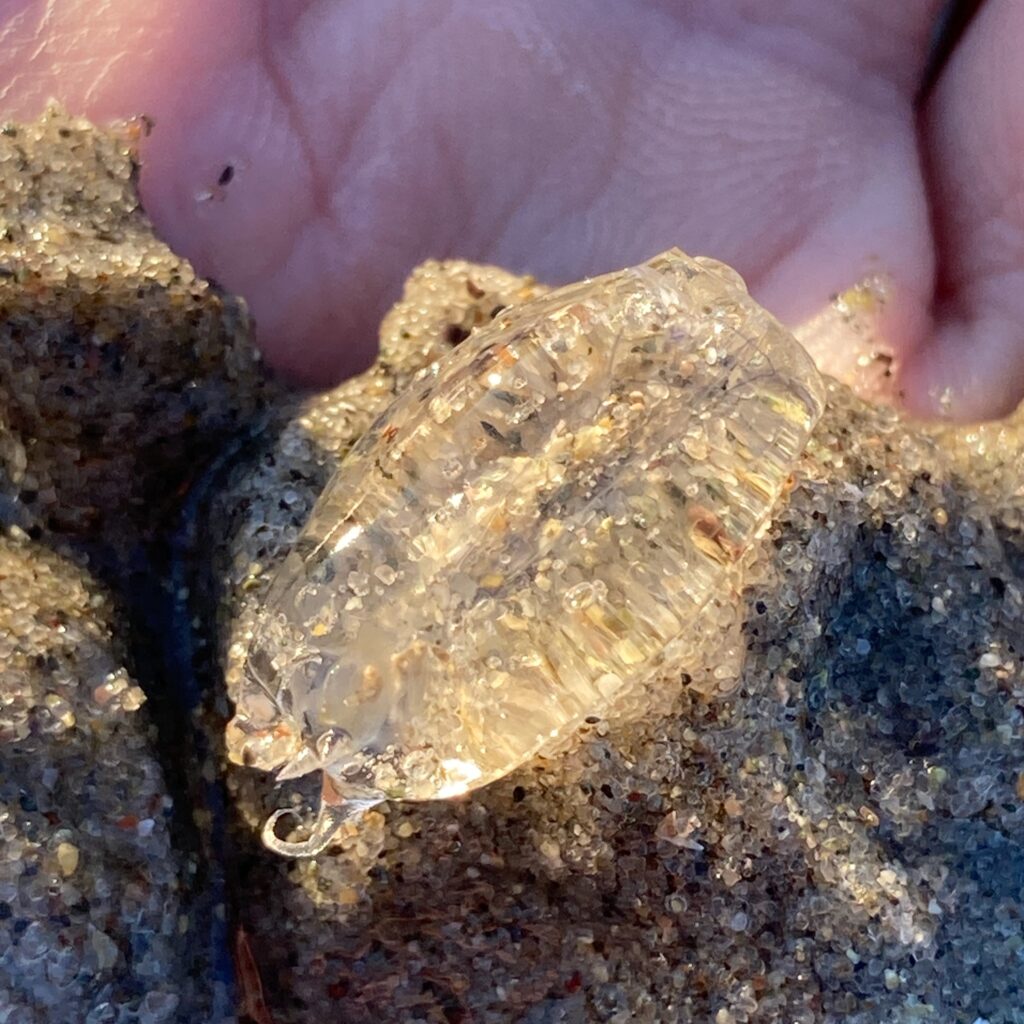
There were also hundreds of small (2-3 cm long), almost transparent jelly-like objects washed up above the line of seaweed. At first glance I thought they were Sea Gooseberries (Pleurobrachia pileus), a species of comb jellies. But when I put my photos on iNaturalist, user ja-fields corrected me — they were salps.

A small jelly-like object held in the palm of my hand.

What is a salp, you ask? It’s an organism in Family Salpidae. The Salpidae are in Subphylum Tunicata, which is a part of Phylum Chordata — animals with spinal cords. Human beings are also in Phylum Chordata, so this odd little animal is more closely related to us than are crabs, sea urchins, or starfish.

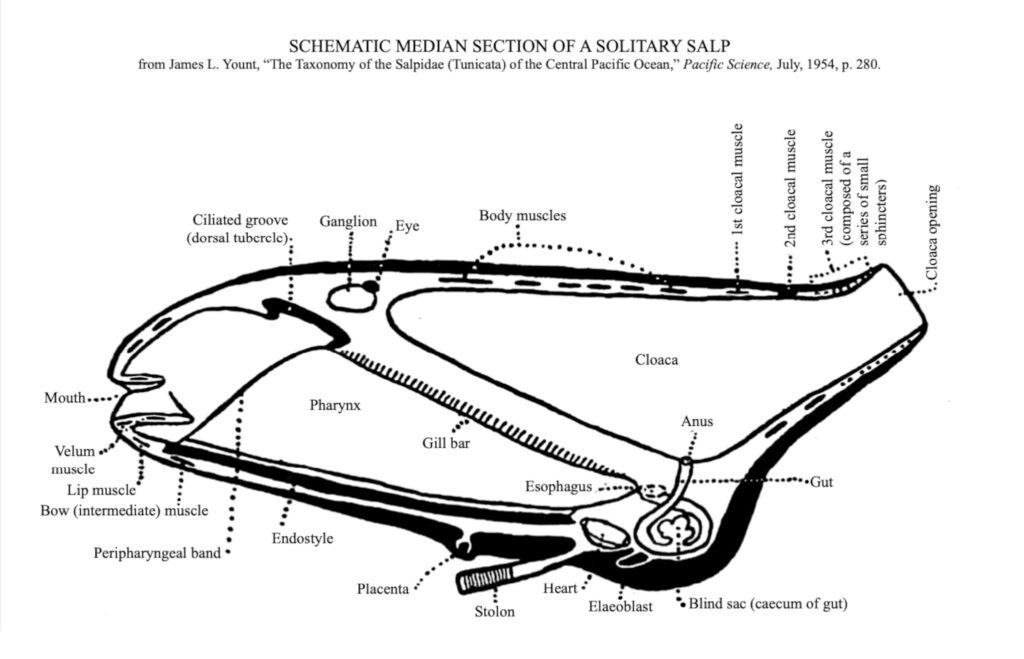
This made me curious — how does one identify Salpidae, if not to species level, then at least to genus? James L. Yount, “The Taxonomy of the Salpidae (Tunicata) of the Central Pacific Ocean,” Pacific Science, July, 1954, has a “Key to world species and reproductive forms of Salpidae,” pp. 280 ff. Identification requires looking at the internal structures, and Yount provides a “Schematic median section of a solitary salp (after Ihle, 1935).” I digitally enhanced his sketch, and identified the body parts in easy-to-read type:

Sketch of a schematic median section of a solitary salp
After Yount (1954).Click the image above for a PDF version.

At some point, perhaps I’ll type up Yount’s key. In the mean time, you can find it yourself here.

View from the bell tower of a 1747 meetinghouse

I climbed up to the bell level of the tower of the Cohasset Meetinghouse, because someone wanted to know if our bell was cast by Paul Revere (it was not). While I was up there, I took a panoramic photo. Not much of a view, to be honest — the tower isn’t all that tall, and it doesn’t have the dramatic view the you get from First Parish in Lexington (from which you can see the skyscrapers of Boston), or from First Unitarian in New Bedford (from which you can see New Bedford Harbor). But it’s still a charming view.

Click on the image above for a higher resolution version.
Revolutionary War stories, part 2

(Continuing with yesterday’s Memorial Day post.)

Briton Nichols, a Life of Adventure

The second story of a Revolutionary War veteran is especially interesting because of the way historians have been able to connect separated facts in the historical record, and then tell a fuller story of one person. This is the story of Briton Nichols.

In the historical record, you can find a list dating from July 19, 1780, giving the names of nine men from Cohasset who began six month’s military service on that day.(10) One name on that list, the name of Briton Nichols, stands out for two reasons. First, he had a very unusual name; the written record shows no other man in Massachusetts with the first name of Briton. Second, Briton Nichols is identified as being Black, the only person on that list whose race is given, and (as near as I can tell) the only Black man from Cohasset who served in the American Revolution.

Because Briton Nichols had such an unusual first name, and because his race is given, historians have been able to trace his life in more detail.(11) Historians discovered that in 1760, he published a book in which he told of thirteen years worth of adventures.(12) As a boy, he was enslaved by the Winslow family of Marshfield. At that time, he called himself Briton Hammond. On December 25, 1747, with the permission of his master, Briton left Marshfield to go on a sea voyage; perhaps his master hired him out as a sailor, taking a cut of his salary, a common practice in those days. Briton doesn’t say how old he was when he sailed, but later sources give his birth year as roughly 1740, so he may have been a boy or a young teen. The ship Briton was on sailed for Jamaica, took on a cargo of wood, and sailed north. Having struck a reef off Florida, the ship was attacked by Native Americans who killed everyone except Briton, and then set the ship on fire. After being held captive by the Native Americans for five week, he was able to make his escape on a Spanish schooner, whose captain recognized him, and took him to Havana, Cuba. The Native Americans followed and demanded the Governor of Havana return Briton to them, but the Governor paid ten dollars for him and kept him. A year later, Briton was caught by a press gang, but he refused to serve in the Spanish navy and was thrown in a dungeon.

Title page of an old book.
Title page of the book written by Briton Hammond (later Briton Nichols), from a digitized version on the Library of Congress website.

Briton was finally released from the dungeon four years later, though he was still trapped in Havana. Then a year after his release from the dungeon, he managed to escape from Havana aboard a ship of the British Navy. It appears Briton served in the British Navy for some time thereafter, aboard several different ships, until 1759 when he was wounded in the head by small shot during a fight with a French ship. Briton was put in Greenwich Hospital, where he recovered from his wounds. After additional service on British Navy ships, this time as a cook, he managed to find a berth on a ship bound for New England. By coincidence, his old master, one General Nichols, was on the same ship. Through that chance meeting, Briton was finally able to return to his home in Marshfield after a thirteen year absence.

Soon after his return from Marshfield, Briton’s account of his adventures was published in Boston, perhaps the earliest published memoir written by an African American. Two years later, in 1762, Briton married Hannah, a Black woman who was a member of First Church in Plymouth (today this a Unitarian Universalist congregation). In the late 1770s, Briton left the Winslow family, possibly upon the death of his master, and moved to Cohasset to join the Nichols family; at this time he changed his last name from Hammond to Nichols.

In 1777, Briton joined the Continental Army.(13) He must have been around forty years old when he enlisted. We can only speculate as to why he decided to enlist at that age. Most likely, enlisting in the military was a way for him to free himself from slavery. Ambrose Bates, who was one of Briton’s messmates, left a diary that tells a little about their military service.(14) Briton Nichols, Bates, and the rest of their contingent left Cohasset on August 27, 1777, and finally reached Saratoga, New York, in early September. There they joined the conflict between the Continental forces and General Burgoyne’s forces. Much of their military service was filled with boredom. Several days were filled with monotonous marching back and forth from one place to another. On other days, Bates simply records, “Nothing new today.” Those days of boredom were interspersed with days where they had more than enough excitement. To give just one example, on October 7, Bates recorded: “today we had a fight we were alarmed about noon and the fight begun, the sun two hours high at night and we drove them and took field pieces and took sum prisners.” The tide of battle was with the Continental forces, and Burgoyne finally surrendered on October 16. Soon thereafter, Bates and the other Cohasset men marched down to Tarrytown. Their service in Tarrytown was less exciting. Finally, on November 30 their term of military service ended, and they began marching home. They finally arrived back in Cohasset on December 7. So ended Briton Nichol’s first term of military service.

Briton Nichols enlisted again in 1780, giving his age at the time as forty years old.(15) I suspect he lied about his age, presenting himself as younger than he was. I could find no details of his 1780 military service. The next time I found him in the historical record was in the 1790 federal census. At that time, he was living in Hingham as a free Black man, along with his second wife Experience and one other household member, probably their child.

The story of Briton Nichols shows how we can recover some of the lost knowledge of Revolutionary War veterans. Briton Nichols was little more than a name on a list of soldiers, until historians were able to deduce that he was almost certainly the same person as Briton Hammond who had had such amazing adventures from 1747 to 1760.

Of special interest to those of us who are currently part of First Parish, Briton Nichols would have attended Sunday services right in our historica Meetinghouse. We can imagine him sitting upstairs in the balcony, where people of color and White indentured servants had to sit. We can imagine Briton sitting in that gallery on Sunday, August 24, 1777, a few days before he marched off to Saratoga. We can imagine the prayers of the entire congregation centering on the hope that all nine of the Cohasset men marching off as soldiers that week would return home safe and sound.

We today think of all those from this congregation who have served in the military. We think of all those veterans who are now members and friends of First Parish. We also think of those who grew up in this congregation and went off to join the armed services. And we think of those people from First Parish who died in military service. It is good for us to keep alive the memories of all those who served in our armed forces. It is good to keep those memories alive, because it reminds us of the bonds of love which transcend even death.

Tomorrow: a follow-up post sharing my research tips, in the hopes that others will be inspired to do more research into Revolutionary War veterans.

Notes

(10) Victor Bigelow, Narrative History of Cohasset (1898), p. 308.

(11) An introduction to a narrative by Briton Nichols, who earlier in life was called Briton Hammond, gives an overview of what historians conclude about his life: “It is accepted that in 1762 Hammon married Hannah, an African American woman and member of Plymouth’s First Church, with whom he had one child. For many years this was all that was known of Hammon’s life after his return to New England. More recent research, however, has revealed that Hammon probably changed his name to Nichols some time in the late 1770s, after the family with whom he and his master were living when Winslow died in 1774. Briton Nichols is listed as having fought for the Continental Army in the American Revolutionary War, as did many members of the white Nichols family…. In later census records, Briton Nichols is described as a free husband and father.” Derrick R. Spires, editor, Only by Experience: An Anthology of Slave Narratives (Broadview Press, 2023), p. 54.

(12) In this paragraph, the details of the earlier life of Briton Nichols/Hammond are taken from his book, A Narrative of the Uncommon Sufferings, and Surprizing Deliverance of Briton Hammon, A Negro Man (Boston: Green & Russell, 1760); as reprinted on the Pennsylvanian State Univ. website https://psu.pb.unizin.org/opentransatlanticlit/chapter/__unknown__-9/ accessed 22 May 2025.

(13) Victor Bigelow, p. 208.

(14) Victor Bigelow reprints the text of this brief diary, pp. 299-303.

(15) Entry for Briton Nichols, 19 July 1780, “Massachusetts, Revolutionary War, Index Cards to Muster Rolls, 1775-1783,” FamilySearch.org website https://www.familysearch.org/ark:/61903/1:1:QLLS-BBT3 accessed 22 May 2025.

Revolutionary War stories

A post in honor of Memorial Day.

The American Revolution began 250 years ago, as of April 19 this year. This significant anniversary is a good time to reflect on the sacrifices that were made by Revolutionary War-era soldiers and sailors.

And it turns out that we don’t know as much as we think we know about the soldiers and sailors of the American Revolution. We don’t have very good records of exactly which soldiers and sailors died during the Revolutionary War; there simply weren’t full and accurate records of military service,(1) and we don’t even have accurate figures for how many military deaths there were in the Revolution.(2) Yet by digging in to the historical record, historians have been able to recover some remarkable stories that had been forgotten or mis-remembered.

I went looking for stories about people from Cohasset who served in the American Revolution. (My interest was partially selfish — since First Parish, where I serve, was the only church in town during the Revolution, then if I found a Cohasset resident who served in the Revolutionary War, they would have been part of First Parish.) I found two super interesting stories that had been partially forgotten or obscured — but thanks to the efforts of twenty-first century historians, we have now recovered many lost details.

Persis Tower Lincoln, Revolutionary War Heroine

Victor Bigelow, town historian and author of A Narrative History of Cohasset (1898), tells the story of Persis Tower Lincoln. During the occupation of Boston, which lasted from spring of 1775 into 1776, Persis was married to Allen Lincoln, a seaman; Persis was then 16 years old, and Allen was 20; John Browne, minister of First Parish, officiated at their wedding. Allen then left Persis for military service. While he was away, Persis sailed a small boat across Massachusetts Bay to Gloucester to get supplies through the British blockade, so we remember her as a heroine of the American Revolution. Meanwhile — so the traditional story goes — Allen’s ship was captured by the British, and according to local tradition he was taken to Dartmoor prison in England where he died.(3)

Persis’s story appears to be true. Unfortunately, Allen’s story has been remembered incorrectly. Dartmoor Prison wasn’t completed until 1809, so he couldn’t have been imprisoned there during the Revolution. Then too, Allen and Persis had daughter together, and their daughter Sally was born in 1778.(4) Finally, military records show that Allen Lincoln of Cohasset served in the Continental Army after his purported death, in 1776, 1777, and again in 1778.(5)

A more accurate history of Allen Lincoln appears to be something like this: After serving in the military for several months in both 1776 and 1777, Allen re-enlisted in the Continental Navy with the rank of Seaman. Then on March 17, 1778 he was taken prisoner by the British; he was captured about a month after his daughter Sally was born, and was initially imprisoned at Rhode Island.(6) Subsequently, he was apparently taken to Halifax, Nova Scotia, where he died in 1778.(7) It’s not surprising that he died while he was a prisoner of war; the mortality rate was notoriously high among prisoners of war held by the British, and more Revolutionary War soldiers and sailors died in prison camps than died in battle. Allen died at age 22, leaving behind an 18 year old wife and an infant daughter whom he probably only saw for the first few weeks of her life.

Allen Lincoln’s story is worth remembering on its own merits. But it’s also a reminder of how much has been forgotten or mis-remembered about the sailors and soldiers who died during military service in the Revolution. Indeed, historians aren’t even sure how many prisoners of war died while being held captive by the British; it may have been as many 19,000 men.(8) At a local level, it seems that we’re not even sure of how many people from First Parish served in the Revolution. It should be simple to generate such an honor roll of military service — First Parish was the only church in Cohasset, everyone in town belonged to the church, so all we’d need is a list of Cohasset residents who served. However, the only such list I found lists almost certainly includes men from other towns who were recruited by Cohasset to help fill the town’s quota.(9) Given the incomplete records that remain, we may never know exactly how many people from Cohasset served in American Revolution — nor how many of those soldiers and sailors gave their lives in military service.

Yet even though the historical record has gotten a bit muddled over the past two and a half centuries, what’s remarkable is how much we still remember. We still remember Allen Lincoln and Persis Tower, and we still tell their stories when we talk about the history of First Parish. Even if some of the details of the story have been confused or forgotten, we still remember this young couple from First Parish who can be counted among the heroes and heroines of the American Revolution.

Part two: the story of Briton Nichols.

Notes

(1) Historian mark Edward Lender states that “…most combat was local and took place without major British or Continental forces on the scene”; in other words, many soldiers served in militia units. Lender, Citizen Soldiers or Regulars? The Revolutionary Militia Reconsidered,” in Jim Piecuch, ed., Seven Myths of American Revolution (Hackett Publishing, 2003) p. 59. Militia units did not necessarily keep accurate records, and even where good records were kept they may not have survived or may be hidden in local archives.

(2) According to historian Howard Peckham, who carefully reviewed military records kept by the original thirteen colonies, 5,992 soldiers were killed in military engagements, and 832 sailors were killed in naval engagements, for a total of 6,824 battle casualties. In addition, Peckham estimated that 10,00 soldiers died in camp from diseases such as dysentery, and 8,500 soldier and sailors died in British prisoner-of-war camps. Thus, Peckham estimated the total number of probable deaths in service at over 25,000. Source: Howard Peckham, The Toll of Independence : Engagements & Battle Casualties of the American Revolution (Chicago: Univ. of Chicago Press, 1974), “Summations and Implications.” However, other historians feel that Peckham underestimated the number of deaths among prisoners of war, see e.g., Edwin G. Burrows, Forgotten Patriots: The Untold Story of American Prisoners during the Revolutionary War (Basic Books, 2008), p. 317 n. 12; Burrows places the total number of prisoners of war who died at 19,000, giving a total death toll that is closer to 35,000. (Burrows cites the total number of Americans who took up arms during the war as 200,000.)

(3) Victor Bigelow, Narrative History of Cohasset (1898), p. 290. The marriage record showing that John Browne officiated at the wedding may be found here: Entry for Allen Lincoln and Persis Tower, 23 Nov 1775, “Massachusetts, State Vital Records, 1638-1927,” archived on FamilySearch website https://www.familysearch.org/ark:/61903/1:1:FHQY-G2B accessed 23 May 2025.

(4) According to the Massachusetts State Census of 1855, Sally was born in 1778; so this was not a matter of a christening that was delayed for three years. According to Cohasset Vital Records, she was christened on 18 Oct. 1778.

(5) A search for military records for Allen Lincoln on genealogy website FamilySearch.org turned up two records for military service of Allen or Allyn Lincoln from Cohasset: First, as one of the soldiers who mustered at Hull on June 14, 1776, to serve in the military: Entry for Allyn Lincoln, 14 Jun 1776, “Massachusetts, Revolutionary War, Index Cards to Muster Rolls, 1775-1783″, FamilySearch.org website https://www.familysearch.org/ark:/61903/1:1:Q2RC-LHBT accessed 22 May 2025. Second, as serving in “the Northern Dept.” in 1777: Entry for Allen Lincoln, 24 Aug 1777, “Massachusetts, Revolutionary War, Index Cards to Muster Rolls, 1775-1783,” FamilySearch.org website https://www.familysearch.org/ark:/61903/1:1:Q2RC-9CH6 accessed 22 May 2025.

(6) Entry for Allyn Lyncoln, 17 Mar 1778, “Massachusetts, Revolutionary War, Index Cards to Muster Rolls, 1775-1783,” FamilySearch.org website https://www.familysearch.org/ark:/61903/1:1:Q2RC-2NLM accessed 22 May 2025.

(7) The FamilySearch.org entry for Allen Lincoln lists his date of death as 1778, and place of death as Halifax, Nova Scotia, unfortunately with no documentation. See person entry for “Allen Lincoln” FamilySearch.org website https://www.familysearch.org/en/tree/person/details/LCZP-2JH accessed 22 May 2025.

(8) See e.g. Edwin G. Burrows, Forgotten Patriots: The Untold Story of American Prisoners during the Revolutionary War (Basic Books, 2008), p. 317 n. 12.

Jacob Flint’s history sermons

Below you’ll find the text of two sermons (with some annotations) published in 1822 by Rev. Jacob Flint of Cohasset, Massachusetts. While these sermons might appear to be of little interest to anyone except students of Cohasset history, they also contain some interesting theological content for those interested in the battles between the Unitarians and Trinitarians in 1820s Massachusetts.

Two years after Flint gave these two sermons, in December of 1823, he preached two sermons stating in no uncertain terms that trinitarian beliefs were supported neither by the Bible nor by human reason. The 1823 sermons precipitated a split in the Cohasset congregation. In the present sermons, preached in December of 1821, Flint claims that a couple of his predecessors were Unitarians in thought if not in name; in addition, he makes it clear that he agrees with his allegedly Unitarian predecessors. Anyone who heard the 1821 sermons could not have been surprised by the 1823 sermons.

Interestingly, the second of the 1821 sermons includes a long footnote in which Flint carefully outlines how the Cohasset congregation had lived in unanimity for most of a century. He must have been aware of the trinitarian leanings of some of his congregants; was this his way of trying to keep them from splitting the congregation?

I also noticed the way Flint erases the Indians from his account of Cohasset history, confining any mention of them to a short section labelled “Curiosities.” He never mentions how there were Indians who were members of the church in the mid-18th century. As it happens, I’ve just been reading Jean O’Brien’s book Firsting and Lasting: Writing Indians out of Existence in New England (Univ. of Minnesota: 2010), which examines the ways in which the authors of local histories in New England created the myth of the “vanishing Indian.” Flint’s sermons are early examples of that myth.

So there’s more going on in these two sermons than just boring local history!

Notes on the text: OCR-generated text found online was checked against a physical copy of the sermons in the archives of First Parish of Cohasset, and a number of corrections were made. Footnotes in the original have been numbered consecutively, with numbers enclosed in square brackets, and moved to the end of each section (Discourse I, Discourse II, and Geographical Sketch). A few editorial notes have been added, enclosed in square brackets. Pages breaks in the original have been indicated by enclosing “page X” in square brackets. One or two long quotations have been placed in separate paragraphs.

The 1823 sermons: Earlier this year, I put Flint’s 1823 Unitarian sermons (the ones which precipitated the split with Second Congregational Church) on this blog: the first sermonthe second sermon.

Facsimile of the title page; full text appears below.
Continue reading “Jacob Flint’s history sermons”

The sermon that split a congregation, part two

In an earlier post, I published the first of a series of two sermons preached by Rev. Jacob Flint here in Cohasset in December, 1823. In these sermons, Flint proclaimed publicly that he supported the Unitarian side of the Unitarian / Trinitarian controversy then raging through eastern Massachusetts churches of the Standing Order. Not surprisingly, once their minister openly espoused Unitarianism, the Trinitarian sympathizers in the congregation left to form their own Trinitarian church.

I’m finally getting around to publishing the second sermon, the one that Flint preached in the afternoon. I can’t help wondering how the Trinitarian sympathizers responded after hearing the first sermon, the one in the morning. Did they gather together during the lunch break to talk? Did some of them refuse to return for the afternoon sermon? If they did return, were they angry as they sat there listening to their minister tell them that their cherished theological beliefs were irrational, non-Biblical, and even unchristian? And how did the Unitarian sympathizers in the congregation feel? — were they perhaps relieved that at last their minister came out and stated openly the beliefs that probably everyone in the small town of Cohasset knew he held?

It turns out to be a fairly well written sermon. Today’s Unitarian Christians might even find it to be of mild theological interest.

But I suspect most of the interest this sermon holds today is its historical interest. It’s a sermon that cause an open rupture between Unitarians and Trinitarians in one small town. It is in a sense a microcosm of the larger theological and institutional battle raging through organized religion in eastern Massachusetts. Flint was not arguing about abstract theological issues; he was arguing with people that he knew well, people he saw every day. His sermon might even cause us to reflect on the power of words and the power of thought, and how words and thought can lead to open conflict and (according to tradition) acrimony as well.

Original page breaks are noted in square brackets, like this: [p. 14]. Footnotes from the original have been numbered and placed as endnotes. A few editorial notes have been included, always enclosed in square brackets.

Read Part I.

Discourse in which the Doctrine of the Trinity is examined…

by Jacob Flint (Christian Register: Boston, 1824).

Image of the original title page

[p. 11] PART II

[1] Thes[salonians] v. 21. — “Prove all things; hold fast that which is good.”

The Scriptures, given by inspiration of God, contain, as I attempted to show you in the morning, a system of doctrines and morals admirable for their simplicity and truth, and a most necessary guide for men to faith, duty, and happiness. They are in the highest degree profitable for doctrine, reproof, correction, and instruction in righteousness. But I had to remark, that unhappily for the peace of society, and good will of christians towards each other, these sacred writings had not long been in the hands of fallible and and erring mortals, before they were made to teach, for doctrines, the inventions and commandments of men. These inventions, or spurious doctrines, became the source of almost endless dispute, animosity and persecution among christians. For these dreadful effects, however, there is no blame that can justly be attached to the gospel, because that every where inculcates forbearance, charity, and good will in all men.

Continue reading “The sermon that split a congregation, part two”

Connected to the whole

Brief excerpt from the opening paragraph of a sermon given by Rev. Jacob Flint here in Cohasset, Mass., on 19 October 1823:

“Nature has formed an infinite number of systems, which are parts only of the great whole, connected by a chain which can never be broken without injury to the parts and disorder to the whole…. Being connected, the parts are so constructed that … they are mutually dependent on each other for their support, general utility, beauty, and order. This is true of what is called the natural world, as well as of the moral.”

The text he chose for this sermon was Romans 12:5, “So we being many are one body in Christ, & every one members one of another.” Two months later, Flint precipitated a split in the Cohasset congregation by preaching a sermon in which he attacked the doctrine of the Trinity. I can’t help but wonder if he wrote the October sermon having already observed the beginnings of a split in the congregation, and hoping to persuade people that they were still part of a unity; then by December, he gave up preaching unity and went on attack.

Regardless of the historical background, I find the above passage to be still relevant. It is reminiscent of what 20th century theologian Bernard Loomer called the interdependent Web of Life.

The original colors of New England meetinghouses

There’s a stereotype that all the old colonial-era meetinghouses in New England were covered with white paint both inside and outside.

Not true.

According to Peter Benes, in his definitive book Meetinghouses of Early New England, there was a wide range of exterior colors, ranging from unpainted to blue to green to orange. The Cohasset Meetinghouse was built in 1747; the first record of its exterior color dates to 1812, when it was pea-green with white trim.

As for the interior color, an architectural consultant hired for the 1986 renovation found what he thought was a bit of the original interior paint color under the pulpit. When the steps to the pulpit were remodeled c. 1837, a board was left behind with pale yellow paint marking out where the former steps were. The architectural consultant believed this was the original color. While he didn’t give his reasoning, the layer of paint is quite thin, thinner than you’d expect if it had been recoated at some point.

Pea-green outside, and pale yellow inside, not stark white. How tastes have changed over the years.

Old wood showing some pale yellow paint.

Eclipse

In order to watch the solar eclipse this afternoon, I set up binoculars on a tripod next to the Parish House at First Parish of Cohasset. This is the same set-up I used to project the transit of Venus back in 2012. Here’s what it looked like:

Binoculars taped to a tripod with gaffer's tape, with a large shade collar attached.The binoculars are projecting an image of the sun on a white sheet on the ground.

I used an old pair of inexpensive binoculars, so the image quality wasn’t perfect. But the image was good enough that we could see at least one sunspot. The size of the projected image was about 4 inches across.

The eclipse reached about 92% of maximum here in Cohasset. Some high thin clouds passed over, but they weren’t thick enough to block the sun. As the eclipse progressed, it didn’t get dark, but the light was dim enough to make it feel like dusk. Some robins started singing their evening song. The air grew noticeably cooler.

I took photos showing most of the progress of the eclipse, and assembled them into an animated GIF. Two notes about this GIF: First, the amount of time each image of the GIF is displayed is proportional to the amount of time elapsed between photos. Second, the GIF shows the image as projected; but the projection was inverted from what we saw through the protective glasses. Also, notice the chromatic aberration when the eclipse is at the maximum, presumably from refraction.

Animation showing the progression of the eclipse using projected images.

Half a dozen people from First Parish came over to the Parish house to watch the eclipse. Everyone else had a pair of those protective glasses. It was fun to be able to view the eclipse both through the glasses and with the projection. Hosetly, we probably did more talking than looking at the eclipse. We kept inviting random passers-by to join us. A parent with a couple of preschool-aged kids came over, and it was interesting to see that they were too young to understand what a projection was, or really even to understand what they were seeing through the protective glasses.

See also my post on the 2017 solar eclipse.