Go to the main Perry Mason page.
Summaries of Perry Mason novels from the 1960s.
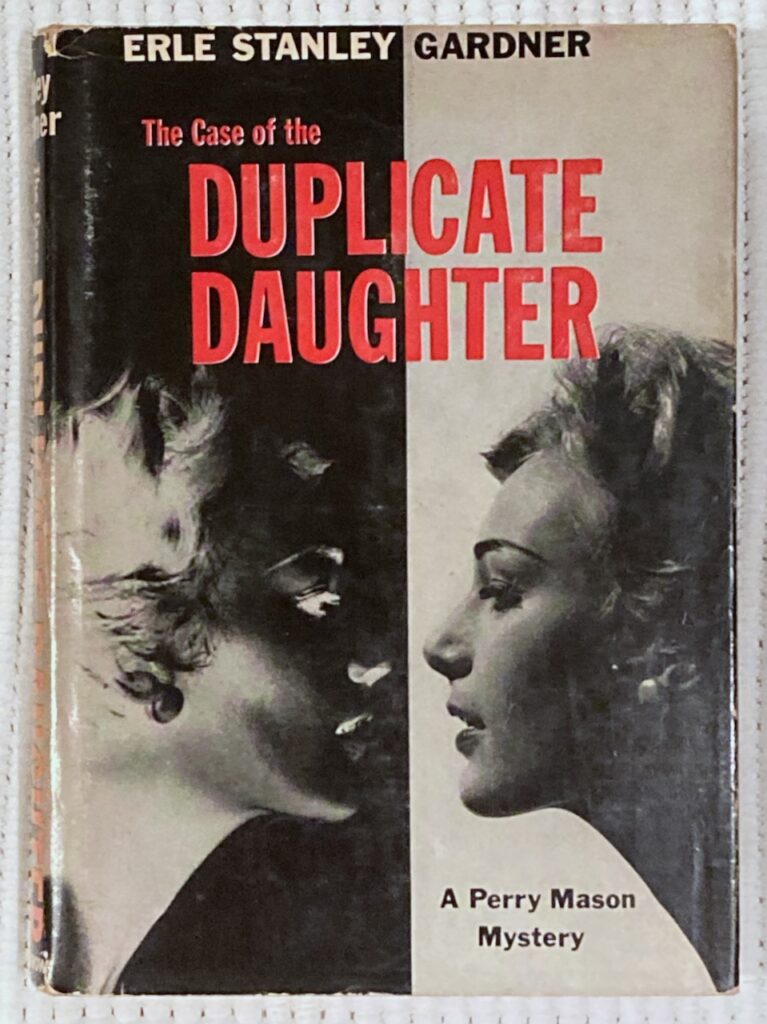
62. The Case of the Duplicate Daughter
Serialized: Saturday Evening Post, June-July, 1960
Morrow: June, 1960
Recurring characters:
Mason, Della Street, Paul Drake, Lt. Tragg, Hamilton Burger.
Plot devices:
1. Blackmail
2. Mistaken identity
3. Gambling: a trip to Las Vegas
4. Lie detectors: Mason has one of his clients take a lie-detector test; although it won’t be used in court, he wants the results released to the newspapers to drum up public support. During the lie detector test, Mason finds out a key piece of evidence, one that he was not expecting.
Legal matters:
As usual, the trial is solved by Mason during the preliminary hearing.
63. The Case of the Shapely Shadow
Morrow: Oct., 1960
Recurring characters:
Plot devices:
Legal matters:
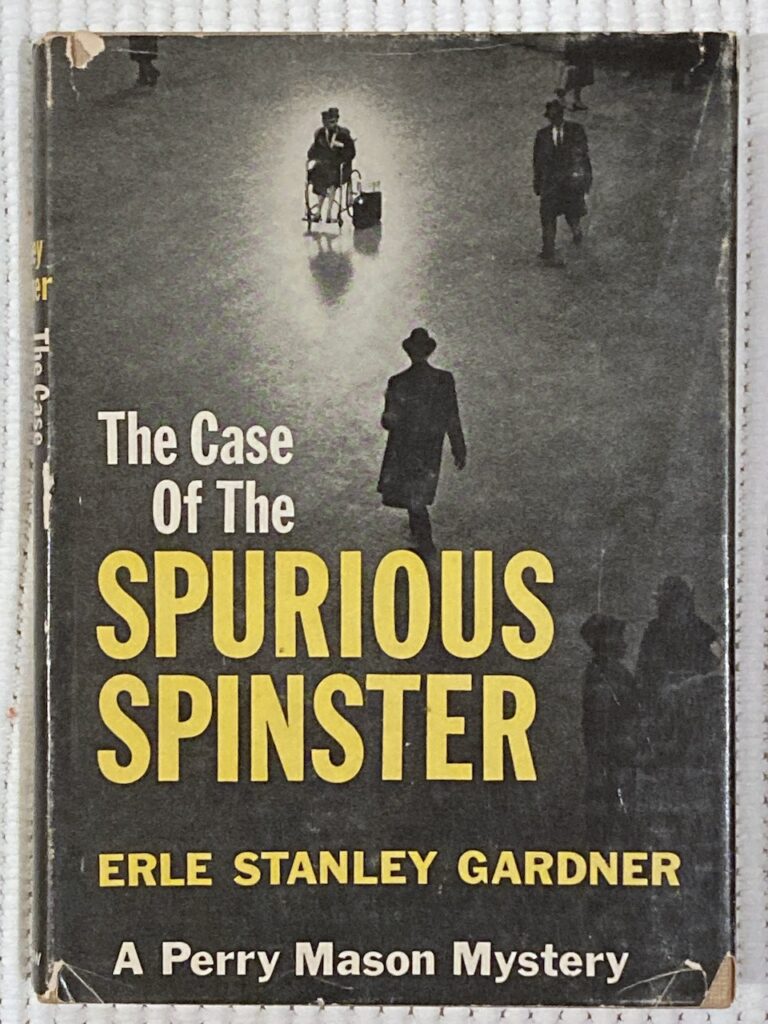
64. The Case of the Spurious Spinster
Serialized: Saturday Evening Post, Jan.-Mar., 1961
Morrow: Mar., 1961
Recurring characters:
Plot devices:
Legal matters:
65. The Case of the Bigamous Spouse
Serialized: Saturday Evening Post, July-Aug., 1961
Morrow: Aug., 1961
The plot of this story is a little too convoluted — a gun gets dropped by the side of the road, gets randomly picked up by someone, becomes a murder weapon, is traced to someone who is not involved in the murder, but who is tied to the murdered man in such a way that Mason is able to figure out who committed the murder. It’s just too big a coincidence, and not especially believable.
Recurring characters:
Perry Mason, Della Street, Paul Drake, Gertie the receptionist (off stage), Lt. Tragg, Hamilton Burger.
Alexander Redfield, the police ballistics expert, testifies during the preliminary hearing.
Plot devices:
1. Bigamy: Gwynn Elston works in door-to-door sales. While making a sales call, she sees a photo of Felting Grimes, the husband of her best friend, Nell Grimes — but he’s also married to the woman on whom she’s calling.
2. Poisoning: Gywnn Elston finds out that Felting Grimes is trying to poison her with strychnine.
3. Fast driving: In contrast to earlier books where Mason likes to drive fast, he now says: “I don’t like to drive fast on wet roads.”
4. Mountain cabin: Gorman Gillette, the deceased man’s father, lives in a mountain cabin.
5. Fingerprints: After Gorman Gillette dies, Mason takes the dead man’s fingerprints in the funeral home (while Della Street distracts the funeral director).
6. Blackmail: The murdered man hired a private investigator, who turned around an blackmailed him.
Legal matters:
The murder is solved during a preliminary hearing.
66. The Case of the Reluctant Model
Published: Toronto Star Weekly, Oct. 7, 1961
(Periodical title: “The Case of the False Feteet”)
Morrow: Jan., 1962
Recurring characters:
Plot devices:
Legal matters:
67. The Case of the Blonde Bonanza
Serialized: Toronto Star Weekly, April, 1962
Morrow: June, 1962
Recurring characters:
Plot devices:
Legal matters:
68. The Case of the Ice-Cold Hands
Morrow: Oct., 1962
Recurring characters:
Perry Mason, Della Street, Paul Drake, Lt. Tragg, Hamilton Burger.
Plot devices:
1. Gambling: Mason’s client, Audrey Bicknell, bets on a horse race — and wins big.
2. Embezzlement: Allegedly, the money that Audrey Bicknell bet on the horses was embezzled.
3. Motel: Audrey Bicknell stays in a room at the Foley Motel — and finds a body there.
4. Lying clients: Audrey Bicknell lies repeatedly to Mason.
5. Robberies and hold-ups: Audrey Bicknell claims she was robbed of the money she won from betting on a horse. She describes the robber to Lt. Tragg:
“‘He was rather short. I think he was about forty. He had a mask that had been made by putting a handkerchief around his forehead, holding it in place with a hat and letting the handkerchief hang down over his face. There were two holes cut for his eyes. All I could see was the hat, the handkerchief and the eyes. I — I knew he smoked because I could smell tobacco.’”
5. Technology and science: Lt, Tragg discovers an empty dry ice container in Audrey Bicknell’s motel room. He suggests the dry ice was used as part of a plan to fake an alibi for the murder. The dry ice, it turns out, came from a trout farm — a place where people can fish for stocked trout in a pond, then place their catch on dry ice so it doesn’t spoil. When Audrey handles some dry ice, her hands become ice cold — thus the title of the book.
Dry ice (a brand name for frozen nitrogen) was not exactly new technology when this book was published — dry ice was made commercially available in 1925 — but it is the sort of technology that tended to fascinate Gardner.
6. Fingerprints / Technology and science: Mason explains to his client a new fingerprinting technique:
“‘All right,’ Mason said, ‘I have information for you. It’s hard to get fingerprints from paper under certain circumstances. It depends on the paper and the circumstances, but there’s a new technique in use at the present time by which they develop fingerprints from the reaction of the ammo acids on the paper. Those amino acids have a delayed reaction with the surface of the paper and sometimes they can get fingerprints, and very fine fingerprints, even as much as several years after the fingers have touched the paper. The old method was mainly that of placing the paper in a container filled with iodine fumes and trying to develop latents that way. It wasn’t always satisfactory and was rather difficult. That’s why the impression got around that it was pretty much of an impossibility to get fingerprints from paper. But with this new amino acid technique it’s possible to get fingerprints from paper.’”
7. The story involves a secret compartment for hiding small valuable items, which is very similar to the secret compartment described in The Case of the Fenced-in Woman.
Legal matters:
1. Perry Mason explains some of the law concerning embezzlement to Della Street. What happens if, as appears to have happened, a man embezzles money, then gives that money to his sister to bet on a horse, and wins that bet? Can the person from whom the money was embezzled claim the winnings?
“‘Technically,’ Mason said, ‘he’s within his rights. The money was embezzled and it remained his money. If it was put out on a profitable investment, he’s entitled to the profits.’
“‘And can still prosecute for the embezzlement?’
“‘Embezzlement,’ Mason said, ‘is a crime, it doesn’t give the embezzler title to the money. If he doesn’t have title to the money, he isn’t entitled to profits on the money.’
“‘But how about the money our client bet on [the horse named] Dough Boy?’
“‘There’s a question,’ Mason said. ‘A great deal depends on the embezzlement, how the money was embezzled and where it came from. Now, if Rodney gave his sister five hundred dollars and told her to bet it on Dough Boy, and that money was embezzled, and Fremont can prove that it was embezzled from him, Fremont is entitled to all of the money that was won. But he’s got to prove a lot of things. He has to prove the embezzlement, he has to prove the identity of the money, and he probably would have to prove that the sister was an accessory or at least had guilty knowledge. It’s an unusual situation.’”
2. The case is brought to a grand jury, and then quickly brought to a jury trial, avoiding a preliminary hearing.
3. Hamilton Burger appears in the trial, assisted by a trial deputy, because — so he says:
“…for reasons which will appear as the case develops, this is going to be a very important case and a unique case and one in which it will be necessary for the duty elected district attorney of this county to take a personal part. There are legal issues involved which will probably establish a precedent in this county….”
While talking the case over with Della Street and Paul Drake, Mason figures out that this precedent results from a new law:
“‘Mason said, ‘Burger is going to question him about the embezzlement, and Rodney is going to state that he refuses to answer questions on the advice of counsel, that the answers would tend to incriminate him and that he has been advised by counsel that such is the case. Thereupon, Burger is going to stand up and file an application with the Court to have the Court order him to answer the question anyway, and state that as far as the particular crime is concerned that Rodney is going to testify to, the prosecution will grant him full immunity.’
“‘Then Rodney will have to answer the question?‘ Della Street asked.
”Mason nodded. ‘It’s a relatively new law.’…”
69. The Case of the Mischievous Doll
Published: Saturday Evening Post, Dec. 8, 1962
Morrow: Feb., 1963
Recurring characters:
Plot devices:
Legal matters:
70. The Case of the Stepdaughter’s Secret
Morrow: June, 1963
Recurring characters:
Plot devices:
Legal matters:
71. The Case of the Amorous Aunt
Morrow: Sept., 1963
Recurring characters:
Plot devices:
Legal matters:
72. The Case of the Daring Divorcee
Morrow: Feb., 1964
Recurring characters:
Plot devices:
Legal matters:
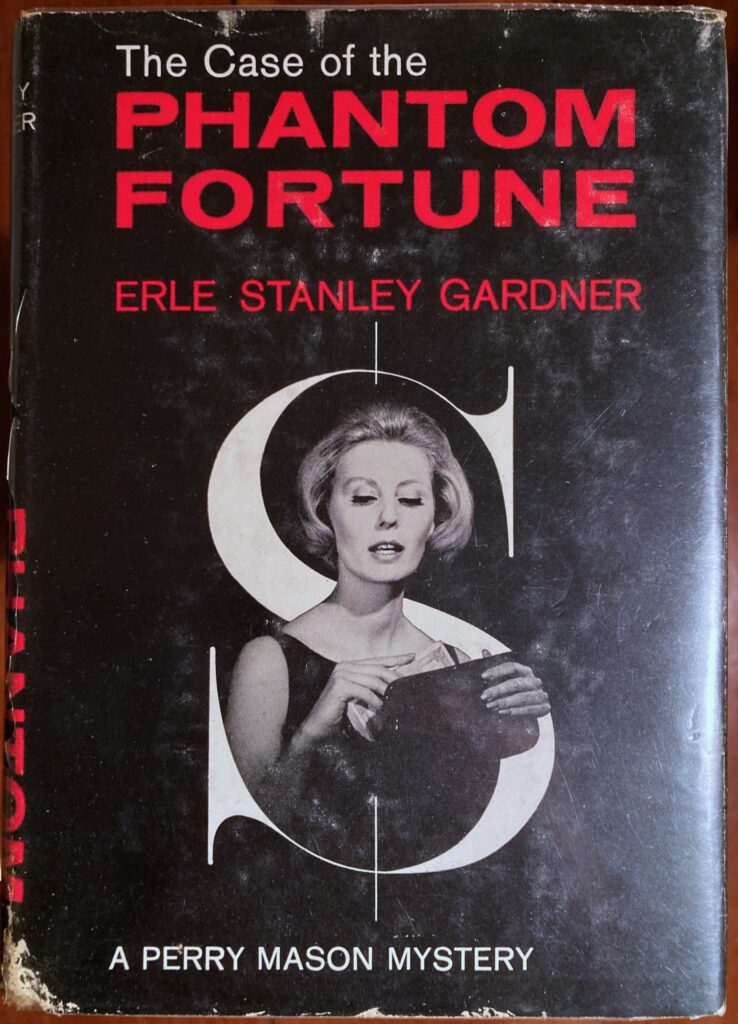
73. The Case of the Phantom Fortune
Morrow: May, 1964
Recurring characters:
Mason, Della Street, Gertie the receptionist, Paul Drake, Lt. Tragg, Hamilton Burger.
Sgt. Holcomb makes a very minor appearance. Alexander Redfield, the ballistics expert, is a witness during the trial.
Plot devices:
1. Fingerprints: To get fingerprints of unsuspecting people, Mason hires Paul Drake to be a caterer. Mason tells his client: “This dummy caterer’s truck, which is really a fingerprint laboratory with several trained assistants, costs five hundred dollars for an evening in addition to the catering charge.” (In 2025 dollars, the charge would be $5300 for the base charge, plus $265 – 370 per person for the catering.)
2. Blackmail: An ex-con blackmails Mason. Mason finds a way to turn the tables on the ex-con, using a faked Identikit sketch.
3. Cooperating with Tragg: By helping Tragg behind the scenes, Mason is able to protect the privacy of his clients.
Legal matters:
During a preliminary hearing, Mason cross-examination of the ballistics expert reveals that the latter gave testimony that had been carefully rehearsed with the D.A. Then Mason’s cross-examination of Lt. Tragg reveals that Tragg had not thoroughly searched the murder scene.
74. The Case of the Horrified Heirs
Morrow: Sept., 1964
Recurring characters:
1. In chapter 22, Arthur Tragg trusts Mason enough to go along with him to interview a key witness; the case is solved. But we are assured that the police department will make sure Tragg winds up getting credit for solving the case (though Tragg himself is honorable enough that he will not try to grab the credit).
2. Perry Mason and Della Street have a mildly romantic interchange in chapter 20. Mason’s dialogue in this scene tends towards the stilted:
“‘Your hands,’ he said, ‘are wonderfully reassuring. You have competent hands, feminine hands but, nevertheless, strong hands.'”
Plot devices:
Legal matters:
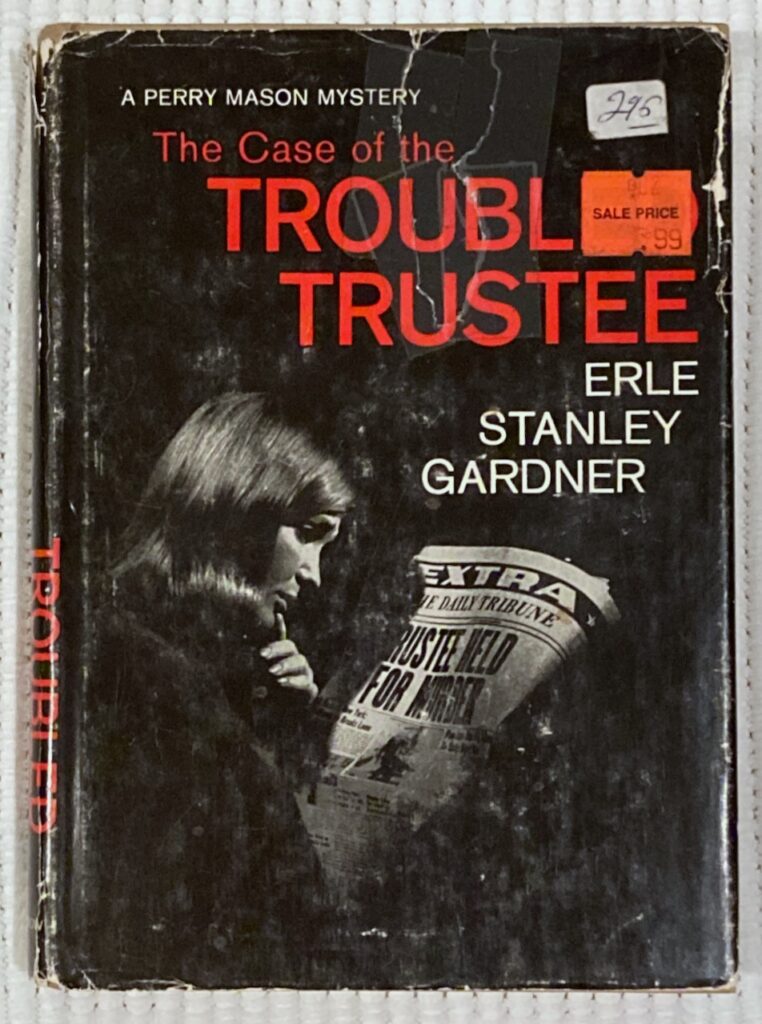
75. The Case of the Troubled Trustee
Morrow: Feb., 1965
Recurring characters:
Plot devices:
Legal matters:
76. The Case of the Beautiful Beggar
Morrow: June, 1965
Recurring characters:
Plot devices:
Legal matters:
77. The Case of the Worried Waitress
Morrow: Aug., 1966
Recurring characters:
Plot devices:
Legal matters:
78. The Case of the Queenly Contestant
Morrow: May, 1967
Recurring characters:
Plot devices:
Legal matters:
79. The Case of the Careless Cupid
Morrow: Mar., 1968
Recurring characters:
Plot devices:
Legal matters:
80. The Case of the Fabulous Fake
Morrow: Nov., 1969
This is the last Perry Mason book Gardner wrote, though two other novels were published after his death.