
Go to the main Perry Mason page.
Summaries of Perry Mason novels from the 1950s.
For a direct hyperlink to one of the story summaries, add a forward slash and hashtag symbol, like this — /# — followed by the first full word of the title that occurs after “The Case of the”; in case of hyphenated words, use only the word before the hyphen. Then add this to the URL of this webpage. E.g.: https://www.danielharper.org/yauu/perry-mason-novels/perry-mason-novels-1950s/#fiery
36. The Case of the One-Eyed Witness
Morrow: Nov., 1950
Recurring characters:
Plot devices:
Legal matters:
37. The Case of the Fiery Fingers
Morrow: May, 1951
Recurring characters:
Perry Mason, Della Street, Sgt. Holcomb, Gertie the receptionist (off stage), Paul Drake, Lt. Tragg, Hamilton Burger.
Sgt. Holcomb is taking public speaking lessons from Nathan Bain, and is therefore clearly biased towards Bain in more than one legal matter.
Plot devices:
1. Lying clients #1: Nellie Conway hires Mason for a case where it’s obvious that she is not telling the whole story.
2. Lying clients #2: When Mason finished with Nellie Conway’s case of petty larceny, he is retained by Victoria Braxton for a murder case. Vicki also lies to Mason
3. Fast driving: Della Street drives Perry Mason and Paul Drake to see a client, and Drake feels she drives too fast, and too aggressively.
2. Technology and science: Mason asks Paul Drake to test a single pill for some alleged poison, but does not want the pill to be destroyed:
“Drake said, ‘It’s a cinch, Perry. I have a friend who has access to a crime laboratory where they have one of these new X-ray defractors [sic; I believe Gardner means “diffraction”] that uses X-rays and gets a graph from the molecular defraction [sic] of a substance. I don’t know how it works. All I know is, it does the work. You can take an unknown powder and get a pretty good idea of what’s in it in a very short time, and it only takes a microscopic amount of powder to do the job.’”
5. Technology and science: Ned Bain hires Nellie Conway as an overnight practical nurse. Bain suspects Conways of stealing from him, and hires a private detective named Jim Hallock to help him catch the thief:
“…Bain … went on, ‘Hallock had some very practical suggestions. We removed most of the really valuable pieces from my wife’s jewel box and substituted imitations. Then we dusted the jewel box with a fluorescent powder so that if anyone touched that box some of the fluorescent powder would adhere to the fingers. Then we took pains to take the jewel box out of my wife’s desk and leave it on top of the desk as though we’d overlooked putting it back. We made a complete inventory of the contents of the jewel box, Mr. Mason. All of the jewels were imitations but it was such an expensive jewel case no one would ever have thought the jewels were other than genuine.
“‘This afternoon Hallock and I again made an inventory of the contents of the jewel box. Nothing was missing. Tonight, when the day nurse went off duty, we once more checked the contents of the jewel box. Everything was in its place.
“‘About half an hour ago, when Nellie came down here to fix some hot malted milk for my wife, she was gone quite a long time. We purposely gave her an opportunity to be alone and undisturbed. Then we entered the room after she’d taken the hot malted milk upstairs, and inventoried the contents of the box. A diamond pendant was missing, so we called Nellie down here, turned off the lights and switched on some ultra-violet light. The results were all that anyone could have asked.’
“‘I don’t know how that stuff got on my fingers,’ Nellie said.”
N.B.: I originally had noted this incorrectly as phosphorescence. Don O., a professor of physics, emailed me to say that the phenomenon described in the story is actually fluorescence; important to note, because evidently Erle Stanley Gardner was careful to research the plot devices he uses in his books. Thank you, Professor Don, for the correction!
6. Wills: See Legal Matters below.
7. Poisoning: Elizabeth Bain dies of arsenic poisoning. When Drake reports this to Mason, Mason asks him for information about arsenic poisoning, and Drake goes on at some length:
“Once more Drake consulted his notes and said, ‘Well, take Professor Glaister’s Medical Jurisprudence and Toxicology. He says that the symptoms [of arsenic poisoning] usually appear within an hour. In one case, where the stomach was empty, the symptoms did not appear until after two hours. Then, of course, there have been cases where the symptoms didn’t develop for seven to ten hours.’
“‘And fifteen grains is a fatal dose?” Mason asked.
“‘Oh, sure. There has been a fatal case recorded where the amount of arsenic was only two grains, according to Professor Glaister.
“‘Gonzales, Vance and Helpern, in their book entitled Legal Medicine and Toxicology, state that three grains of arsenic absorbed into the system will kill a man of average weight. Of course, there have been cases where large doses have been taken without fatal results, but usually the poison was rejected by the stomach before it could get into the system.’”
(The first book Drake refers to is John Glaister, Medical Jurisprudence and Toxicology [E.S. Livingston, 1950]. The second book is Thomas A. Gonzales, Morgan Vance, and Milton Helpern, Legal Medicine and Toxicology [New York: D. Appleton – Century Company, 1940]. Presumably Gardner had both these books in his legal library.)
Later on, Ned Bain is alleged to have poisoned his first wife using arsenic.
8. The case takes Mason and Drake to New Orleans, and there are some scenes describing the French Quarter — scenes that sound a little too much like descriptions of the French Quarter in Gardner’s 1942 murder mystery Owls Don’t Blink, in the Cool and Lam series.
9. Divorce: Just before she dies, the murdered woman, Elizabeth Bain, allegedly tells her half sister that she is going to file for divorce.
Legal matters:
1. When his client is accused of petty larceny, Mason insists on a jury trial, believing that his client has been set up by Ned Bain. Mason’s client is (of course) acquitted; the jury only requires ten minutes to return the verdict of not guilty.
2. Victoria Braxton — half sister of Elizabeth Bain, Ned Bain’s wife — asks Mason what constitutes a valid will. Mason replies that in the state of California, “a will is good if it is made, dated and signed in the handwriting of the testator.” (This was still true as of 2016 when i was living in California, and I actually wrote a will for myself based on this principle.) Miss Braxton then shows Mason a will written by Elizabeth Bain and asks if it is valid. Mason replies that while Elizabeth Bain did include her name in the will, she did not actually sign her name; and further that the will does not have any final punctuation. Miss Braxton is incredulous that such minor things might invalidate a will. Mason then proceeds to give her a short lecture about the law of wills — here is just one part of his mini-lecture:
“‘For instance,’ Mason said, ‘if you’re interested in the legal reasoning, here’s the Estate of Kinney, reported in 104 Pacific 2d at page 782, where it was held that the writing of the testator’s name only in the beginning of the declaration is a sufficient signing to justify admitting a will to probate, even though there is no affirmative expression adopting the name so placed as the signature of the testator.
“‘Then in a recent case, Estate of Kaminski, reported in 115 Pacific 2d at page 21, it was held that the name of the testator at the beginning of an alleged holographic will constitutes a sufficient signature where the instrument appears to be a complete testamentary expression of his desires.
“‘Now, in the Estate of Bauman, 300 Pacific, 62, it was held that in all cases of this sort the entire instrument must be examined to find out whether it was intended to be a complete will. The final expression, the abruptness in closing, and even the final punctuation are to be considered for the purpose of determining whether the writer intended to adopt the name as written in the opening clause as a signature or merely as words of description.
“‘Now you notice that your sister’s will has some very peculiar closing words — “with the understanding that they will take my property” … The testator could very well have been intending to add “subject to the following trust,” or “to be used for the purpose of”…’
“‘But she didn’t mean that at all,’ Miss Braxton interrupted. ‘She simply meant that the understanding was that by this will we were to take all of her property so that Nathan Bain wouldn’t have any opportunity —— ‘
“‘I understand that’s your contention,’ Mason said, ‘but you hand me a sheet of paper, you ask me a legal question, and I’m giving you the best answer I can.’”
3. The case goes to a grand jury, then direct to a jury trial, bypassing a preliminary hearing.
4. Mason doesn’t solve the case in the trial. Instead, he manages to get a temporary adjournment of the trial until the judge can rule on a legal question. Then he gets Paul Drake to plant a microphone to record Nathan Bain illegally. That illegal recording reveals the true murderer; Mason also asks Della Street to place a call to one of the people on the recording to prompt them to flee, since flight can be used as evidence of guilt.
Based on the recording that Drake’s men make, Mason calls in Lt. Tragg. After Tragg listens to the recording, he agrees to say that the microphone was placed there by police, thus accepting responsibility for Mason’s illegal action.
Given the different standards for conducting investigations today, I wonder how this case would fare in court today (in 2026).
Other Matters
1. Bon Mot #1: While talking with Della Street, Perry Mason makes fun of his cooking abilities, in one of my favorite Mason sayings from the entire series:
“Della nodded. ‘Shall we say the plot thickens, Chief?’
“‘Just like that gravy I tried to make on my last hunting trip, Della. It thickened in lumps. “Thousand Island Gravy,” the boys called it.’”
2. Bon Mot #2: Sgt. Holcomb says something absolutely infuriating to Mason over the phone. Mason tamps down his anger, though Della Street suggests it would be better if he expressed his anger — which results in another one of my favorite Mason saysing from the entire series:
“She said, ‘I wish you’d let go and cuss him [Holcomb]. It’s going to sound unladylike if I voice my thoughts on behalf of the firm.’
“Mason shook his head. ‘A good lawyer must always remember one thing. Never get mad unless someone pays him to do it.’”
38. The Case of the Angry Mourner
Morrow: Oct., 1951
Recurring characters:
Plot devices:
Legal matters:
39. The Case of the Moth-Eaten Mink
Morrow: Apr., 1952
Recurring characters:
Plot devices:
1. Mink coat: The solution to the plot requires Perry Mason and Della Street to figure out why someone let moths get into a mink coat. Della helps Perry understand a woman’s point of view on mink coats.
Legal matters:
40. The Case of the Grinning Gorilla
Morrow: Nov., 1952
This novel is jam-packed full of plot devices and legal matters. Unfortunately, two of those plot devices are so obvious (see nos. 17 and 18 below) that it spoils the story. As Paul Drake puts it at the end of the book, “Well, it was a bizarre scheme.” Yes, Paul, the plot is just too bizzare to be believable. All those other plot devices are kind of fun and entertaining — however, I don’t recommend reading this book unless you’re a die-hard Perry Mason fan.
Recurring characters:
Perry Mason, Della Street, Jackson the law clerk, Gertie the receptionist, Sgt. Holcomb, Lt. Tragg, Hamilton Burger.
1. Jackson appears off-stage. Mason tells Della Street:
“‘Have Jackson go up to the courthouse, Della, look through the file of actions and find out what the devil the case of Kempton versus Addicks is all about. He can telephone in a report.’”
2. Paul Drake is described as “cadaverous’:
“Paul Drake, a tall, cadaverous, solemn-looking individual, whose eyes had been trained by years of poker-faced observation to show no flicker of expression, assumed his favorite position in the big, overstuffed, leather chair, his long legs hanging over one rounded chair arm, the other arm supporting his back.”
3. Pleased by a development in the case, Perry Mason kisses Della Street.
4. During the story, Perry Mason and Della Street eat dinner at a Chinese restaurant. She gets a fortune in a fortune cookie that reads: “If you marry him you will be very happy and present him with a man child who will be very like his father.” Della Street hides the fortune from Perry Mason; he later finds it, telling Della that he didn’t find it, and puts the fortune in his wallet.
Plot devices:
1. Cheesecake: Mason buys the effects of Helen Cadmus, a woman who allegedly committed suicide, at an auction held by the public administrator. The auction allows the public administrator to clear out personal effects that haven’t been claimed. Mason and Della Street open the photo album in Helen Cadmus’s effects, and find a cheesecake photographs of a woman in a very skimpy bathing suit:
“‘If that’s a bathing suit,’ [Della] said, ‘I—’
“‘Apparently,’ Mason said, ‘the suit consists of three squares of cloth skillfully knotted about the curves of a very nice figure — I wonder if that is Helen.’”
2. Photography: Whoever took the cheesecake photographs was a skilled photographer. In addition to admiring the cheesecake, Mason admires the technique: “Whoever did the photography knew what he was about. They’re sharp as a tack.”
3. Benjamin Addicks raises “gorillas, chimpanzees, monkeys.” These primates live in his large house, and the smell of them permeates the house. At one point, Perry mason and Della Street see one of the gorillas escaping:
“They sat in spellbound silence while the oblong of light framed the massive body of the huge gorilla. The animal stretched forth a long, groping arm, then made a leap for the branches of a shade tree. A moment later he was slithering down the shade tree, and, within a matter of seconds after that, floodlights blazed on all over the yard, sirens began to scream a warning, and the barking of dogs reached a crescendo of excitement.”
Which brings us to the next plot device….
4. Gated estate: Benjamin Addicks has an estate with high walls around it, and dogs that patrol at night.
5. Planting evidence: Mason tosses his silver cigarette case over the wall of the gated estate, hoping to prompt police to search for the murder weapon; he is accused of planting evidence.
6. Mining: Paul Drake tells Mason that Benjamin Addicks “made a stake in gold mining, turned to oil.”
7. Amnesia: When Benjamin Addicks arrived in Los Angeles, he claimed to have amnesia:
“‘But, good heavens, Paul, how about the income tax people?’
“‘He told them he had amnesia. The first thing he remembered was being here, waking up in a hotel with about two thousand dollars on him.’
“‘Did they believe any such yarn as that, Paul?’
“‘Certainly not. They managed to get his fingerprints. Up to that time he’d never been printed. The FBI has no record on him.’”
However, Addicks apparently remembers enough of his earlier life (pre-amnesia?) to know that he has a brother, and that he came from a working class background.
8. Fast driving: There are several instances where both Mason and Della Street drive far too fast, while the other one is riding with them — scaring each other in turn.
9. Blackmail: Addicks’s lawyer tries to blackmail Mason.
10. Chinese culture: Gardner was more sensitive to Chinese culture than most White people of his time and place. Thus I’m always interested in the little bits of Chinese culture that creep into the Mason books, like this one, when Mason and Della Street are finishing dinner in a Chinese restaurant:
“The Chinese waiter brought back a big pot of tea. ‘Best kind,’ he said. ‘Ooh loong cha.’ He gave them fresh teacups and a bowl of rice cakes.”
“Ooh loong” is what we today call oolong; “cha” is tea.
11. Motel: Addicks’s second (bigamous?) wife and baby are hiding out in a motel in a “small town in California.”little California town up on the edge of the desert.”
12. Bigamy: It turns out that Addicks was previously married, and could not dissolve the marriage. Therefore, his Nevada marriage to Helen Cadmus was a bigamous marriage. See also: item #4 under Legal Matters below. However, at the very end of the book, Mason says that he’s pretty sure that the first wife died 18 months previously. So maybe it wasn’t a bigamous marriage.
13. Associate counsel: Mason conducts the defense at the preliminary hearing with James Etna, a young attorney, as associate counsel.
14. Forgery: A cashier’s check is introduced into evidence at the trial, where the signature was forged using the tracing method.
15. Lying client: Mrs. Kempton mostly tells the truth to Mason, but she does lie about one important thing, finally admitting her lie in the middle of the preliminary hearing.
16. Technology and science: There is testimony in the preliminary hearing about tests to detect human blood. An expert witness on the subject of blood tests gives a fairly lengthy talk on the history of blood tests, showing off his knowledge. Mason then teaches him something about his area of expertise:
“‘Now then, are you acquainted with Dr. R. B. H. Gradwohl?”
“‘I have heard of him. I am not acquainted with him.”
“‘He is the director of the St. Louis Police Laboratory in St. Louis, Missouri?”
“‘I believe that is right.”
“‘Are you familiar with his experiments conducted during 1951 and 1952 with the improved technique now available?”
“‘No, sir. I am not.”
“‘Are you familiar with a paper which was published first in the Laboratory Digest, Volume 15, February 1952, pages 4, 5, and 6, in which Dr. Gradwohl followed up this early suggestion and made precipitin tests with the blood of apes?”
“‘Why — now that you mention it, I believe that I did have the matter called to my attention at one time.”
“‘I submit that if you are going to testify in this matter you had better keep up with the latest scientific advances in it,’ Mason said. ‘You will find that Dr. Gradwohl, with the new improved equipment, made a scries of tests with the blood of chimpanzees, and found that he obtained exactly the same reaction in the precipitin test with chimpanzee blood that he got with human blood. To complete the chain of evidence he then injected rabbits with chimpanzee blood, producing an anti-chimpanzee testing serum, and found that this gave identical results with both chimpanzee and human blood samples.‘
“‘Well, I didn’t know that!” Groton exclaimed….”
Note that this novel was published in 1952, and Dr. Gradwohl’s article was published in that same year. Gardner was really keeping up with some of the latest developments in criminology.
17. Identity confusion: Herman Barnwell pretends to be his brother Benjamin Addicks (a.k.a. Benjamin Barnwell). As soon as Benjamin Addicks appears with his face swathed in bandages, astute readers will assume that somebody is trying to take on his identity for some nefarious purpose.
18. In one of Gardner’s worst plot devices ever, it turns out the murders were committed by a man dressed up in a gorilla suit. Astute readers will have suspicions about that early in the book. And then astute readers will wonder — with all those real gorillas around, wouldn’t a guy dressed up in a gorilla suit stand out like a sore thumb?
19. Hypnotism: Addicks has a hypnotist on staff named Alan Blevins. Blevins worked with the gorillas, but also hypnotized his ex-wife.
Legal matters:
1. Mrs. Josephine Kempton, a former employee of Benjamin Addicks, was dismissed from his employment. James Etna, Mrs. Kempton’s lawyer> tells Mason:
“‘Mrs. Kempton was peremptorily dismissed. She had been in Mr. Addicks’ employ for about two and a half years. Addicks gave no reason for dismissing her. Mrs. Kempton was angry when she left. She didn’t ask for any letter of recommendation. She was discharged without notice.’”
Then Mrs. Kempton takes a number of positions afterwards, and in each case Addicks writes to her new employer that she had stolen a valuable diamond ring — an accusation he had never made to her, nor to the police. Mason talks in general terms with Etna about the legal grounds for Mrs. Kempton’s lawsuit:
“‘I suppose,’ Mason said, ‘you’ve looked up the law in regard to privileged communications?’
“‘That’s what I’m digging around in now,’ Etna said. ‘There’s a question of privileged communications. Also the question of malice, the question of reasonable grounds for writing such a letter, and all of that stuff. The law isn’t too clear.’”
Mason goes out to visit Addicks, and finds evidence that Mrs. Kempton did not commit theft. Sidney Hardwick, Addicks’s lawyer, argues that Addicks cannot be held legally liable for accusing Mrs. Kempton of the theft:
“‘Let’s look at the thing from a cold, legal standpoint,” Hardwick went on. ‘There are two instances in which one person may accuse another person of crime with no liability on the part of the person making the accusation. One of them is in the event the person actually is guilty of the crime. The law of slander and libel in this country is different from what it is in many countries. Here the truth is always a defense to a statement which might otherwise be libelous or slanderous.’
“‘Thank you for telling me the law,’ Mason said.
“Hardwick smiled. ‘I’m not telling you the law. I’m pointing out a legal situation. The second class of case, Mr. Mason, is a privileged communication. Now let’s suppose Mr. Addicks accused Josephine Kempton of crime. He has two defenses. In the event she was guilty of crime, he can plead the truth, and that’s a complete defense. In the event she wasn’t guilty of crime but he said she was, all he needs to do is to show that the communication was privileged. In other words, that he was acting in good faith in giving information to a person who had a legitimate interest in the matter. That completely disposes of any question of defamation.’
“Mason stretched his arms, yawned, and said, ‘I never like to argue legal points unless I’m paid for it. So far no one has retained me, and somehow I don’t think anyone is going to.’”
2. Not long before he dies, the murdered man makes a holographic will, which is a legal will under California state law.
3. Addicks tells newspaper reporters that Addicks was married, and instructs them about the law of common-law marriage:
“‘What about common-law marriage?” one of the [reporters] asked.
“‘In some states it’s recognized,’ Mason said, ‘and in others it isn’t. But where a man travels with a woman as his wife he may well find himself in a state that recognizes common-law marriage. But what you fellows may be overlooking is that right here in this state when two people live together as husband and wife there’s a disputable presumption of marriage. That’s a rule of evidence, a legal presumption.’
“The reporters exchanged glances.
“Mason opened a book, placed it on the desk. ‘There it is, Subdivision 30 df Section 1963 of the Code of Civil Procedure.’”
4. Mason talks with Helen Cadmus, the woman whom he thought to be Addicks’s wife. She doesn’t want to reveal anything, but while they’re talking Mason deduces that their marriage was not legitimate, and he comes up with a legal reason why:
“Mason said, ‘In many states it is impossible to divorce a woman who has been adjudged insane. Now then, suppose that Benjamin Addicks had married. Suppose that woman had been adjudged insane. Addicks’ hands were tied. And furthermore, suppose that woman developed a form of insanity that would make her dangerous, that would — I think we’re getting somewhere, Della.’
“Mason inclined his head slightly toward the woman in the wrapper. She was having trouble with her face. A spasm of grief contorted it, then she suddenly said angrily, ‘Damn you! What are you? A mind reader? Do you have to go prying into peoples’ lives?…’”
41. The Case of the Hesitant Hostess
Morrow: Apr., 1953
Recurring characters:
Plot devices:
Legal matters:
42. The Case of the Green-Eyed Sister
Morrow: Nov., 1953
Recurring characters:
Perry Mason, Della Street, Paul Drake, Gertie; Sgt. Holcomb, Lt. Tragg. (Hamilton Burger does not appear.)
When the court adjourns to view the apartment where the body was placed after the murder, Sgt. Holcomb is angry and does not want to cooperate. As a result, the judge rebukes him.
Plot devices:
1. Sisters: Two sisters are at the center of the plot — a mousy homebody sister, and an attractive divorcee sister. The latter is the sister with green eyes. Della does not like the green-eyed sister, who manages to get Mason in trouble. The green-eyed sister also tries to steal her sister’s sort-of boyfriend. In the end, the “green-eyed sister” helps the murderer escape. However, the green-eyed sister winds up having to pay Mason’s fee to defend the mousy sister from the murder charge.
2. Blackmail (see below).
3. Technology and science: There are at least four plot devices involving tape recorders — a technology that Gardner enjoyed playing with, and made use of in his writing.
First, the blackmailers put together an audio recording on magnetic tape which seems to incriminate the target of blackmail. The audio recording, however, has been spliced — the target of the blackmail was recorded in an entirely innocent conversation, then one of the blackmailers spliced in questions in his voice that made the innocent conversation sound incriminating.
Second, Mason goes to an interview with one of the blackmailers wearing what appears to be a hearing aid, but which is in reality a tiny audio recorder. Using that, he records the playback of the supposedly incriminating audio tape. Then, using a magnet he finds in the kitchen of the blackmailer, he manages to erase the blackmail audio tape.
Third, the blackmailer installs a hidden recording device on a timer, to record a conversation that Mason has with Della Street and his client.
Fourth, when Mason loses all trust in his client, he tells her that not only will Della Street take notes on their conversation, he will also make an audio recording of it. (Which infuriates his client. Which is part of his intent.)
4. Cooling things artificially: The murderer tries to tamper with the evidence by placing the body in a freezer, in order to increase the cooling thus prompting the medical examiner to place the time of death earlier than it actually happened, during a time when the murderer had a solid alibi.
Legal matters:
1. Perry Mason lectures his client on statutes of limitations. A bank robber becomes immune from prosecution after the statute of limitations; but if that robber has held on to the money that was stolen, the money is covered by a different statute of limitations:
“Mason said, ‘[T]hey’ve had some very clever attorneys looking up the statute of limitations, and they’ve decided that the lapse of time has made Fritch immune from prosecution on any charge. That’s probably why the police haven’t swooped down on Fritch and arrested him for that bank job. It’s up to the bank in a civil suit to try to recover its property — ’
“‘But doesn’t a statute of limitations run against a bank?‘
“‘There,’ Mason said, ‘you’re up against a peculiar, tricky legal situation. In certain types of involuntary trust, where the custodian of the property is presumed to have knowledge of the illegal means by which the property was acquired, and the other person has no knowledge and is prevented from having knowledge by the secretive acts of the involuntary trustee, the statute of limitations may run from the discovery of the facts rather than the facts themselves.’
“‘Oh, you lawyers!’ she said. ‘You’re so technical.’”
2. Later on, Mason gives Sgt. Holcomb a legal lesson in whehter police officers can detain citizens, according to the law:
“‘Hold him,’ Holcomb shouted.
“A uniformed officer grabbed Mason by the arms.
“‘Bring him back,’ Holcomb said.
”Mason said, ‘If you want to charge me with first-degree murder, Sergeant Holcomb, I’m here ready to be charged. If you want to put me under arrest, take me to headquarters. If you forcibly restrain me without putting me under arrest, or if you arrest me without charging me with crime, I’m going to sue you for false arrest and for assault. Now make up your mind which you want.’”
43. The Case of the Fugitive Nurse
Serialized: Saturday Evening Post, Sept.-Nov., 1953
Morrow: Feb., 1954
Recurring characters:
Plot devices:
Legal matters:
44. The Case of the Runaway Corpse
Morrow: June, 1954
Recurring characters:
Plot devices:
Legal matters:
45. The Case of the Restless Redhead
Serialized: Saturday Evening Post, Sept.-Oct., 1954
Morrow: Oct., 1954
Recurring characters:
Plot devices:
Legal matters:
46. The Case of the Glamorous Ghost
Morrow: Jan., 1955
Recurring characters:
Perry Mason, Della Street, Paul Drake, Lt. Tragg, Hamilton Burger, Sgt. Holcomb
Plot devices:
1. Cheesecake: The “glamorous ghost” of the title is a young woman named Eleanor Corbin who appears in front of some people at night, in the moonlight, “apparently in the nude save for a fluttering diaphanous covering.”
2. Amnesia: When the “glamorous ghost” is picked up by the police, she claims to have lost her memory.
3. Jewels: The client’s family is in the wholesale diamond business.
5. Blackmail: Douglas Hepner makes his money informing on wealthy smugglers, people who bring jewels or similar items into the United States from abroad without paying customs duties. This puts him in an excellent position to blackmail people, rather than informing the federal authorities, if he chooses.
6. Bigamy: Eleanor Corbin is courted by one Douglas Hepner, who claims he wants to marry her. However, he is secretly married to another woman.
7. Smuggling: While Eleanor Corbin is “recovering” from amnesia, Mason discovers that she has been in possession of several jewels — fifteen diamonds, three emeralds, and two rubies.
8. Gambling: Douglas Hepner had once been a professional gambler in Las Vegas.
9. Art: Suzanne Granger, who dated Douglas Hepner before he took up with Eleanor Corbin, is an amateur painter.
10. Lying client: Eleanor Corbin is yet another one of Mason’s clients who lies to him repeatedly. Unfortunately, she lies so often that when she finally tells Mason the truth, he finds it hard to believe her.
Legal matters:
1. The case proceeds very quickly, straight from the grand jury to a jury trial, bypassing a preliminary hearing. The speed with which the case is brought to trial poses challenges for Mason’s legal abilities
“Perry Mason found himself for once in his life entering upon a trial of a case where he knew that he would inevitably be confronted with evidence which would be disastrous to the defendant, where he had been unable to learn from the defendant the true story of what had happened, where he must rely entirely on his powers of observation and cross-examination, where he would have to get the facts of the case from the mouths of hostile witnesses.”
After a dramatic trial, during which Hamilton Burger becomes enraged, Mason reveals the solution to the mystery in a conference with Burger and the judge in the judge’s chambers.
47. The Case of the Sun Bather’s Diary
Serialized: Saturday Evening Post, Mar.-Apr., 1955
Morrow: May, 1955
Recurring characters:
Perry Mason, Della Street, Paul Drake, Gertie (off stage), Hamilton Burger, Sgt. Holcomb (off stage).
Lt. Tragg does NOT appear.
Plot devices:
1: Cheesecake: Arlene Duvall is an attractive young woman, and a nudist who lives in a trailer. When she is out of her trailer with no clothes on, her trailer is stolen. She calls Perry Mason both to ask for legal representation, and to provide some clothes.
2. Robberies and hold-ups: Arlene Duvall’s father, Colton Duvall, is imprisoned for his role in a bank robbery. The police suspect Arlene of having the money he stole.
3. Fast driving: Mason does not drive fast in this novel:
“Mason eased his car out into the congested traffic of the afternoon rush hour.
“‘How long will it take us?’ Della Street asked.
“‘Twenty minutes at least.’
“Della Street raised her eyebrows. ‘Your new pledge of careful driving?’
“Mason nodded. ‘The automobile, Della, has become a very deadly weapon….’”
It sounds like a public service announcement for the Traffic Safety Bureau — and it probably was something equivalent to that.
4. Technology and science: A photograph of key evidence is destroyed by an X-ray machine in a doctor’s office.
5. Photography: There is some technical detail about how the photographs of the key evidence were taken: Plus X film, an extension sleeve, fine-grain developer. (It’s obvious that Gardner was an accomplished amateur photographer.)
6. Lying clients: Mason suspects his client of lying to him, about not having the money that her father stole from the bank. However, she turns out to be telling the truth.
There are several plot devices used that aren’t at all central to the main plot, but are used mostly to provide some background and color.
A. Gambling: A minor plot point: Jordan Ballard, who was supposed to inspect the shipment of money that got stolen, wasn’t paying attention because he had a bet on a horse — the horse won (and paid off well), but Ballard lost his job.
B. Mining: A minor plot point: Thomas Sackett, one of the men who steals Arlene Duvall’s trailer, is a prospector.
C. Blackmail: A minor plot point: some of the serial numbers of the stolen money were recorded, because they were going to be used to catch a blackmailer.
Legal matters:
1. Perry Mason signs a document without reading it. This astonishes the man who asks him to sign the document, since he thought all lawyers tell their client to read anything before they sign it. Mason says:
“‘I can tell you a point of law that may come in handy sometime.’
“‘What?’ Hartsel asked.
“‘A document,’ Mason said, ‘in order to constitute an agreement has to be signed, sealed, and delivered. In this state this signature imports a seal, but the document is valueless unless it’s delivered.’
“‘Well?’ Hartsel asked.
“‘And while I didn’t read it before I signed it, I read it after I’d signed it, while I was holding it for Miss Street to copy.’”
2. Hamilton Burger subpoenas Perry Mason to appear before a grand jury. Burger claims that Mason perjured himself before the grand jury. This puts him in an awkward legal situation, as he himself describes it:
“[Burger will] bypass the grand jury and have a complaint for murder filed against Arlene Duvall. Then he’ll have a preliminary examination and call me as a witness on behalf of the prosecution. That will force me into the open and force Arlene Duvall to either take a murder rap or else try to pin it on me. In either event he’ll have all the cards in his hands.”
3. During the preliminary hearing, Hamilton Burger calls Perry Mason as a witness for the prosecution. Mason proceeds to solve the murder while he’s on the witness stand.
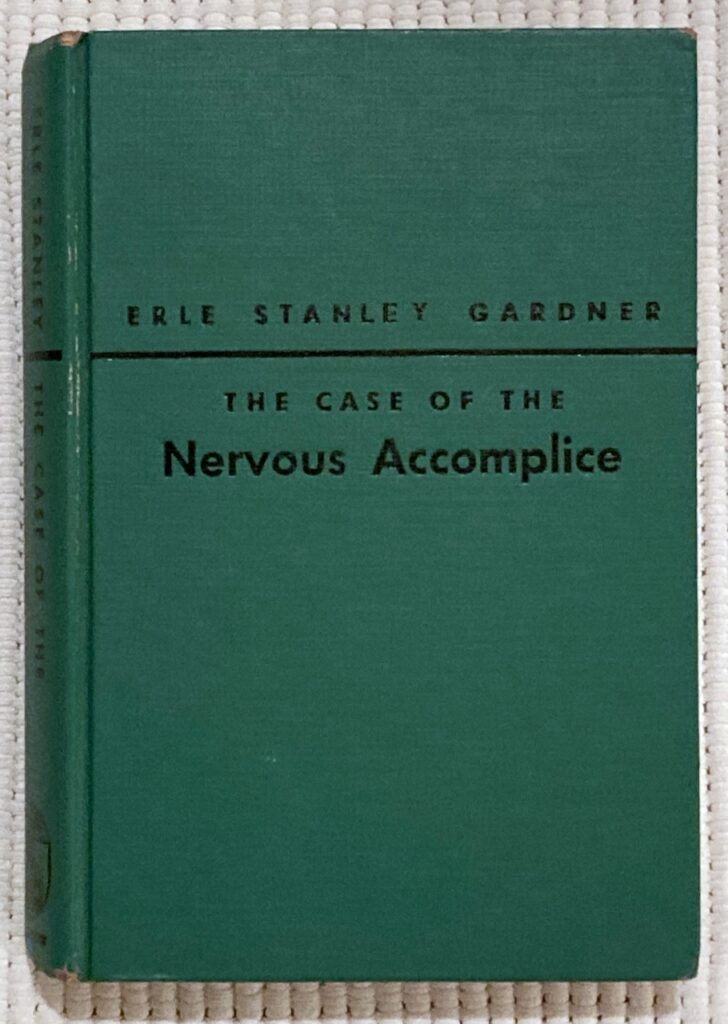
48. The Case of the Nervous Accomplice
Morrow: Sept., 1955
Recurring characters:
Plot devices:
Legal matters:
49. The Case of the Terrified Typist
Morrow: Jan., 1956
Recurring characters:
Plot devices:
Legal matters:
50. The Case of the Demure Defendant
Serialized: Saturday Evening Post, Dec., 1955-Jan., 1956
(Serial title: “The Case of the Missing Poison”)
Morrow: May, 1956
Recurring characters:
Perry Mason, Della Street, Paul Drake, Gertie the receptionist, Jackson (identified as “the law clerk” — off-stage), Sgt. Holcomb, Lt. Tragg, Hamilton Burger
This novel has one of the classic descriptions of Gertie, the receptionist — contrast this description with Gertie’s first appearance in The Case of the Rolling Bones:
“Gertie, a girl in her late twenties, inclined to put on weight with every chocolate sundae which she ‘simply couldn’t resist,’ never failed to dramatize each incident which took place during the day. Long experience had taught Perry Mason and Della Street to discount her excitement.
“She romanticized life and sex. In her more slender moments, she was prone to indulge in tight sweaters while imprisoning herself in the tightest, firmest girdles that she could possibly wear. At such times she was happy. Then when the inevitable desire for sweets got the best of her curves, she would go to the other extreme, subsisting for two or three days on buttermilk and grapefruit juice, looking wan and weak, but righting her avoirdupois with grim determination, only to surrender again as soon as she had partially achieved her objective.”
Alexander Redfield, the police ballistics expert, is called into court to weigh the shot (i.e., bullets used in a shotgun), to determine if a piece of evidence is admissible or not.
Plot devices:
1. Technology and science: Dr. Bert Denair explains to Perry Mason that he has been treating a young woman, one Nadine Farr, using “truth serum” drugs. Mason wants to know how effective these drugs are:
“‘It depends on what you’re looking for and what you get,’ Dr. Denair said. ‘From an experimental laboratory standpoint they’re effective just about a hundred per cent of the time, as far as specific information in regard to certain acts is concerned. In other words, you can take a bunch of students, have them commit synthetic crimes, and they’ll promptly tell you all about what they have done when you put them under the influence of one of the so-called truth serum drugs — scopolamine, sodium pentothal, sodium amytal — or any of the others, provided, of course, the proper technique is used.
“‘On the other hand, you take the hardened criminal who has been denying guilt of one crime and another over a period of years, who has been subjected to all sorts of third-degrees and examinations under pressure, and you don’t know what you are getting.’…”
2. Attractive young women: Nadine Farr is attractive but demure. Della Street describes how she appears demure:
“‘…oh, you know, she has good-looking legs but doesn’t show them; nice curves but doesn’t push them out or wiggle; beautiful eyes but she keeps her eyelids lowered; nice hands and they’re crossed on her lap. Her eyes are definitely interesting they’re eloquent but soft-spoken, if you get what I mean. You probably won’t until you’ve seen her.’…”
When Nadine goes to trial, the press describes her as “dazzlingly beautiful.”
3. Motels: Perry Mason has Nadine Farr check in to the High-Tide Motel, under her own name, to give him time before the police get to her.
4. Poisoning: Under the influence of the truth serum, Nadine Farr says she poisoned Mosher Higley. She had possession of cyanide pills (she was thinking of committing suicide): and the attending physician gave the cause of death as coronary thrombosis, the symptoms of which are almost identical to cyanide poisoning.
5. Eccentric character: Cap’n Hugo was present when Mosher Higley died. He was a sort of odd-job man for Higley:
“Cap’n Hugo would have been around six feet tall if he had stood straight, but an easygoing slouch had been crystallized by age so that now his head was thrust forward, his shoulders rounded. The man seemed abnormally thin except that the forward thrust of his spine had pushed his stomach out so that he seemed a little paunchy in the middle. His neck, arms, wrists and ankles were pipestem thin. He had high cheekbones, a pointed jaw and a sloping forehead. The forward thrust of his neck held his face downward so that he had to look up when he wanted to meet a person’s eyes. He accomplished this by a little sideways, upward toss of the head and an elevation of his eyebrows. For the most part the man seemed intent on looking at the floor. From time to time he darted these elfin glances upward in what almost seemed a deliberately droll manner.”
6. Mining: Mosher Higley owned a property in Wyoming that was reputed to have oil.
7. Blackmail: Nadine Farr was blackmailing Mosher Higley.
8. Lying clients: Nadine Farr doesn’t tell Mason about a key point of information (a lie by omission), thus hamstringing his efforts to protect her legally.
9. Planting evidence: Burger (wrongly) accuses Mason of planting evidence.
Legal matters:
.1. Under the influence of “truth serum,” a young woman tells Dr. Bert Denair that she has committed murder. Denair consults Perry mason about whether he has to go to the authorities.
“Mason said, ‘Listen carefully, Bert. I am asking you if there is any chance that the crime to which she apparently confessed is a figment of the imagination.’
“‘Oh,’ Dr. Denair said, grinning, ‘I get you now. Yes, there is a chance.’
“‘How much of a chance?’
“‘Not much, but some chance.’
“‘Then,’ Mason said, ‘as a doctor, if you should rush to the police with a story of murder that should subsequently turn out to be merely the result of a drug-induced hallucination, your patient would be in a position to sue you for slander, for defamation of character, for an invasion of privacy and for a betrayal of professional confidence. It would ruin you professionally. It would also have very unfortunate repercussions as far as your patient is concerned. Therefore if, as a doctor, you can tell me that there is some chance that the crime to which she confessed is merely the figment of a drugged mind, I would be forced to advise you that you should proceed cautiously, that your first duty would be to make a factual investigation.’”
Later, during the trial, when the prosecution wants to have this tape admitted as evidence, Mason offers legal arguments as to why it should not be admitted:
“Judge Ashurst looked at Perry Mason. ‘I’d like to hear the position of the defendant on that.’
“Mason said, ‘This is a confidential communication. It was made under the influence of drugs. The witness would not have been permitted to take the stand and testify while in that drugged condition. Therefore she shouldn’t be permitted to testify by means of a tape recorder.
“‘The rule in this state was originally established in the case of People versus Robinson, 19 California 40, which was to the effect that words uttered by a defendant while not conscious of what he was saying could not constitute evidence of guilt and are inadmissible. This rule was held to exclude statements made by a defendant while asleep.
“‘That case, if the Court please, was subsequently cited in the case of Chadwick versus United States, 141 Federal 225.’”
Then the judge asks Hamilton Burger for his counter-argument:
“‘Well, that whole doctrine is obsolete,’ Hamilton Burger said. ‘It was decided in People versus Rucker, 11 California Appellate 2nd 609, 54 Pacific 2nd, 508, that any evidence tending to establish that a defendant was not in full possession of his faculties at the time he confessed guilt would not affect the admissibility of the confession but would be evidence for the jury to consider in determining the weight to be given to the confession.
“‘I therefore insist that this confession can be heard by the jury. Counsel can then introduce all of the evidence he wants tending to show the mental condition of the defendant at the time the confession was made. The jury can consider that evidence for the purpose of determining whether or not the confession is true. However, if the Court please, all of the physical facts show that that confession is true. The truth is apparent because it dovetails in with every physical fact.
“‘Under the law any confession, no matter how it is obtained, can be admitted if there is corroborating evidence showing it to be true. I will, if the Court please, read from Volume 8, California Jurisprudence, at page 110: “Inasmuch as the theory upon which involuntary confessions are excluded is their possible falsity, if the confession discloses incriminating facts which are shown to be true, the reason of the rule ceases to exist, and so much of the confession as discloses the fact and the fact disclosed are competent.” Now then, if the Court please, this rule was followed in the case of People versus Castello, 194 California 595, 229 Pacific, 855, where it was stated that where physical facts and circumstances corroborate confessions of guilt, the reason of the rule which would otherwise exclude involuntary confessions to this extent ceases to exist.’”
2. Hamilton Burger wants to arrest Mason as an accessory after the fact, saying that Nadine Farr murdered Mosher Higley, and Mason helped her to cover up the crime. Mason tells Burger that before he can arrest Mason, he has to prove a murder:
“…‘You can’t accuse me of being an accessory after the fact in a murder case until you can prove there was a murder in the first place. You can’t prove there was a murder in the first place by using the tape-recorded conversation with Nadine Farr. She was under the influence of drugs when she made that statement and—’
“‘That goes to the weight to be given to evidence, not to its admissibility,’ Burger interrupted.
“‘Don’t be too certain,’ Mason told him. ‘The woman was incompetent at the time. She couldn’t have been called as a witness. If she had been on the witness stand in that drugged condition the court wouldn’t have let her testify. A court isn’t going to let words that are on a recorded tape have greater weight than would be given those same words in a courtroom.’
“‘We’ll see about that,’ Burger announced belligerently.
“‘And then, of course,” Mason said, “you have to prove that Mosher Higley didn’t die a natural death. The attending physician said he died of coronary thrombosis.’…”
3. Married persons cannot testify against one another. John Locke and Nadine Farr try to drive to Yuma to marry — so he won’t have to testify to facts which might serve to incriminate her — but they are stopped by police.
4. The case goes directly to a jury trial; there is no preliminary trial.
51. The Case of the Gilded Lily
Morrow: Sept. 1956
Recurring characters:
Plot devices:
Legal matters:
52. The Case of the Lucky Loser
Serialized: Saturday Evening Post, Sept.-Oct., 1956
Morrow: Jan., 1957
Recurring characters:
Plot devices:
Legal matters:
53. The Case of the Screaming Woman
Morrow: May, 1957
Recurring characters:
Plot devices:
Legal matters:
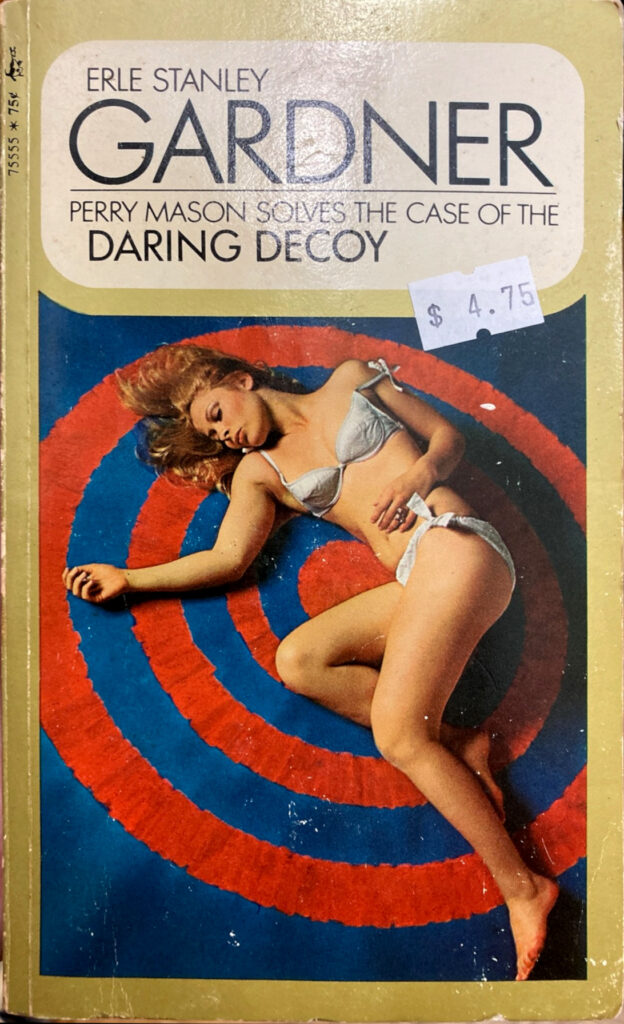
54. The Case of the Daring Decoy
Serialized by the Chicago Tribune/New York News, Sept.-Oct., 1957
(Serial title: “The Proxy Murder”)
Morrow: Oct., 1957
Recurring characters:
Plot devices:
Legal matters:
55. The Case of the Long-Legged Models
Serialized: Saturday Evening Post, Aug.-Sept., 1957
(Serial title: “The Case of the Dead Man’s Daughter”)
Morrow: Jan., 1958
Recurring characters:
Plot devices:
Legal matters:
56. The Case of the Foot-Loose Doll
Serialized: Saturday Evening Post, Feb.-Mar., 1958
Morrow: May, 1958
Recurring characters:
Plot devices:
Legal matters:
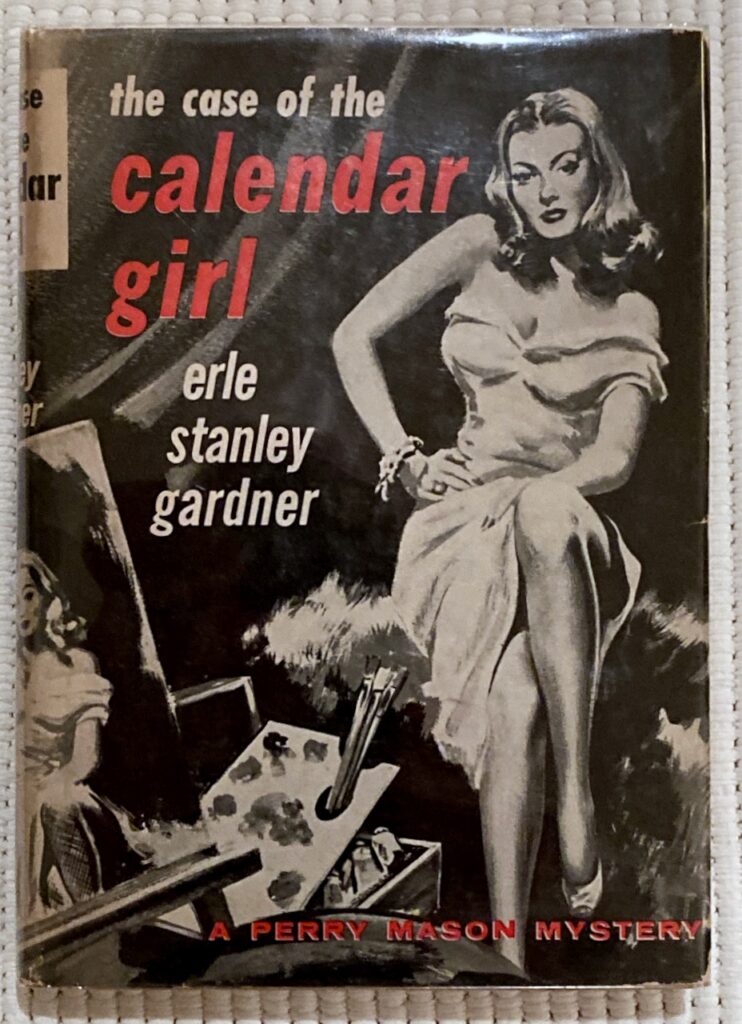
57. The Case of the Calendar Girl
Morrow: Oct., 1958
Recurring characters:
Plot devices:
1. Cheesecake: The plot involves a man who likes to take cheesecake photographs.
2. Photography: The plot involves details of photographic methods.
Legal matters:
58. The Case of the Deadly Toy
Serialized: Saturday Evening Post, Oct.-Dec., 1958
(Serial title: “The Case of the Greedy Grandpa”)
Morrow: Jan., 1959
Recurring characters:
Plot devices:
Legal matters:
59. The Case of the Mythical Monkeys
Serialized: Saturday Evening Post, May-June, 1959
Morrow: June, 1959
Recurring characters:
Plot devices:
Legal matters:
60. The Case of the Singing Skirt
Morrow: Sept., 1959
Recurring characters:
Plot devices:
Legal matters:
61. The Case of the Waylaid Wolf
Serialized: Saturday Evening Post, Sept.-Oct., 1959
Morrow: Jan., 1960