
Go to the main Perry Mason novels page.
Summaries of Perry Mason novels from the 1940s.
16. The Case of the Baited Hook
Morrow: Mar., 1940
Recurring characters:
In the last few pages, Perry Mason tells Sergeant Holcomb how to solve the case. Holcomb is initailly suspicious, but eventually takes Mason up on the offer. Mason even allows Holcomb to take full credit for solving the case, and Holcomb even thanks him:
“Surprised, Mason shook hands.
“Sergeant Holcomb said, ‘Don’t think for a minute this gives you any right to cut corners on your next case.’
“‘What does it give me?’ Mason asked, his eyes twinkling.
“‘My thanks for handing me a tip on a silver platter and for bringing a murderer to justice. Any cop worth his salt will respect a man who can do that.’…
“Once more Sergeant Holcomb strode across the office. Just before he jerked the door closed, he turned back to say to Mason, ‘I still don’t like your methods.’
“‘I understand,’ Mason said.
“Sergeant Holcomb’s glittering eyes held the lawyer. ‘And I don’t think,’ he went on, ‘that I like you.’
“The door slammed….”
Plot devices:
1. Mason is retained by a man who cuts a ten thousand dollar bill in two parts, gives one part to Mason, and gives another part to a masked woman. Mason is instructed to defend the woman from an unspecified criminal charge. When she needs his help, the woman will give Mason the other part of the ten thousand dollar bill and that will be his fee.
2. Mining: There’s a questionable mining company (and its stock).
3. Identity confusion (Adoption): A young woman who is trying to break into high society turns out to be adopted.
Legal matters:
1. The law of agency makes up a key part of the plot. Mason deflates a stuffed-shirt corporate lawyer with a short lecture on agency:
“Mason said, ‘You might examine Restatement of the Law. Take for instance pages 309-310 of the volume on Agency and notice the illustrations therein cited as representing judicial applications of the doctrine that death prinicipal terminates the authority of the agent. I call your attention particularly to the following….'”
— and Mason goes on for another two paragraphs on the topic.
2. There is no courtroom scene in this book.
17. The Case of the Silent Partner
Morrow: Nov., 1940
Recurring characters:
Lieutenant Arthur Tragg appears for the first time in this novel:
“Lieutenant Tragg said nothing but concentrated on driving in traffic. He was about Mason’s age. His features stood out in sharply etched lines. His forehead was high, his eyes keen and thoughtful, an entirely different type from Sergeant Holcomb. Mason, studying the profile as the car screamed through the streets, realized that this man could be a very dangerous antagonist indeed.”
Plot devices:
Legal matters:
18. The Case of the Haunted Husband
Morrow: Feb., 1941
Recurring characters:
Plot devices:
Legal matters:
19. The Case of the Empty Tin
Morrow: Oct., 1941
Recurring characters:
Plot devices:
Legal matters:
20. The Case of the Drowning Duck
Morrow: May, 1942
Recurring characters:
Perry Mason, Della Street,
At the very beginning of the novel, we are told why Perry Mason is a good lawyer:
“Once when Della Street, Perry Mason’s private secretary, had asked him what was the most valuable attribute a lawyer could have, Mason had answered, ‘That peculiar something which makes people want to confide in you.’
“Certainly Mason possessed this power to a marked degree. When he walked, across a room, people instinctively followed him with their eyes. When he seated himself m a hotel lobby or on a train, persons who were seated next to him almost invariably started a casual conversation and wound up baring their innermost secrets.”
Plot devices:
1. Technology and science: The early 1940s saw the beginnings of widespread commercial availability of detergents in the U.S., and Gardner has one of his characters explain how a detergent can remove the oils on a duck’s feathers, thus causing the duck to sink and drown.
Legal matters:
Other Matters:
Written early in the war years, this novel has a character who is about to go off to war.
21. The Case of the Careless Kitten
Serialized: Saturday Evening Post, May-July, 1942
Morrow: Sept., 1942
Recurring characters:
Plot devices:
Legal matters:
22. The Case of the Buried Clock
Morrow: May, 1943
Recurring characters:
Plot devices:
1. Technology and science: A clock found buried in the ground seems to be set to sidereal time (a timekeeping system used by astronomers), rather than ordinary time.
Legal matters:
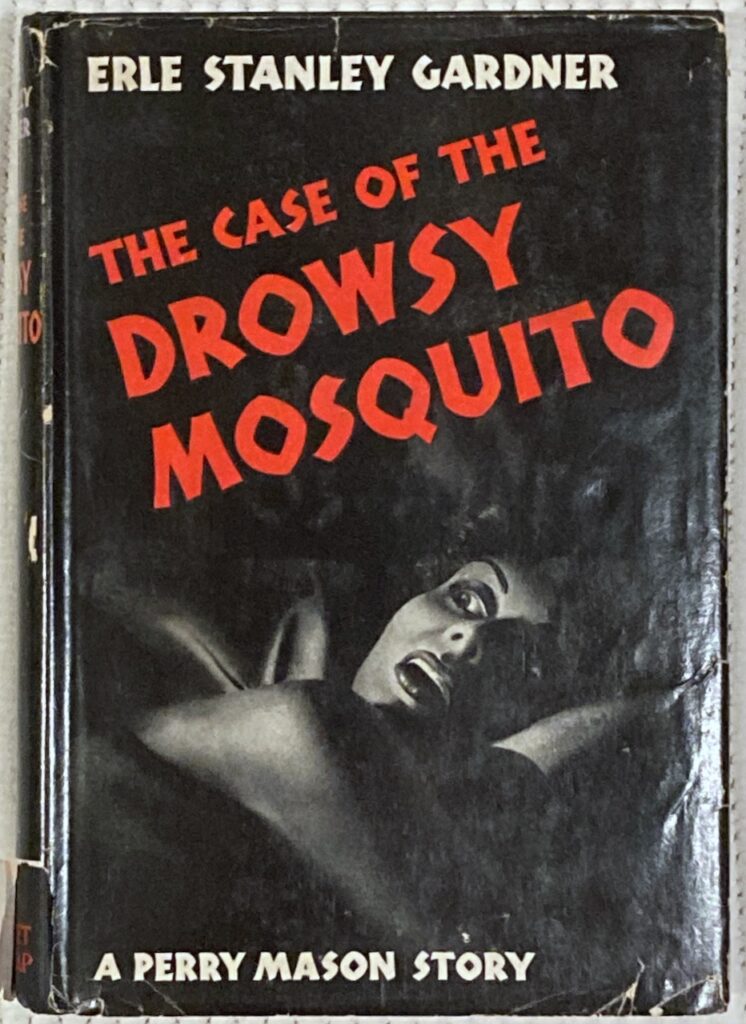
23. The Case of the Drowsy Mosquito
Morrow: Sept., 1943
Although several of the plot devices are rather threadbare, there are so many of plot devices that this book turns out to be a lot of fun to read.
Recurring characters:
1. Sheriff Greggory of San Roberto County makes his sole appearance in the Perry Mason books — but he turns out to be the brother-in-law of Lt. Tragg.
2. Although the primary setting of the book is San Roberto County, Lt. Tragg, Mason, Della Street, and Paul Drake all appear.
3. Towards the end of the book, Mason proposes to Della Street (again) and she turns him down (again).
Plot devices:
This is yet another Mason murder mystery centering around mining. It also has lots of plot devices.
1. The “drowsy mosquito” of the title is the humming sound made by an electric ultraviolet light source, which is used surreptitiously by one of the characters trying to find evidence of a rich mine. The UV light makes certain ore-bearing minerals fluoresce.
2. An actual mosquito does make an appearance in the story — in a glass phial with some flakes of gold. The mosquito proves to be evidence about the faked will.
3. Wills and faked wills: There is a faked will, and the real will is hidden — but Mason finds it.
3. Arsenic poisoning: Mason and Della Street have a meal at a client’s house, and are both poisoned by arsenic. The police find arsenic in the sugar bowl, but other people at the table who used sugar from that sugar bowl don’t get poisoned.
4. Split personality: Pete Sims claims that when he’s drunk, he gets taken over by a personality named “Bob.”
5. Mining: Paul Drake pretends to be a drunken prospector — a new role for the usually laid back detective.
6. Mining: There is also a strange kind of a hidden treasure map. Plus a story of a mysterious lost mine.
7. Desert camping: A romantic scene where Mason and Della Street camp out in the desert (along with some other people, so don’t get any ideas).
8. Stockholder fight: Stockholders with interests adverse to Mason’s client attempt to take over a company.
Legal matters:
1. Chapter 15 describes the taking of depositions for a fraud lawsuit, during which Mason matches wits with a lawyer named George V. Moffgat, and with a hostile witness named James Bradisson. (In re: fraud, Mason references Beckley versus Archer, 74 Cal. App. 489.)
2. In chapter 21, Mason is questioned by the district attorney of the county where the case takes place (outside of Los Angeles) about why he took possession of a will. Topham accuses him of stealing it; but the will names Mason as executor, so under the law he is required to take possession of it.
3. There is no trial. Mason manages to put Sheriff Greggory and D.A. Topham at loggerheads; then convinces Topham to let him (Mason) question a key witness — and that witness spills the beans, revealing who must be the murderer.
Other matters
There are frequent references to the Second World War (the book was published in 1943, and probably written sometime in 1942.)
24. The Case of the Crooked Candle
Morrow: May, 1944
Recurring characters:
Plot devices:
1. Boats: A candle is attached to a table where a murder is committed, inside a sailboat. After the murder, the boat, which is aground, tilts with the tide and suddenly the candle no longer appears to be vertical. This bit of evidence allows Perry Mason to solve the mystery.
Legal matters:
25. The Case of the Black-Eyed Blonde
Morrow: Nov., 1944
Recurring characters:
Plot devices:
Legal matters:
Personal trivia:
This was the very last Perry Mason novel that I read. I found a copy at Pegasus Books on College Ave. in Oakland, started reading it, left it by mistake in the restroom of a sushi restaurant, but was able to order a copy online so I could finish the book.
26. The Case of the Golddigger’s Purse
Morrow: May, 1945
Recurring characters:
1. Mason, Della Street, Paul Drake, and Lt. Tragg all appear. Hamilton Burger, however, does not appear.
2. Mason is present when the murder is discovered (by the murdered man’s wife), and tells his client to call the police. When she does, Lt. Tragg isn’t available, and instead Sgt. Dorset is sent — which causes Mason to express, in a backhanded way, his admiration of Tragg:
Sally Madison called to him from the bedroom. “Everything’s been done, Mr. Mason. Mrs. Faulkner is waiting in the living room. Mr. Drake is on his way out here and I’ve notified the police.”
“Lieutenant Tragg?” Mason asked.
“Lieutenant Tragg wasn’t in, but Sergeant Dorset is on his way out.”
Mason said, “That’s a break,” and then added, “for the murderer.”
Plot devices:
1. Goldfish: The plot involves specially bred goldfish varieties, including a variety Gardner calls “Veiltail Moor Telescope.” The murder appears to result from the hobby of goldfish breeding. A key bit of evidence for the murder appears to be how long a goldfish can live out of water. (As a side note, Raymond Chandler included goldfish in his short story “Goldfish” published in Black Mask magazine in June, 1936. Gardner would have been very aware of Chandler, and probably read this story. We can only wonder if Chandler’s earlier story somehow inspired Gardner’s 1945 story.)
2. Attractive young women: The “golddigger” of the title is an attractive young woman who is not exactly a golddigger — she’s actually trying to get money for her tubercular boyfriend. The “golddigger’s purse” is important because Della Street finds that the young woman’s purse contains cash in the form of a roll of big bills — and a revolver. The golddigger herself involves Mason and Street in illegal activities, so that Mason has to represent her, and lies to Mason several times.
3. Bullets being switched: There is a subplot which involves switching bullets, though it’s not central to the murder mystery.
4. Mason does not solve the case during the preliminary hearing — he solves it during a break from the preliminary hearing, and gives Lt. Tragg the information needed to arrest the real killer.
Legal matters:
Nothing of interest.
Personal trivia:
As near as I can recall, this was the very first Perry Mason novel I ever read. If I recall correctly, it was a paperback book my parents had stashed in the basement; I distinctly remember the cover with an illustration by Robert McGinnis.
27. The Case of the Half-Awakened Wife
Morrow: Sept., 1945
Recurring characters:
Plot devices:
Legal matters:
28. The Case of the Borrowed Brunette
Morrow: Nov., 1946
Recurring characters:
Perry Mason, Della Street, Paul Drake, Gertie the receptionist, Lt. Tragg.
Hamilton Burger does not appear.
Plot devices:
1. Attractive women: While driving through Los Angeles, Della Street and Perry Mason notice eight attractive brunettes standing on street corners. They stop to ask one of the brunettes what’s going on, and she says she responded to an ad placed in a trade paper read by actresses, which said:
“WANTED Neat, attractive brunette, age twenty-three to twenty-five, height five feet four and one-half inches, weight one hundred and eleven pounds, waist measurement twenty-four inches, bust measurement thirty-two. Weight and measurements must be absolutely exact, and the applicant must be free for colorful, adventurous work that will pay fifty dollars a day for a minimum of five days, maximum of six months. Successful applicant may select her own chaperone, who will be with her constantly during period of employment at salary of twenty dollars a day and expenses. Telephone Drexberry 5236 and ask for Mr. Hines.”
Although she doesn’t get the job, her roommate does — and as a result, winds up being part of a murder case.
2. Divorce: The roommate becomes Mason’s client. She gets hired to impersonate a woman who is in the middle of a divorce. This woman knows her husband has hired private detectives to shadow her, and wants Mason’s client to fill in for her.
3. Hiding the murder weapon: The murder weapon, a handgun, gets thrust into a garbage can. During the preliminary hearing, there is extensive testimony about whether the defendant put the gun in the garbage can, or merely looked in the garbage can.
Legal matters:
1. When talking with the accomplice of the woman who’s in the middle of a divorce, Mason goes into the law around impersonation:
“‘And I take it you’re aware it’s a crime to impersonate others?’
“‘Only when there is an intent to defraud, Mr. Mason. I have looked up the law very, very carefully. I can assure you that every step I have taken is strictly within the law. There is no intent to defraud anyone,’ Hines explained.
“‘But you do intend to deceive people.’
“‘There’s a legal distinction.’
“‘I know there is,’ Mason said. ‘I’m trying to find out whether you are aware of that distinction.”
“‘I am!’”
2. Although the case goes to a preliminary hearing, it is actually solved during a Grand Jury session. At the end of a session of the preliminary hearing, the vindictive assistant district attorney subpoenas Mason to appear before a Grand Jury. Mason solves the murder trial (with the help of a sympathetic jury foreman) while giving his testimony to the Grand Jury.
3. Mason is able to get back at Gulling, the vindictive assistant district attorney, during the Grand Jury session. After the murderer (a man named Reedley) confesses, Gulling tries to hang a larceny charge on Mason. Here’s how Mason tells the story to Della Street and Paul Drake:
[Mason said,] “‘But after they had Reedley’s confession, I was in a beautiful position to teach Gulling some law.’
“‘How do you mean?’ [said Drake]
“‘Reedley admitted that he had put his own money in the wallet and tossed it on the floor. And because the money already there was in tens and twenties only, and Reedley wanted to have it all in bills of high denomination, he put that money in his pocket and replaced it with bills of his own before he tossed it on the floor. Therefore, when Adelle Winters picked it up, she wasn’t “finding” anything within the meaning of the law.’
“‘What was she doing?’ Della Street asked.
“‘Taking possession of property that had been abandoned,’ Mason said. ‘There’s quite a distinction in law between lost property and abandoned property. When Reedley tossed his own money on the floor, he had abandoned it. When property has been lost, the owner retains the title but is deemed to have parted with the property accidentally. When property has been abandoned, it is deemed to have returned to the public domain, and the first person who takes it into possession is entitled to retain not only the property itself but the title to it.’”
29. The Case of the Fan-Dancer’s Horse
Morrow: June, 1947
Recurring characters:
Plot devices:
1. Cheesecake: The plot centers around a fan dancer — that is, a woman who performs a kind of strip tease dance where she covers key parts of herself with large fans.
Legal matters:
30. The Case of the Lazy Lover
Morrow: Oct., 1947
Recurring characters:
Perry Mason, Della Street, Gertie, Paul Drake, Lt. Tragg
1. This book has one of the classic descriptions of Paul Drake, as he makes the first appearance in the book:
“Paul Drake draped his loose-jointed length over the big client’s chair, twisting around until he had a comfortable position. Then after a moment, he squirmed about until his legs were hanging over the overstuffed arm of the chair.
Paul Drake carefully cultivated a nondescript appearance and a lugubrious countenance. There was, to him, no romance in connection with the operation of a detective agency. He looked upon his profession with an air of pessimistic detachment, did his work competently and deprecatingly.”
2. Gertie the receptionist is described as follows (which is quite different from her first appearance in the Mason books): “…Gertie, the big, affable, somewhat overweight receptionist….” Mason asks Gertie to take on the role of the wife of a man who supposedly suffers from amnesia:
“‘What’s this bird like?’ Gertie demanded.
“‘I think he’s quite a wolf, Gertie. Long eyelashes, dark wavy hair, the romantic type —’
“‘Sold,’ Gertie announced, and then added with a laugh, ‘and, I’ll either crack that alibi of his or I’ll prove that he has genuine amnesia. One or the other.’”
3. We get a portrait of Lt. Tragg’s office:
“Tragg’s office was impressive, the walls being decorated with display cases in which were knives, guns and blackjacks; below each of the weapons was appended a history of the case in which it had been used. The furniture in the office told its own story of drama. The massive oak tables were charred along the edges where burning cigarettes had been placed while someone answered the phone, only to spring into immediate action at word of some homicide or attempted homicide, leaving the cigarette unnoticed to burn a deep groove into the table. Here and there were scratches and nicks where someone had thrown a captured gun or knife onto the table, or where some prisoner in desperation had beaten his handcuffed wrists against the wood.”
Plot devices:
1. Divorce: Yet another divorce situation: Bernard Allred believes his wife, Lola Faxon Allred wants a divorce (or does he?)
2. Mining: Bertrand Allred is in the mining business. He engages is various kinds of legal skullduggery. Early in the book, he is being sued by someone who claims he misrepresented a mining property.
3. Forgery: Mason receives two checks in the mail, both from the same person, both for the same amount — $2,500 ($37,000 in 2025 dollars). One of the checks turns out to be a forgery. The bank manager explains to Mason how the forgery was accomplished:
“‘Someone traced the signature on the check with a piece of carbon paper. That’s one of the oldest forms of forgery known and a modification of the tracing formula. A person gets a paper bearing the genuine signature of the one whose name he wants to forge. He puts a sheet of carbon paper under that signature and the document which is to be forged, underneath the carbon paper. Then very gently the forger runs a toothpick or other pointed instrument over the lines of the genuine signature. The pressure is light enough so that it leaves a barely perceptible carbon paper imprint of the signature on the paper beneath.’
“‘Then what?’ Mason asked.
“‘Then the forger takes a pen, usually a pen with a quite heavy ink, such perhaps as black drawing ink, or any India ink.’
“‘Go ahead.’
“‘And traces loop by loop, line by line, over the carbon paper signature. Frankly, Mr. Mason, it makes a most excellent forgery, one, which when skillfully done, can only be detected by an expert — depending somewhat upon the age, the mentality, and the emotions of the person forging the signature. The pen, of course, moves more slowly than in the case of a genuine signature. Therefore, if a person is nervous, there are more apt to be microscopic irregularities in the lines of the signature, due to tremors. But if a person has a steady hand and is free from mental excitement, the forgery can be made quite convincing.’
“Mason merely nodded.”
(Before you go out and try this, you better learn how to write with an old-fashioned pen that you dip in India ink.)
4. Motel: While getting away, Lola Allred and her presumed lover, Bob Fleetwood, (who’s not actually her lover) stay in motel — in a double cabin.
Then they move to another motel, the Snug-Rest Auto Court.
5. Amnesia: On a dark and stormy night, Lola’s daughter, Patricia, hits Bob Fleetwood with her car (or does she?). He sustains a head injury and gets amnesia. Fleetwood is a key witness in a potential lawsuit threatening Bertrand Allred, so the amnesia has to be covered up.
6. Fast driving: This is one of the books in which Mason drives way too fast — this time, on a rainy night, on a twisty mountain road.
7. Car run off mountain road: The murdered man is found in a locked car (with blood on the floor) which was run off the road — the same winding twisty mountain road that Mason drove up earlier, at way too high a rate of speed:
“‘You mean there wasn’t an automobile accident? You mean my car didn’t go over the grade?’ [said Lola Allred.]
“‘No,’ Tragg said ‘I mean that there was an accident. I mean that your car did go over the grade. I mean that there’s a dead man locked in the car, and I mean the car was deliberately driven over the grade in low gear.’…”
8. Mountain cabin: The supposed amnesiac winds up hiding out in a mountain cabin.
9. Lying client: Mason’s client lies to him repeatedly, and never tells him the whole truth. (He gets her off anyway, of course.)
10. Tracking: Tracks left by the defendant are key evidence in the case against her. However, the tracks could be interpreted in more than one way. As Mason puts it, “Circumstantial evidence never lies, but it isn’t always easy to interpret it correctly.”
Legal matters:
Other Matters:
Second World War: One character believes the supposed amnesiac is suffering from shell shock.
31. The Case of the Lonely Heiress
Morrow: Feb., 1948
Recurring characters:
Plot devices:
Legal matters:
32. The Case of the Vagabond Virgin
Morrow: July, 1948
Recurring characters:
Plot devices:
Legal matters:
33. The Case of the Dubious Bridegroom
Morrow: Feb., 1949
Recurring characters:
Perry Mason, Della Street, Paul Drake, Sgt. Holcomb, Lt. Tragg, Gertie the receptionist
Paul Drake has a “code knock” to let Perry Mason and Della Street know he wants to get into their office. In this novel, the code knock is given as “one rap then a pause, three raps then a pause, then two raps.”
Plot devices:
1. Attractive woman: Perry Mason is asleep in his office when an attractive woman named Virginia Colfax (a.k.a. Virginia Bynum) creeps down the fire escape. He invites her in through the window. She throws something into the alley — perhaps a gun. Mason is suspicious, and pats her down to look for a gun.
2. Mining: Virginia is spying on the Garvin Mining, Exploration, and Development Company.
3. Gambling: Poker games and gambling in Idaho form minor plot points. (Slot machines were legal in Idaho from 1947 to 1953.)
4. Bigamy: Edward Garvin, the head of the mining company, got a Mexican divorce from his first wife, and remarried. He consults Mason about whether a divorce obtained in Mexico is legal in the U.S. Mason says, probably — but there remains the possibility that his second marriage is bigamous. Mason agrees to look into the legality of his Mexican divorce. And the first wife, Ethel Garvin, files a complaint with the D.A.’s office. See also under Legal Matters below.
5. Mexican culture: Mason drives to Mexico with Garvin, his client, and Garvin’s second wife; in Mexico, his second marriage is not bigamous. Gardner paints a sympathetic, albeit stereotyped, portrait of Mexican people. On the stereotyped side, the proprietor of a hotel tells Mason:
“Thees is Mexico, Senor. We do not work all during the day and all during the night the way you people do. When we come home from work in Mexico we are done.”
On the sympathetic side, Mason deals with a worker at the hotel who seemingly doesn’t speak good English, but Mason does not make any assumptions. At last, the young man speaks in unaccented idiomatic English, and Mason replies:
“Mason grinned, took the keys and said, ‘You do speak good English, don’t you, Pancho?’
“‘What the hell do you think I go to school for?’ Pancho asked.”
6. Tracking: Auto and human tracks at the murder scene are crucial evidence.
7. Stockholder fight: Garvin’s ex-wife tries to get enough stockholder proxies to enable her to take over Garvin’s company at a stockholder meeting.
8. Lying client: Garvin lies to Mason about spending all night asleep in bed with his second wife, on the night of the murder.
Legal matters:
1. Perry Mason instructs Lt. Tragg on the laws around Mexican divorces:
“Mason said, ‘There’s some interesting law involved, Lieutenant. Section 61 of our Civil Code provides that a second marriage made during the lifetime of an undivorced spouse is illegal and void from the beginning.’
“‘That’s what I was telling you,’ Lieutenant Tragg said.
“‘On the other ’ Mason said, ‘Section 63 of the Civil Code also contains some very interesting language.’
“‘Such as what?’ Tragg asked.
“Mason took a piece of paper from his pocket, on which he had copied Section 63 of the Civil Code. ‘Listen to this, Lieutenant. ”All marriages contracted without this state, which would be valid by the laws of the country in which the same were contracted, are valid in this state.”’”
Tragg disagrees with Mason, but Mason has additional legal authorities to quote:
“‘But look here,’ Tragg said. ‘It’ll be possible to prove that these two people left California in order to perpetrate a fraud on the marriage laws of California and…’
“Mason smiled, and shook his head. ‘Read the case of McDonald versus McDonald, 6 California Second 457. It’s also reported and discussed in 106 A.L.R. 1290 and is reported in the Pacific Reporter in 58 Pacific Second Page 163. That case holds squarely and fairly that where people leave California for the sole purpose of contracting a marriage, in defiance of the laws of California, and go to another state, and, as a part of that general scheme, a marriage is contracted in that state, that marriage is valid. It is a legal and binding ceremony in California, regardless of the fact that such marriage is not only contrary to the laws of California but contrary to the underlying policy of the laws of California. … [Garvin is] in the rather unique position of having committed legal bigamy and having had two perfectly legal wives.’”
Then Mason backs off from this statement a bit:
“Mason said, ‘Tragg, I’m telling you, the minute this man sets foot in Mexico, he’s married to this woman standing here at his side. I’m willing to concede that when he goes back to the United States, he may be held to have committed bigamy. That’s why I don’t propose to have him go back to the United States. He’s living here with his lawfully wedded wife. Now, Mexico will grant extradition for a crime that is a crime against the laws of the United States, but it’s not going to grant extradition for an act performed under the laws of the Mexican government which is perfectly legal here but which could be held to be illegal in California.’”
2. Mason gives a little lecture to Paul Drake about the unreliability of witnesses — one of Gardner’s favorite points:
“Mason said, with feeling, ‘It’s been demonstrated dozens of times that if you have a crime committed in front of a whole room full of witnesses and then call on those witnesses to make a written statement of what took place, the statements will contain all sorts of variations and contradictions. People simply can’t see things and then tell what they’ve seen with any degree of accuracy.’
“‘I suppose so,’ Drake said.
“‘Hell, it’s been demonstrated time and again,’ Mason said. ‘It’s a favorite stunt in classes in psychology in college. But what happens when you have witnesses in the trial of a case? They get on the stand one after another and tell a story that might have been written on a mimeograph. A witness sees something. He tells it to the police. The police point out little discrepancies between his story and that of the other witnesses. They point out what must have happened. Then they let the fellow think it over. Then they talk with him again. Then they let him talk it over with other witnesses. Then they take him to the scene of the crime. Then they get the witnesses to re-enact what happened. By the time a witness gets on the stand he’s testifying to a composite of what he saw, what he thinks he saw, what the other fellow tells him he saw, and what he concludes he must have seen, judging from the physical evidence….’”
3. The trial takes place in San Diego County.
Mason solves the mystery during a continuance of the murder trial — but we never get to see how Mason reveals the solution to the D.A. of San Diego County.
34. The Case of the Cautious Coquette
Morrow: May, 1949
Recurring characters:
Plot devices:
Legal matters:
35. The Case of the Negligent Nymph
Serialized: Collier’s, Sept.-Oct., 1949
Morrow: Jan., 1950