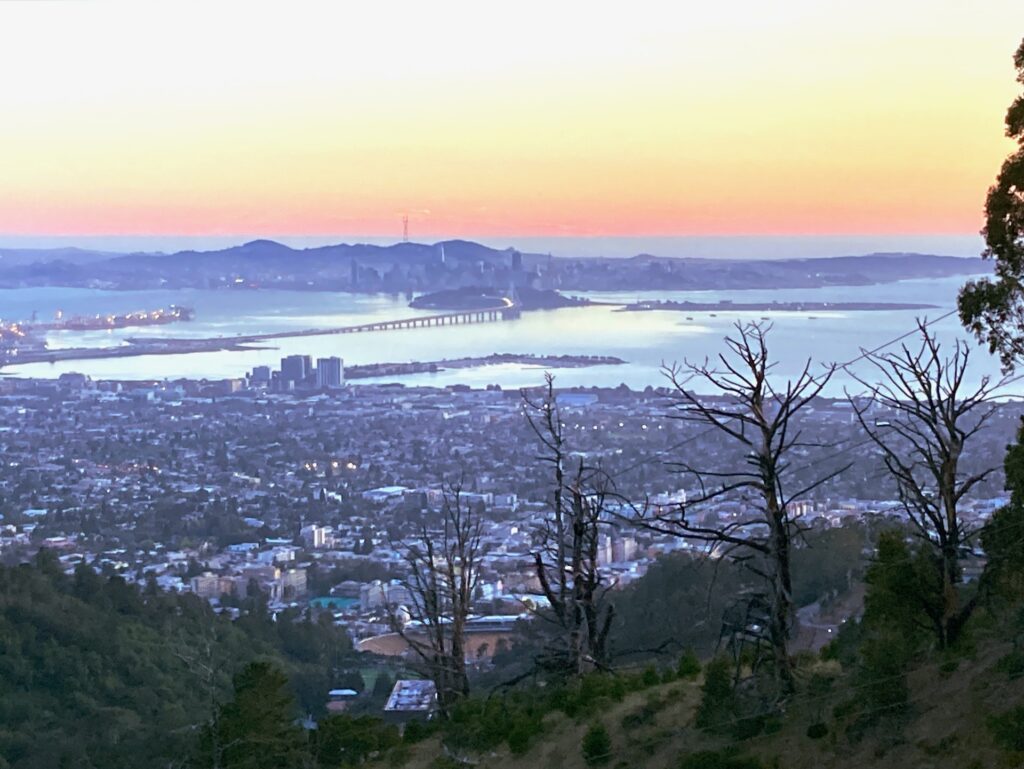
Wendover to Rock Springs, Wyo.

Our room in Wendover looked out onto a rock outcropping which rose up a hundred feet or more behind the motel. After a quick breakfast, I went out and followed an ATV trail up the outcropping. Soon I was fifty feet above the motel, on a level area below the summit of the outcropping. From there I could see the Union Pacific rail lines heading east. A long train squealed slowly around a loop of rail, heading towards the main line. The main line was a straight line across miles of white salt flats, paralleling the interstate highway, both disappearing into the distance. I spent a quarter of an hour on the level area looking at the desert plants there — ephedra (Ephedra sp.), with no leaves to speak of, just stems with chlorophyll; prickly-pear cactus (Opuntia sp.), with a red blossom just gone by; saltbush; sagebrush (Artemisia sp.); and so on. Once again on this trip, I spent far more time looking at the world at my feet, rather than looking up at the awe-inspiring landscape around me.
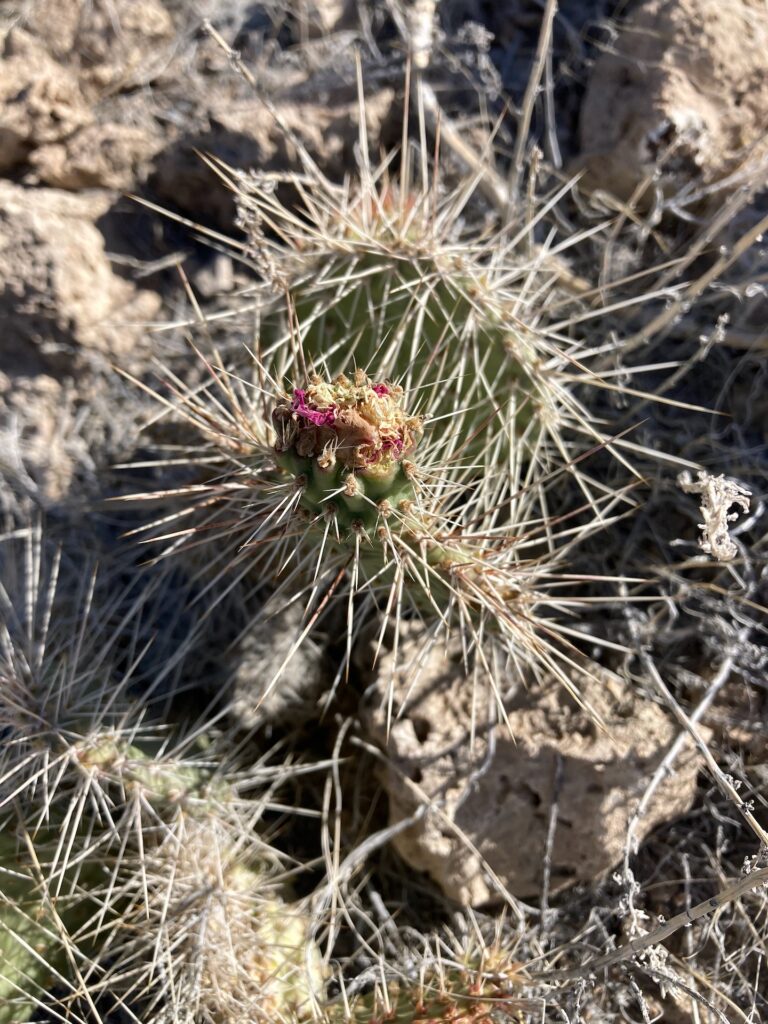
Prickly-pear cactus (Opuntia sp.)

We stopped in Salt Lake City to meet Sandy, an old friend of Carol’s, for lunch. I was fascinated to hear them reminiscing about their days in middle school and high school: the hierarchies of their schools; the track coach who years later would be arrested for molesting his step-daughter; a favorite English teacher, Miss Mountford; the differences between their two families; and so on. I felt they both must have been nice teenagers.

I was especially interested to hear that Sandy serves as a translator for her church’s worship services. She’s fluent in Spanish, so she can translate for English speakers when the sermon is in Spanish. I asked her about the mechanics of translating the sermon, and she said she’s in a sound-proof booth, speaking into a microphone; those who need or want the translation wear an earpiece to listen to her. Maybe someday some of our Unitarian Universalist congregations will be able to do something like that.

I drove as we left Salt Lake. Carol dislikes twisty mountain roads, and the road from Utah into Wyoming is definitely a twisty mountain road. We pulled over at a rest stop at about mile 170 on I-80 for a mid-afternoon snack. There were picnic tables up a steep paved sidewalk, and up another even steeper paved sidewalk was an observation platform. Behind the rest area, a plain dotted with sagebrush sloped up to peaks above.
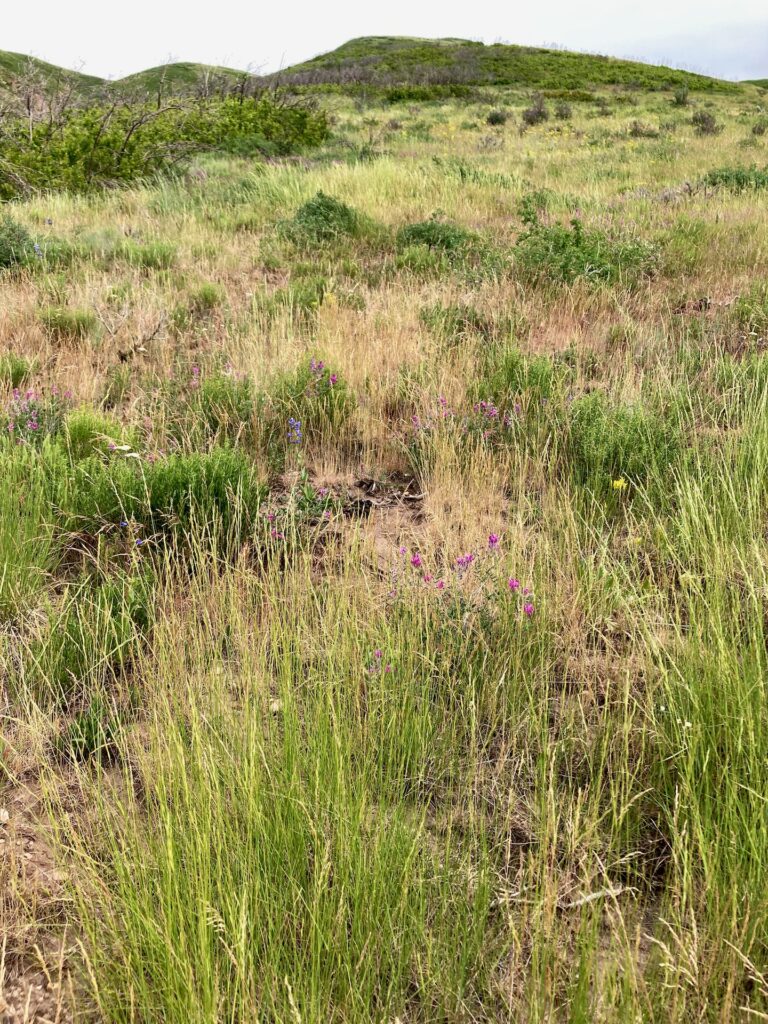
A sign on a fence said that this land was a wildlife management area. I walked through the fence, and out onto that sagebrush-dotted slope. There were flowers everywhere. I spent a happy half hour looking at flowers and taking photographs, until my cell phone rang. It was Carol asking where I was. “You don’t have to hurry back,” she said, “I just wanted to know where you were.” I took her at her word, and spent another quarter of an hour looking at flowers. My favorite was the Sego Lily: three white petals marked with yellow and deep red at their bases, over three cream colored sepals.
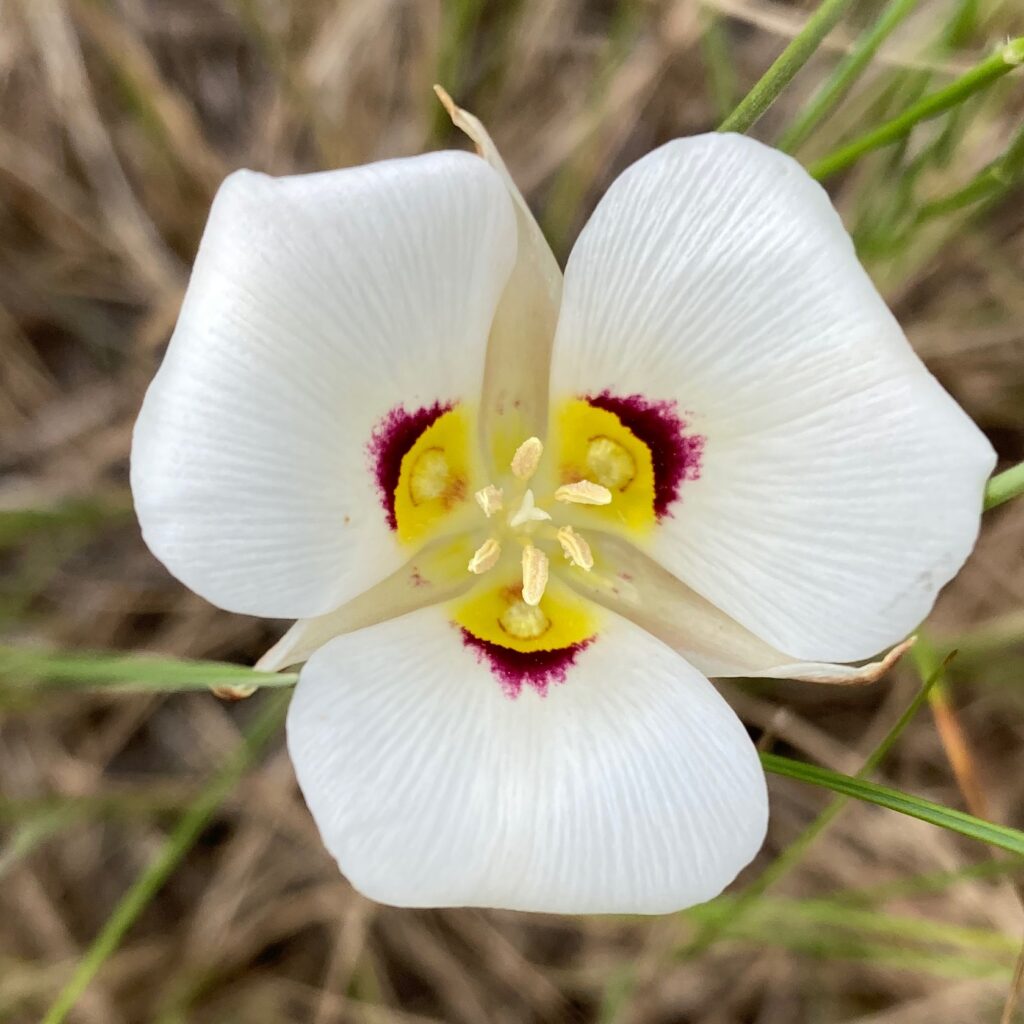
Sego Lily (Calochortus nuttallii)

When we got to Rock Springs, we followed the signs to the “Historic Downtown” area, parked the car, and walked around. We saw some people cooking something outdoors. “Want to go over?” Carol said. At first I said no, but I realized I was hungry, so then I said yes. A talkative woman greeted us, and pointed to a whiteboard with the menu: hot dogs, Kronski’s, and funnel cakes. We asked what “Kronski’s” were, and the woman told us that they were sausages that were made here in Rock City, in fact they were made in the building that we were all standing in front of.

I ordered a Kronski, and Carol ordered a hot dog. A man — who, as it turned out, was the woman’s brother — cooked the sausage and hot dog for us, and the woman gestured to the tray of condiments. We both put sauerkraut on our meat. The man invited us to sit at some tables behind him, and offered to turn off the Ozzy Osborne he’d been listening to, but we said we liked Ozzy. We had a long chat with the two of them. They had just started out this new business, and were trying to figure out how to make it work.

When we finished eating, we thanked them, and finished our walk around the historic district. It was getting dark, so then we drove back to the motel.
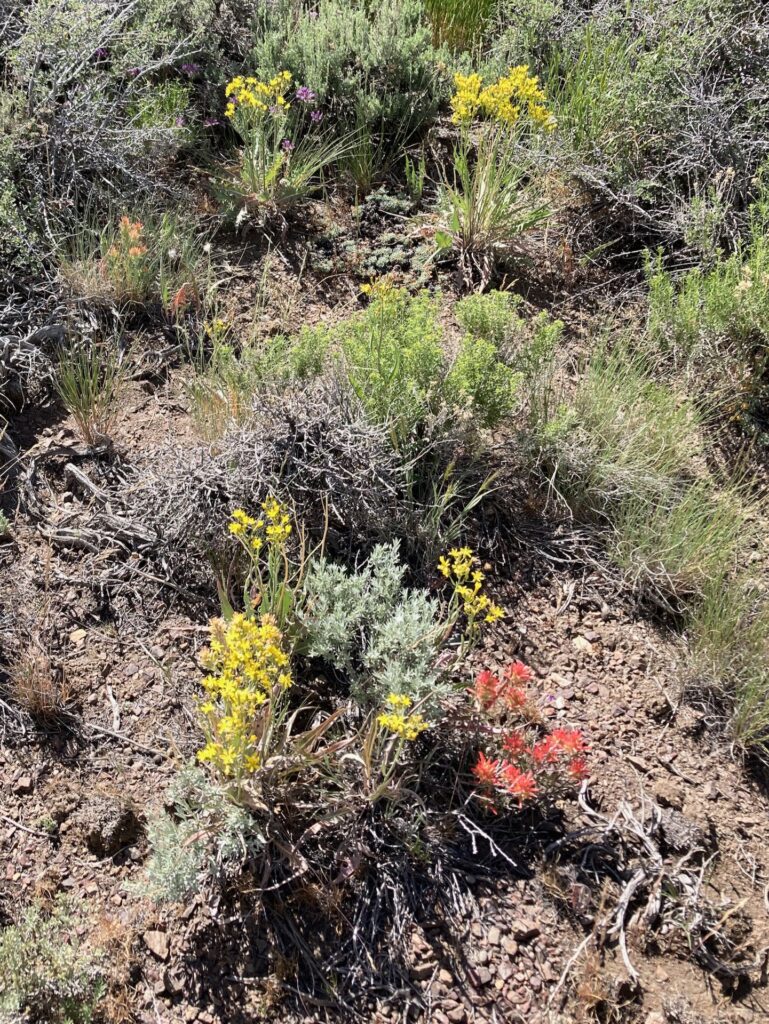
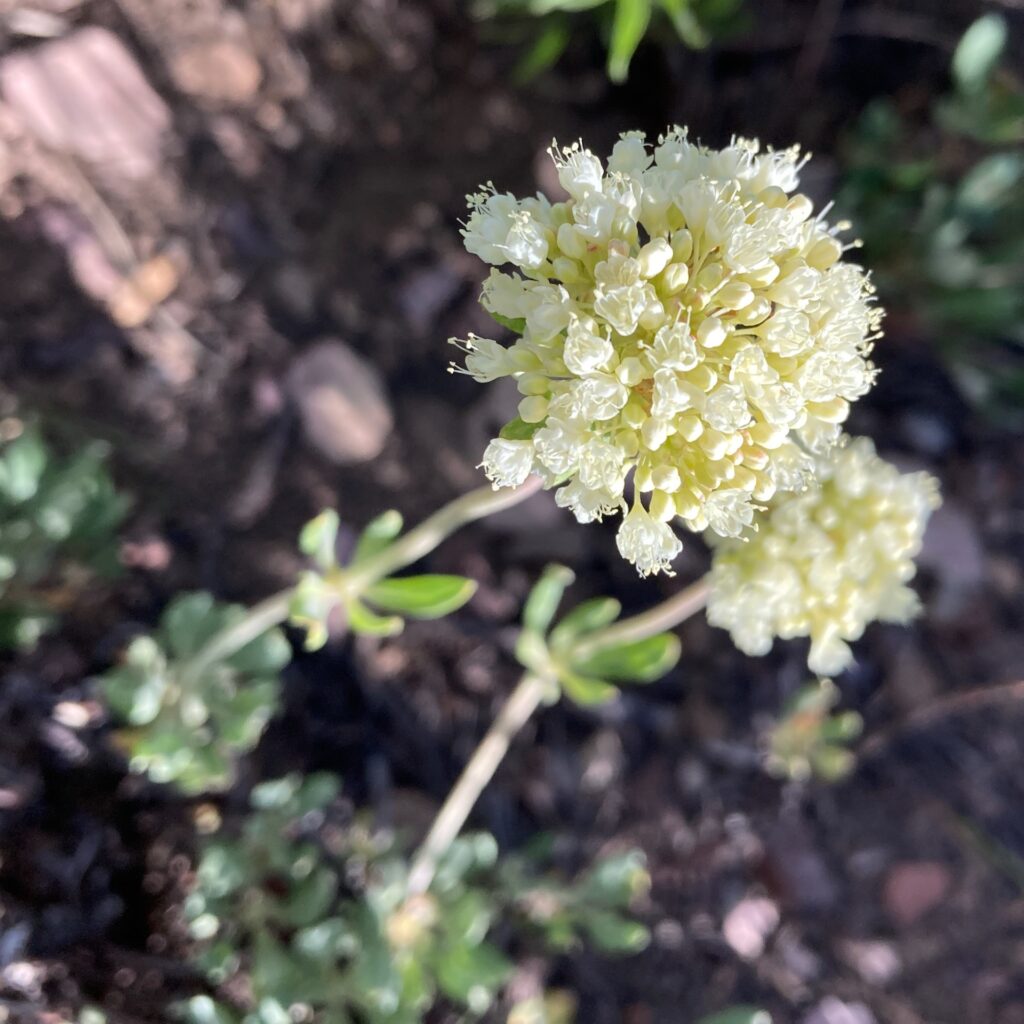
My iNaturalist observations for June 22

Fernley, Nev., to Wendover, Utah

We drove past dramatic scenery today: the Forty-Mile Desert, the green Humboldt River valley in between sagebrush plains, towering 11,000 foot mountains…. But what stays in my mind are the flowers we saw blooming near Pequop Summit.

We parked in the Pequop Summit rest area, elevation 6,967 feet above sea level. We walked over the cattle guard to a dirt road cut into the side of the hill, and then I saw a flower up a fairly steep embankment. I scrambled up to look at it. There was a small Single-leaf Pinyon Pine (Pinus monophylla) just beyond it, then a pale yellow Paintbrush (Castilleja sp.) above that, and then some purple Hooker’s Onions (Alium acuminatum) above that. “Be careful coming down,” said Carol from the dirt road twenty feet below me. I decided that going up was easier than trying to slide down, so I scrambled up to the top of road cut. By now, I was more than thirty feet above the highway, so I must have been over seven thousand feet.

It was beautiful up there. At seven thousand feet above sea level, it was still springtime. Flowers were blooming everywhere. In some places you couldn’t move without stepping on a flower. In among the pungent-smelling sagebrush (Artemisia sp.), sprightly yellow Groundsels (Packera sp.), like tiny little yellow daisies, grew next to low-growing Lava Asters (?) (Ionactis alpina). The Mule’s Ears (Wyethia sp.), with their leaves like the ears of mules and their flowers like little sunflowers, were mostly past their prime, but in the shade of some big sagebrush bushes a few sheltered plants were still in full bloom.

The yellow flowers are Hawksbeard (Crepis sp.), the red ones are Paintbrushes (Castilleja sp.), and the small purple ones are Hooker’s Onion (Allium acuminatum)

In addition to the flowers, small grasshoppers were buzzing and jumping all through the scrubby growth. Birds sang throughout the sagebrush, and as I approached them were apparently surprised that a human was walking through their territories.

All this was happening within sight and sound of Interstate 80. Most of this was happening below the level of my waist. I was so fascinated by the sights, sounds, and smells that I never even looked up to admire the view from Pequop Summit, if there was indeed a view.

Eriogonum sp.

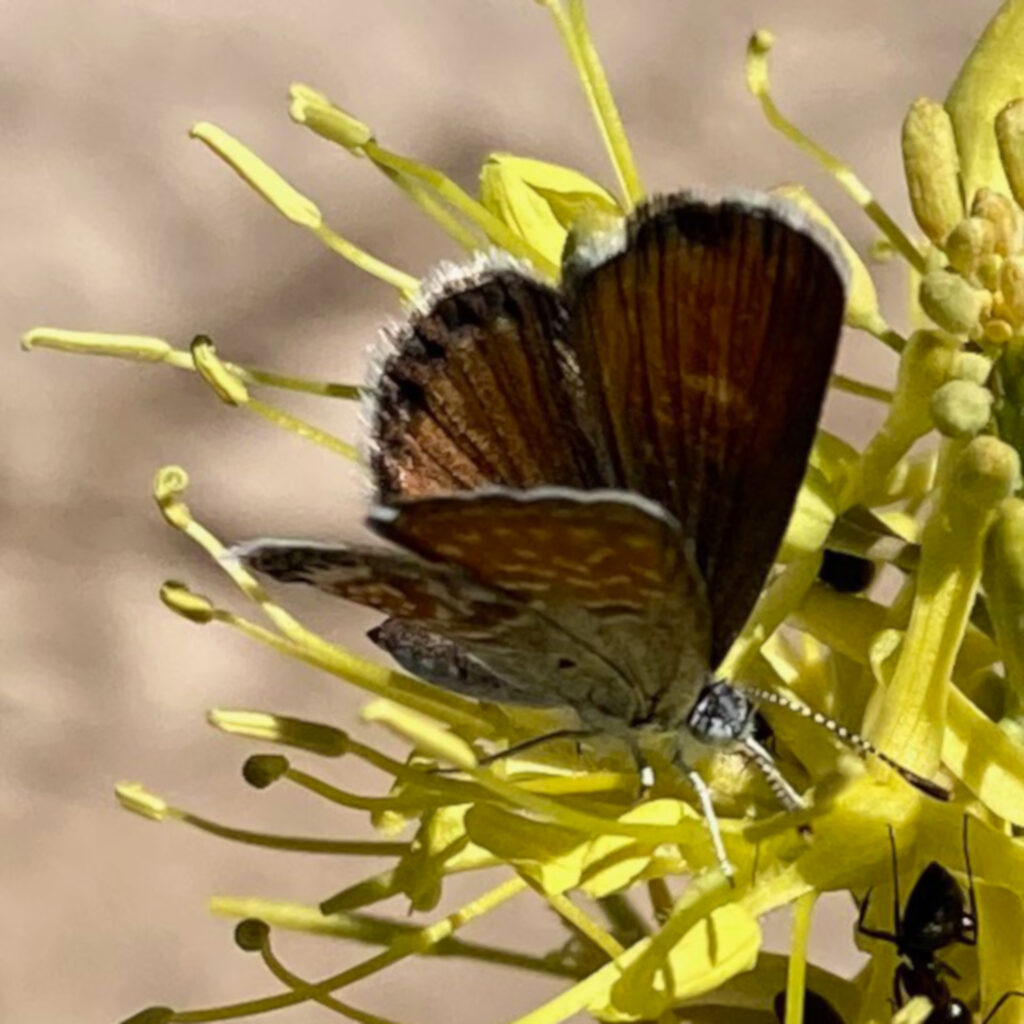
Earlier in the day, we had stopped for a rest break near Oreana, Nev. This was at a much lower elevation, and I didn’t expect to find any flowers in bloom. But I walked a little way down a dry wash, and there found two or three clumps of Desert Prince’s Plume (Stanleya pinnata) blooming. Pollinators swarmed around these flowers, including a Western Pygmy Blue butterfly.

Western Pygmy Blue (Brephidium exilis)

In Oreana as at Pequop Summit, I barely noticed the grand landscape scenery around me: my attention was on the small, intimate landscape at my feet.

My iNaturalist observations for June 21

San Mateo to Fernley, Nev.

We got up early, and kept working from six thirty to twelve thirty. We put a few last items in the moving container, tied the canoe on the car, did some more last minute cleaning, loaded up the car, argued about little things, did a walk-through of the house with Kathy the cemetery superintendent and Joe from the cemetery’s board of trustees. The truck came by at about 9:30 to pick up the moving containers — what a relief that was. The car was packed by noon. It was a “Spare the Air” day, and the smog was unpleasant. We were ready to go.

Thank goodness it was a holiday, the new federal holiday to commemorate Juneteenth. A holiday reduced the traffic from intensely unpleasant to merely horrible. We drove out through the inner Coast Range and into the Central Valley. We stopped at Dixon Fruit Stand, but they had mediocre fruit and durly clerks. We kept driving. Just past Davis, I said, “Let’s get off at Yolo Bypass.” “Where?” said Carol. “Right here, this exit,” I said. Carol zipped off the freeway at the last minute, saying she was willing to do something I wanted to do; meaning I should be nice to her when there was something she wanted to do later in the trip.

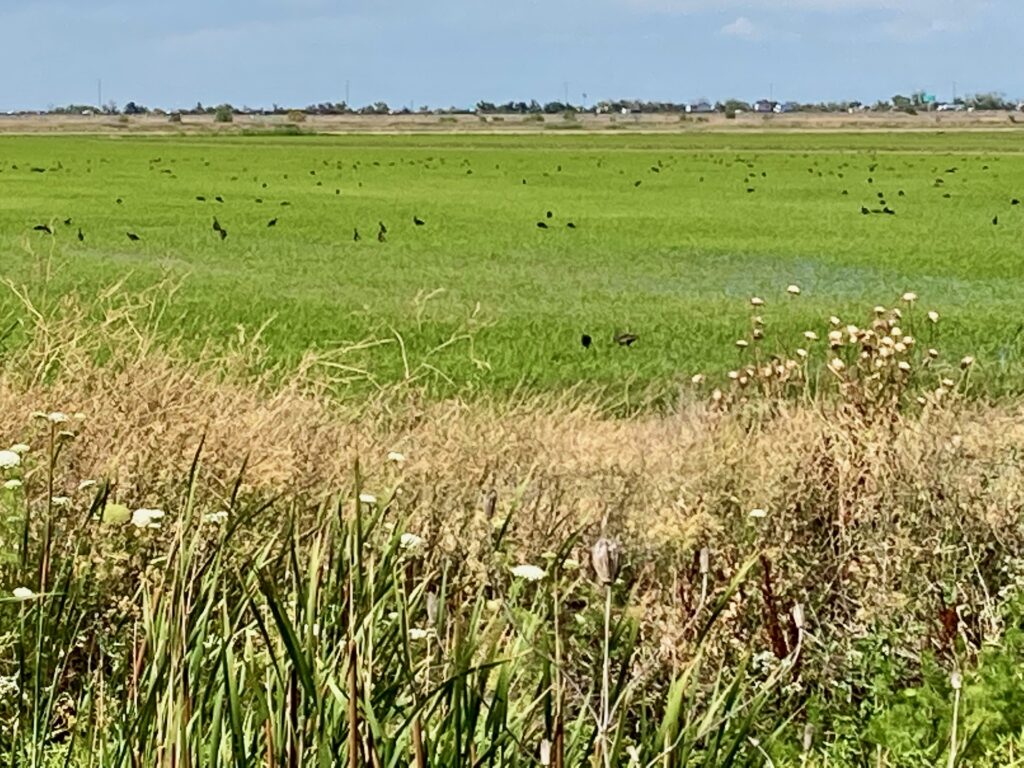
We drove to Parking Lot B, three quarters of a mile into Yolo Bypass Wildlife Management Area. Carol stayed in the car to take care of some business on her phone. I got out into the Central Valley heat, into the intense sunlight. I walked down a road. Yellow Star Thistle (Centaurea solstitialis) lined the road, but just a yard or two from the road, there was a band of tall Bisnaga (Visnaga daucoides), the white umbrels of flowers waving above the feathery green foliage. Beyond that, bulrushes (Schoenoplectus sp.?) grew where the road dropped off into marshlands. Off to my right, green rice fields stretched into the distance. A large flock of White-faced Ibis circled overhead, then settled into the rice fields.

White-faced Ibis in a rice field, Yolo Bypass Wildlife Management Area

After this stop, I felt different. I felt sane. Packing up and emptying out the house had felt strange, not completely moored in reality. The first two hours driving in the car still felt a little detached from reality. But the brilliant sunlight, the flowers, the pollinators, the birds, the jackrabbit loping lazily across the road — it felt like I was reconnecting with reality.

While I was photographing a flower, a man pulled up in his car, and spoke through the open window. “Um, I was just curious what you’re doing there. Not that you have to tell me, but…”

“Do you know this social media app iNaturalist?” I said. He didn’t. I explained that you could take a photo of a plant or animal, upload it, and get an identification. “I got into flowers recently,” I said, “and that’s how I’m learning them.” He asked me a few questions, then got ready to move on. “I’m Thomas, by the way,” he said. I introduced myself, then he drove off.

I walked slowly back to the car. Carol got out to take a short walk with me, but we agreed it was too hot, so we started riving again.

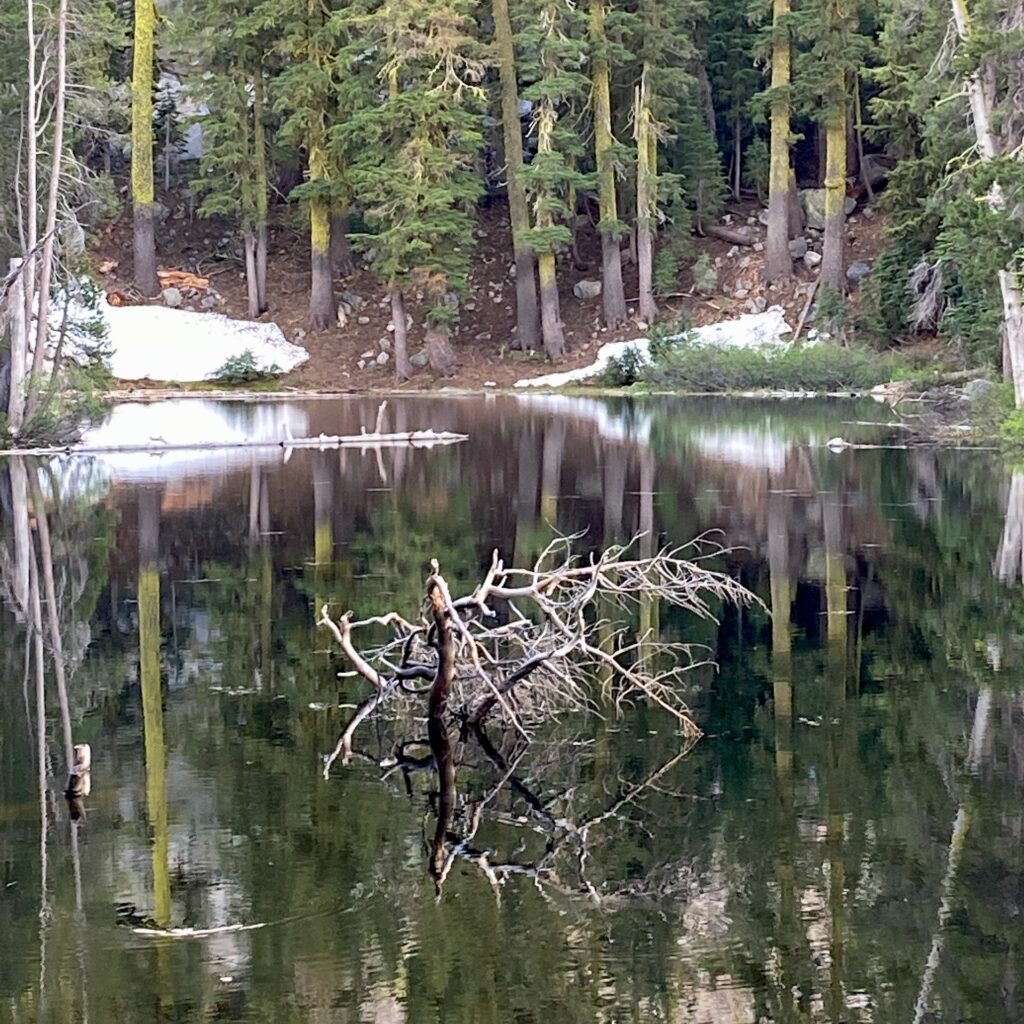
We stopped again at the Donner Pass rest area, and walked the little half mile loop next to the parking lot. It was already summer in the Central Valley, but it was still spring in the High Sierras. I saw a manzanita (Arctostaphylos sp.) still in bloom. We came to a small pond, and on the opposite shore there was still some unmelted snow.

Unmelted snow near Donner Pass

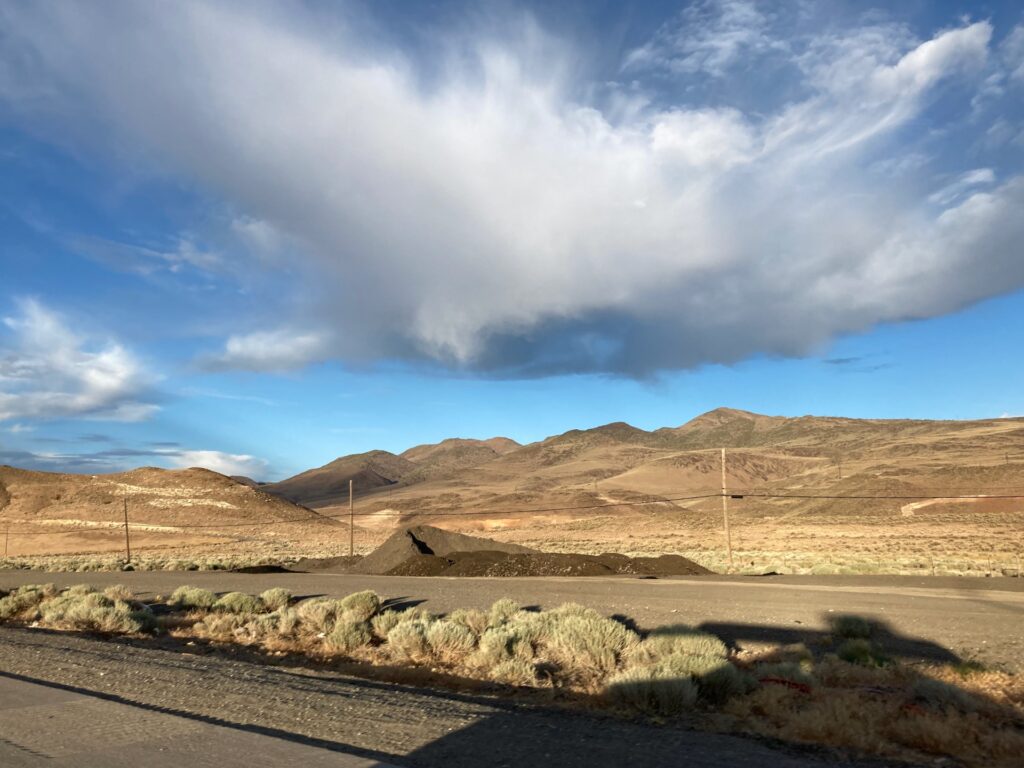
Then down the eastern slope of the Sierras into Nevada. Now we were in the dramatic landscape of the Great Basin. I noticed the canoe on top of the car cast an odd shadow as we drove.

Near Reno, on I-80

As sublime and awe-inspiring as the landscape was, it had been permanently marked by humankind. The philosopher Martin Heidegger, Nazi sympathizer though he was, had a useful insight with his concept of “Enframing”: part of the logic of modern human technology is to exclude all other ways of thinking about the world.

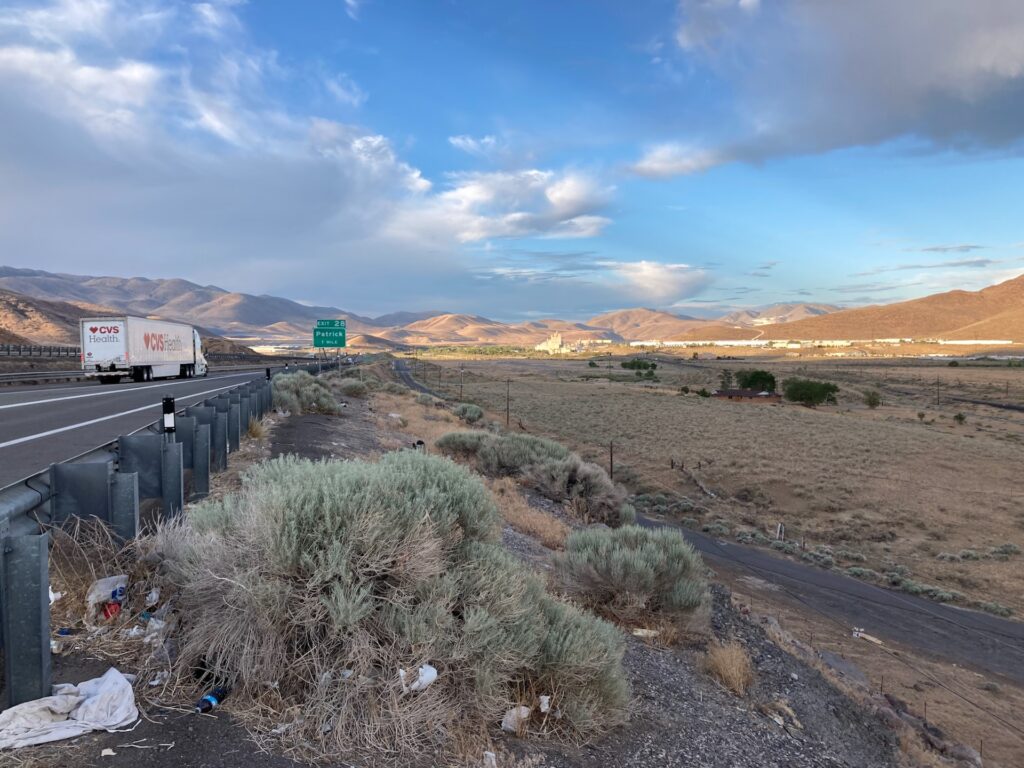
Patrick, Nev.

That sublime Nevada landscape is completely surveyed, marked out with roads and power lines, dotted with trash and effluvia; the habitats of plants and territories of birds must fit into the interstices of that human framework.

We drove on under the awe-full evening sky, and checked into our motel in Fernley, Nev.

My iNaturalist observations for June 20

San Mateo

The day before a road trip is usually busy. When you’re taking a road trip to move across the continent, the day before a road trip is especially busy.

Tomorrow we start driving to Massachusetts. We spent the day packing up the last of our belongings into moving containers. In the morning, we felt a bit frantic thinking of all we had to do today. Fortunately, Nancy and van came over to help out. They also brought food and, best of all, conversation. We had a pretty cheerful day.

While I was packing the moving container, half a dozen neighbors stopped by to ask us where we were moving to. Two of those neighbors were people I had never seen before. We’ve had a hard time meeting people in the neighborhood; I guess we should have moved out sooner, we would have met more people.

We face a busy day tomorrow. I’m going to crawl into bed — no, I take that back, I’m going to crawl into my sleeping bag. I’m so tired I’ll probably fall asleep immediately, even though I will be sleeping on the floor.

Happy Watergate Day

Long-time friend JB (no, not that JB, this JB) just reminded me that on June 17, 1972, 50 years ago this Saturday, undercover police arrived at the Watergate Complex to investigate a possible break-in. The police arrested five guys wiretapping and burglarizing the headquarters of the Democratic National Committee there. These five hapless idiots actually had a lookout across the street who was supposed to keep an eye out for police, but he got hooked watching a B-movie, “The Attack of the Puppet People.” Ultimately, it turned out the president of the United States, Richard Nixon, had authorized the break-in, and the subsequent cover-up. Nixon would famously declare on national television, “I Am Not a Crook.” Very few people believed him.

Please do not draw unhealthy parallels between Richard Nixon and Donald Trump. Trump had nothing to do with the storming of the Capitol building on January 6, 2021. Nor has Trump tried to cover up his involvement in that armed insurgency. The big difference between Trump and Nixon is that Trump is actually in fact and really truly the lawfully elected president of the United States. He won the 2020 election. Trump is not a loser like Nixon. He is a winner. Therefore, everything he does is lawful, by definition. Donald Trump Is Not a Crook. Now that we’ve gotten that out of the way (no parallels between Nixon and Trump! none!), let us continue.

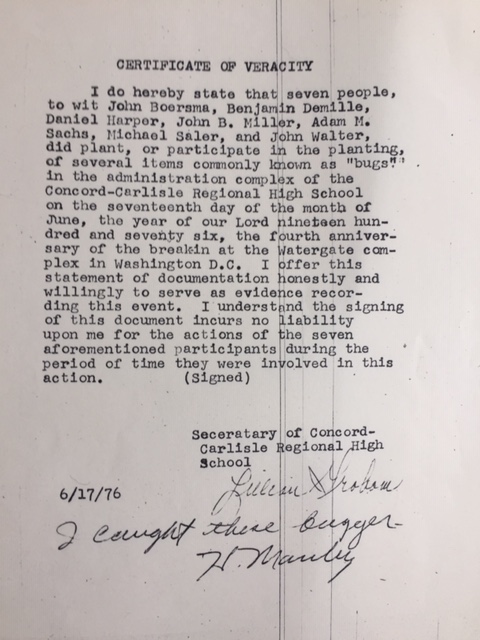
I was in middle school when the Watergate break-in happened. The subsequent Watergate scandal and the eventual melt-down of the Nixon administration had a big impact on people in my age cohort. I was in high school on the fourth anniversary of Watergate Day, and six of my friends and I decided to engage in some political theatre: we would “break in” to the main office of the high school, and plant some bugs (dead insects we found lying around school somewhere). Then we would ask the secretary to sign a document we prepared in advance, attesting that we had “bugged” the office.

We were all about 14 or 16 years old, and both disgusted and fascinated by the spectre of the American political system as it unraveled before our eyes. We could barely keep from giggling as we carried out our plan. As the secretary willingly signed our “Certificate of Veracity,” the assistant principal, the man in charge of discipline at the high school, walked in. He barely restrained his own laughter, and at the bottom of our “Certificate” wrote: “I caught these buggers,” then signed his name.

This story of political theatre is primarily aimed at today’s middle school and high school students. Perhaps it will serve as inspiration for you on the fourth anniversary of the storming of the Capitol building.

Happy Watergate Day.

Thanks to J.B. for sending along this photo of the Certificate of Veracity

Moving by the numbers

We’re getting ready to move to Massachusetts, some 3,150 miles away (give or take a couple of hundred miles).

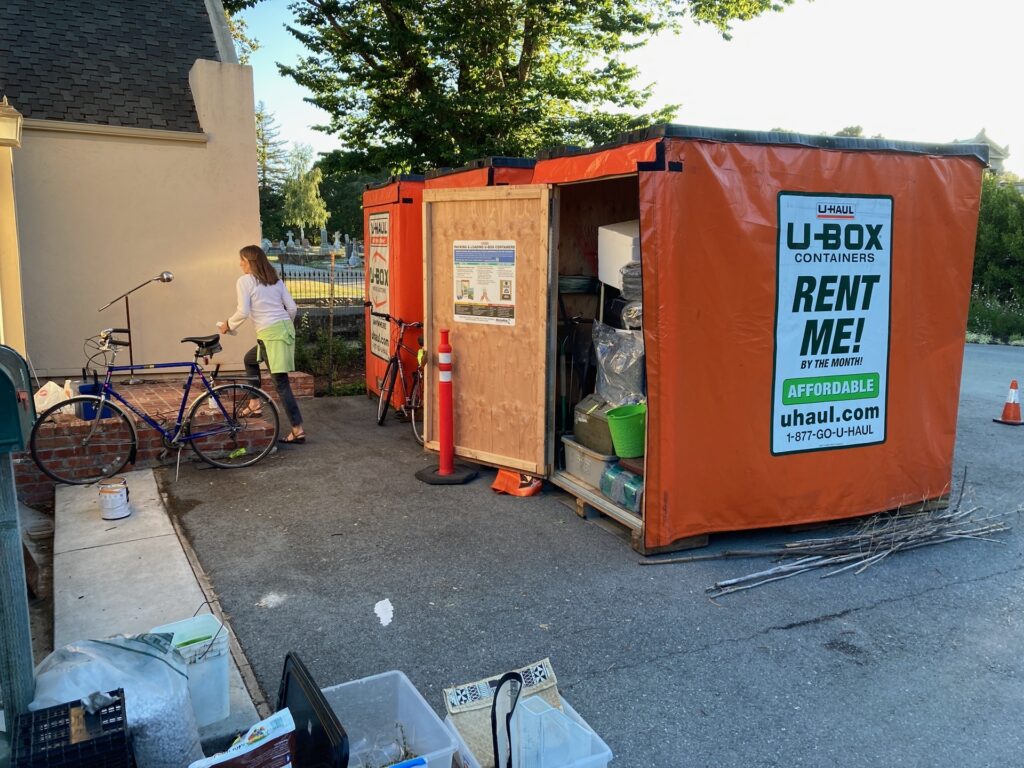
Right now, we’re packing all our belongings into four moving containers that are approximately 8 feet deep, 5 feet wide, and 7 feet high, or 1120 cubic feet. When we moved to California in 2009, we fit everything into a moving container that was 8 feet by 8 feet by 12 feet, or 768 cubic feet. Somehow in the last 13 years we’ve accumulated another 352 cubic feet of belongings. We would be poster children for consumer capitalism, except that many of our belongings have been scrounged or otherwise obtained outside of consumer capitalism.

We’re using a lot of cardboard boxes to pack up all these belongings. I find myself astonished at the number of cardboard boxes we’re packing up, and schlepping out to the moving containers, and then stacking up. After a week of this, my muscles feel a little sore. I don’t like owning all this stuff. But I have enjoyed spending this past week not sitting at a desk, or logging onto videoconference meetings, but instead engaging in constant physical activity. I’ve lost an inch around my waist, and I feel fit and strong.

We’ve also been giving lots of stuff away. Carol is part of the local Buy Nothing group, and they’ve taken some of the stuff we don’t want to move. One woman just came up and mostly filled the back of her small SUV with things she wanted to take away, including a Tree Mallow (Lavatera sp.) we had growing in a galvanized metal washtub. Another of Carol’s friends is coming up this afternoon to take away an eight foot high potted bamboo plant. Carol has also sold some clothes on Poshmark, and we’ve taken other things to Goodwill. There is a thriving network of exchange that exists partly within the dominant capitalist economy (Poshmark, Goodwill), and partly as a non-capitalist parallel economy (the Buy Nothing Project).

Time to get back to working, putting cardboard boxes into moving containers. Watch this space for further updates….

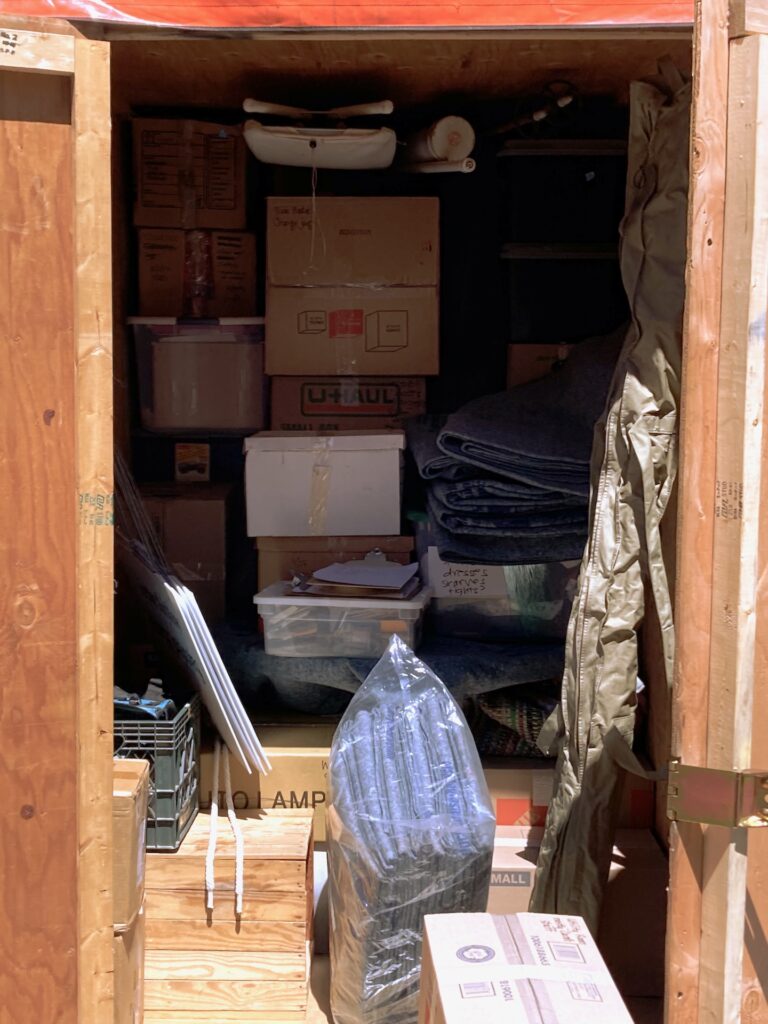
Far too many cardboard boxes inside a moving container

View from Grizzly Peaks

In the 2003-2004 school year, I drove to work every day from Oakland to Kensington along Grizzly Peaks Boulevard. The road winds through the Berkely Hills, rising to almost 1,500 feet above the level of San Francisco Bay, just a few miles away. That commute had the most spectacular views of any commute I’ve ever driven. On my way home from work, I could stop at a number of roadside pullouts, and admire a spectacular view of the Bay, the Golden Gate, and the Pacific Ocean beyond.

Today we went to visit my cousin Nancy, who lives in North Berkeley. Nancy suggested we drive home via Grizzly Peaks. We wound up on the highest point of the road right after sunset. The city has blocked off the roadside pullouts and posted No Parking signs everywhere, but scores of people parked along the road anyway to enjoy the last red-gold light of the setting sun over the Pacific Ocean. We pulled over (right in front of a No Parking sign) to enjoy one of our last views of the sun setting in the ocean. In another month, we’ll be in New England, on the other side of the continent, watching the sun rising up out of the ocean….

Foreground: Slopes of the Berkeley Hills. Near distance: University of California and downtown Berkeley. Middle distance: San Francisco Bay with (l-r) the lights of the Port of Oakland, the Bay Bridge, Yerba Buena Island, Treasure Island. Opposite side of the Bay (l-r) part of San Bruno Mt., San Francisco; the Golden Gate is just out of the picture to the right.

Quoted without comment

From Ursula K. LeGuin, from her science fiction novel The Left Hand of Darkness:

“To be an atheist is to maintain God. His [sic] existence or his non-existence, it amounts to much the same, on the plane of proof. Thus ‘proof’ is a word not often used among the Handarata, who have chosen not to treat God as a fact, subject either to proof or to belief: and they have broken the circle, and go free.”

“Whitened Buddhism” and the opiate of the masses

Carolyn Chen, a UC Berkeley sociologist who studies religion, spent the last few years studying religion in Silicon Valley. She’s especially interested in the way work has become a religion for the tech workers of Silicon Valley — and in the way tech companies use religion to keep their workers in line.

Not surprisingly, given the stark realities of Silicon Valley, Chen finds that White supremacy is alive and well in this toxic mix of work, religion, and corporate control. In her book Work Pray Code, Chen writes about how tech companies co-opt Buddhism in service of making workers compliant and more productive:

“Most White Westerners don’t realize that the Buddhism they know is a particular brand of Buddhism that has been repeatedly altered and adapted to appeal to them…. This brand of ‘nonreligious’ Buddhism, however, has racial implications. It associated Asian Buddhism’s ‘rituals, robes, and chanting’ with ‘the complications of religious tradition.’ It dismisses the religious reality of most Buddhists who are Asian and is therefore a form of White supremacy….”

For this last insight, Chen cites Race and Religion in American Buddhism: White Supremacy and Immigrant Adaptation by Joseph Cheah (Oxford Univ. Press, 2011); looks like I’ll have to add that book to my reading list. Chen then goes on to detail the ways in which Whitened Buddhism ignore the religious realities of Asians:

“For the vast majority of Buddhists who reside in Asia, Buddhism is a devotional faith that involves the veneration of deities and beliefs in the supernatural. For example, in Chinese, the phrase that describes practicing Buddhism, ‘bai Buddha,’ translates to ‘worship Buddha.’ Most lay Buddhists in Asia orient their devotional practices — offerings of incense and fruit, ritual chanting, praying, bowing, donating money to temples and monasteries — to the attainment of merit or a favorable rebirth….”

Of course, for Silicon Valley tech companies enamored of Buddhism, what Buddhism is really all about is things like meditation. And meditation is supposedly a value-neutral “technology,” not a religious practice. Whitened Buddhism focuses on things, like meditation, that can increase worker productivity and worker compliance. Whereas non-White Buddhism is deliberately ignored:

“Whitened Buddhism tends to protray the ‘religious’ Buddhism of Asians and Asian Americans as burdened by unnecessary accoutrements — ‘complications,’ ‘culture,’ ‘folklore,’ ethnicity,’ baggage’ — that distract from the essence of the Buddha’s teachings. For example, Mandy Stephens, whose company runs a meditation app for corporate clients, explains that they distill medication to ‘the fundamentals,’ ‘the part that isn’t religious or spiritual.’ Her company gets to ‘the fundamentals’ by getting rid of teachers who are ‘zany gurus’ [i.e., non-White] and replacing them with ‘strait-laced [White] trainers’ in [Western] business casual clothes. The chanting at the local Asian temple is ‘folklore,’ says former tech executive Pierre Beaumont, irrelevant to ‘what’s good for me in meditation.’ Mandy and Pierre dismiss the very elements of Buddhism that tens of millions of Asians hold most dear.” [my comments in brackets]

Because if you’re White, it’s apparently OK to co-opt whatever you want out of other religious traditions, and use it for whatever you feel like. And then you can say it’s not even really religion: “This Whitened Buddhism becomes a ‘universal philosophy’ and ‘science.’ It become ‘White’ — floating above context, invisible, and normal….” [Chen, excerpts from pp. 165-167]

I find the entire Silicone Vally Religion of Work to be repellent. But I find this especially repellent: co-opting a non-White religious tradition, perverting it from its original purpose to stop the endless cycle of rebirth, and instead using broken bits of it to control workers.

Indeed, as Chen notes elsewhere in her book, when tech companies offer things like meditation and mindfulness training to help tech workers deal with the overwhelming demands of Silicon Valley overwork, these companies are merely offering “therapeutic interventions, Band-Aids lovingly applied to deep and gaping wounds. Their programs might not be too distant from the ‘opiate of the masses’ that [Karl] Marx wrote about.” [Chen, p. 85]

Nine more copyright free hymns

Nine more copyright-free hymns. Yes, you can use these hymns online without having copyright trolls harass you. They’re in this Google Drive folder, along with 91 others — making a total of 100 copyright-free hymns in that folder.

Of interest in this batch of copyright-free hymns:

There are 3 hymn tunes by Thomas Commuck, the first Native American composer to publish his music. In two cases, I found texts in a current UU hymnal with copyright-protected music, and substituted one of Commucks’ tunes instead. In the third case, I found a lovely text by Frances Ellen Watkins Harper, the African American Unitarian poet from the mid-19th century, and paired it with a Commuck tune. These three hymns will be of interest if you’d like to include an Indigenous composer in your worship music.

For “Hush, Somebody’s Calling My Name,” I found a 1923 arrangement by J. B. Herbert, based on melodies provided by Rev. Turner Henderson Wiseman (1881-1939). T. H. Wiseman was a charismatic African American minister of the early twentieth century. On Feb. 7, 1914, the Kansas City (Mo.) Sun called him “a brilliant young minister,” adding: “Perhaps there is no young man in the ministry of the African Methodist Episcopal Church who has made such an enviable reputation as Rev. T. H. Wiseman…. Rev. Wiseman is not only a pleasing and intellectual preacher of the Gospel, but is one of the most accomplished and sweetest singers of the race.” He made a number of recordings in the 1920s, many of which you can find online. His quartet’s recording of “Hush” is online at the Internet Archive, and is well worth listening to. In the notes to this hymn (see below), I discuss what Wiseman’s contribution to this song might have been.

(Researching these nine hymns was painful. My brain hurts. I need to take a break from this copyright-free hymn project.)

Notes to all nine new hymns below the fold.

Continue reading “Nine more copyright free hymns”