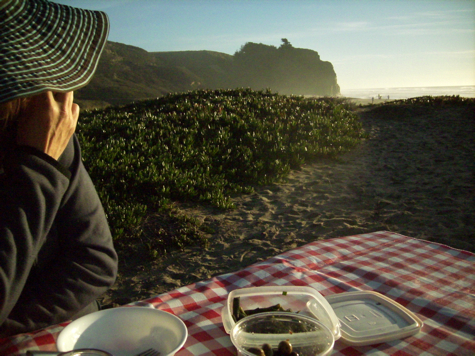
Sausage-and-apple ravioli, green beans garnished with garlic chives that grow on our balcony, and olives. At Pomponio Beach 12 miles south of Half Moon Bay. It was kind of chilly.
Yet Another Unitarian Universalist
A postmodern heretic's spiritual journey.
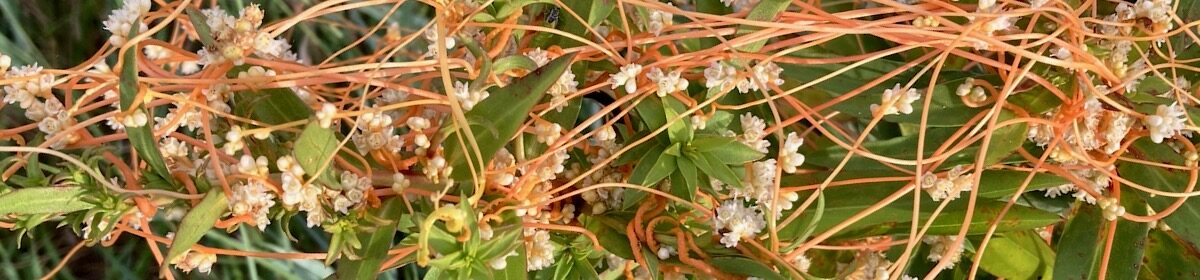
Sausage-and-apple ravioli, green beans garnished with garlic chives that grow on our balcony, and olives. At Pomponio Beach 12 miles south of Half Moon Bay. It was kind of chilly.
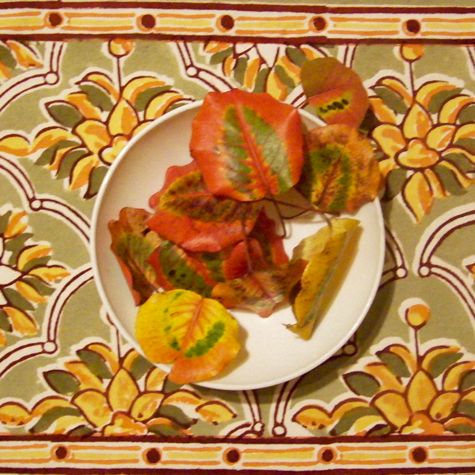
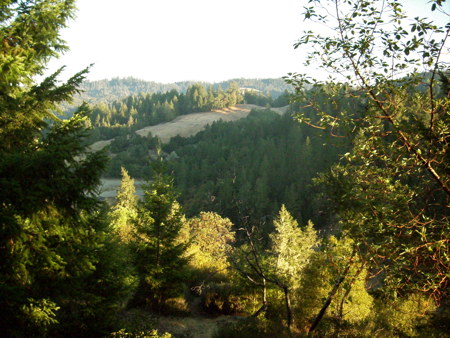
The view from St. Dorothy’s Retreat Center, Camp Meeker, California, where I am on retreat.
(Posted a day late due to slow Internet connection at the retreat center)
The weather forecast said that today would be the hottest day of the heat wave, with temperatures expected to climb up to ninety-five degrees: just the kind of fall weather in which temperature inversions form. Sure enough, as I drove across the San Mateo Bridge this morning, I realized the air closest to the ground had a definite yellowish tinge; above a certain altitude, about a thousand feet there was an abrupt transition from that yellowish color to no color at all. The heat and sunlight was creating smog, and a temperature inversion was keeping the smog from dispersing upwards. My throat has felt a little raw since the hot weather, and the attendant temperature inversions, began two days ago, and now I could see the cause of the rawness: the nasty yellow-tinged smog I was breathing in.
We’re having one of those Bay area hot spells that come in late September or October. As I drove across the San Mateo Bridge, I looked ahead at the Peninsula. The hills of the Coastal Range were pale blue in the haze. I could see horizontal bands where the hills were more or less obscured: temperature inversions. When I got back to San Mateo and rolled down the car windows, there was a faint smell of smog in the air, and the temperature must have been over ninety degrees. And it’s supposed to be hotter tomorrow. And it’s supposed to continue for several days….
It rarely rains in the Bay area in summer time, but today we had a few scattered rain showers.
Just now, I was sitting at my desk, and happened to look up at the sky. I can’t see much of the sky from where I sit: trees and buildings limit my view. But there, in the small portion of the sky I could see, was part of a rainbow. I stepped outside to look at it. There was one small rain shower coming down from the clouds to the east — I could see the gray streaks of rain — and a little patch of sunlight just happened to light up that portion of the sky, causing a rainbow that encompassed about fifteen degrees of a complete circle.
I stood and watched it for about five minutes. At its brightest, there was the main spectrum, then immediately under it a smaller spectrum, the blue of the larger one fading directly into the red of the smaller one, and under that an even smaller spectrum. But soon the rain shower drifted out of the patch of sun, and the rainbow faded away.
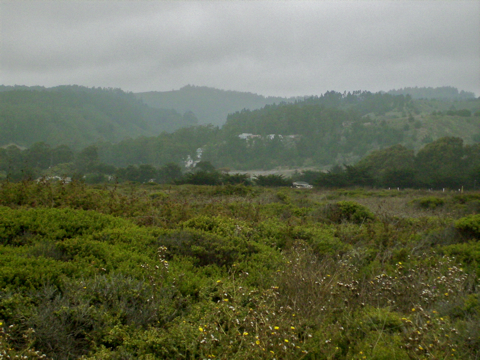
I took a drive coastside with E and Eric today. This is what we saw looking back towards San Mateo.
Once every two and a half years or so, the moon becomes full twice in the same month. The second of these full moons is called a “blue moon.”
Tonight Tomorrow night* is the second full moon this month:
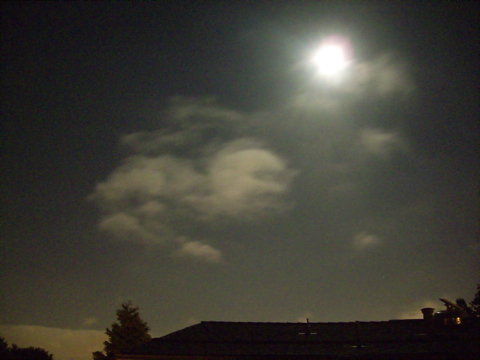
*Thanks to E and Eric for the correction.
I’ve been leading a monthly memoir writing at church. I do the exercises, too, and recently I wrote about something that happened almost exactly thirty years ago this week. So here are my memories of that day. I’ve changed the names, because there’s no reason to give those names to intrusive search engines.
August —, 1982
During the summer, the lumberyard always hired someone extra to help out in the in the yard, and to help out stocking shelves in the store. Summers were busy, and there was always at least a truck driver, or one of the yardmen, or the stock clerk, on vacation. One summer they hired Bud, whose father worked in the building trades, and who lived in one of the streets back in behind the lumberyard. He was a few years younger than I, which means he must have been seventeen or eighteen. If you saw him, you’d describe him immediately as a good guy: he was always smiling and cheerful, he always worked hard and he was in great shape.
Continue reading “Memoir”While we were away at General Assembly back in June, some of the plants we had growing on our little balcony shriveled up for lack of regular water. So today we went to the little nursery down the street from our apartment and bought a couple of drought tolerant plants — a good-sized lavender, and a small aloe vera. At home, I dug up some garlic chives and put them in a large pot, repotted an aloe vera plant we already had, and planted some nasturtiums in the planter box. It is remarkable how good this made me feel: I find taking care of plants to be enormously satisfying. I am only a few generations removed from a time when most of my ancestors grew or raised or hunted or gathered a significant portion of their food. We did not evolve to be “knowledge workers.”