Native American members of a church that became UU

(I don’t usually link to my sermons, because reading sermons can be about as interesting as watching paint dry. But today’s sermon had some interesting history in it, and I’ll provide direct links to the interesting bits so you can skip the boring bits.)

In the 17th century, our congregation, First Parish in Cohasset, had at least two Native American members.

Sarah Wapping joined our church on January 7, 1738 [N.S.], exactly 296 years ago today. Not much in the historical record, but I found a few things to say about her.

Naomi Isaac joined our church on September 19, 1736 [N.S.]. I may have found out more about Naomi Isaac’s life — though you have to read the footnotes so you can see why much of what I say is only tentative.

None of this is to imply that either Naomi Isaac nor Sarah Wapping was a Unitarian Universalist. Our church was not Unitarian in the 1730s. It was a fairly liberal Christian church for its time and place, since it was under the influence of Ebenezer Gay of Hingham; but it was not yet a Unitarian Universalist congregation.

Nevertheless, it’s still very interesting that our congregation had Native American members i the mid-eighteenth century. There were Black members, too. Thus, in spite of a rigid racial hierarchy, in the mid-eighteenth century ours was a multiracial congregation. Then by 1790, the town of Cohasset had become entirely White (the 1790 U.S. Census reports no non-White population at all), and the congregation was also entirely White. The town and church went from moderately racially integrated, to entirely segregated in the space of half a century.

Noted without comment

— A character being interrogated by the fictional lawyer Perry Mason, in Erle Stanley Gardener’s The Case of the Rolling Bones (William Morrow, 1939).

Intersectional

Christian Cooper, a self-described gay Black nerd, writes:

“Some African Americans — some of the ones who aren’t LGBTQ — dismiss the gay experience because, unlike Black folk, gays can blend in at will…. Being Black and gay, I find the ‘Who’s More Oppressed?’ sweepstakes exasperating. There can be no winner, and it creates the false impression of a stark divide between communities. (It also ignores a special case where the gay and Black experiences are remarkably similar: the situation of light-skinned African Americans who hide their heritage to ‘pass’ as white, which maps closely with the experience of being in the closet.) The reality is that these experiences live together in the brown-skinned, queer bodies of hundreds of thousands of people, including me.” [Better Living Through Birding, pp. 25, 26-27]

As a gay teenager, Cooper found refuge in the nerd worlds of birding, and of science fiction and fantasy. (Coincidentally, he and I were both at Noreascon in 1980 worldcon, which is the only worldcon I ever attended.) Which is kind of interesting, since both birding and science fiction fandom are astonishingly White.

Year in review, pt. 2

In part 1, I reviewed the year in U.S. religion. In this second part, I’ll review they year in Unitarian Universalism.

How non-UUs viewed us

Let’s start with how others perceived us this past year. Unitarian Universalists are a tiny, tiny group, but we made the news with four stories this year. I’ll start with the lesser stories, and save the big one for the end.

1. Religion News Service (RNS) covered the annual General Assembly of the Unitarian Universalist Association (UUA) back in June, and wrote about two main stories. One story, with the headline “Unitarian Universalism revisits identity, values at 2023 gathering,” talked about the proposed revision to ARticle II of the UUA bylaws. It was the kind of article where you felt the reporter was working pretty hard to make it sound newsworthy. Revising bylaws isn’t going to be of much interest to non-Unitarian Universalists.

2. RNS was much more interested in the fact that the “Unitarian Universalists elect first woman of color, openly queer president,” especially considering the fact that this new president was taking over from the first woman who served as president. They wrote (by my count) four separate articles on this basic story.

Continue reading “Year in review, pt. 2”

Year in review, pt. 1

It’s been an eventful year, both for U.S. organized religion generally, and for Unitarian Universalism in particular. In this post, I’ll start by reviewing some of the key developments in organized religion in the U.S. In a second post, I’ll review some of the explosive developments within Unitarian Universalism.

1. Culture wars and religion

Religion is right at the center of the ongoing escalation of the culture wars in the United States. And the role of religion in the culture wars has gotten more complex than ever. To try to make sense out of it all, I’ll consider some of the culture wars battlegrounds separately.

Continue reading “Year in review, pt. 1”

Police departments vs. labor

Starting with the George Floyd protests in 2020, we began hearing calls to defund police. Police departments, so the thinking went, mostly served White interests, and thus tended to support White supremacy. This argument may have been valid, but it ignored other interests that have controlled police departments in the U.S.

“On May 28, 1937, a strike of seventy-eight thousand steelworkers spanned seven states in the Steel Belt from Homestead to Chicago. The Little Steel Strike of 1937 showed that business would not accommodate unionization even in the face of federal directives. Little Steel companies came prepared. They each bought tens of thousands of dollars’ worth of tear gas, gas grenades, pistols, and rifles to supply to local police and corporate guards to stop a strike. A congressional investigation found that the companies together had purchased $178,000 worth of such armaments. Bethlehem Steel had directly paid the policemen’s salaries. In Chicago, on Memorial Day, came the climax of the strike, when a thousand strikers took American flags and began to walk toward the steel mill. When told to disperse by police, they refused. The police fired on the crowd in what was reported as the Memorial Day massacre, killing seven and wounding ninety. Most of the injured were shot in the back. The strike fell apart soon after….” (Louis Hyman, Temp: How American Work, American Business, and the American Dream Became Temporary [Viking, 2018], p. 35)

That’s just one small example of how police have always served the interests of corporate employers over the interests of working people. Police departments are still serving corporate interests over worker interests. I’ve never heard of a police department protecting striking union members from corporate security. I’ve never heard of a police department raiding a company’s premises to stop unsafe and exploitative work practices. You will never, ever hear of a police department shooting and killing CEOs. Police departments get paid to support bosses, not workers. (And please notice that I’m referring to “police departments” and not “police” — many police officers are ethical people working a tough job; but, like other workers, they have to do what their bosses tell them.)

The key point is that police departments serve the existing power structure. If the existing power structure includes systemic racism, then the police departments will support that systemic racism. If the existing power structure wants cheap labor to maximize corporate profits, then the police departments will suppress workers who go on strike.

Which raises an interesting point: It might be that the interests of Black and other non-White people, and the interests of working class people of whatever race, have some significant overlap.

An unusual Christmas carol

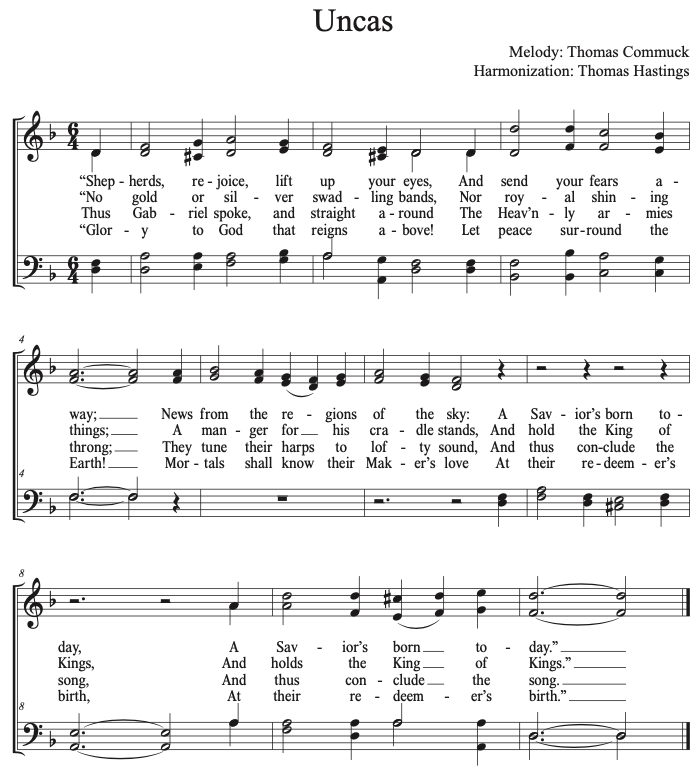
Back in 1845, Thomas Commuck published a book of sacred songs titled “Indian Melodies.” Commuck called his book that because he was a member of the Brothertown Indian Nation. In the introduction, referring to himself in the third person, he tells why his published his book: “his object is to make a little money.” To increase sales, he managed to convince Thomas Hastings, then a well-known composer of sacred music, to harmonize Commuck’s melodies. Commuck then named most of the tunes after Indian tribes.

Most of Commuck’s tunes are delightful, and Hastings’s harmonizations tastefully support the melodies without overwhelming them. The tune “Uncas” is simple but very singable, with a fun arrangement by Hastings. And the words are a classic Christmas text, “Shepherds rejoice, lift up your eyes….”

So here, for your Christmas pleasure, is Thomas Commuck’s Uncas. Commuck and Hastings put the melody in the tenor line (as was common in early American sacred song); I’ve switched their soprano and tenor lines, so that the melody is now in the soprano.

Sheet music for Uncas.
Click the image above for a PDF of the sheet music.

More problems with captchas

A reader emailed me saying that he had been prevented from entering a comment by my captcha plugin (Simple Cloudflare Turnstile); he got a message saying he had to verify he was human but was not given a problem to solve. Reading the online forum for this plugin on WordPress.org reveals that others have had this problem, too. Then today I got shut out of logging in by exactly the same problem. That did it. I logged in from another computer, and disabled the Simple Cloudflare Turnstile plugin.

Most captcha plugins for Wordress use Google’s recaptcha service. I refuse to use Google products because of their evil practice of stealing user data. However, there are now WordPress captcha plugins using the hCaptcha service, which has a much better privacy policy: “Our systems are designed from the ground up to minimize data collection and retention while maintaining class-leading security. The best way to protect user data is not to store it at all.”

It’s too bad I had to do this. Simple Cloudflare Turnstile has a lot of potential — keeping bots at bay without making everyone solve a stupid captcha puzzle. But when it blocks me from logging into my own blog — well, that’s something I just can’t accept.

I apologize in advance for making you (and making myself) solve a stupid captcha puzzle.

What exvangelicals do instead of church

Exvangelicals are forming “spiritual collectives” — which have superficial resemblance to Unitarian Universalist (UU) congregations, because they’re LGBTQ+ friendly, open to non-Christian sources of wisdom, and don’t have doctrines or dogmas.

There are also big differences. Exvangelical spiritual collectives have a different worship style. Their preachers are more likely to do their preaching (which they may call teaching) wearing a dark polo shirt and khakis — while most UU ministers wear stoles and robes while preaching. Exvangelical spiritual collectives are still evolving rapidly. They describe themselves as “experimental” — while I don’t hear many UU congregations talking about being experimental. Exvangelical worship services remain close to their evangelical roots. Their liturgies and governance still look like low-church evanglicalism— while most UU liturgies and governance practices are much closer to mainline Protestantism. As for age demographics, there are a lot more young adults in photos of these exvangelical groups.

In spite of the obvious differences, I’d love to sit down with people from these spiritual collectives and learn more about them. How are we UUs different from them? How are we the same?

Youth safety

Some people are living in the past. Specifically, some people apparently think it’s still the 1970s.

So I’m volunteering on a task force for a UU nonprofit that is trying to figure out how to offer safe youth programming. As part of the research we’ve been doing on youth safety, I’ve been looking at some sample youth safety policies from other nonprofits, as well as licensing requirements, recommendations from insurers, and other legal issues around non-school youth programming.

I already knew that sexual and emotional abuse of teens has been widespread in pretty much all youth programming. The Catholic church and the Boy Scouts get all the press, but from what I can tell all youth programs had similar issues. The Boy Scouts, the Catholics, along with other nonprofit youth programs, other religious groups, youth sports programs, after school programs, etc. — none has adequately protected youth. This is well-known, and I was expecting it.

What I wasn’t expecting was how bad some of the Unitarian Universalist (UU) youth programs still are.

Back in the 1970s, youth programming throughout society was influenced by a notion that subjecting people to intense situations in a very compressed time-frame would lead to personal growth. So, for example, “est” (Erhard Seminars Training) reportedly required participants to be present for an emotionally intense training from 9 a.m. to midnight with only one meal break. This is the era when ropes courses were popularized, subjecting people to physically demanind and physically frightening experiences to promote personal growth.

Back in 1995, when I started helping to lead UU youth programs, many of these techniques still reigned supreme. Sleep deprivation was seen as a positive force for personal growth, and teens were tacitly encouraged to stay up all night. Emotional intensity was used in many situations — there were “touch groups,” small groups where you were encouraged to bare your soul; there were activities designed to encourage people to reveal intimate personal details; and once you arrived at a “con” (youth conference) on Friday afternoon, you were pretty much stuck in this emotional cauldron for the next 36 hours.

Some teens did benefit from this kind of emotional intensity. Some White, upper-middle class teens who already had good emotional skills found the con experience to be highly beneficial.

On the other hand, over time I became aware that sexual assault and racism thrived in the con setting. I still remember being at the same conference center with a conference of non-White UU youth. Some of them spoke to me of how they experienced con culture as racist. I also heard about sexual assault at cons, ranging from unwanted touching to statutory rape. Most of my knowledge was second hand, but I’ve also heard from some women who experienced sexual assault at UU youth cons when they were teens.

And no wonder. The sleep deprivation and the emotional intensity led to poor impulse control, both on the part of youth and of adults. The organizational chaos resulting from all that emotional intensity mean adequate supervision was impossible. The chaos was amplified because there was no real curriculum, no real programming. So I stopped volunteering at cons and UU summer camps about twenty years ago. It just felt too dangerous.

What blows my mind is that there are still UU groups doing youth programming based on that old 1970s-era personal growth model. I guess these UU groups don’t seem to realize that standards of care have changed a great deal in the past decade — heck, they’ve changed a great deal in the past five years. These days, you have to have constant adult supervision and no chaos.

Equally troubling, we UUs don’t seem to have much else to offer. Too many UU programs for teens still focus on “personal growth.” Or the programming has the goal of “radicalizing” teens, which mostly seems to involve encouraging teens to go to protest rallies. By contrast, we’re not taking teens to speak at city council meetings, or to participate in labor union events, or to observe courtroom proceedings. Pretty much what you’d expect from upper middle class White folk.

Maybe we’re so backward on standards of care for youth programming precisely because we have so little to offer. Why invest in youth safety if you don’t really have a meaningful program?

I’ll end on a hopeful note. I’ve helped create UU programming for teens that’s not based on “personal growth,” that’s safe, and that’s also compelling. Once you let go of personal growth (and sleep deprivation) as the highest goals, lots of possibilities open up. But the first step towards meaningful and safe teen programming is to let go of that old 1970s-era personal growth model.