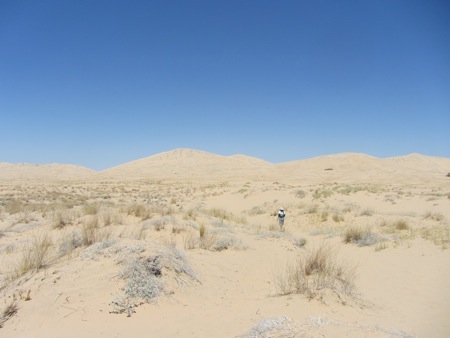
Carol walking towards the Kelso Dunes, Mojave National Preserve, California.
A postmodern heretic's spiritual journey.

Carol walking towards the Kelso Dunes, Mojave National Preserve, California.
Ada Maria Isasi-Diaz, the theologian who was central in developing Mujerista — which can be translated as womanist — theology, died May 13 in New York City. Her obituary in the New York Times notes that Isasi-Diaz preferred the term “Mujerism” to the term “feminist” because, she said, many women in the Hispanic community considered feminism to be “a preoccupation of white Anglo women.”
Many of us are Unitarian Universalists are about to head off to General Assembly in Phoenix, where we will be concentrating a good deal of our attention on the immigration issues facing the Hispanic community. Feminism and feminist theology has been at the center of our identity as a religious community. As we continue to look into issues facing the Hispanic community, it seems to me worth out while to look more closely at Mujerism as it applies to North America. So I’m putting Ada Maria Isasi-Diaz on my reading list for the coming year.
When I was a child, maybe eleven or twelve years old, I discovered my parents’ old science fiction books on some metal shelves in the basement. The only one of these books I really remember was a paperback edition of Ray Bradbury’s The Illustrated Man. In my mind’s eye I can still see the cover design, and the cracked binding. One of the stories in particular stuck with me, still sticks with me:
In “The Man,” a spaceship travels to a planet that hasn’t been visited by any spaceships for a long time. The crew of the space ship expects to be greeted with astonishment and wonder, but upon landing they discover that another visitor, a solitary man, has preceded them by just a few days. Everyone who met this man is filled with a kind of peace and inner contentment. This amazing man has gone on to a new planet. Some of the crew decide they must meet this man themselves, and they head off in the space ship to follow him. But a few of the crew remain on the planet; they know that the rest of the crew who are pursuing this man will never quite catch up with him, they will miss him by a day, then by a few hours, then by minutes, but they will always miss meeting him in person; they decide they don’t need to meet the man in person, that living on this now-peaceful planet with these now-peaceful people is enough.
Even at eleven or twelve years old, I figured out that this story was about religion, about a Jesus-like figure. Later, I figured out that this story was criticizing literalism in religion; it is futile to try to find the “real” Jesus, the “real” prophet, because you will never catch up with him (or her). Later still, I discovered that Ray Bradbury was a Unitarian Universalist, and this was exactly the kind of story a religious liberal would write.
Some of Bradbury’s work can be overly sentimental, with stereotyped characters and pat endings. One such a story comes to mind: In “Kaleidoscope,” a spaceship explodes, the crew in spacesuits are propelled off in all directions, knowing they will live only as long as the oxygen lasts in their space suits; they talk with each other via their suit radios, talking, crying, saying vicious things, telling what direction they’re headed in, coming to peace with one another. Slowly each one passes out of radio range of the others. One of them is captured by the gravitational well of Earth, and is seen from the surface of Earth as a meteorite, a shooting star. It’s a story about how we all have to die alone, but Bradbury can’t resist the pat ending of having one of the dying crew men end life as a shooting star upon whom a boy makes a wish. But in spite of that, I can’t help liking “The Kaleidoscope”: I know we die alone, and that most of human death amounts to little more than a lone spaceman flying off into the endless void; but I want to believe that once in a while, the end of a human life can be a force for good in the world, even if it’s little more than a brief flash of light in the night.
I’m taking a break from work here at the Palo Alto church, and watching the transit of Venus. I’m projecting an image of the sun using a pair of 7×25 binoculars mounted to a tripod. I have a white card set up about six feet from the binoculars, resulting in an image that’s approximately five and three quarters of an inch in diameter. The optics in the binoculars are not particularly good, and there’s enough chromatic aberration that I don’t get a particularly crisp image. Nevertheless, I can clearly see the shadow Venus is casting as it crosses the sun; on this projection, it’s approximately three-sixteenths of an inch in diameter, and at this time about one and three sixteenths inches from the nearest edge of the sun. The card I’m projecting the image on is eight and a half by eleven inches oriented horizontally; the earth moves such that I have to readjust the binoculars every sixty or seventy seconds in order to keep a complete image on the card.
Venus does not appear to be moving in relation to the sun. I suppose if I sat out here long enough, I’d be able to see some relative motion; but the transit is going to take four hours, and I don’t suppose I can take that much time away from work.
And yes, the transit is a pretty amazing phenomenon to watch, even with my crude projection device.

Corrected per Erp’s comment.
Jeremy, someone who sings in the same group I do, passed along a photocopy of an article, “The Enlightenment, Naturalism, and the Secularization of Values,” from the magazine Free Inquiry. It’s a historical overview of the Enlightenment by historian Alan Charles Kors of the University of Pennsylvania. During the break in singing tonight, I told him that I finally read the article.
“What did you think?” he said.
“I liked it,” I said. I told him I had been expecting the article to come down on one side or the other of the argument going on right now about whether the Enlightenment is a good thing, or something we have to move past; that is, I had been expecting a modernist/postmodernist argument. Instead, Kors gives a pretty straightforward overview of the Enlightenment from his perspective as a historian.
We both agreed that we’re of the party who would like to continue the values of the Enlightenment. “But we can’t go back to the eighteenth century Enlightenment,” I said.
Jeremy wondered aloud: “Why not?”
I argued that the insights we have gotten in the twentieth century from psychology, particularly developmental psychology, pose a major challenge to at least one eighteenth century Enlightenment assumption: we now know that children think differently than do adults; they are not rational in the way that adults may be said to be rational. Furthermore, beginning in the lat twentieth century we began to learn from neuroscience and cognitive science that human beings may not be as rational as we’d like to think they are, or perhaps not rational in the same way that we have imagined them to be.
Jeremy argued that the insights of developmental psychology, neuroscience, and cognitive science do not fundamentally contradict the eighteenth century Enlightenment philosophers. But I said we can’t yet be sure of that. The field of neuroscience, for example, is changing so rapidly that we really only have preliminary hypotheses of how the brain works; new experiments could change our ideas even further. And developmental psychology is still trying to reconcile the two very different approaches of Piagetian and Vygotskian (more individualistic and more communal) developmental psychology.
The only conclusion we came to was that we both were happy to have moved beyond the excesses of Romanticism. Although Jeremy loves that quintessential Romantic composer, Beethoven, while I don’t; and I still remain at heart an Transcendentalist. So maybe we haven’t escaped Romanticism as much as we thought we have.
This is mostly for my dad, because he and I talk a lot about the war in Afghanistan. I happened to preach two Sundays in a row, once on war, and once on peace, and I’ve now put those sermons online:
On May 20, a sermon about a program we did with kids called “Peace Experiments.”
On May 27, a sermon about how we might memorialize the war in Iraq and Afghanistan.
I find the ongoing war in Afghanistan to be very difficult to talk about, and consider both these sermons to be inadequate. At the same time, it’s one of the top three moral problems facing us in the United States today; we have to talk about the war, we have to try to sort through the moral issues it raises.
Quick, what was the first world religion? — that is, the first religion that expanded well beyond its origins within a given culture and/or political unit.
April DeConick, an expert on Gnostic religion, asserts that Manichaeism was the first world religion. “Who gets taught that in World Religions courses?” DeConick adds. After its start in Persia in the third century, it had expanded to the Atlantic ocean by the fourth century, and along the Silk Road to the Pacific ocean in China by the eighth century or so.
According to this BBC feature article, best-selling author Ann Patchett believes it is still possible to have a successful bookstore. Six months ago she opened a bookstore in Nashville, Tennessee, and although she didn’t need to make a profit, in the interview she says “we’re doing really well.”
Patchett addresses the rise of ebooks. She does not denigrate ebooks, but points out that that many readers still appreciate a physical book. “Just because ebooks are becoming popular doesn’t mean that we should scoop all the other books into a pile and burn them,” she says. “And there is a spirit or attitude of, ‘Well, books are dead, it’s over, forget it.’ And it’s not over.”
I was chatting with one of the guys at the meat and fish counter at our neighborhood supermarket while he was weighing out a pound of Dover sole for me. I asked him if he was more of a meat guy, or a fish guy.
“You have to be both,” he said. “The fish used to come in here whole. We’d gut it over there” — he pointed to the counter where they crack Dungeness crabs for you — “and fillet it. But yeah, I first worked for a butcher.”
“Working with meat must keep you physically fit,” I said. “Having to lift all that weight.”
“No, not really,” he said. “That enough?”
“One more,” I said.
He threw on one more fillet, and wrapped the fish up. “Nah, once you get it on the hook, the cuts just fall off as you work. We don’t get many whole animals in these days, though — but once in a while.” He handed me the package. “Anything else?”
I said no, and thanked him. There was another customer waiting. I moved away, glancing at the door of the cold room in the back, which must have meat hooks on the ceiling, and a band saw, and other butcher tools. I’m seen the butcher work with a knife, and it looks like he’s got good hand skills. I imagined him hauling a carcass up on meat hook, using his knife so that the cuts of meat fell off with little effort, and I couldn’t help but remember Cook Ting in the Chuang-tzu, who tells Lord Wen-hui how he cuts up an ox:
“…Whenever I come to a complicated place, I size up the difficulties, tell myself to watch out and be careful, keep my eyes on what I’m doing, work very slowly, and move the knife with the greatest subtlety, until — flop! the whole thing comes apart like a clod of earth crumbling to the ground. I stand there holding the knife and look all around me, completely satisfied and reluctant to move on, and then I wipe off the knife and put it away.” [Chuang-tzu, ch. 3, Burton Watson translation]
The difference between the two is that Cook Ting is very articulate and gets very mystical about butchering — “What I care about is the Way, which goes beyond skill…” — whereas our local butcher is plain-spoken and down-to-earth. I have to admit, I prefer our local butcher.
Dad and I have been talking for some time about our discomfort with the term “humanist” (a term which, by the way, can be applied to both Christians and atheists). Neither one of us seems to have much interest in putting humanity at the center of the universe; we’re both more willing to call ourselves religious naturalists.
My fever came back this afternoon, and I slept through the time I usually talk with dad. But late in the evening, I came across the following in a book of critical essays on science fiction; it begins to express some of the feelings I have about the position of humanity in the universe:
It isn’t that mankind is all that important. I don’t think that Man is the measure of all things, or even of very many things. I don’t think that Man is the end or culmination of anything, and certainly not the center of anything. What we are, who we are, and where we are going, I do not now, nor do I believe anybody who says he knows, except, perhaps, Beethoven, in the last movement of the last symphony. All I know is that we are here, and that we are aware of the fact, and that it behooves us to be aware — to pay heed. For we are not objets. That is essential. We are subjects, and whoever among us treats us as objects is acting inhumanly, wrongly, against nature. And with us, nature, the great Object, its tirelessly burning suns, its turning galaxies and planets, its rocks, seas, fish and ferns and fir trees and little furry animals, all have become, also, subjects. As we are part of them, so they are part of us. Bone of our bone, flesh of our flesh….
Ursula K. LeGuin, “Science Fiction and Mrs. Brown” [1975] in The Language of the Night (Ultramarine Publishing, 1980), p. 116.