
REA: “Cross-cultural Analysis” and “Sabbath as Post-Christian Ed”

On Friday afternoon at the Religious Education Association 2014 conference, I attended a colloquium with two presenters: Courtney Goto ofBoston University presented “Troubling Cross-Cultural Analysis in Healing the Effects of Racism,” and Jonathan LeMaster-Smith, doctoral student at Garrett-Evangelical Theological Seminary, presented on “Sabbath as Post-Christian Education: The (De)valuing of Rural Working-Class Persons as Liberation from Socio-Economic Disposability.”

Goto told us that she was presenting work in progress, and what she was going to present differed from the outline on the conference meeting Web site. She is working on two case studies, comparing the way two different cultural communities use aesthetic practices to form people theologically, aesthetically, and culturally.

Her first case study is of Lithuanian rituals on All Saints Day, during which families place candles and decorations at the grave sites of deceased family members. Her second case study is of an All Saints Day ritual at the Sacramento Japanese United Methodist Church.

Since Lithuanians and Japanese Americans are people on the margins, Goto’s research will use the concept of “social death” to explore these two case studies. Social death happens when a group of people is treated as nonpersons by the dominant culture. Examples of victims of social death include Jews during the Holocaust, native Americans in the U.S., etc. Both Japanese Americans and Lithuanians were victims of social death before and during the Second World War. Both communities use All Saints Day to hold rituals which serve as a response to trauma.

Of particular interest to me were the slides that Goto showed of an All Saints Day art installation in the Sacramento Japanese United Methodist Church. 26 yukata (a type of traditional Japanese clothing) were hung from from the ceiling of the sanctuary; another yukata clothed the usually plaint cross at the front of the church. The symbolism — how this art installation represents the way Japanese Americans were treated during the years of internment — was explained during services, in orders of services, etc. I felt this was a powerful example of all-ages religious education in a congregation.

Jonathan LeMaster-Smith spoke about another marginalized group, rural white working class persons. He is in the process of investigating ways to do religious education around the Sabbath in a post-Christian rural working class context. “One possible pedagogical practice is the observance of Sabbath,” LeMaster-Smith said — but not Sabbath in the traditional sense of a day of rest on Sunday (or Saturday).

Rather, LeMaster-Smith wants to ways the concept of Sabbath could be incorporated into popular culture rituals such as, for example, a Hallowe’en bonfire. (One of the participants later pointed out the obvious parallels between the Lithuanian popular culture ritual on All Saints Day described by Goto.) LeMaster-Smith said he saw potential in finding Sabbath-type observances in existing holiday celebrations.

A draft of Lemaster-Smith’s paper is online here. I saw a great deal of potential in this idea of translating the old observance of Sabbath into current post-Christian celebrations. Indeed, I believe some churches and faith communities are already on this path, e.g., many non-Hispanic congregations are incorporating Dias de los Muertos into Sunday services. LeMaster-Smith is simply asking faith communities to take this kind of thing outside the walls of the church building, out into the community. It seems to me that powerful things could happen at the intersection of pop culture and post-Christian religion.

REA: Peace Experiments

The text of the formal presentation portion of my workshop:

Let me begin by telling you about the context in which I do religious education. I’m minister of religious education at the Unitarian Universalist Church of Palo Alto, California, a mainline congregation founded in 1947. Like so many mainline congregations founded in the post-World War II era, today we struggle to adapt to new and different demographic, economic, and theological realities. In particular, we’re trying to figure out what the end of Christendom means to us as a post-Christian congregation, and we’re adapting to an intensely competitive nonprofit landscape.

Four years ago, I suggested to our lay leaders that we might do a six-week spring curriculum unit in peacemaking for K-5 Sunday school classes. That program, which I based on an old 1980s curriculum called “Peace Experiments,” was described by Geez magazine — a magazine subtitle “Holy mischief in an age of fast faith” — like this:

Continue reading “REA: Peace Experiments”

REA: “My God, what have we done?”

Leah Gunning Francis opened the first plenary session of the Religious Education Association 2014 conference. She introduced the plenary speakers, and informed us that unfortunately Gabriel Moran was not able to be present. Francis lives in St. Louis, Missouri, and given that the theme of this year’s conference is “Religion and Education in the (Un)Making of Violence,” she showed some of her photographs of the protests in Ferguson, Missouri — to the great interest of the conferees.

The first “speaker” was Andrea Bieler, Professor of Practical Theology at the Kirchliche Hochschule in Wuppertal/Bethel, Germany. Bieler did not appear in person; her presentation was a video, in which she spoke, and showed various works of art and other material.

Bieler’s video began with a statement by Theodor Adorno: “The principal demand upon all education is that Auschwitz does not happen again.” Bieler extended this to other instances of systematic violence, including systemic racism in the United States, the state terrorism and “disappearances” in Argentina and Chile, apartheid in South Africa, etc.

In the video, Bieler laid out a nuanced argument, beginning with theories of memory and winding up with a discussion of remembering violence through aesthetic art. I was most interested in her analyses of several site-specific art works in Berlin, particularly the Chapel of Reconciliation, built near the site of the Berlin Wall.

Continue reading “REA: “My God, what have we done?””

REA: Teaching and learning in online spaces

In the afternoon pre-conference session of the Religious Education Association 2014 conference, Eileen Daily of Boston Univeristy and Daniella Zsupan-Jerome of Loyla University presented a workshop titled “Teaching and Learning in Online Spaces: An Experiential Engagement with Digital Creativity.”

While online media are new, Daily reminded us that religions have always used mediated forms of communication. “What did Paul do? He wrote letters!” she said. “Email is just another form of letter,” she added. “These are just new names for things we’ve been doing for a long time. There’s a difference of form, but there’s not necessarily a difference of message.”

Daily told us that when she teaches religious education online, she emphasizes nonlinearity. Whereas face-to-face learning environments lend themselves to a linear path through a subject, online environments lend themselves to a nonlinear approach. However, you still have to pay careful attention to course structure; there is a “Skinnerian side of education,” so there’s always a sense in which you have to “keep students in the rat maze” to produce behavioral outcomes. And Daily reminded us that the goal of any religious education is to “integrate religion into people’s messy lives.”

Daily and Zsupan-Jerome then led us in “a mini non-linear learning event that will appear on a curated platform at the end of the session.” As a subject for this experience in non-linear online learning, Daily and Zsupan-Jerome had us investigate the Salt Creek watershed; Salt Creek runs immediately behind the conference hotel. They split us into six groups, each group charged with investigating the environmental challenges facing Salt Creek through different approaches. Thus one group conducted Skype interviews with people who knew about Salt Creek; one group investigated sacred texts on the subject of the environment; another group researched specific environmental challenges facing Salt Creek today; etc.

Continue reading “REA: Teaching and learning in online spaces”

REA: Tending your digital presence

Mary Hess of Luther Seminary presented the first pre-conference session, on “Creating and Tending Your Digital Presence as a Scholar,” at the Religious Education Association annual conference. Although I’m a minister of religious education, not a scholar of religious education, I figured I would hear much that was applicable to me — and I did.

Hess began by making an important point by referring to research on (a href=”http://mediatedcultures.net/youtube/context-collapse/>context collapse done by cultural anthropologist Michael Wesch. Hess told us that tending one’s digital presence is a way to intentionally build context in the face of context collapse. “I don’t think it’s a choice any longer,” she said, to tend one’s digital presence.

One problem faced in tending your online presence is figuring out how to uniquely identify yourself — especially challenging for those of us with common names. Hess introduced us to ORCID, a registry of unique researcher identifiers for scholars. (As a minister in a numerically small denomination, I already have a unique identifier — search for “dan harper unitarian” and you’ll find me.)

Hess reviewed some social media sites aimed at academics, including academia.edu, Mendeley as a useful digital repository or archive, and Merlot for sharing teaching resources.

Hess said that for her, Slide Share has actually been more useful at getting her work out than any sites dedicated to academics.

Turning to what she called “popular publication,” Hess spoke briefly of popular Web sites such as the Huffington Post, Religion Dispatches, and Odyssey Networks. Hess feels that it is critically important for religious education scholars (and practitioners!) to break out of the boundaries of our narrow intellectual speciality.

“I think in my more cynical moments that as higher education focused on production of certain kinds of knowledge, it has removed people from public life,” she said. She contrasted this attitude with the attitude of John Dewey, one of the founding intellects of the Religious Education Association. Dewey, she said, was a public intellectual. She added that the question of what it means to be a public intellectual is critically important.

Slides for this presentation on Slide Share

The day after election day

Yesterday, before I voted, I spent at least an hour doing some final research into the various candidates and ballot initiatives. The San Jose Mercury news and the San Francisco Chronicle had offered a reasonable amount of coverage of California ballot initiatives, and of the more prominent statewide elections. I already had most of the information I needed to cast my vote. Nevertheless, I went to the League of Women Voters (LWV) Web site to review information about those initiatives and candidates.

News media had offered very little coverage of county elections, like the contentious San Mateo Harbor District Commission elections, and very little coverage of minor state elections, like the elections for Board of Equalization Members. Again, the LWV Web site was invaluable — e.g., it pointed me to an online video of a LWV forum with most of the Harbor District Commission candidates.

In the end, I was able to make what I felt were reasonably informed decisions on most of the candidates and initiatives. But I also realized that I had not spent enough time really learning about the issues and candidates. I should have attended candidate forums for local elections. I should have spent more time learning about statewide elections. Democracy takes time, and I did not put in enough time. And these days, I think political advertisements are so full of lies and innuendo that each time you see or hear one should count as negative time spent on learning the issues — which means spending even more time actually learning about issues and candidates.

Today, I was reading Hannah Arendt’s On Revolution, and came across this quotation from Thomas Jefferson: “If once [our people] become inattentive to the public affairs, you and I, and Congress and Assemblies, Judges and Governors, shall all become wolves.”

Is that howling I hear in the distance?

BlogNov0514

Sabbatical

I’m taking sabbatical time this year — four non-consecutive months, plus three additional non-consecutive weeks — to work on a writing project.

November is the first month of my sabbatical. So of course I was up late last night, madly finishing of my list of things that Must Be Done Before The Sabbatical. I checked off the last item on my list at 11:28 p.m., and went to bed.

This morning I awoke feeling a little stunned: I was actually on sabbatical. In more than a decade as a minister, and two decades working in congregations, I’ve never had a sabbatical before. It’s a funny feeling knowing that the only thing I am supposed to do this month is — well, what am I supposed to do with a sabbatical?

In contemporary language, a sabbatical is a tool for sustainability. It is abased on the ancient Hebrew custom outlined in Leviticus 25.2-5:

“When ye come into the land which I give you, then shall the land keep a sabbath unto the Lord. Six years thou shalt sow thy field, and six years thou shalt prune thy vineyard, and gather in the fruit thereof; But in the seventh year shall be a sabbath of rest unto the land, a sabbath for the Lord: thou shalt neither sow thy field, nor prune thy vineyard. That which groweth of its own accord of thy harvest thou shalt not reap, neither gather the grapes of thy vine undressed: for it is a year of rest unto the land.”

So during my sabbatical time, I won’t sow or prune, nor will I answer email for four hours a day, nor run around like a chicken with my head cut off trying to catch up on administrative tasks. Instead, sayeth Elohim, I’m supposed to let my soul lie fallow.

Not only is a sabbatical about sustainability, it is also about social justice for workers, immigrants, and other sentient beings, according to Leviticus 25.6-7:

“And the sabbath of the land shall be meat for you; for thee, and for thy servant, and for thy maid, and for thy hired servant, and for thy stranger that sojourneth with thee. And for thy cattle, and for the beast that are in thy land, shall all the increase thereof be meat.”

I have not done so well in carrying out this part of taking a sabbatical. While I’m away, the Religious Education Assistant and members of the Religious Education Committee have to take care of some of the things I normally do, though I have tried to minimize what they have to do. Ideally, an entire community would all take a sabbatical together; everyone would stop work. However, in this ear of globalization and consumer capitalism, if everyone stopped working we would face economic ruin — the next version of the iPhone would be delayed by a year! there would be no fossil fuels to burn and send carbon into the atmosphere! — so I will just have to accept the fact that I am going to have to go on sabbatical by myself.

And what will I do while on sabbatical? How will I let my soul lie fallow? I’m going to write: writing seems to be good for my soul, and I’ve been too busy the past few years to write much; you may see some of that writing here on this blog. Maybe I’ll do some other things, too; I don’t really know; this sabbatical thing is new to me.

(I’ll include the official statement about my sabbatical below the fold — not that you care, but just so it’s here on my blog, in case someone is looking for it.)

  Continue reading “Sabbatical”

Weed, Calif.

BlogOct2514

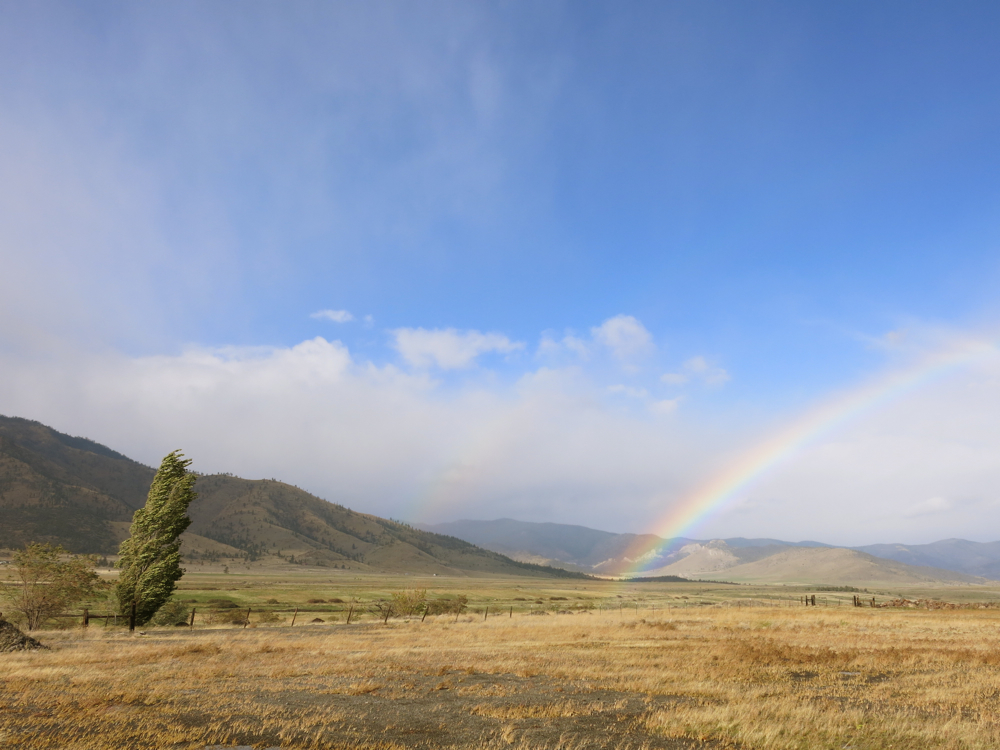
Light rain began blowing against the windshield as I drove south on Interstate 5 towards Weed, California. The sun was still shining, but Mount Shasta was obscured by clouds. I stopped at a rest area to stretch my legs, and looked north, the way I had come: there was a rainbow behind me. As I watched, a faint second rainbow was forming. I took a photo, got back in the car, my hair blown every which way, my glasses speckled with rain drops, and drove south into the rain.