Obscure Unitarians: Annie Upton Lawrence Corbert

A schoolteacher and supporter of women’s suffrage, Ann Upton Lawrence was born on Nantucket Is., Mass., on Oct., 1840, to Frederic W. Lawrence and Susan Hussey. Since her birth is recorded in the Quaker manner as “10th month” (rather than “October”), perhaps her family were Quakers; a Quaker upbringing could help explain her lifelong support of equal rights for women.

Her life can be traced through the U.S. Census. In 1850, she was living on Nantucket Is. with her father and mother, and younger siblings Amelia and Everett; her father was working as an accountant. By 1860, she was living with her father in San Francisco, and working as a school teacher; her father was working as a clerk, and they shared a house with William H. Lawrence, a mariner, and his wife and child.

Annie married Edward W. Corbert before 1866. In 1870, she and Edward were living in San Francisco, where Edward worked as “Assessor, Int. Rev.”; they had two children, Louise (b. c. 1866, Calif.), and Sadie (b. c. 1869, Calif.). In 1880, she and Edward were living in Martinez with Louise, Sadie, and Anita Lawrence (b. June, 1874, Calif.). By 1900, Annie was widowed and living with Anita in Palo Alto; Anita was working as a teacher. And in 1910, Annie was still living with Anita, as well as with her son-in-law, John Byxbee; John was the Palo Alto city engineer for whom Byxbee Park is named.

Annie supported women’s suffrage. She was president of the Santa Clara County Equal Suffrage Assoc. in 1900, and said in her presidential address of that year, “We are simply waiting and watching, and working to strengthen our forces and our cause, so that at the golden moment we may be ready to spring into place.” She continued working for equal suffrage through the successful campaign in 1911 which gained California women the right to vote: “Mrs. John F. Byxbee, Mrs. George Rosebrook and Mrs. Annie L. Corbert entertained at a suffrage tea Thursday afternoon at the Byxbee home in Alma Street.”

Her civic activities were not limited to equal suffrage. She also found time to support the schools and the public library, and she belonged to the Palo Alto Woman’s Club, the Civic League, the Peace Society, and the Historical Society.

She was active in the early days of the Unitarian Church of Palo Alto, and was one of the early members of the Women’s Alliance. She helped run the Unitarian “Post Office Mission” in Palo Alto. She sang in the church choir, and her “clear true alto” voice was “always a power in quartette singing, even to the time of her last illness.” She divided her time between San Francisco and Palo Alto, and was also an officer for the San Francisco branch of the Women’s Alliance.

Her obituary in the Pacific Unitarian gave three samples of her religious philosophy, things she said not long before she died:

“As a church we should ask ourselves, continually, What is the church for—are we doing something worthy, or are we marking time.”

“I have found that we must not judge people. Minds are different, and we must not condemn as unworthy that which does not suit our own ideas.”

“The human soul is a lonely thing. It must stand by itself at the last.”

Notes: 1850, 1860, 1870, 1880, 1900, 1910 U.S. Census; Vital Records of Nantucket, Massachusetts, to 1850, vol. II—Births (G-Z), Boston: New England Historical Genealogical Society, 1926, p. 235; Gayle Gullett, Becoming Citizens: The Emergence and Development of the California Women’s Movement, 1880-1911, Univ. of Illinois Press, p. 109; San Francisco Call, Aug. 20, 1911; Pacific Unitarian, Aug., 1916, p. 262; Pacific Unitarian, March, 1915, p. 137.
N.B.: In the printed record, her married name is often spelled “Corbett,” but when she signed her name she wrote “Corbert”; furthermore, she signed her first name “Annie,” not “Ann.”

Obscure Unitarians: Effie June Scott and Edward Curtis Franklin

Effie June Scott Franklin — A professor of French and German, she was born Aug. 5, 1871, in on a farm in Carlyle Township, Kansas. Her father, Dr. John W. Scott, came to Kansas in 1857, and was active in the free state fight, serving in the first state legislature; Dr. Scott served in the Civil War as surgeon of the Tenth Kansas, and after that war was president of the company that laid out the town of Iola, Kansas.

Effie’s family family moved to the town of Iola, Kansas, in 1874. She graduated from high school in Iola, Kansas, in 1887. She had two older brothers: Angelo C., the eldest; and Charles F. Scott, ten years older than Effie, who represented Kansas for several years as a Republican in the U.S. Congress.

After graduating from high school, Effie taught in the Kansas City, Kansas, schools, and then taught high school in Leavenworth, Kansas. She then began studies at the University of Kansas, receiving her A.B. in 1891. Subsequently she pursued graduate study at Cornell and at the University of Berlin. She was assistant professor of French and German at the University of Kansas for two years until her marriage in 1897; William Carruth was at that time professor of German.

She married Edward Curtis Franklin on July 22, 1897, at Central Presbyterian Church in Denver, Colorado. She and Edward had three children: Anna Comstock (b. Sept., 1898), Charles Scott (b. c. 1902), and John Curtis (b. c. 1905).

Politically, she was a progressive who supported “woman suffrage.”

She was active in the Unitarian church in Lawrence, Kansas, and was a delegate from the Lawrence church to the National Conference of Unitarians in 1911 (the family lived in Washington, D.C., 1911-1913 while Edward worked for the government Hygenic Laboratory).. Prof. William Carruth was also a member of the Lawrence, Kansas, church before he moved to Palo Alto.

Effie moved to Palo Alto in 1903 when her husband accepted a position as professor at Stanford. She was an early member of the Unitarian Church of Palo Alto, and was active in the Women’s Alliance.

When Maria Protsman Scott, Effie’s mother, died in 1907, she was staying with her daughter in Palo Alto; however, it doesn’t appear that Maria was living with the Franklins.

In 1914, a classmate from the University of Kansas visited the Franklins, as well as former Kansans Jennie and Helen Sutliff, and William and Katharine Carruth. She wrote: “At Stanford I spent several days with the Sutliffs and Franklins and had a pleasant visit with Dr. and Mrs. Carruth. … Dr. Franklin was soon to leave for New Zealand where he was going at the request of the British government, in company with fourteen other American scientists of note. Dr. and Mrs. Franklin have a very handsome big daughter Anna, a high school girl, and two younger boys, Charles and Jack.”

Effie was an accomplished pianist, and she was elected an honorary member of the Stanford Music Club in 1916.

She died at her home in Palo Alto on March 31, 1931.

Notes: 1900, 1910 U.S. Census; Graduate Magazine of the University of Kansas, 1931, p. 14; William E. Connolley, History of Kansas Newspapers, Topeka: Kansas State Printing Plant, 1916, p. 47; William E. Connelley, A Standard History of Kansas and Kansans, vol. 3, Chicago: Lewis Pub. Co., 1919, p. 1360; Iola Register, May 30, 1902; Jan Onofrio, Kansas Biographical Dictionary, St. Clair Shores, Miss.: Somerset Pub., 2000, p. 142; The Arrow of Pi Beta Phi, Ann Arbor, Mich.: Michigan Chapter of Beta, October, 1893, p. 118; Iola Register, July 30, 1897, p. 8; John William Leonard, Woman’s Who’s Who of America, 1914-1915, New York: American Commonwealth Co., 1914, p. 305; Christian Register, Oct. 19, 1911, p. 1095; Graduate Magazine of the University of Kansas, March, 1907, p. 224; Graduate Magazine of the University of Kansas, Dec., 1914, p. 91; Stanford Daily, Jan. 25, 1916, p. 2.


Edward Curtis Franklin — A renowned chemist who grew up in Kansas while it was still part of the frontier, he was born in Geary City, Kansas, on March 1, 1862. He was raised in Doniphan, Kansas, where his father owned a saw mill and grist mill. At the time he was young, that part of Kansas still had the flavor of the frontier, to which some ascribed his later “noticeable impatience with convention.” As a boy, he enjoyed the outdoors, including hunting, fishing, swimming in the Missouri River, and collecting fossils; this love of the outdoors was to remain with him his whole life, and he was an active mountain climber who belonged to the Sierra Club, and summited a number of 14,000 foot peaks. He and his brother William, later a professor at Massachusetts Institute of Technology, made their own batteries, a two-mile long telegraph line, and their own telephone in 1877, only a year after A. G. Bell patented his tel-phone.

After he graduated from high school, he worked for a pharmacy in Severance, Kansas, from 1880-1884, then at age 22 entered the University of Kansas. He received his S.B. from the University of Kansas in 1888, studied at the University of Berlin 1890-1891, and received his Ph.D. from Johns Hopkins University in 1894. He was a professor of chemistry at the University of Kansas from 1891 to 1903, and worked for a gold mining company in Costa Rica for a time in 1897. He was professor of chemistry at Stanford from 1903 to his retirement in 1929. As a chemist, he was best known for his work on ammonia and other nitrogen compounds. He was considered an excellent teacher who delivered exceptionally clear lectures.

He married Effie Scott on July 22, 1897, in Denver, Colorado, and they had three children: Anna Comstock (b. Sept., 1898), Charles Scott (b. c. 1902), and John Curtis (b. c. 1905).

He was an early member of the Unitarian Church of Palo Alto. He hosted the monthly social gathering of the Unitarian Church, entertaining “the company with some experiments with liquid air.” Theologically, Unitarianism was a good fit for Franklin: “Even as a youth…Franklin was inclined to be a ‘free thinker’ and agnostic.”

After his wife Effie died in 1931, he lived with his daughter, Anna Franklin Barnett, in Palo Alto. In the last three years of his life, he took long auto-mobile tours of the U.S. and Canada, and died just two months after returning from the last such trip. He died Feb. 13, 1937.

Notes: Alexander Findlay, Journal of the Chemical Society, 1938, p. 583; Howard Elsey, Biographical Memoirs, Nat. Academy of Sciences, 1991, pp. 67-75; Stanford Daily, Feb. 15, 1937, p. 1; Jan Onofrio, Kansas Biographical Dictionary, St. Clair Shores, Miss.: Somerset Pub., 2000, pp. 139 ff.; obituary, Stanford Daily, Feb. 15, 1937; John William Leonard, ed., Men of America: A Biographical Dictionary, New York: L. R. Hamersly & Co., 1908; Pacific Unitarian, April, 1909, p. 186. Photo of Edward from a U.S. Government Web site, ihm.nlm.nih.gov/images/B06647, accessed May 23, 2017.


Anna Comstock Franklin Barnett — A physician and graduate of the Unitarian Church of Palo Alto Sunday school, she was born Sept. 12, 1898, in Lawrence, Kansas, daughter of Effie Scott (q.v.) and Edward Curtis Franklin (q.v.).

Her family moved to Palo Alto in 1903. In 1905, Anna was “one of the first pupils of the Sunday-school” of the Unitarian Church of Palo Alto.

She received her A.B. from Stanford University in 1920, and her M.D. from Stanford in 1924. On July 12, 1924, she married Dr. George de Forest Barnett; he was a physician and professor of medicine at Stanford. They had two children, Margaret A. and Edward F. After the death of her mother in 1931, Anna’s father came to live with her.

Anna joined the faculty of Stanford School of Medicine. Her husband, who had also taught at Stanford School of Medicine, died in 1955. Anna continued to live on campus after her own retirement.

On Oct. 1, 1968, the Stanford Daily reported: “The badly decomposed body of Dr. Anna Barnett, a retired Medical School professor, was discovered in the hills behind Stanford Friday morning. The body was found near Stanford’s antenna farm at 7 a.m. by Eleanore Norris, a resident of Palo Alto, who was strolling in the area near Stanford’s antenna farm. Dr. Barnett, despondent over eye trouble and a scheduled eye operation, disappeared September 13. She left a note indicating she was contemplating suicide. A morphine overdose was determined as the cause of death.” The date of death on the death certificate was Sept. 27, 1968.

Notes: 1900 U.S. Census; Christian Register, Dec. 17, 1925, p. 1236; Stanford University Alumni Directory, 1921, 1931; Stanford Daily, April 30, 1924, p. 1; Stanford Daily, Oct. 1, 1968, p. 4; Carl T. Cox, “Anna Com-stock Franklin,” The Orville, Sutherland, Cox Web site: Ancestors, descendants, and Family Information, oscox.org/cgi-bin/igmget.cgi/n=jucox? I17378, accessed May 25, 2017. (N.B.: Anna’s biography was added an hour or so after Effie’s and Edward’s biographies were posted.)

Obscure Unitarians: Emily Sophia Elliot Pardee Karns Dixon

Emily Elliott was born March 3, 1853 in Kane County, Ill., daughter of Wilson and Maria J. Elliot Edmund and Sarah (Smith) Elliott [corrected per comment below], both born in New Hampshire. Her family left Illinois and moved to a farm in California’s Central Valley when Emily was six; it seems likely that the family traveled overland on the Oregon Trail or the California Trail. In 1860 she and her parents were living in Elkhorn Township, San Joaquin County; her father was working as a farmer, and the Elliot family shared their home with another farmer and three farm laborers.

Though not listed as a graduate, she studied at the California State Normal School c. 1870. In 1870, she was living in San Francisco and “attending school”; the State Normal School was then in San Francisco. Emily taught school in Oakland for seven years.

She married Dr. Enoch H. Pardee on July 19, 1879, when she was 26 and he was 52; Enoch’s 22 year old son George was not pleased when his father remarried. Enoch was mayor of Oakland and a co-founder of the Unitarian church in Oakland. Enoch and Emily had one child, a daughter Eleanor (“Nellie”), born in 1880. Enoch died in 1896, and four months Nellie, then age 15, also died. After a legal battle with Enoch’s son, Emily received a third of Enoch’s substantial estate. Enoch’s estate was valued at approx. $275,000, or roughly $8 million in 2016 dollars; so Emily received the equivalent of $2.6 million.

For the next few years, she traveled extensively. She married William A. Karns, a lawyer, in Baltimore on March 21, 1898. The couple moved to San Jose where William practiced law.

Emily settled in Palo Alto in 1903. In August, 1906, William filed suit for divorce on the grounds of desertion. A bitter legal battle ensued, during which Emily revealed that she had indeed left her husband, but had done so on advice of a physician. William was denied a decree of divorce. Then in 1913, Emily filed for divorce on the grounds of desertion and failure to provide. This time, William did not appear at the trial because he was a fugitive from justice, and Emily received a divorce decree under which she retained control of extensive property interests.

Emily supported woman suffrage, and in 1911 was the president of the Palo Alto Suffrage League. She was one of the early members of the Woman’s Club of Palo Alto. and served as president. She was active with the Daughters of the American Revolution, and the local chapter was organized at her house in 1924.

In 1916, she married a third time, to James Leroy Dixon, who was some twenty years younger than she (b. c. 1874). Leroy was a Stanford graduate, and in 1916 was principal of the high school in Lakeport, Calif.; by 1919 he was teaching at San Francisco Polytechnic High School. Their marriage lasted only three years.

She was an early member and later president of the Women’s Alliance of the Unitarian Church of Palo Alto, and was active in the national Unitarian Women’s Alliance. In 1908, she hosted the Sunday school picnic on the ten-acre grounds of her Palo Alto house. She later gave the house grounds to the City of Palo Alto as a park to memorialize her daughter Nellie. In 1909, Emily was a delegate to the Pacific Unitarian Conference in Seattle.

She died on Feb. 5, 1940, in Palo Alto.

Notes: 1860, 1870, 1880, 1920 U.S. Census; John W. Leonard, Woman’s Who’s Who of America, New York: American Commonwealth Co., 1914; Historical Sketch of the State Normal School at San José, Sacramento: State Office, 1889; “How Palo Alto’s Pardee Park Came To Be,” Pardee Home Museum Newsletter, Nov., 1999, pp. 2-3; “The Pardee Home Histo-ry,” Pardee Home Museum, www.pardeehome.org/history.htm, accessed May 23, 2017; Emily Karns Dixon, Daughters of the American Revolution Magazine, 1948, p. 758; San Francisco Call, July 9, 1913, p. 2; Stanford University Alumni Directory, 1921; Calif. State Board of Education, Directory of Secondary and Normal Schools, Sacramento: Calif. State Printing Office, 1916, p. 33; Calif. State Board of Education, Directory of Secondary and Normal Schools, Sacramento: Calif. State Printing Office, 1919, p. 117; Pacific Unitarian, Aug., 1909 p. 294. N.B.: In early records of the Unitarian Church of Palo Alto, she appears as Emily S. Karns, later as Emily Karns Dixon.

“Pray When the Morn Unveileth”

The appealing imagery of natural beauty in the first stanza of this hymn text draws you in right away, and sets you up for the social and ethical implications of the second verse. Penina Moise, who wrote the text, was a Sephardic Jew born in Charleston, North Carolina, in 1797; she lived her entire life in Charleston, dying there in 1880 (Marion Ann Taylor, Heather E. Weir, Let Her Speak for Herself [Baylor University Press, 2006], 194). Her congregation, Beth Elohim in Charleston, published her hymnal in 1842, “the first hymnal written by an American Jew”; and her hymns continued to be sung long after her death, so that the Reform Jewish hymnal of the 1960s contained more hymns by Moise than by any other Jewish author (Colleen McDannell, ed., Religions of the United States in Practice, vol. 1 [Princeton Univ., 2001], 108 ff.). She is considered to be the first American Jewish woman to write poetry of note in the United States (Solomon Breitbard, “Penina Moise, Southern Jeiwsh Poetess,” ed. Samuel Proctor, Louis Schmier, Malcolm H. Stern, Jews of the South
[Mercer University Press, 1984], 32 ff.).

This setting of Moise’s text comes from the Union Hymnal of 1914. The music is by Alois Kaiser (1840-1908), who was born in Hungary and emigrated to the U.S. in 1866. He was an important early U.S. cantor, and a prolific composer.

Pray When the Morn thumbnail

Pray When the Morn Unveileth (PDF, sized for order of service insert, 5-1/2 x 8-1/2 in.)

The tune is typical of late 19th century American hymnody, which may not appeal to all tastes; and the melody has perhaps too wide a range for a congregational hymn (an octave and a fourth, as bad as “The Star Spangled Banner”). But the music is well-crafted, providing a pleasant setting for the text, and I thought it worth including here: even if it is never sung by congregations, it would make a nice choir anthem.

Click here for permissions and more about the 50 American Sacred Songs project.

Progress report

Four months ago, I wrote on this blog that grief takes time. Now, just over a year after my dad’s death, I can reaffirm that statement: grief takes time. It’s worth repeating, because our society promotes the myth that you’re done with grief in a few weeks, or, if it’s really bad, maybe a few months. Which brings up an interesting anecdote about the mathematician Paul Erdos, told by another mathematician and reported in the book The Man Who Only Loved Numbers: The Story of Paul Erdos and the Search for Mathematical Truth by Paul Hoffman (New York: Hyperion, 1998), pp. 143-144:

“‘I was walking across a courtyard to breakfast at a [mathematics] conference,’ recalled Herb Wilf, a combinatorialist at the University of Pennsylvania, ‘and Erdos, who had just had breakfast, was walking in the opposite direction. When our paths crossed, I offered my customary greeting, “Good morning, Paul. How are you today?” He stopped dead in his tracks. Out of respect and deference, I stopped too. We just stood there silently. He was taking my question very seriously, giving it the same consideration he would if I had asked him about the asymptotics of partition theory. … Finally, after much reflection, he said: “Herbert, today I am very sad.” And I said, “I am sorry to hear that. Why are you sad, Paul?” He said, “I am sad because I miss my mother. She is dead, you know.” I said, I know that, Paul. I know her death was very sad for you and for many of us, too. But wasn’t that about five years ago?” He said, “Yes, it was. But I miss her very much.” We stood there silently for a few awkward moments and then went our separate ways.'”

In this anecdote, Wilf represents the typical attitude of our culture: get over your grief quickly, and five years is certainly too long a time to feel sad over a parent’s death. But consider that Paul Erdos was born a Jew in Hungary in 1913: while he was able to leave Hungary, he lived through two world wars and a Communist dictatorship; many in his family were killed by the Nazis, and his father was imprisoned in a Siberian gulag; he was blacklisted from entering the United States during the McCarthy era because he was from what was then a Communist country. I think there’s something in American culture — particularly upper middle class (i.e., college educated) white American culture — that wants us to believe that life is perfect, and wants us to reject anything that challenges that belief. Erdos had a more realistic understanding of life, an understanding that was not predicated on denying real problems, and so he felt free to feel very sad about his mother’s death five years after she had died — to the awkward bewilderment of Herb Wilf.

Noted with comment

And consumer capitalism favors sports over organized religion not least because sports can generate a large amount of consumer spending. Ordinary religion does not generate so much consumer spending: Scientology generates ongoing spending by adherents though one could argue that it’s not spending on consumer goods; Hiillsong Music and other producers of Christian pop music generate some significant consumer spending; and not much more. How can religion serve as the opiate of the masses when what the masses really want to do is spend money on consumer goods?

Bath time

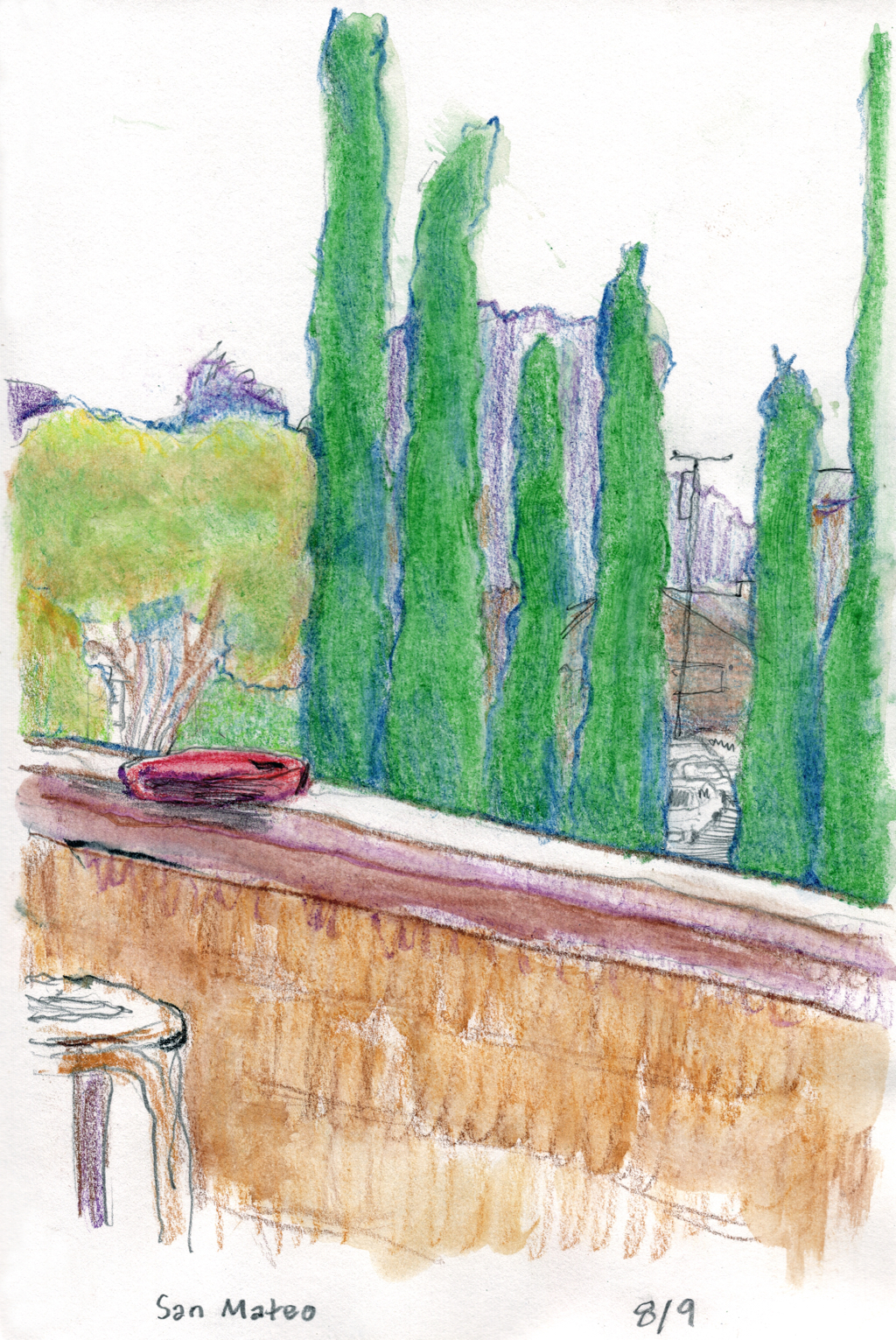
We left a large clay saucer (the thing you put under a potted plant to hold excess water) out on the railing of our balcony, and filled it with water to make a bird bath. Many of the neighborhood birds have come to drink or bathe, including California Scrub Jays (Aphelocoma californica), American Crows (Corvus brachyrhynchos), Cedar Waxwings (Bombycilla cedrorum), House Finches (Carpodacus mexicanus), and Dark-eyed Juncos (Junco hyemalis). The crows and scrub-jays are too big to bathe, and all they do is drink the water — pretty boring. I most enjoy watching the juncos bathing — sometimes, one bird will be splashing around in the water while another waits impatiently for its turn to bathe. Yet even watching crows drink is better than staying glued to online “news” sources for more stories about a U.S. president who denies human-caused climate change while taking great glee in dropping the biggest bombs he can.

Dealing with attacks again

My hosting service let me know that evil hackers are attacking various parts of my blog. To address this, I’ve implemented “captcha” forms on various parts of the blog. Sorry for the inconvenience, but you’ll have to do some simple math before you post a comment. I’m also implementing other security measures — please email me if you run into problems.

In a comment, Alyson writes: “I was wondering if you had any practical input on how to teach this subject without making the non-white children in the congregation feel uncomfortable or singled out in the process. Our RE class is actually fairly diverse, more so than the entirety of the congregation, and I do not know how to broach this topic with them.”

Alyson, I’m facing the same problem: how to teach a group of Unitarian Universalist children who are not all white about white supremacy. Here’s what I’ve been thinking so far….

For initial inspiration, I start with Dr. Marcia Chatelaine and her crowd-sourced #FergusonSyllabus. Although Chatelaine’s Ferguson syllabus was mostly aimed at public schools and post-secondary education, this is actually incredibly useful for those of us working in Sunday schools that are at least somewhat diverse — because Chatelaine’s syllabus has to deal with far greater diversity than exist in most Unitarian Universalist Sunday schools, it helped me see how to structure lessons that do not assume that everyone is white, that do not assume that everyone shares exactly the same opinions about race, etc. In other words, I feel that Chatelaine’s approach opens up a metaphorical space in which to explore the topic from diverse experiences and diverse points of views. This article by Chatelaine at The Atlantic has a good set of resources to explore, including links and children’s books; at least some of these resources could be useful in teaching a diverse Sunday school group about white supremacy.

As noted in an earlier post, Chatelaine recommends working in subject areas that you know something about. With that in mind, I’m working on some Unitarian Universalist-specific children’s stories from Unitarian Universalist history (based on serious historical research I did, including in primary sources). Two stories I’m working on right now are about nineteenth century African Americans, one a would-be Unitarian and one a short-term Universalist, that reveal how Unitarianism and Universalism were less-than welcoming places for non-white persons. One of these stories-to-be also touches on class bias in Unitarianism, so we can get into intersectionality at a kid-friendly level (one of the points Chatelaine made in a workshop that I attended is that intersectionality is a useful strategy in teaching this general topic). In the other story, the African American was a vital part of a local congregation, but only for a short time. Most importantly, the stories of these two people are complex, not simplistic, and inspirational: some white persons were moving away from white supremacist worldviews at the same time that some black persons were moving towards liberal religion, and all these persons had complex lives and motivations worth telling stories about.

If I manage to write these two stories, and I think they’re worth sharing, they’ll get posted here on my blog. But even if I don’t, maybe this can get you thinking about how you can take Chatelaine’s advice and use YOUR strengths as a Unitarian Universalist religious educator — what topic area do you know best, and how can you apply that to teaching about white supremacy? And then how can you use your expertise to open up a metaphorical space in which children with diverse experiences and diverse points of views can explore the topic?

I think it’s also important to acknowledge some of the resistance we will face when we try to create this open metaphorical space in which a diverse group of children can explore this topic. I think we religious educators will face strong and conflicting pressures: white parents who want to protect their children from this topic, non-white parents who don’t want their children to have to be in a white-dominated environment to learn about this topic, non-parent adults who want us to adhere to a strict party line, congregational leaders who want us to fit into what they’re doing (instead of asking us what we’re doing, and building something around the children) — and some of us may also have to deal with micro-managing parish ministers and clueless denominational leaders and busybody academics, all of whom think we religious educators are not competent to take on leadership in this area.

But acknowledging the potential sources of resistance helps me clarify three basic pedagogical challenges. First, we know there is always resistance to tackling tough moral and ethical issues; we have dealt with this before, in teaching comprehensive sexuality education, in teaching about death, in teaching children to think for themselves. Second, we know Unitarian Universalism is a non-creedal religion devoted to open inquiry; we constantly challenge children to think deeply and openly about everything from the Bible and God, to masturbation and consent, and we constantly have to work to hold open that metaphorical space where children can enter the zone of proximal development in a learning community. Third, we know that race and racism are topics that make adult Unitarian Universalists very uncomfortable, which means they will tend to judge us harshly no matter what we teach; but we’ve been through this before, when we religious educators quietly taught about sexism and heteronormativity in Sunday school classes, even though those topics made many adults uncomfortable.

I think the thing that makes me most nervous about this white supremacy teach-in is that so many people will be watching me, ready to judge my teaching inadequate. And I wonder if your question stems in part from that same feeling. As an educator, I know these one-shot teach-ins never accomplish much, so I know already that whatever I do in a one-hour teach-in will be inadequate. Teaching and learning are long, slow, mysterious processes; we will not achieve miracles in an hour; we need to be in this for the long haul. And that means that the most important thing I can do in this teach-in is to respect each individual who participates, listen with openness to what they have to say, create a supportive learning community — so that they will keep coming back. It’s just like teaching OWL for grades 7-9 — many of the teens don’t want to come to the first few sessions, so you have to build a supportive community where any question is taken seriously and everyone feels a part of the community. For this white supremacy teach-in, then, our most important goal will be to make people want more.

That’s all I’ve got for you right now. Not sure if I’ll post my lesson plans and supporting material here — Unitarian Universalists are far too prone to savage and destructive criticism when it comes to teaching about white supremacy, and I just don’t have the energy for that right now. But feel free to contact me through email.