The Ministerial Fellowship Committee (MFC) of the Unitarian Universalist Association (UUA) has sent out the following notice:
“I am writing to inform you that the Ministerial Fellowship Committee voted recently to remove the Rev. Bob LaVallee from fellowship with the Unitarian Universalist Association for violating UUMA Ethical Standard #10, which prohibits sexual contact, sexual harassment, sexualized behavior and sexual relationships with anyone the minister serves, and Ethical Standard #13, which prohibits engaging in words or actions that degrade the vocation of ministry.”
A quick web search shows that Bob LaVallee was the associate minister of the Albuquerque congregation for about five years, up until 2025. As always, I’m making no judgement myself about any of these notices — I’m not part of the MFC, and it’s been many years since I was part of any congregation where a minister was removed from fellowship. Especially so in this case, as I’ve never heard this name before, and I know nothing about the Albuquerque congregation.
A couple of weeks ago, I got one of those emails from the Ministerial Fellowship Committee of the Unitarian Universalist Association. The key paragraph read as follows: “The Ministerial Fellowship Committee voted at its December 2025 meeting to remove the Rev. Benjamin Meyers from fellowship with the Unitarian Universalist Association for violating the terms of ministerial probation, as related to acts of plagiarism.” When I was in the Bay Area, Ben served at the Berkeley Fellowship and the congregation in San Mateo.
This raises a question for me:
Does using generative AI to write a sermon count as plagiarism?
Technically, it’s not plagiarism. At the same time, it’s not your own work. It’s an interesting ethical question.
I feel like such a grouch. I keep writing blog posts about ways the Unitarian Universalist Association (UUA) could be more transparent in the ways it handles clergy misconduct. But I’m not one of those people who post criticism of the UUA but who aren’t looking for actual improvement, they just want to badmouth the UUA. My purpose is different. I actually like the UUA. But like all human institutions, the UUA could be better, and I’d like to contribute in some small way to making it better. Since I have no skills for committee work or denominational governance, what I do is write about possibilities for improving the UUA.
So I’m really not a grouch. I hope.
Anyway, I’ve been thinking about ways the UUA could be more transparent in its handling of clergy misconduct. And I’d like to point out three other religious groups who inspire me with their attempts to be more transparent.
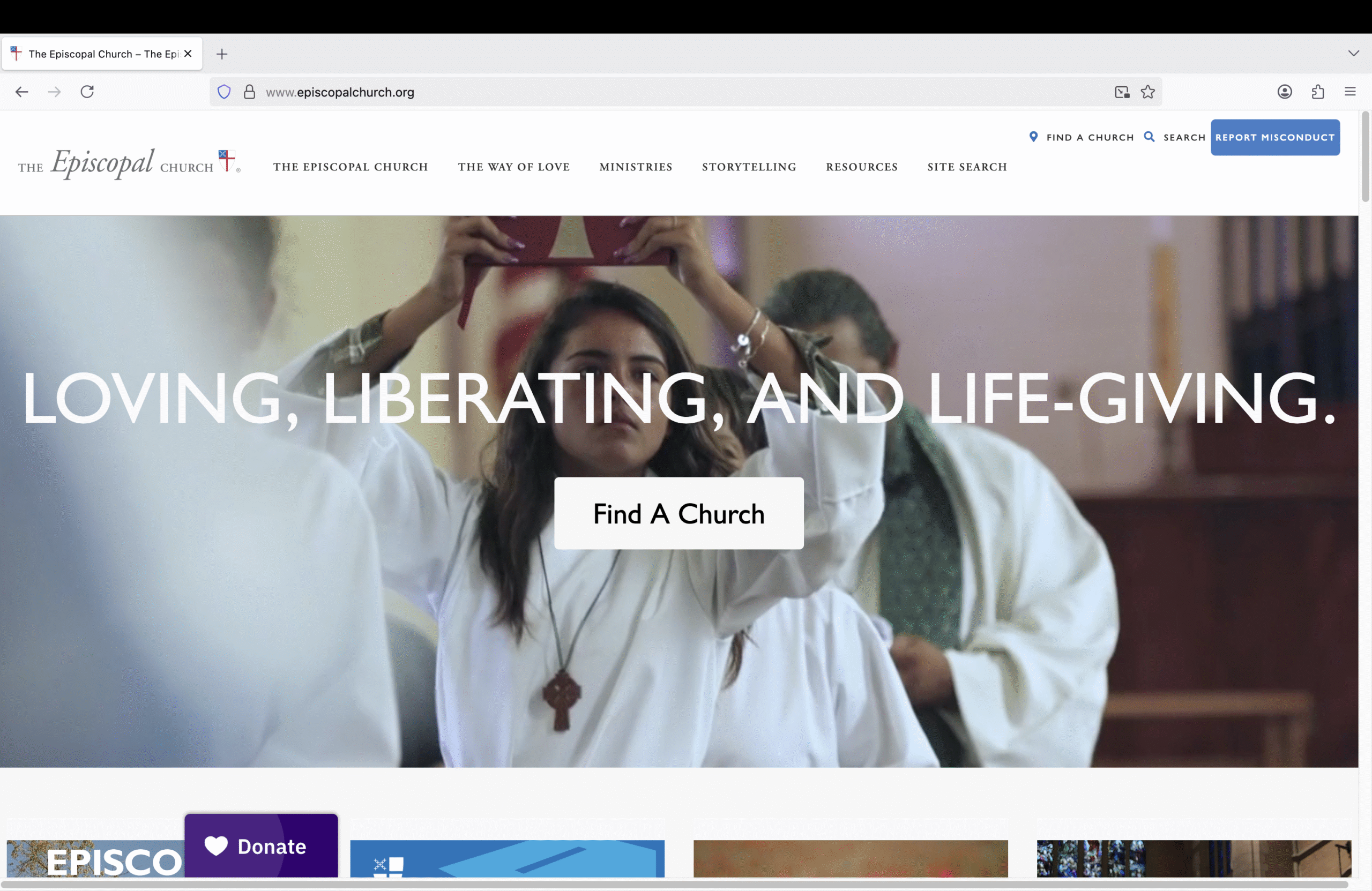
First, I’d like to point out the website of the Episcopal Church here in the U.S. Take a look at the screenshot below that shows the front page of their website:
It’s a little hard to see in my screen grab, but in the upper right hand corner there’s a prominent button that reads “Report Misconduct.” If you click on that button, you are taken to another webpage with detailed and (to my mind) confusing instructions about how to report misconduct by clergy. Indeed, there has been criticism from within the Episcopal Church about how their actual processes are not especially transparent.
But forget about their problems with their internal processes for a moment. I applaud their decision to post a prominent link on the very front page of their website that takes you right to instructions on how to initiate a complaint about clergy misconduct. Contrast that with the UUA website, which has no such prominent link. I find it very difficult to locate any information on the UUA website about how to initiate a complaint regarding clergy misconduct.
One final point — given all the publicity around clergy sexual misconduct in the past twenty years, it seems to me to be a smart marketing move by the Episcopal Church to have that prominent link on their front page. It says to people who are looking for a religious home — “We’re serious about stopping clergy misconduct.” It signals that they might be a safer religious home than, say, Unitarian Universalism.
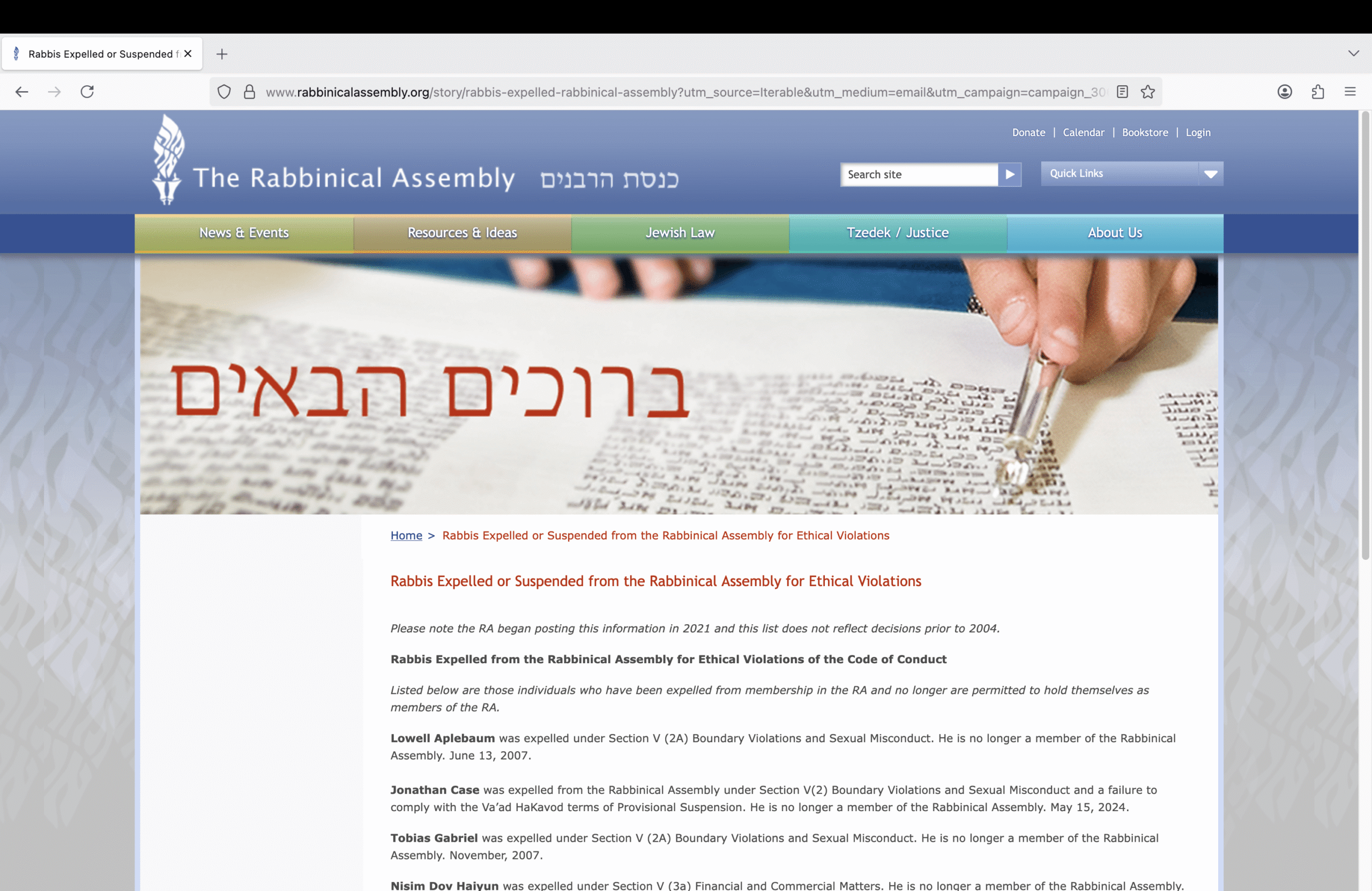
On this page, freely visible to anyone visiting their website, the Rabbinical assembly lists the names of seven rabbis who were expelled from the Rabbinical Assembly since 2004. This is exactly what should happen — if a clergy is expelled from a denomination of association of congregations, then the denomination-level website should make their names freely accessible in the interests of transparency.
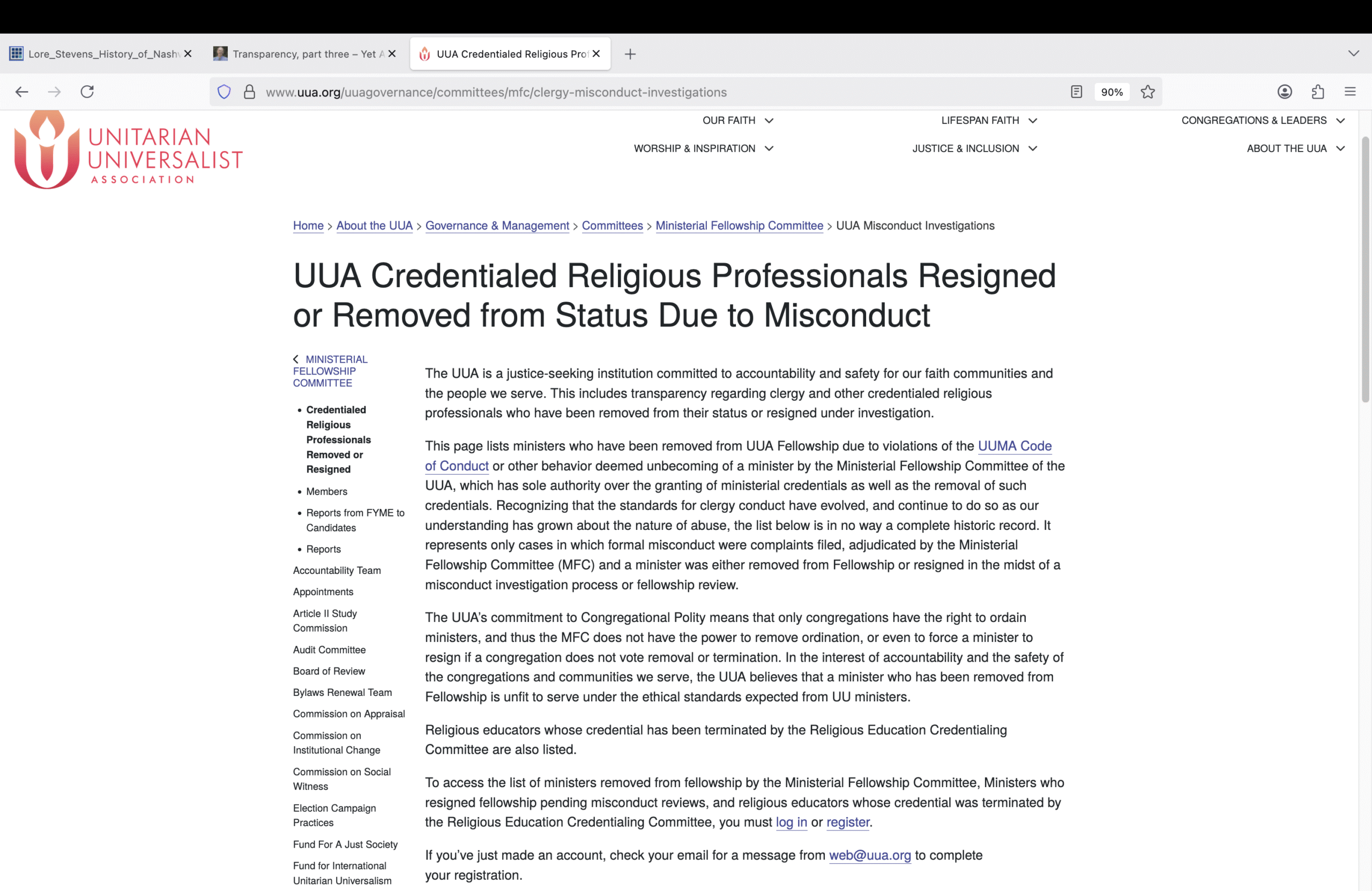
The UUA tried doing this for a while, beginning in 2021. Then, a couple of years ago, that list was hidden from public view. You can still see a webpage titled “UUA Credentialed Religious Professionals Resigned or Removed from Status Due to Misconduct” on the UUA website — but when you get to that page, you are instructed: “To access the list of ministers removed from fellowship by the Ministerial Fellowship Committee, Ministers who resigned fellowship pending misconduct reviews, and religious educators whose credential was terminated by the Religious Education Credentialing Committee, you must log in or register.” You can just about read these instructions on the screen grab below:
I can understand why this page has been restricted —I imagine that in an era of increasing violence, the UUA has the admirable goal of keeping names and personal information hidden. But there are several names that do not need to be hidden, such as ministers who have been convicted of sex offenses, so that their misconduct is a matter of public record. Examples include David Kohlmeier, Ron Robinson, and Mack Mitchell. In addition, this webpage should clearly state why access to the list is restricted — I’ve imagined a charitable reason why the UUA has hidden this page, but someone else could imagine the UUA has hidden the list for nefarious reasons.
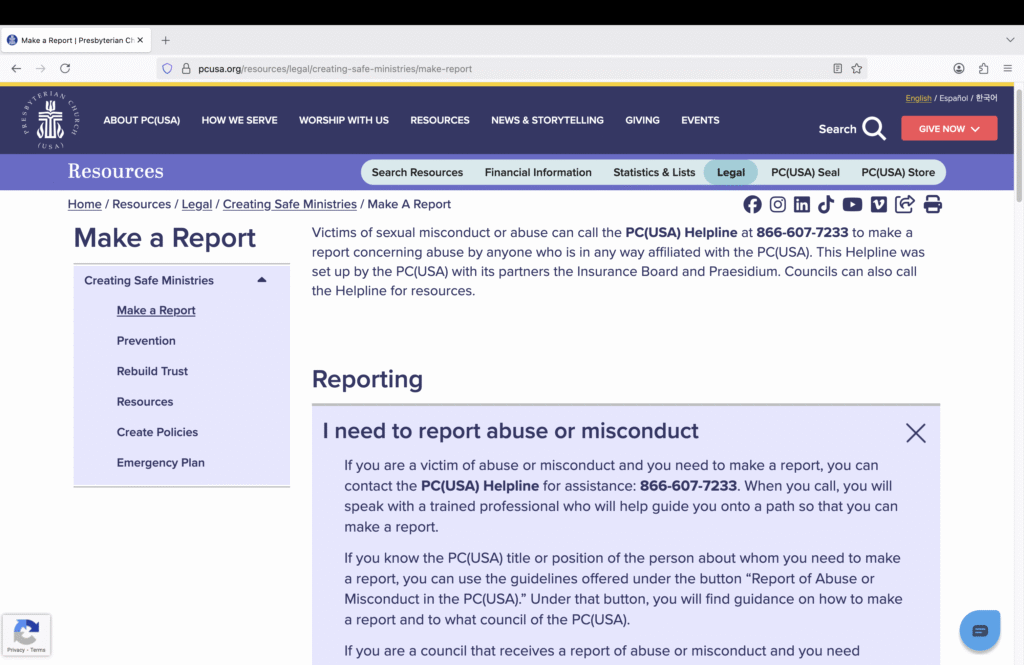
Third, the Presbyterian Church USA actually has a phone hotline that you can use to report abuse, as shown on this screen grab:
Admittedly, there are all kinds of potential problems with this helpline. Most obviously, who is the “trained professional” who answers the helpline? If it’s a denominational staffer, someone paid by the denomination, I’m going to be skeptical of their ability to remain neutral; I’d hope the “trained professional” is actually employed by their insurance carrier (which seems to be implied here), because an insurance carrier is somewhat more likely to take misconduct allegations seriously. Also, I could wish that the helpline would offer both voice calls and texting (I hate talking on the phone, but I love texting). And finally, I would like to see a guarantee of confidentiality — please tell me that if I call, and I feel uncomfortable with the “trained professional,” that you’re not going to track me down through my phone number.
Nevertheless, this makes it really easy to report misconduct, and I applaud this attempt at making the reporting process as transparent as possible. (I also applaud the fact that the “trained professional” can also provide information about abuse prevention resources — great idea.)
How might this apply to the UUA? Here are three practical suggestions — and the first two are actually very easy to implement.
First, the UUA should have a prominent link on the landing page of their website that with one click provides specific, actionable instructions on how to report misconduct.
Second, at least a partial list of ministers removed from fellowship should be publicly accessible on the UUA website without requiring registration — and there should be a clear explanation of why seeing the full list requires registration.
Third, ideally the UUA would provide an easily accessible service for reporting misconduct. And ideally, this service will be provided by an independent contractor, not by a denominational employee.
Another in a series of stories for liberal religious kids.
The great philosopher Socrates, who lived two thousand five hundred years ago, once had a long conversation with another philosopher named Gorgias. And during that long conversation, he told a story about what happens to human beings after we die.
Listen, then (said Socrates), as story-tellers say, to a very pretty tale, which I dare say that you may be disposed to regard as a fable only. But I believe this is a true tale, for I mean to speak the truth.
The poet Homer tells us in his immortal poem The Iliad, how the gods Zeus and Poseidon and Pluto divided the empire which they inherited from their father. Poseidon ruled the oceans, Hades ruled the underworld, while Zeus ruled over everything, including over the other gods and goddesses.
Now in the days of Cronos there had existed a law about what happens to human beings after we die. This law has been in force since the beginning and remains so today. The law decrees that human beings who have lived their whole lives in justice and holiness shall go, after they die, to the Islands of the Blessed, where they will dwell in perfect happiness. On the other hand, human beings who have lived unjust and irreverent lives have to go to Tartaros, the house of vengeance and punishment.
In the time of Cronos, and even into the early days of Zeus’s reign, the judgement was given on the very day on which people were to die — the judges were alive, and the people were alive — and the consequence was that the judgements were not well given. So Hades and the authorities from the Islands of the Blessed came to Zeus, and said that some of the people who had died had found their way to the wrong places.
“Well, first of all,” Zeus said, “we must put a stop to human beings knowing the time of their death; for this they at present do know. However, Prometheus, the god of foresight, has already been given the word to stop this in them.
“Next,” said Zeus, “human beings must be stripped of their clothing and indeed of their very bodies, and stripped of everything else before they are judged. In other words, the human beings must be fully dead when they are judged, and not alive as they currently are. Furthermore, whoever judges them also must be dead and covered over with no clothing nor a body, nor with their wealth and families or other fine array. In this way, the judge’s naked soul will be able to perceive the truth of the other naked souls. If the judgment is carried out in this way, then it will be just.”
Zeus then decreed that three of his own human children should become judges, once they died. These three were Minos and Rhadamanthus from Asia, and Aeacus from Europe. When they died, they were assigned to stay in the “meadow at the parting of the ways.” Two roads left this meadow: one road went to the Islands of the Blessed, and the other road went to Tartaros. Rhadamanthus judged all the humans who died in Asia. Aeacus judged all the humans who died in Europe. And Minos served as the final court of appeal, if either of the others had any doubt about a human being who came before them.
Brief commentary
[A couple of points you might want to mention if you talk about this story with actual children:] This “fable” was written nearly half a millennium before the Christian era. And it’s worth remembering that Socrates spoke a different language from us, and his word for truth — aletheia — meant something more like “revealing” or “disclosing.” Aletheia was not the opposite of falsehood, but rather the opposite of forgetfulness. Aletheia was also a goddess.
Source:
Plato, Gorgias 523a – 524a, trans. Benjamin Jowett (1871), with reference to the translation by W. R. M. Lamb (1925).
Back in 2022, I mentioned in a year-end blog post that Rev. Kathryn J. Rohde had been removed from fellowship by the Ministerial Fellowship Committee (MFC) of the Unitarian Universalist Association (UUA). Now it turns out there’s a (publicly available) sequel.
The following year, 2023, Rohde sued the UUA for removing her from fellowship, and further for ending the retirement stipend she received from the “Unitarian Service Pension Society” (an organization I didn’t even know existed). You can read the basic court documents here, but I read about the case in a blog post by Daniel Dalton on the website of Dalton-Tomich, a law firm specializing in “religious properties” (a legal speciality I didn’t even know existed).
According to the court filings, and Daniel Dalton’s blog post, Rohde got in trouble because of a social media post made in 2020:
“In 2020, Rohde posted in a private Facebook group with about 1,200 members. Three individuals found her posts offensive and reported them to the UUA. The UUA allegedly initiated a disciplinary process against Rohde, despite her being retired. Rohde claims the process was politically motivated, driven by a ‘woke’ faction within the UUA. She was stripped of her ministerial credentials and retirement stipend, with no clear violation of UUA policies cited.”
[Parenthetical note: “private Facebook group” is an oxymoron; social media is never private.]
[Another parenthetical note: Both the court filing and the Daniel Dalton blog post state that Rohde alleged she was the victim of sexual harassment early in her ministerial career — an allegation I would expect to be true, based on what older women ministers told me about the way they were treated by male ministers and denominational officials in the late twentieth century.]
Daniel Dalton goes on to reveal what the court decided; or rather, didn’t decide:
“In a ruling on July 11, 2025, Judge Mary Kay Costello issued a mixed ruling on the defendants’ motion to dismiss based on the ministerial exception to the First Amendment. Rev. Rohde’s claims of defamation, invasion of privacy (false light); tortious interference with contract, and breach of contract (specifically regarding her removal from fellowship and alleged procedural failures) were dismissed without prejudice. However, her claims of breach of contract, related to her retirement benefits, breach of contract against the Unitarian Service Pension Society and promissory estoppel were allowed to continue. The court also granted Rohde the opportunity to file an amended complaint by July 25, 2025, consistent with the court’s decision.”
I have not been able to find out whether Rohde filed an amended complaint. I did find out that the usual vocal critics of the UUA — the Fifth Principle Project, the North American Unitarian Council, etc. — have been trumpeting Rohde’s case as another example of how “wokeness” has overtaken the UUA. Rupert Murdoch’s New York Post also picked up the story, using it to castigate so-called cancel culture.
Daniel Dalton, however, draws different conclusions from this case. First, he points out that most of Rohde’s claims were dismissed, not necessarily on their merit (or lack of merit), but rather on the legal notion of “ministerial exception.” As I interpret this, the dismissal, then, does not necessarily represent a judicial judgement (for or against) on Rohde’s claims.
Second, he notes that the Rohde case “prompts questions” in the area of “governance and accountability” regarding disciplinary procedures. Such question could lead to “greater transparency in internal investigations.” While Dalton seems to direct this comment at the UUA, I would imagine that local congregations should also pay attention to this — disciplinary procedures should always be clear and transparent.
Among other conclusions, Dalton points out that this case highlights the need to balance freedom of expression over against “community values.” Dalton suggests: “UU congregants and leaders may need to find ways to balance inclusivity with respecting diverse viewpoints.”
Dalton also highlights “ideological splits within the denomination,” and he then speculates if this might prompt “wider discussions on political polarization, identity politics, and theological diversity” within Unitarian Universalism. I think we Unitarian Universalists try to ignore the divisions among us, but Dalton shows us just how visible those divisions are to outsiders.
So that’s the inconclusive sequel to the 2022 removal of Kate Rohde from ministerial fellowship. Yet even though this sequel is inconclusive, there’s one conclusion I’d like to draw. Expanding on what Daniel Dalton says, I think it would be good to have additional clarification on Unitarian Universalist disciplinary policies for ministers (at both the denominational and local levels), as well as “greater transparency in internal investigations” (again, at both the denominational and local levels). The problem is that I don’t know how to make that happen. Our individualism means we find it hard to work together. 25 years of budget cuts have left the UUA understaffed in some key areas. Wider American society has grown polarized, and people are tender and raw. All these factors are going to make it extremely hard to come together to talk openly about a difficult topic like how we discipline clergy.
12 Oct. 2025: Minor edit made that didn’t change basic content (added brackets and intro phrase to the second parenthetical note).
Email piled up while I was on vacation. I missed the fact that the Ministerial Fellowship Committee sent out another notice back on July 16:
“With regret, I am writing to inform you that the Rev. Kaaren Anderson has resigned her fellowship during a full fellowship review with the UUA’s Ministerial Fellowship Committee (MFC) for bullying and abusive behaviors in the workplace including in prior ministries. This fellowship review occurred after a full investigation by an independent investigator. The Executive Committee of the MFC met with the Rev. Anderson in early July and recommended removal from fellowship, necessitating a full fellowship review. It was during this process that the Rev. Anderson resigned.”
As I’ve said before, I do wonder who the independent investigator was. Does the UUA have enough money to pay for an outside law firm or consulting firm to carry out these reviews? If not, who is the independent investigator? In any case, Kaaren Anderson has her own website, where you can her employment history.
The Ministerial Fellowship Committee (MFC) and the Religious Education Credentialing Committee (RECC) of the Unitarian Universalist Association (UUA) sent an email dated July 9. It reads:
“This email is to inform you of recent decisions of the UUA’s professional credentialing bodies. The Religious Education Credentialing Committee (RECC) has terminated the religious educator credentials of Gregory Carrow-Boyd. This determination was upheld by the Board of Review, upon appeal. The RECC was referred this case, following a decision by the Ministerial Fellowship Committee to remove Mr. Boyd from ministerial aspirant status because of conduct unbecoming of a minister, pursuant to UUMA Ethical Standard 13 – specifically sexual misconduct connected to consent, boundaries, and power dynamics. The MFC affirmed the findings of the thorough, independent investigation, which found a persistent pattern of these boundary violations and misconduct over many years.”
He was most recently the combined minister and director of religious education at the UU congregation in Honolulu. As always, by posting this I’m making no judgement about the facts of this particular situation. I post these on my blog simply because not everyone gets these emails. In addition, the page on the UUA website where these decisions are listed now appears to be hidden from public view and available only by application to the UUA; presumably this is part of the UUA’s decision to hide names and identifying information from bad actors. While making it more difficult to see this page is probably the right thing to do (in our current tumultuous socio-political moment), it also makes it easier to overlook this important repository of MFC judgements.
There is one thing in this email that I’d like to know more about. The email references a “thorough, independent investigation.” It makes sense to have an independent investigation, but I’d like to know who made this investigation. Identifying the investigating body would increase transparency, and consequently increase trust in the overall process.
On another topic — I don’t remember getting an email from the Religious Education Credentialing Committee before. I didn’t know that they could terminate religious education credentials. It makes sense that they can do so; I just didn’t know about it.
Update 15 July 2025: Added a sentence that got left out by mistake in the editing process.
On Friday morning, I went to “Global Worship: Celebrating Our Diverse Faith,” led by (among others) Rev. Zsolt Elekes of the Transylvanian Unitarians; Juban Lamar, a member of the Jowai church of the Khasi Hills Unitarians; Vyda Ng, executive Director of the Canadian Unitarian Council; and Liz Slade, chief officer of the General Assembly of Unitarian and Free Christian Churches (United Kingdom). As I understand it, a couple of other primary worship leaders did not receive visas and were unable to attend General Assembly.
I found this worship service to be very moving. Zsolt Elekes talked about how the Transylvanian Unitarians went through some hard times, particularly under the repressive Ceausescu regime; yet they found strength through their international partnerships. All the speakers used the image of a bridge held up by many pillars — the bridge representing worldwide liberal religion, and the pillars representing the various Unitarian, Universalist, Unitarian Universalist, and Free Christian groups that are spread throughout the world.
What holds all these groups together? What, for example, do the distinctly theistic Khasi Hills Unitarians have in common with some of the fundamentalist humanist Unitarian Universalists in the United States? One of the speakers said, half-humorously, that we’re all heretics — but that remark was only half humorous, because in all seriousness our willingness to be heretics is a unifying factor. We also share the symbol of the flaming chalice, which is used by our co-religionists around the world. Zsolt Elekes also pointed out that the Flower Celebration, developed by Norbert and Maja Capek in the Prague Unitarian Church just over a hundred years ago, is something else we hold in common — a religious celebration that symbolizes how we perceive human unity in our diversity.
Wednesday evening, Carol, Ms. M., Roger, and I joined the watch party for the opening worship service for General Assembly. The video worship service was well done — the script was good, the performances of the individual elements were well done, and the editing as good. But online worship always makes me feel like a passive consumer, whereas live worship (if it’s done right) makes me feel like an active participant.
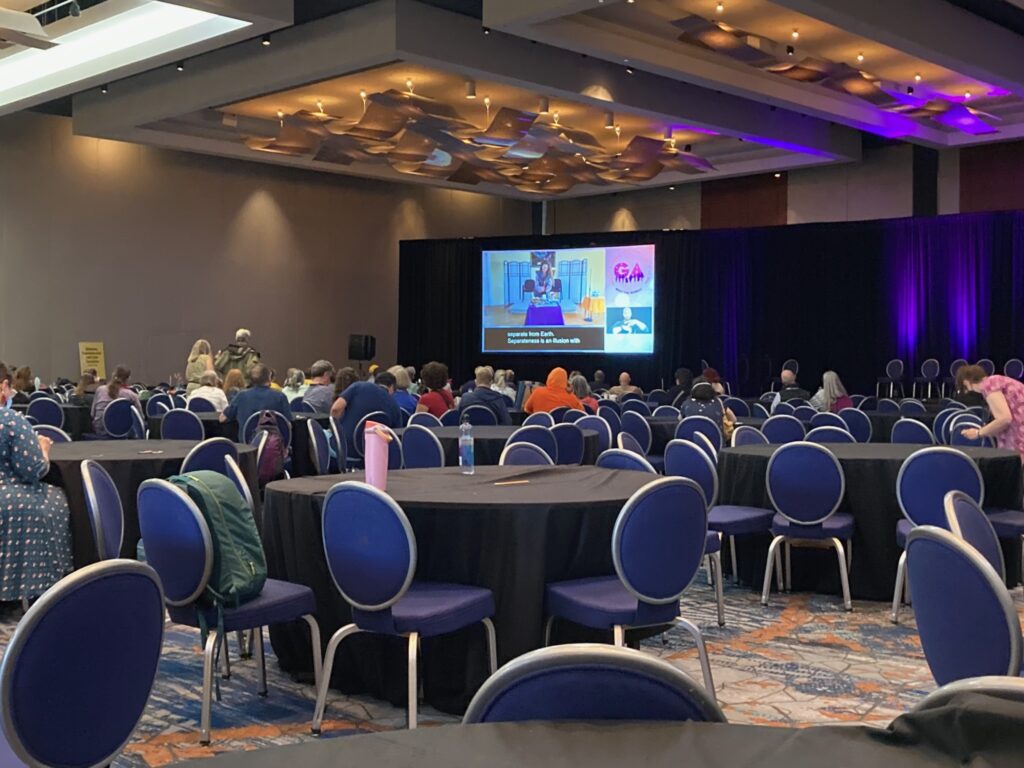
Not that many people showed up for the watch party. A few hours earlier, the room looked nearly full, with a few hundred ministers and family members. But for this watch party, the room felt empty.
I also noticed how the audio system boosted the lowest audible frequencies. If you record your audio with a mediocre microphone, your audio track can be filled with low frequency rumble. When you listen to that audio on your laptop, you’re not going to hear that rumble (unless you have really good headphones). But when you pump that audio through speakers big enough to fill a hotel ballroom, that rumble is going to be noticeable. This is something I’m going to remember to be aware of if I ever produce video/audio content that will be heard in a large room.
On Thursday morning, I started walking to the convention center from our hotel. I got almost all the way there when I realized that I had forgotten my face mask. So I walked back to the hotel, and then back again to the convention center, by which time the “Meet the Moment” programming had already started. I tried to figure out which programs were in which room, but I found the Whova event app so user-unfriendly that I gave up and downloaded the PDF program from the UUA website. Then I saw that we are supposed to commit to a single “Meet the Moment” program track for all three days. Frustration set in. Just then, Jen, an old friend, walked up. Jen said she was going to several different “Meet the Moment” tracks, because she was the only person from her congregation and she wanted to be able to go to as many tracks as possible. Yay! I had permission to ignore the rules!
At lunch, I walked through the Baltimore heat to a ramen place about ten minutes away. I was joined by Jen and Abby, who belongs to a UU congregation near my congregation. Abby and I talked about ways our congregations could cooperate. (It’s a little weird that I had to travel all the way to Baltimore to meet someone from a nearby congregation.) Then Jen reminded us both that Spirit Play would be a great kids program for small congregations like ours. So far, this lunchtime conversation is the most valuable thing I’ve gone to at this General Assembly.
Now I’m sitting in the meeting room listening to this year’s Congregational Study/Action Issues (CSAI). Somewhat to my surprise, there’s a CSAI that is fully aligned with one of the big priorities of our congregation — “Housing: Diversity, Equity, and Inclusion.” And one of the speakers in support of this CSAI actually mentioned classism (she’s affiliated with UU Class Conversations). The other two CSAIs are also worthy projects, but as the only delegate from our congregation, I’m going to vote for the issue that I think will be of the greatest interest to us.
It was nine o’clock by the time we checked into our hotel, so I gave up on any notion of attending the last activities at Ministry Days, the annual meeting of the Unitarian Universalist Ministers Association. In the morning, I walked the four blocks to the convention hotel in time for the opening worship service at Ministry Days. The service was fine, but marred both by the horrible acoustics and dreary aesthetics of the hotel ballroom (I never understood why they call it a “ballroom” when no one holds balls any more), and the uncomfortable chairs that always seem to plague hotel ballrooms.
I went for a long walk during our lunch break, and arrived back in time for the afternoon program. The program tracks included “Joy and Creativity,” “Rest Is Resistance,” “Organizing” (community organizing, not organizing your job better), and identity caucuses. None of these seemed like a good match for my professional development needs, so I sat outside the meeting rooms and waited to see if I’d wind up in an interesting conversation. Sure enough, Jay Atkinson sat down and started to tell me about a research project he’s working on. Our Unitarian Universalist leaders, said Jay, often talk about “our theology” as that which unified Unitarian Universalism. But what is that theology? Do we even have a distinctive Unitarian Universalist theology? I especially liked the distinction between “scholarly theology” and “vulgar theology.” Jay told me the name of the scholarly theologian who coined those terms, a name which I promptly forgot, but it’s a useful distinction, analogous to the distinction that sociologists make between “lived religion,” the religion of ordinary people, as opposed to the religion of elite practitioners.
Carol and I had dinner with Ms. M and Roger. Fortunately the restaurant wasn’t crowded, because we were there for two hours catching up with what was going on in each other’s lives.
This morning, I went back to the convention center hotel for the opening worship at Ministry Days. But I just wasn’t in the mood for sitting in a dreary hotel ballroom with a few hundred other people, passively consuming the excellent music, the dance performance, and the spoken word. I ducked out and now I’m headed up to the Walters Art Museum to meet Carol.