
Happy 375th birthday

My home congregation, First Parish in Concord, Massachusetts, the Unitarian Universalist church I grew up in, just celebrated its 375th birthday. My dad, who is still a member of that congregation, attended the festivities. In fact, he was one of the honored guests at the birthday banquet last night:— he was one of 16 people who have been members of the congregation for 50 or more years. He and my mother joined First Parish not long after I was born, and there’s a story behind that.

My mother had grown up Unitarian, had been the Superintendent of the Junior Department of the Sunday school of the Wilmington, Delaware, Unitarian church back in the 1950s when they had something like 600 kids in their Sunday school, but when she and my father moved to Concord, she did not go to church. The minister at that time called on her to find out why she wasn’t coming to church, and she told him it was because she had an infant (me) and a toddler (my older sister Jean), and there was no child care during the Sunday services. So the minister recruited a woman named Betsy Connelley, along with some other people, to serve as volunteer staff in a child care service they called “Pooh Corner” (and before the wiseacres in the audience ask, it was named after Winnie the Pooh, and the name had nothing to do with the diapering process). Once there was child care, my parents could attend Sunday services, and 50 years later, my dad is still a member there. Moral of the story: provide great child care in your congregation.

Dad told me that one of the honored guests sitting with him last night was none other than Betsy Connelley. She still remembers me, and asked me dad to say hi. One of the best things about congregations is the sense of continuity they can provide; they are communities in which human connections can be held for generations.

So here’s to First Parish in Concord on its 375th birthday!
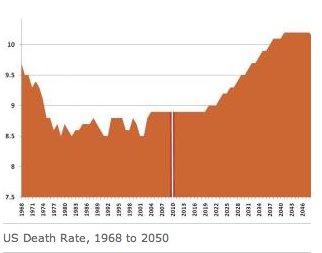
“The coming death tsunami”

The Ministry Matters blog has a good post on how a projected increase in U.S. death rates could affect congregations. Here’s a graph of the projected rise in death rates:

The post is an excerpt from the book Focus: The Real Challenges that Face the United Methodist Church by Lovett Weems. While the United Methodists have been declining faster and for a longer period than have Unitarian Universalists, the predicted rise in U.S. death rates could have a similar effect on both congregations: older members, who are the biggest givers, will be dying off more quickly than we can replace them by younger people. And this will have serious financial implications:

Countless churches have fewer worshipers today than they did ten or twenty years ago. Most of them, however, have budgets as large as or larger than they did when they had more constituents, even after adjusting for inflation. Such a congregation manages in the early years of decline by the greater giving of their fewer participants. As things get tighter, the lowering of expenditures combined with greater per capita giving maintains financial stability.

A church then gets to a point at which attendance has declined so much that making the budget each year becomes the preoccupation of the church and its leadership. Each year they search for that one new source of income or cut in spending so they can manage to make their plan. They also realize that even these yearly heroic efforts will not be enough going forward as they note the high percentage of their annual giving that now comes from those over age 70.

Weems advocates making budget cuts now to increase financial viability for the future; you can read the whole post here. From my point of view, the most important point is to get away from putting the budget at the center of a congregation’s reason for existence: if a congregation is really focused on “making the budget,” you might just as well close the doors now, and save everyone the heartache of decline; for it will be, not the imperceptible decline that’s going on right now in many congregations, but a heartstopping avalanche of decline.

A portrait of the minister as a misconductor

Recently I received an unsolicited book in the mail. As a minister and as a blogger, I sometimes receive unsolicited books in the mail, usually on topics in which I have no interest, and I generally toss them straight into the recycling bin. Upon opening the envelope, I read the title of the book, Being Alive and Having To Die: The Spiritual Odyssey of Forrest Church, and having no interest in Forrest Church I headed for the recycling bin. But before I tossed the book, I thought to myself, “I wonder if the author dared tackle Church’s sexual misconduct?” The author did dare, so I decided to read on.

Dan Cryer, the author of Being Alive and Having To Die, portrays Forrest Church as having come from privilege. The son of Frank Church, a prominent U.S. Senator, Forrest Church could trace his ancestry back to the Mayflower through both his mother and his father. He grew up in large part near Washington, D.C., in a county with the highest per-capita income in the country. His father went to Stanford University, and that’s where Forrest received his undergraduate degree. Although he was estranged from his father during the late 1960s, as were so many upper middle class young men of his generation, he once avoided arrest because U.S. Forest Service troopers liked his father’s pro-conservation initiatives in the Senate. Forrest Church continued following his father’s footsteps: his father had gone to Harvard Law School, and after a year at Pacific School of Religion Forrest transferred to Harvard Divinity School.

He married Amy Furth when they were both undergraduates at Stanford. Cryer’s descriptions of their marriage makes Forrest Church sound like a male chauvinist pig, e.g., “…the young husband did have a bad habit of wounding Amy by making important decisions without consulting her” (p. 65). Beginning in 1976, Church began having affairs with other women, although he himself “declined to characterize these as ‘affairs'” (p. 188). After he was called to the prestigious pulpit of All Souls Unitarian in New York (in “that nation’s wealthiest ZIP code”[p. 110]) in 1978, the affairs continued, though not with members of the congregation. By 1991, the marriage of Amy and Forrest Church “had been shaky for a long time” (p. 187). It was in that year that the whole thing blew up. Continue reading “A portrait of the minister as a misconductor”

A definition

This morning, Robert Latham, our interim district executive is meeting with the district’s ministers. One of the things he said is sticking with me:

“One way to define dysfunctionality is: to dream big and act small. Then one way to define funtionality is: to dream big and act big.”

October 2 sermon topic: discuss….

My title for this Sunday’s sermon here in the Palo Alto church is “Liberal religion, Silicon Valley style.” I’m a big believer in the notion that any religious organization will be influenced by the immediately surrounding community. Therefore, Unitarian Universalism in Silicon Valley should have some distinctive features. So what are some of the most important of those distinctive features, and how do they affect the way we do religion here? Here are three possible answers:

(1) One distinctive feature of Silicon Valley life is the ethic of hard work: here in the Valley, people believe that the harder one works the better off one will be. By contrast, Thoreau’s famous book Walden, an important book for many Unitarian Universalists, extolls the virtue of spending less time working hard, and more time contemplating Nature. I’d say Silicon Valley liberal religion extolls the virtue of lots of hard work, and tends to ignore thinkers like Thoreau.

(2) Another distinctive feature of Silicon Valley life is that we live in a truly multicultural and multiracial place. Santa Clara County is a white-minority county with no dominant racial or ethnic group; this is what the rest of the United States will look like within a generation. And while our congregation is 85-90% white, that also means that we are 10-15% non-white, and we’re all so used to living in the multiracial, multicultural world of Silicon Valley that it seems to me we’re pretty relaxed about becoming an increasingly multicultural congregation.

(3) Now add another distinctive feature of Silicon Valley life: the engineering and entrepreneurial drive which lead us to believe we can fix anything if we put our minds to it. I think Silicon Valley is going to be the place where liberal religion figures out how to be truly multiracial and multicultural. Here in the Valley, multiracial doesn’t mean there are both black and white people in the congregation, it means there are whites, blacks, East Asians, and South Asians; and people who were born in several different countries (Russia, India, Taiwan, etc.).

So liberal religion in Silicon Valley is characterized by a strong work ethic; by multiculturalism; and by a can-do attitude. This raise the interesting question that I’m going to try to address in the sermon: Does this mean all we’re going to do in our congregation is work our asses off? Because if all we’re going to do is to work our asses off (or work our collective ass off, whatever), even if it’s for a good cause, I’m just not interested. There has to be a better way to do religion….

Finding documents relating to the sexual revolution within UUism, 1965-1985

The sexual revolution has both direct and indirect effects on Unitarian Universalism. Persons who were part of Unitarian Universalism experienced the sexual revolution in their personal lives, the work place, etc., and these experiences indirectly affected Unitarian Universalism; since experiences are not peculiar to Unitarian Universalists, strictly speaking they do not relate to the history of the sexual revolution within Unitarian Universalism.

When I think about those aspects of the sexual revolution that most directly affected Unitarian Universalism, I think of the following, in no particular order: sexuality education, sexual experimentation, LGBTQ rights, theological stances, feminism and the Women and Religion movement, marriage and divorce. Each of these aspects of the sexual revolution had a direct impact on local congregations and the denomination as a whole, as well as on individual Unitarian Universalists.

For each of these aspects of the sexual revolution, I have tried to brainstorm a list of where we might find relevant documents dating from the era 1965-1985.

For all these topic areas, Unitarian Universalist periodicals from that era that should be reviewed for relevant materials, and the two official denominational periodicals, UU Register-Leader (to 1970) and UU World (1970 on), are of primary importance. Independent publications which may contain relevant material include First Day’s Record, published by and for clergy, and Unitarian Universalist Voice. Congregational newsletters may also have relevant information; since there are probably tens of thousands of such documents, a researcher can only sift through a small portion of them.

Here, then, are some preliminary ideas of where we might find documentation dating from 1965 to 1985 on the general topic of the sexual revolution: Continue reading “Finding documents relating to the sexual revolution within UUism, 1965-1985”

Singing school, part one

We had a good turnout for the first session of our Sacred Harp singing school at the Palo Alto church: we had set out 54 chairs, and at one point every chair was taken. A dozen or so experienced Sacred Harp singers showed up to help support Marsha Genensky, our singing master for the day. The new singers were about evenly split between people who had sung a few times at a local Sacred Harp singing, and people who had never sung Sacred Harp before but who had some singing experience.

Marsha traced the background of solfege syllables from the Middle Ages up to the development of the “fa, sol, la, mi” syllables used in early American singing schools. She demonstrated how the scale worked with only four solfege syllables: fa, sol, la, fa, sol, la, mi, and back to fa. She showed the class how early American hymnals printed the syllables “F, S, L, M” to indicate pitch. Later, these same syllables were printed beneath standard round-headed notes, and finally notes with different shaped note heads were developed to help make it easy to sight-read a piece of music: fa corresponded to a triangular note head, sol to a round note head, la to a rectangular note head, and mi to a diamond-shaped note head. (Link to a sample scale in shape notes.)

Marsha then organized the class into a scale: some people sang a low fa, a different small group so, the next group la, and so on up the scale. Then she told us to sing our note when she pointed at us — and by “playing us like a marimba,” she had us sing the tune to “Amazing Grace.” (She also told the class that the name of the tune is actually “New Britain,” while the name of the hymn or poem is “Amazing Grace.”)

By this time, the class was ready to sing some songs, and Marsha led us through a couple of easy songs. She had each section — altos, trebles (with men and women singing an octave apart), tenors (the melody line, with men and women singing an octave apart), and basses — sing their part separately and slowly, using the “fa, sol, la, mi” syllables. Then she put us together so that we were singing in four parts. The experienced singers kept us on our parts, and there were plenty of other fine voices in the room, so we sounded great!

After an hour of the singing school, we segued into the regular bimonthly Palo Alto singing. The tempo of the songs picked up, and at times some of the new singers got a little lost, but from where I sat in the back of the bass section, everyone I could see was enjoying themselves, and enjoying the music.

Historical note: The singing school was a regular feature of eighteenth century American life, and persisted well into the nineteenth century in America outside of urban areas. The singing school continued through the twentieth century in the rural South in the tradition of Sacred Harp singing (so named because the tune book used by the tradition is titled “The Sacred Harp”), and today is enjoying a revival outside the South in northern and Western cities, and abroad in Ireland, England, Australia, and even Poland. The singing school remains an excellent way to teach people how to sing, which is why I brought a singing school to our Unitarian Universalist church in Palo Alto.

The end of summer slow-downs

This is a busy time of year for many of us who serve congregations as paid staffers or lay leaders. The summer slow down is over, and it’s time to ramp up to the regular schedule. It can be a stressful time of year in congregational life.

And for the first time, I’m feeling impatient with the stress. Why do we even bother to slow down in the summer? I know I have pretty much the same religious needs all year round, and the summer slow-down doesn’t make sense to me.

Not that I don’t value seasonal changes in congregational life. I used to love summers in the Unitarian Universalist congregation I grew up in because the senior minister would get other ministers to preach there while he was on vacation; we’d have several weeks of a rotating cast of characters preaching their best sermons from the past year. (Mind you, I have also been a part of a congregation where the summer services were led by ill-prepared and unskilled speakers; one member of that congregation called summer services “amateur hour”; but that’s a whole different blog post.)

But this idea of partially closing the congregation down in the summer no longer makes sense to me. Sometimes it seems like the only thing the summer slow-down accomplishes is increasing my stress and my workload in the month of August. I just want to put an end to summer slowdowns.

This year’s Berry Street lecture

The text of this year’s Berry Street lecture is now up on the Web. At the Berry Street lecture this past June, Rev. Dr. Deborah Pope-Lance spoke for over an hour to some six hundred Unitarian Universalists on the topic of clergy misconduct. I found it to be a riveting lecture in June, and it is well worth reading the text of the lecture, if for no other reason than the link to the Web page that discusses whom Carly Simon might have been thinking about when she wrote the song “You’re So Vain.”

After Deborah gave the lecture in June, I was one of the many people who crowded around her, wanting to shake her hand. She shook my hand, and all I could say was “Thank you.” I meant: Thank you for telling the truth of clergy misconduct, and for doing so with grace and humor, and in such a way that rather than provoking resistance perhaps we can deal productively with the aftereffects of misconduct. And now I would add: Thank you for pointing out the role of narcissism in clergy misconduct, and thank you for pointing out how “clergy misconduct is nested in an ecology that either promotes or inhibits breakdowns in the ministerial relationships.”

But enough of this. If you weren’t at the Berry Street lecture in June, now is your chance to go read this important document.

Church in summer

Diane, a Lutheran pastor and blogger, writes about going to church in the summer. Common wisdom is that it’s not worth going to church in the summer because there’s “no Sunday school, and no choir, and plenty of other things to do.” But, says Diane:

I saw a smile on the face of a woman who told me that she wanted to give thanks for three years being cancer free. I saw tears on the face of a woman who wanted me to pray for the family of a friend of hers who died last week. I saw a teenager walk into the sanctuary by herself, sit down by herself, and then move to sit down next to her mother’s best friend, and her friend’s mother….

It’s a reminder that there are people who go to church, not for Sunday school or choir or out of habit, but because it really does something for them.