Recently, I used something written by Rev. Elizabeth Tarbox as a reading in a Sunday service. I realized I knew next to nothing about her, so I decided to look up her obituary in the Unitarian, Universalist, and UU Yearbooks (now digitized and online). She died in October, 1999, which means her obituary would be in the following year’s Yearbook — except that was the one year when the UUA decided not to publish minister’s obituaries in the Yearbook. I found no other obituary or life summary for her online.
With a little bit of research, I was able to generate the timeline below — which tells me most of what I want to know:
5 March 1944, born Elizabeth Irene Peck to William and Irene Hard Peck in St. Albans, Hertfordshire, England, United Kingdom (birth record)
1963, married Charles E. Tarbox (1938-2016) in St. Albans; she and Charles later had a child (marriage record; Charles Tarbox obituary in Boston Globe)
1968, she and Charles immigrated to the United States; applied for Social Security card (Social Security records; Charles Tarbox obituary in Boston Globe)
1986, B.A. in philosophy, Bridgewater State College (Bridgewater State yearbook for 1986)
c. 1980s, congregant at First Parish Duxbury, Mass. (mentioned in FP Duxbury newsletter)
c. 1986, began studying at Harvard Divinity School
c. 1988-90, served as student minister, First Parish Norwell, Mass. (mentioned on FP Norwell Facebook page)
1990, graduated Harvard Divinity School (UUA Yearbooks)
1990, ordained (UUA Yearbooks)
1990, settled at First UU Society of Middleboro, Mass. (UUA Yearbooks)
1993, publication of Life Tides: Meditations
1997, settled at First Parish in Cohasset, Mass. (UUA Yearbooks)
1997, publication of Evening Tide: Meditations
1999, resigned from First Parish in Cohasset due to ill health (First Parish Cohasset records)
31 Oct. 1999, died in Duxbury (Duxbury Annual Report; Social Security records)
I’m mostly satisfied with this timeline, though I wouldn’t mind finding answers to a couple of questions. First: When did she become a Unitarian? — it’s even possible she was raised Unitarian, as there was a small Unitarian fellowship in St. Albans in the 1950s, according to Alan R. Ruston, Unitarianism in Hertfordshire (Watford, Hertfordshire, U.K., 1979), p. 26. Second: What was she doing between marriage in 1963 and starting college in the 1980s — which includes a subsidiary question: Why did she come to the United States?
I’ve been trying to find out something about Preston Bradley. He was the minister of People’s Church in Chicago from 1912 to 1976. At its peak, People’s Church reportedly drew 4,000 people each Sunday, presumably over the morning and evening services, probably the largest Unitarian church of all time. Beyond that, Bradley’s radio broadcasts reportedly reached five million people. These figures may be exaggerated — Bradley has been accused of inflating the size of his congregation and the number of his radio listeners — but he certainly reached a great many people, most people than just about any other Unitarian minister; his closest competitors are Theodore Parker and Norbert and Maja Capek.
But there’s not much about him online. This post collects some of the information that I’ve been able to dig up. Feel free to link to more material in the comments.
“One of the most interesting preachers now in the Unitarian Church is the Rev. Preston Bradley of the People’s Church, or Uptown Temple, in Chicago. It is safe to say that for the first time a considerable number of his ministerial colleagues have become acquainted with him. Dr. Bradley began his ministry as a Presbyterian, but soon found his views expanding and gradually he outgrew the creed of his church. In due time he separated from his denomination and with his congregation carries on an independent movement. Feeling the need of fellowship and the advantages of union with some denominational body, they affiliated with the Unitarians seven years ago. One of the best and biggest sessions of the conference was held in his church. The Uptown Temple is a fine new building, in proportions and arrangements not very different from the well known Tremont Temple in Boston, but much more artistic. It seats about thirty-six hundred people and it is filled every Sunday morning.”
When the People’s Church voted to affiliate with the Unitarians, there was an article in the American Unitarian Association’s Christian Register (7 February 1924) — notice that a different attendance figure is reported here:
“Dr. Preston Bradley is minister of the People’s Church in Chicago, Ill. This church was founded by its present minister twelve years ago, and is now one of the most largely attended liberal churches in the world. Its Sunday morning attendance is upward of two thousand. Services are conducted in the Pantheon Theatre on Sheridan Road north of Wilson Avenue. The church voted recently to affiliate with the Western Unitarian Conference, the American Unitarian Association, and the National Federation of Religious Liberals.”
This excerpt from “Another View of Preston Bradley,” by Judy Thornber, gives a sense of the impression Bradley made as a preacher:
“As a true admirer who heard Preston Bradley on the radio and in person at his church, I saw no sign of megachurch techniques. Bradley did not ‘orate.’ He spoke in a personal, conversational way, revealing his own feelings and thoughts and his high aspirations for what people could do. He acknowledged that times were difficult and many people had enormous problems. It was, after all, the Depression. He did his best to provide hope to his following, without mention of God or Jesus, and to engage in citywide social action with various civic organizations. This man was not an Elmer Gantry type egoist. He was passionate about empathy and support for those with troubles, but not in a ‘theatrical’ way. His true genius was that he simply talked directly to his congregation, both on the radio and in the church, as if they were intelligent people who wanted to lead good lives. He tried to encourage them and keep their hope alive.
Thornberg goes on to offer some excellent advice that probably still holds true for today’s Unitarian Universalists ministers:
“Since few of today’s UU ministers can grow membership the way Bradley did, we should seriously study his sermons to understand why they spoke so clearly to people and were so well received by the public. When Bradley spoke, you felt he was speaking to you one on one. He shared himself. He did not pretend to have all the answers. He did preach that hope could be nurtured by persevering and by focusing on leading a good life according to our own best lights.”
With that brief introduction to Bradley’s life and work, here are some of the online resources I’ve found.
Preston Bradley online
N.B.: You must look at the comments for Lisa DeG’s extensive list of links to Bradley material.
“The [25th anniversary] jubilee was that of the world’s largest Unitarian church (2,500 members), founded with 67 members in 1912 by a rotund, swarthy little man who today is Chicago’s most popular Protestant pastor.”
This is the only biography of Bradley that I’ve been able to find online. That the “Dictionary of Unitarian and Universalist Biography” does not have a biography for Bradley may seem like a curious omission, given that Bradley was one of only a handful of Unitarian or Universalist ministers of a 20th C. mega-church (a mega-church is defined as a church with a Sunday attendance of over 2,000; remember, that’s attendance, not membership). Beyond that, because of his radio broadcasts Bradley was arguably one of the most widely-known Unitarian ministers of the mid-twentieth century. Furthermore, Bradley actively promoted social justice, which seemingly would pique the interest of today’s Unitarian Universalist scholars. However, Bradley holds little interest for today’s UU scholars, and that may be for a number of reasons: Bradley trained for ministry at Moody Bible Institute rather than at an elite theological school; Midwestern and Chicago Unitarianism is generally undervalued by UU scholars; and Bradley remained a Christian Unitarian long after that became unpopular. Perhaps his worst sin, though, was that he was a wildly popular preacher, and we UUs seem to be uncomfortable with the fact that our religion actually holds attraction for the common person.
Bradley’s written work
1. A copy of The Liberalist, a publication of People’s Church that mostly featured Bradley’s writing; from May, 1960.
3. Along the Way: An Autobiography, 1962. Hosted at the Internet Archive; if you have an account with the Internet Archive, you are able to “borrow” this book and read it for free online.
The sermons are: “An Inspirational Message in Troubled Times” (25 January 1943) “What is Christianity” (18 January 1959) “Thanksgiving Sermon” (November, 1960) “The Religious Atheist” (12 April 1964) “Meeting Criticism” (24 October 1965 “The Pastor in the Blizzard” (N.D.)
Sikhs are strongly monotheistic. The first words in the Guru Granth Sahib, their collection of holy writings, say “Ek Onkar,” or “God is one.” Furthermore, God is transcendent and has not been incarnated in some physical form. Guru Nanak, the founder of the Sikh religion, wrote a statement of belief that can be translated as follows (reference: Pluralism Project):
There is one God whose name is True. God is the Creator. God is without fear. God is without enmity. God is of eternal form. God is unborn, uncreated, beyond incarnation. God is self-existent and self-sufficient. God is attained by the grace of the Enlightener.
Thus within the Sikh worldview, it would be wrong to say that there is more than one deity. The Sikh religion does recognize a series of ten holy persons, the gurus, of whom Guru Nanak was the first. These human beings are not considered deities by Sikhs — even though from the perspective of other worldviews they may seem to take on some of the qualities of lesser deities — but rather they may thought of as humans who had a special connection to God and who are tehrefore worthy of veneration.
Guru Nanak lived in the Punjab region of South Asia, a place where Hindus and Muslims both claimed their religion was true. Guru Nanak said that God transcends such divisions, and famously proclaimed that there is no Hindu, there is no Muslim.
The story is told that Guru Nanak once visited Mecca, the most holy city for Muslims. Sayad Muhammad Latif, in a history of the Punjab, tells what happened there:
“He (Guru Nanak) travelled over the whole of India, visited Persia, Kabul and other parts of Asia, and it is said even Mecca. A story is related by both Hindus and Muhamadans [sic] in connection with Nanak’s visit to Mecca. It is said that while at Mecca, Nanak was found sleeping with his feet to the Kaba, before which the Muhamadans prostrate themselves when performing their devotions. The Kazi Rukan-ud-din, who observed this angrily remarked: ‘Infidel, how dare you dishonour God’s house by turning your feet towards it.’ ‘Turn them if you can,’ replied Nanak, ‘in a direction where the house of God is not.'” (quoted in Kazhan Singh, History and Philosophy of the Sikh Religion: Part I: History, Lahore: Newal Kishore Press, 1914, p. 99)
This story gives a sense of the Sikh conception of God — transcendent, omnipresent.
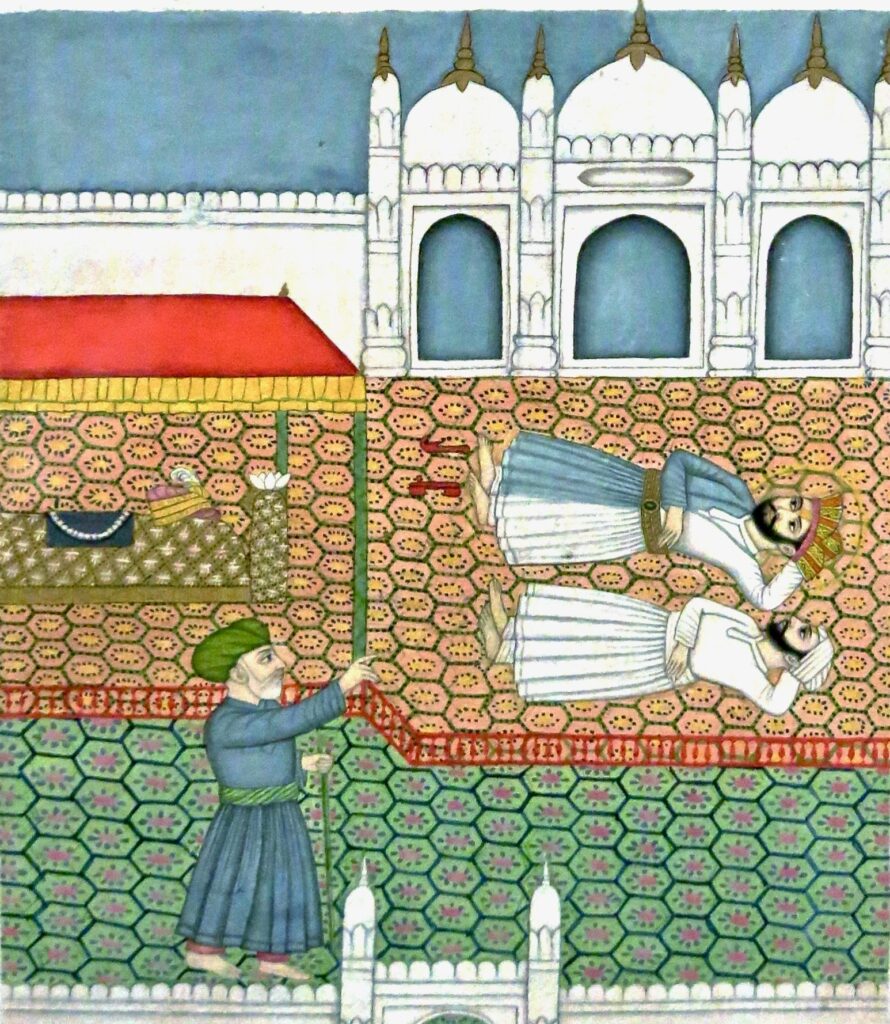
A lovely painting on paper from West Bengal, painted in the mid-eighteenth century and currently in the Asian Art Museum in San Francisco, depicts Guru Nanak sleeping with his feet towards the Kaba:
Labeled in the museum as follows: “Guru Nanak and his disciple encounter a Muslim cleric at Mecca, from a manuscript of the Janam Sakhi (Life Stories)” / Approx. 1755-1770 / India; probably Murshidabad, West Bengal state / Opaque watercolors on paper / Gift of the Kapany Collection, 1998.58.23. [N.B.: While there are many photos of this painting online, I took this photo myself on Sept. 18, 2015, and digitally edited it in 2025; photo copyright (c) 2025 Dan Harper.]
In another version of the story, a Muslim cleric kicks Guru Nanak for sleeping with his feet pointed towards the Kaba, then grabs hold of the guru’s legs and tries to turn his feet away, but “lo and behold the miracle the whole of Mecca seemed to be turning.” (Vaaran: Bhai Gurdas, Pauri 32, At Mecca)
While researching the old Unitarian Church of Palo Alto (1905-1934), I came across someone who is famous enough to be featured on Wikipedia. He’s an entomologist, so he’s not famous famous. He’s not even that famous as scientists go. Still, he’s on Wikipedia so I think it’s worth drawing the attention of today’s Unitarian Universalists to him.
John Merton Aldrich
A renowned entomologist, he was born January 28, 1866, in Rochester, Minnesota. In 1870, he was living with his parents L. O. and Mary, and his older brother and younger sister, in Quincy, Olmsted County; his father was a farmer. In 1880, he was still in Quincy with his family, which now included another younger sister and a servant.
In 1881, John’s family moved to a farm in South Dakota. He attended the new South Dakota Agricultural College in Brookings, S.D., graduating in 1888 after just three years of study. It was in his last year of college that he first took a course in entomology.
Following his graduation, he taught school for a term, then went to study at the University of Minnesota. Although there was then no formal course in entomology at the university, John was able to study with Otto Lugger. Station Entomologist at St. Anthony’s Park. Then in the autumn of 1889, John went to Michigan State University to study entomology. It was there he first turned his attention to Diptera; as he later recalled, his professor advised him “to select a single order as a specialty, and to proceed at once to get together a library and collection; he also suggested the Diptera as a large order in which there were but two workers…at the time in the country.” John began his lifelong study of Diptera in the spring of 1890; this was also the start of his massive collection of Diptera which eventually included some 45,000 specimens.
In November of 1890, John traveled east, both to meet other entomologists and to find work. After failing to obtain a job at Harvard, he traveled to Washington, D.C., and worked for several weeks at the Smithsonian Museum on the insect collections there. However, lack of money forced John to return home, and he spent the winter of 1890-91 working on classifying his growing Diptera collection. He moved to Brookings, and worked worked at the South Dakota Experimental Station, making his first major collecting trip that summer. He received his master’s degree from South Dakota State College in 1891, and had an assistantship the following year. Due to faculty infighting, John lost his assistantship, and he went to to the University of Kansas in 1892; he received a second master’s degree there in 1893.
The University of Idaho was founded in 1893, and John was hired to found the department of zoology. He moved to Moscow, Idaho, to work at the university. There he began working on his catalogue of North American Diptera.
Before leaving South Dakota, he married Ellen J. “Nellie” Roe (b. 1870) of Brookings, S.D., in 1893. Ellen had received her B.S. degree from South Dakota Agricultural College in 1889; she and John had first met while they were both students. At the time of their marriage, Nellie was the assistant principal of the Brookings High School. John and Nellie settled in Moscow, Idaho, where they had a child, Spencer, who died the day he was born, May 17, 1895. Nellie died two years later, on December 3, 1897. To cope with his sorrow after these two deaths, John lost himself in his research. He completed his monumental A Catalogue of North American Diptera (or Two-winged Flies) (Washington, DC: Smithsonian Inst., 1905) on January 1, 1904.
Another excerpt from my long-delayed book on people who belonged to the Unitarian Church of Palo Alto between 1895 and 1934.
Oramanda Boring
An educator and field biologist, Oramanda (Ora) A. Boring was born October 12, 1854, in Carlinville, Illinois. Little is known about her younger years except a few bare facts in the public record. In 1860, she was living in Carlinville with her father John, a carpenter, her mother Mary, her older sister Mary E., and younger siblings Mary Myrtle and William. The family was still in Carlinville in 1870, living close to Blackburn University (called Blackburn College today), a co-educational college affiliated with the Presbyterian church. By this time, Mary E. had died, leaving Ora as the oldest child. By 1880, Ora was working a school teacher, now living with her parents and younger siblings Mary Myrtle (now age 23), William A., Ella L., Lewis H., Blanche M., Frank P., and Florence A. (age 4) in Greenfield, Ill., an unincorporated town just to the west of Carlinville.
After teaching high school in Greenfield, she moved to California in 1881. She was granted a provisional teaching certificate in Los Angeles in January, 1882; the State Board of Education granted her a “life diploma” (or permanent teaching certificate) in 1884. She probably taught in the Los Angeles schools for the next few years.
Ora met David Starr Jordan, the president of newly founded Stanford University, at a conference in Coronado, and he persuaded her to enter college at age 36. She began studying biology at Stanford University as a special student in 1891, the year the university opened, and was reportedly the first woman student. She participated in the first summer session of the Hopkins Seaside Laboratory in 1892.
After a year at Stanford, she returned to teaching school. She had gained enough experience, and enough of a reputation, that she was an instructor in the summer session of the “California School of [Teaching] Methods” in 1892, teaching other teachers about the history of education. After teaching school until about 1896, she then studied at Stanford again more or less full time from 1897 to 1899. In 1899, she returned to teaching school once again, and finally received her A.B. in zoology from Stanford in 1900, at age 46.
Ora had expertise in a wide range of subjects. In the biological sciences, she pursued both ornithology and botany. She became a member of the Cooper Ornithological Club, an early association of field ornithologists. She was also a serious botanist, and Harvard University Herbaria still has her collections of California plants. Although her degree was in biology, Ora taught several other subjects in her long career as a teacher and educator. In the 1893-1894 school year, she taught English, Latin, zoology, and history in the Coronado, Calif., high school. From 1894 to 1896, she was a supervisor in “primary and grammar grade work” in Stockton, in addition to teaching biology at Stockton High School.
Through the 1890s and into 1900s, she published a number of articles in the field of education. To give an idea of her range of interests, her article titled “Nature Study” was published in School Education in 1895; and “Theological Life of a California Child,” co-written with professor Earl Barnes of Stanford, was published in Pedagogical Seminary in 1892.
In her memoir of life at Stanford University, Ellen Coit Elliott witnessed Ora’s field methods for her educational studies:
“Dear Ora Boring appeared about that time. I saw her first at my front door, notebook in hand, asking modestly, like the gentlewoman she was, if she might make a few notes on my children’s reactions to the color element: she was taking one of Professor Barnes’ education courses. Oh, certainly! Louis and Christabel (little guinea pigs) were brought in from the sandpile and stood, big-eyed, in front of the strange lady on the lounge. She showed them strips of colored paper and asked them which they liked best. Christabel preferred bright red. Louis preferred bright red. The reactions were written down. Ora thanked me for the loan of my offspring and returned to her class. Dear Ora! Her lovely life and friendship were with us through the years.”
After her father died in 1893, her mother Mary moved from San Diego to Palo Alto. In 1897, Ora was living in Palo Alto with her mother, her sisters Blanche and Florence, and her brother Frank; both Blanche and Ora were studying at Stanford at this time. Her mother was an active member of the Methodist church; there is no record of Ora’s religious affiliation at this time. Her mother was an invalid by the time she died in 1901, and Ora may have been providing care for her. By 1910, Ora lived at 101 Waverly St. in Palo Alto with her sister Blanche, brother-in-law William Snow, and their children; Ora was working as a high school teacher.
Ora taught in many different school systems across California, so many that it proved impossible to trace them all. In 1899, she was teaching zoology at Palo Alto High School. She was one of the first teachers at the Clear Lake Union High School District in 1901. In 1903, she was teaching in the high school in Riverside. In 1910, she was living in Palo Alto, though it’s not clear where she taught. From April, 1912, to June, 1914, she taught in the Yosemite Valley School, a one room schoolhouse; the school year ran from April through December, and she may have lived elsewhere when the school was not in session, although as a biologist perhaps she chose to live in the Yosemite Valley year round.
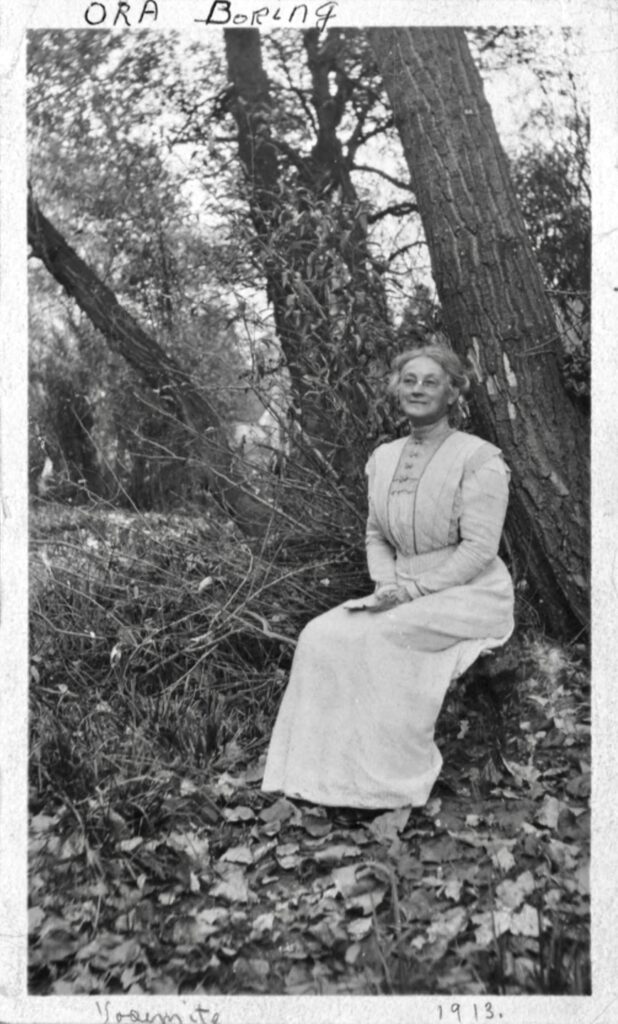
Ora Boring in Yosemite, 1913 (included in “Sunland: A Scrapbook”)
In autumn, 1914, at age 60, Ora began teaching school in Sunland, Calif., then a remote town in the mountains outside of Los Angeles. An unattributed typescript memory of Ora’s tenure in Sunland appears in “Sunland: A Scrapbook,” assembled by Enid A. Larson in 1983:
We hear a lot about the Unitarian and Universalist ministers who stayed in ministry for decades — people like Hosea Ballou and William Ellery Channing. But what about the people who served as Unitarian or Universalist ministers for just a short while, then moved on to something else?
Here is one such person.
William E. Short Jr.
William E. Short, Jr., served as a Unitarian minister for just two years, from 1915 to 1917, primarily at the Unitarian Church of Palo Alto. He left the ministry for radical politics, then became a building contractor and later a realtor.
He was born on September 6, 1888, in Jackson, Miss. Short’s father was an Episcopalian minister, who moved the family to St. Louis, Mo., in 1889. William Short, Sr., died on October 27, 1905, when William, Jr., was 17 years old. After his father’s death, William, Jr., completed high school at the University School, St. Louis, Mo., and went on to attend Trinity College, Hartford, Conn., his father’s alma mater, receiving his B.A. there in 1912.
As an Episcopalian lay reader, William had charge of a few “missions,” or what we now might call church plants or emerging congregations. He received his B.D. from the Episcopal Theological School, Cambridge, Mass., in 1915. Beginning in the fall of 1914, he became interested in Unitarianism, and made contact with the American Unitarian Association (A.U.A.). In the summer of 1915, he served the Unitarian church in Walpole, Mass. At the end of the summer, he was accepted into Unitarian fellowship. The A.U.A. recommended him to the Unitarian Church of Palo Alto, and the congregation called him in November, 1915. It appears that the Palo Alto church never regularly ordained him, due to his feelings about ordination, though he was recognized as a minister by the congregation and denomination.
Initially, he was quite happy in Palo Alto, and wrote to the A.U.A.: “I am more pleased than ever over the fact that I left the Episcopal Church and became a Unitarian.” However, he avoided contact with the denomination, going so far as to resist meeting with other Unitarian ministers. Even though the A.U.A. paid much of his salary, Short consistently neglected to submit to them the monthly reports they required of him.
Another in a long-running series of brief biographies of obscure Unitarian Universalists. This is a chapter from my long-delayed book on Unitarians in Palo Alto from 1895 to 1934.
Out of poverty
Assistant minister, then settled minister, of the Unitarian Church of Palo Alto in 1926-1927, she was born at Larned, Kansas, on October 18, 1888, the first child of Fred Newton Lasley and Leura Auretta Davis. Times were hard in Kansas, and not long after Leila was born, Fred scraped together enough money to take the train to Portland, Oregon, where his brother and half-sister lived, in hopes of finding work. He found work as a carpenter, and saved enough money to send to Leura so that she could join him in Portland. Leura was just twenty years old when she took that five day journey by rail, carrying a baby in diapers, and with no one to help her.
After a year in Portland, Fred found work managing a farm in Springdale, east of Portland. He and Leura felt financially secure enough to have more children, and Leila’s younger sisters Weltha Evadna Lasley, and Gladys Mable Lasley, were born in Springdale; a brother Clarence, born in 1890, died young. By 1896, when Leila was 8 years old, the family had saved enough money to purchase their own farm in what is now Corbett, Ore. On the side of a hill, Fred built a two room shack using rough lumber he purchased, with a root cellar underneath. Fred built a trough that ran from a nearby spring to the house, so that they would have running water in the house. Leila’s sister Clara Belle Lasley was born on the farm the next year, in 1897. Leila’s younger brother Walter was born there in 1905.
The Lasleys were “poor as church mice.” They had few toys, and their clothes were often faded and patched. But their mother kept them looking neat and tidy, and encouraged them with homey moral sayings. If the children felt discouraged and unable to do something, their mother would say, “Mr. Can’t just fell off the fence and broke his neck — now you girls get back to work.” If their mother heard something that sounded like gossip, she would say, “That doesn’t concern you, so don’t publish it.” What Leura lacked in schooling, she made up for in common sense. Leura also had pride: she wanted her daughters “to be brought up decent.”
Religion News Service reporter Kathryn Post has an interview with William J. Kole about his new book, “In Guns We Trust,” to report on White evangelical gun culture. In the interview, titled “‘In Guns We Trust’ challenges white evangelicals to rethink their alliance with firearms,” Kole says that he was a part of White evangelical churches, but has been “deconstructing” his Christian faith over his perception that gun culture (and its ally, Christian nationalism) has nothing to do with Christianity:
“…I feel like the historical Jesus is objectively nonviolent. I understand that evangelicals will cherry-pick Scripture to find a few verses to help them feel more comfortable with gun culture, but I find it completely unbiblical. The churches that are embracing gun culture now were almost entirely pacifist up until the late ’60s and early ’70s, when a shift began. Even the Assemblies of God, where I served as a lay missionary for three years in Europe, was officially pacifist in its constitution and bylaws. So, they’ve had to pivot, and it’s a perplexing pivot for me. I just don’t see how weapons have anything to do with a faith tradition that is rooted in nonviolence.”
Kole also says that he’s now “reconstructing” his Christian faith, adding:
“I just can’t, in good conscience, continue in the evangelical tradition.”
Back in 2010, Scott Wells came up with a list of congregations that claimed an affiliation with both Unitarian Universalism and some other religious tradition. 15 years later, we’ve seen many small congregations close, so I decided to revisit Scott’s list and see how many of the congregations in his post were still in existence.
Below is my list, grouped together by U.S. state, and in alphabetical order within each state grouping. Except where noted, I’ve given religious affiliations as garnered from congregational websites.
Update, 13 Oct. 2025: Thanks to commenter Gabriele Simion, added several congregations; cleaned up some typos, and fixed names of denominations / religious groups. Update, 23 Oct.: Added Free Congregation of Sauk City, thanks to Gabriele again.
The list
The list has all multi-religious congregations I was able to find that are formally affiliated with the UUA. I determined formal affiliation based on the congregation’s appearance in the UUA’s online directory. (N.B.: I haven’t included affiliations with the new North American Unitarian Association, because they don’t publicize a list of their member congregations.) If you know of multi-religious congregations formally affiliated with the UUA that I’ve missed, please mention them in the comments.
First Universalist Church of Hardwick Preservation Trust (part of the Tri-Parish Community Church, which meets at First Universalist July-Dec.; affiliations from UCC denominational website, and UUA directory) — Hardwick, Mass. — UCC, UUA
First Church of Templeton (website is gone, I’ve linked to their active Facebook page; UCC affiliation from other online sources) — Templeton, MA — UCC, UUA
United Church of Winchester (website is gone, I’ve linked to their active Facebook page; UCC, UMC affiliations from other online sources)— Winchester, NH — UCC, UMC, UUA
There are other congregations that may have had a Unitarian or Universalist affiliation in the past, but no longer do. Trying to research such congregations seems incredibly difficult, so I haven’t included them. But here are three examples from Scott’s 2010 blog post:
The Community Church of Pepperell, in Pepperell, MA, is formally affiliated solely with the UCC. On their website they say that they formed as a merger between the Unitarian church and the Congregationalist church in Pepperell.
First Church in Belfast, Maine, was formerly affiliated with the Unitarians and the Congregationalists, but is now solely affiliated with the UCC. (The history section of their website states that “Congregationalists believed in the complete autonomy of the local church; Unitarians did not”; this is incorrect, as both Congregationalists and Unitarians share the same polity).
The Federated Church of Hyannis is an “independent” (i.e., nondenominational) congregation that claims both Universalist and Congregationalist roots. It would be interesting to learn more specifics of their history; there were other Universalist churches which left the Universalist General Convention and affiliated with the Congregationalists in the first half of the twentieth century.
If you know of other multi-religious congregations with a Unitarian or Universalist history, please mention them in the comments. If possible, provide a link to their website or social media presence.
The Walters Museum in Baltimore has a small selection of South Arabian art. I’m completely unfamiliar with South Arabian art, and before I went to the Walters Museum yesterday I knew nothing about its long history. According to the Smithsonian National Museum of Asian Art:
“For over a thousand years, from around 800 B.C.E. to 600 C.E., the kingdoms of Qataban, Saba (biblical Sheba), and Himyar grew fabulously wealthy from their control over the caravan routes of the southern Arabian peninsula and, in particular, from the international trade in frankincense and myrrh. Excavations at the capitals of these ancient kingdoms have yielded spectacular examples of architecture, distinctive stone funerary sculpture, elaborate inscriptions on stone, bronze, and wood, and sophisticated metalwork.”
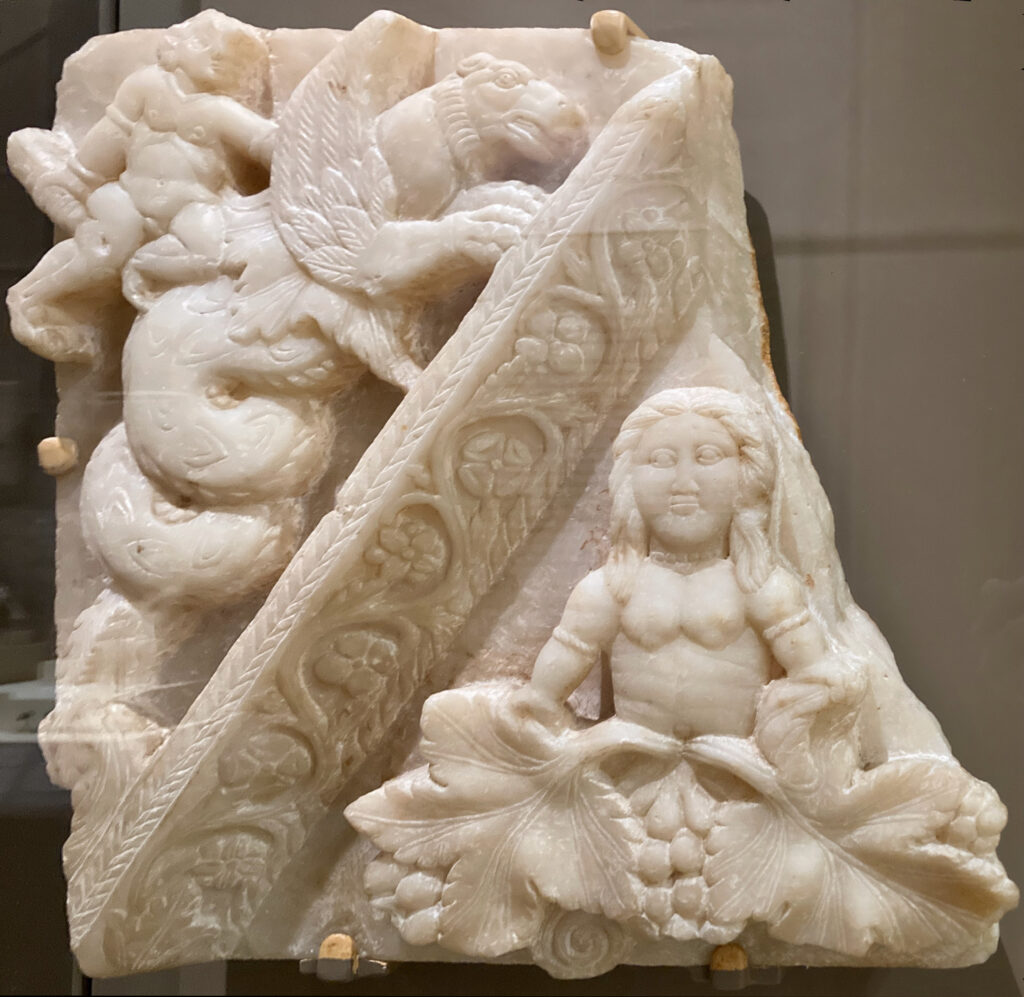
One of my favorite pieces of South Arabian art on the view at the Walters Museum is an unnamed goddess, who appears in a fragment of a pediment. She sits next to a child deity. Due to the lighting, I found it difficult to take a photograph due to the reflections on the glass case which houses this goddess; I had to do a fair amount of digital manipulation to make her look more or less the way she looks in the museum.
Here’s what the museum label says about this sculpture:
Fragment of a Pediment with a Goddess South Arabia (Marib), 2nd century A.D. The upper left side of this composition depicts an imaginary creature composed of an Asiatic lion’s head, a serpent-like body, a fishtail, and wings. A nude child deity grasps one of the creature’s wings with his left hand and holds a short sword in his right hand to control it. A smaller fragment containing the head of a similar composite beast in the British Museum might be the complement to this vignette. The lower right section depicts a nude fertility goddess emerging from vine leaves and grapes. With the increasing influence of Greco-Roman culture curing the 2nd and 3rd centuries A.D., new artistic styles and motifs, such as this female deity, became a part of South Arabian culture. Calcite-alabaster 21.74, gift of Girard and Carolyn Fester, 2014
I wonder if she was really a fertility goddess, or a goddess of wine. I don’t think we’ll ever know.