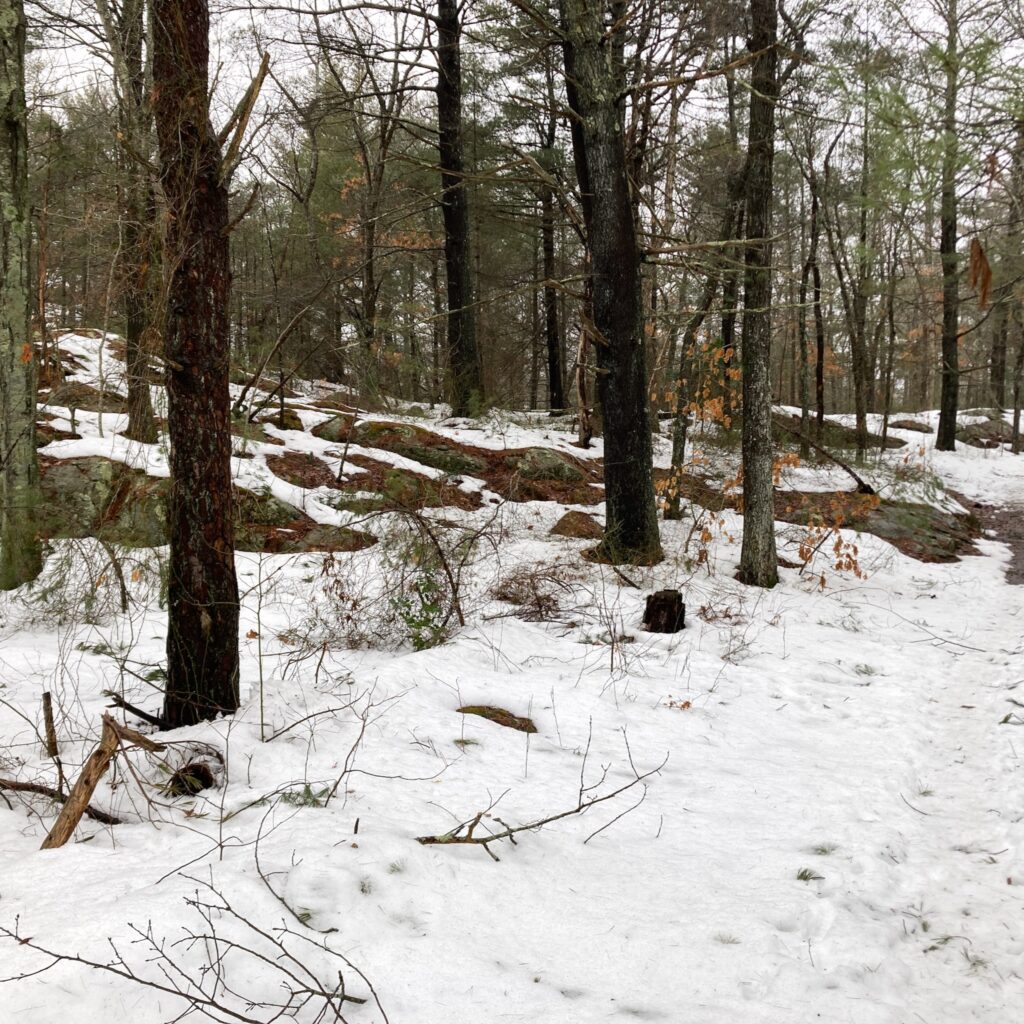
The temperature has been above freezing most of the week. This afternoon, it got up to about 38 degrees F. (3 C.) with light rain and drizzle. I wanted to see how much the snow was melting in the woods, so I went for a walk. I did see some places that were now bare of snow, mostly on south-facing slopes or where the high winds of the blizzard hadn’t allowed much snow to accumulate.
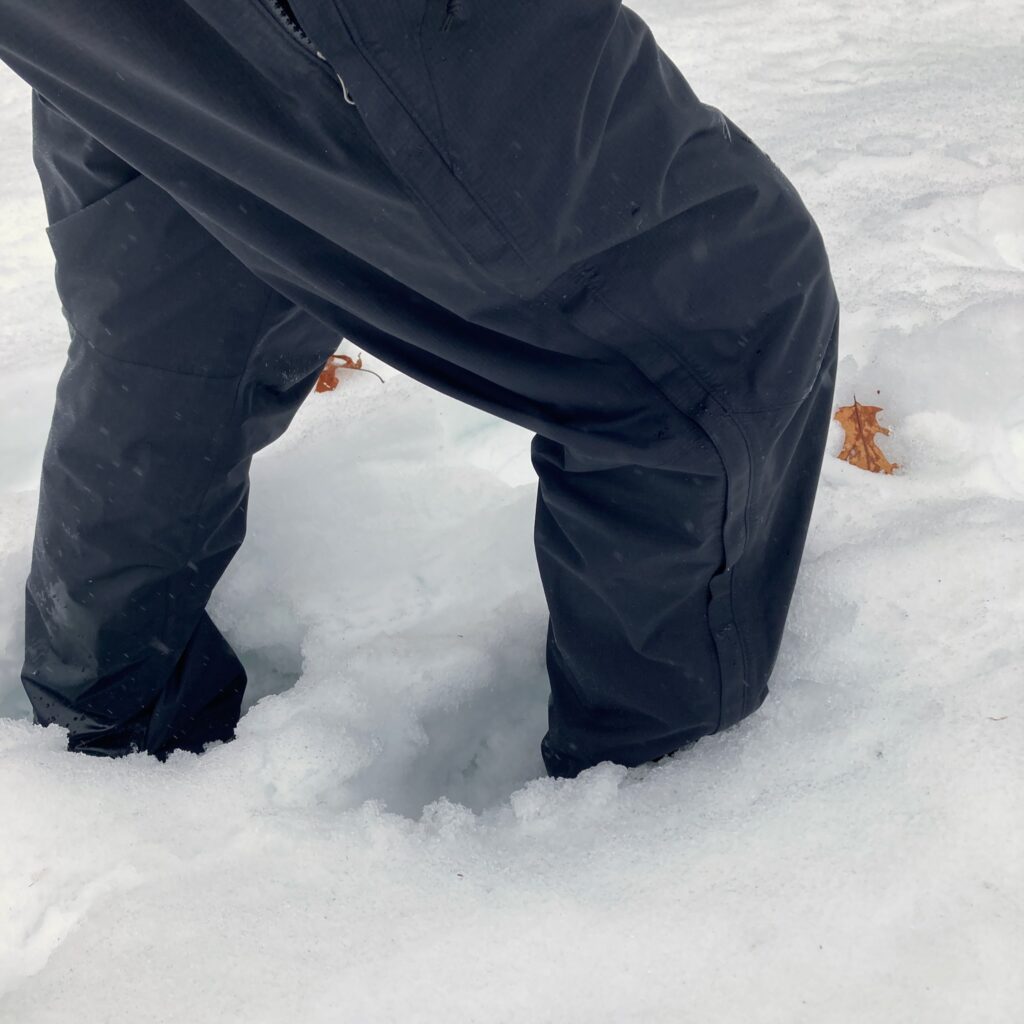
Most of the ground remains covered by snow, though. There are still places with a foot of snow or more. Crossing one field, I had especially tough going. Sometimes I’d sink up halfway up to my knees. In one of the deepest snowdrifts I stopped and stuck my hand down to see how deep the snow was. I didn’t manage to reach the ground, but I’d guess there was still a foot and a half of snow.
In many places, meltwater ran underneath the snow. Some of the trails had turned into shallow streams. My wet boots grew heavy from the weight of the water. I walked to a place where skunk cabbage (Symplocarpus foetidus) usually grows, but I couldn’t get close enough to see if any had emerged from the snow due to a foot of water flooding the area.
At last I made it back to the car. What should have been an hour long walk took two hours. My boots were soaked, my raincoat and hat were dripping with rain. I only wish I could have stayed out longer.
My best guess is that we had between 24 and 30 inches of snow (see note at end of post). Today the temperature got above freezing, and the snow settled down some. But there is still a lot of snow on the ground. Some of the snow piles left by plows along the streets towered five or more feet above the road surface.
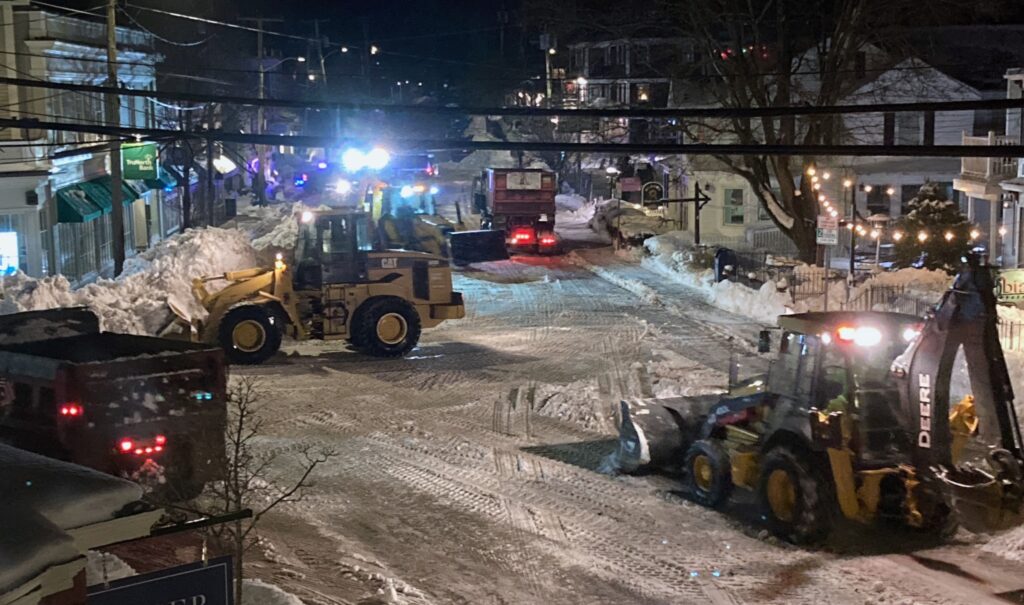
Our neighborhood, known as Cohasset Village, is a business district with on-street parking. The huge snow piles lining the streets took up much of the parking. So tonight, town employees and contractors are here in the Village with one large tractor with a bucket loader, three medium-size bucket loaders, one of those little mini bucket loaders, several police cars, and a long line of dump trucks. The little bucket loader climbs up on the sidewalk and pushes the snow into the street. The medium size bucket loaders carry the snow to a central collection point, the junction of Elm and Main streets, two doors down from our apartment. Then the big bucket loader scoops the snow into the waiting dump trucks, as one by one they drive up, get loaded, and drive off again. Our second floor apartment is the perfect place to watch the action.
Carol watched a murder mystery on TV. I thought it was more fun to watch the snow being pushed around and loaded in dump trucks — showing that I still haven’t gotten over my preschool fascination with heavy equipment at work.
Recently, I used something written by Rev. Elizabeth Tarbox as a reading in a Sunday service. I realized I knew next to nothing about her, so I decided to look up her obituary in the Unitarian, Universalist, and UU Yearbooks (now digitized and online). She died in October, 1999, which means her obituary would be in the following year’s Yearbook — except that was the one year when the UUA decided not to publish minister’s obituaries in the Yearbook. I found no other obituary or life summary for her online.
With a little bit of research, I was able to generate the timeline below — which tells me most of what I want to know:
5 March 1944, born Elizabeth Irene Peck to William and Irene Hard Peck in St. Albans, Hertfordshire, England, United Kingdom (birth record)
1963, married Charles E. Tarbox (1938-2016) in St. Albans; she and Charles later had a child (marriage record; Charles Tarbox obituary in Boston Globe)
1968, she and Charles immigrated to the United States; applied for Social Security card (Social Security records; Charles Tarbox obituary in Boston Globe)
1986, B.A. in philosophy, Bridgewater State College (Bridgewater State yearbook for 1986)
c. 1980s, congregant at First Parish Duxbury, Mass. (mentioned in FP Duxbury newsletter)
c. 1986, began studying at Harvard Divinity School
c. 1988-90, served as student minister, First Parish Norwell, Mass. (mentioned on FP Norwell Facebook page)
1990, graduated Harvard Divinity School (UUA Yearbooks)
1990, ordained (UUA Yearbooks)
1990, settled at First UU Society of Middleboro, Mass. (UUA Yearbooks)
1993, publication of Life Tides: Meditations
1997, settled at First Parish in Cohasset, Mass. (UUA Yearbooks)
1997, publication of Evening Tide: Meditations
1999, resigned from First Parish in Cohasset due to ill health (First Parish Cohasset records)
31 Oct. 1999, died in Duxbury (Duxbury Annual Report; Social Security records)
I’m mostly satisfied with this timeline, though I wouldn’t mind finding answers to a couple of questions. First: When did she become a Unitarian? — it’s even possible she was raised Unitarian, as there was a small Unitarian fellowship in St. Albans in the 1950s, according to Alan R. Ruston, Unitarianism in Hertfordshire (Watford, Hertfordshire, U.K., 1979), p. 26. Second: What was she doing between marriage in 1963 and starting college in the 1980s — which includes a subsidiary question: Why did she come to the United States?
8:15 p.m. — Power went out two houses down from us, but so far we still have it. We’ll see how long it lasts.
Latest National Weather Service (NWS) reports show more than 30 inches of snow from Rhode Island up through southeastern Massachusetts. The nearest trained NWS spotter is in North Scituate, which is about 3 miles from here; that observer recorded 29 inches of snow as of 5:00 p.m.. Carol and I shoveled at about 5, and another couple of inches has fallen since then, so I’m pretty sure we have more than 30 inches at this point. And it’s still snowing.
Early to bed tonight. Beginning at seven tomorrow morning, we’re both volunteering with Cohasset Emergency Management to help staff the warming center for people who have lost power.
Blizzard conditions are defined by the NWS as visibility of 1/4 mile or less and wind speeds (sustained or frequent gusts) of 35 mph or higher, for 3 hours or more. These conditions were officially reached throughout eastern Massachusetts, from Providence, R.I. and Martha’s Vineyard, west to Worcester and north to Beverly, Mass. I guess we start calling this the Blizzard of ’26.
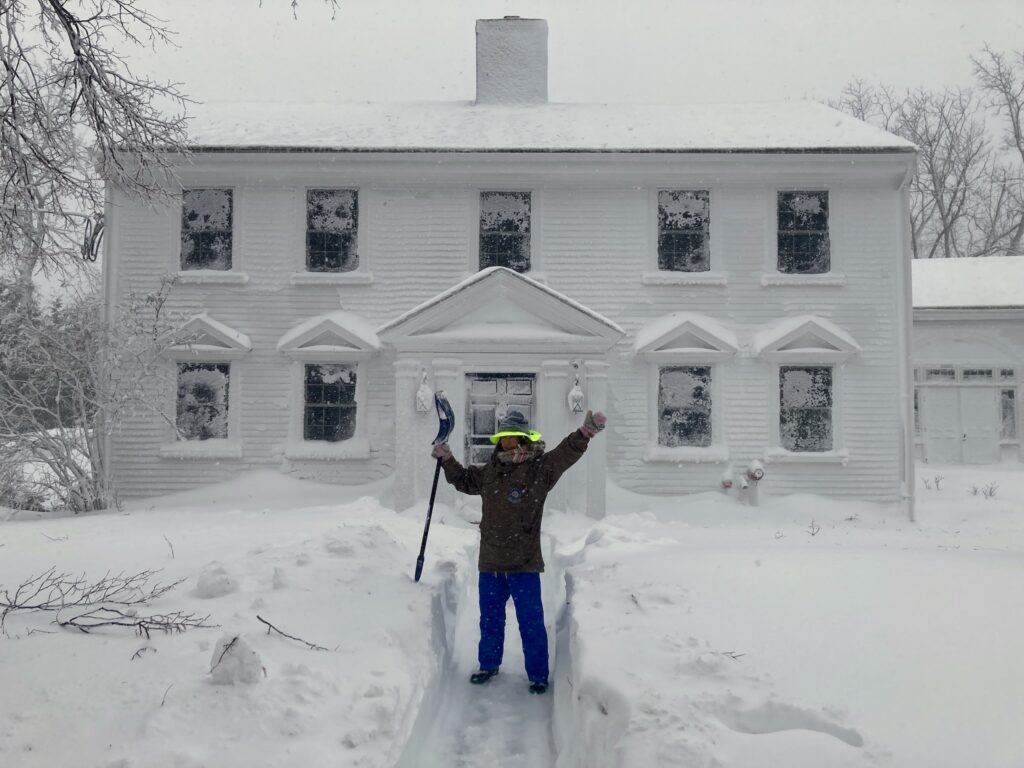
Carol and I shoveled a path to the front door of the church’s Parish House. Carol is wearing the anorak that her father had when he wintered over in Antarctica. The snow wasn’t very deep where we were shoveling, because the wind had scoured it away. A friend with an anemometer saw 60 mile an hour wind gusts this morning.
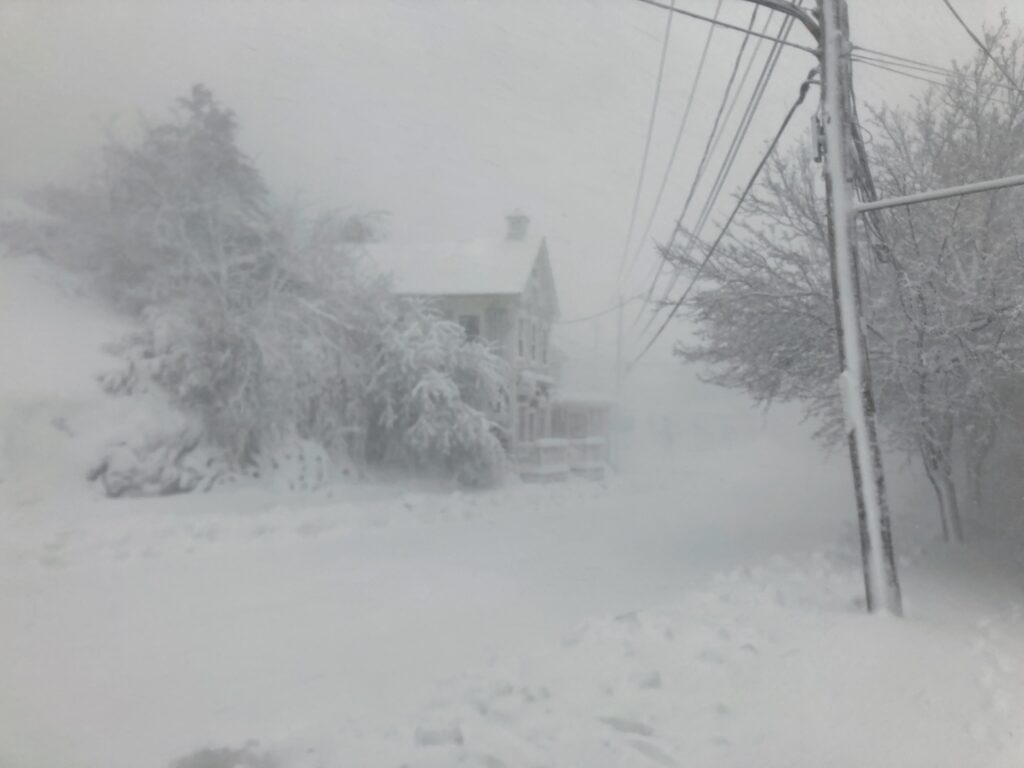
I went out for a short walk. A few wind gusts strong enough to knock me off balance. Lots of downed branches, mostly fairly small. Heavy snowfall, an inch of two an hour, with very low visibility. It’s a wild storm.
The lights keep flickering, so I’ll post this while we still still have power.
It kept snowing all day today. The town’s plows haven’t been able to keep up, so the town has extended the on-street parking ban through Wednesday at 8 a.m.
Because it’s been so windy, it’s hard to say how much snow we got here in Cohasset. The National Weather Service reports that a trained spotter measured 13.5 inches of snow in Rockland, just south of here, at 5:13 this morning. We’ve had another 2 to 4 inches since then, and it’s still snowing. I’d guess the total snowfall will be at least 18 inches here in Cohasset.
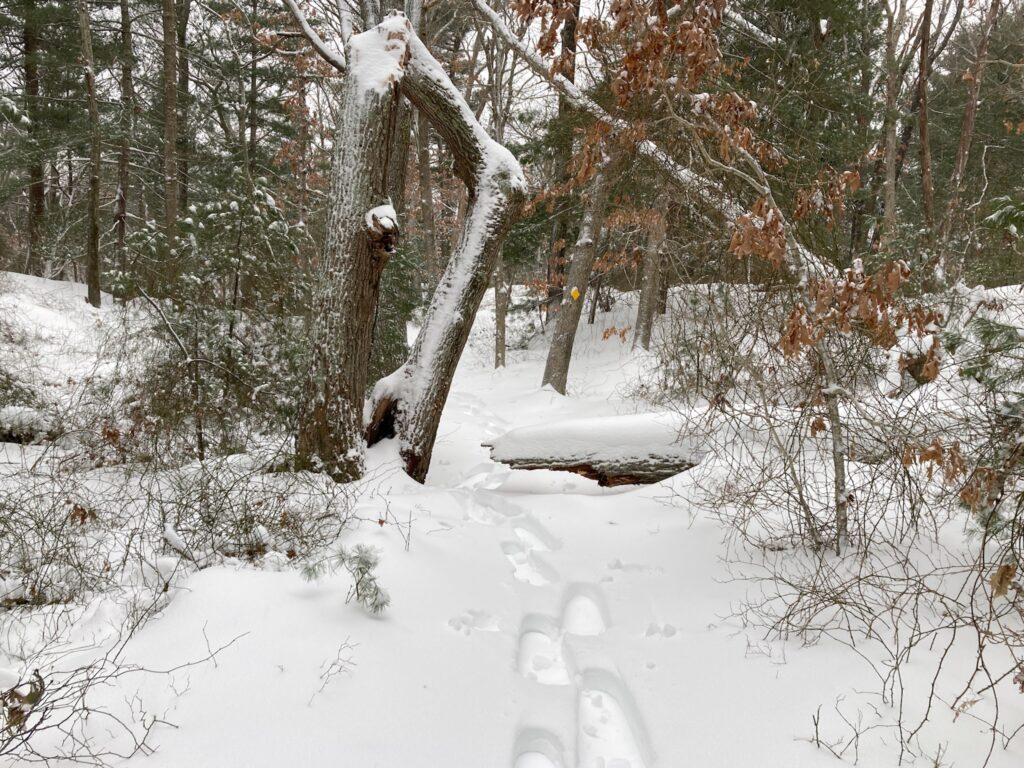
I took a break from work in the middle of the day, and went snowshoeing in Great Brewster Woods, a 25 acre tract of conservation land close to our house. It felt like I was out in the middle of nowhere — a pretty amazing feeling for crowded suburbia. I didn’t see another soul, and the falling snow deadened all the sounds except for a Great Horned Owl hooting mournfully in a tree overhead.
Snowshoeing in Great Brewster Woods, Cohasset, Mass.
Update 1/28: NWS spotters from the immediate area reported 18 to 24 inches of snow from the storm. I’d guess about 20 inches here, though because of drifting it’s hard to tell. In any case, a very substantial storm.
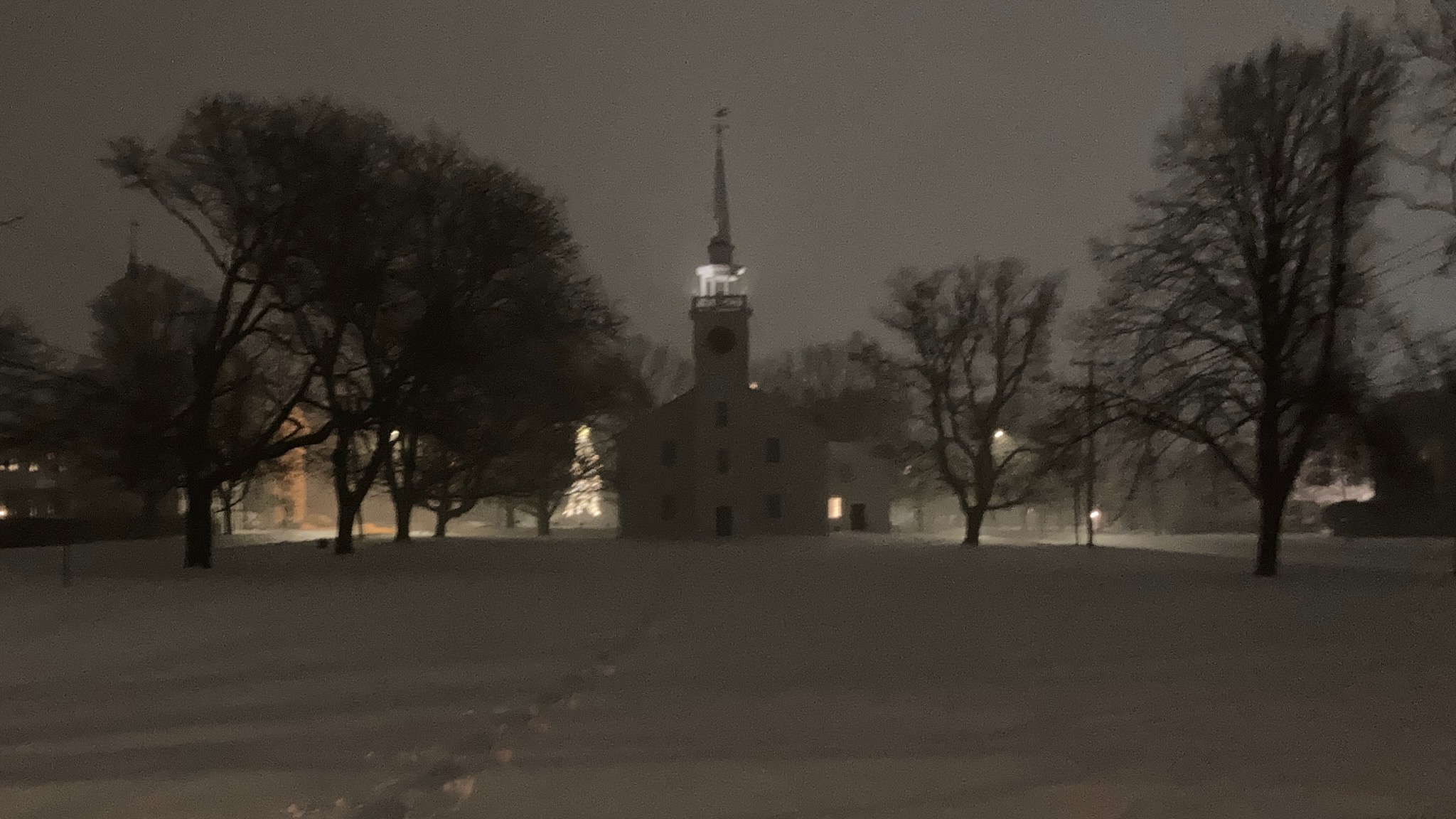
Snow is coming down, maybe an inch an hour. The wind is drifting the snow around our building, and I couldn’t really tell how much snow we have gotten so far. So I put on my snowshoes, walked over to Cohasset Common, and saw there was at least eight inches of snow in the middle of the common.
The Common was quite beautiful. A few kids were sliding down the hill that St. Stephen’s church is on, and the occasional snow plow rumbled past. Aside from that, no one else was out. Lights were on in nearly all the houses around the common, making it look cheerful in spite of the gusty winds.
Cohasset Common in a night time snowstorm. The First Parish meetinghouse is in the center, with my snowshoe tracks leading towards it.
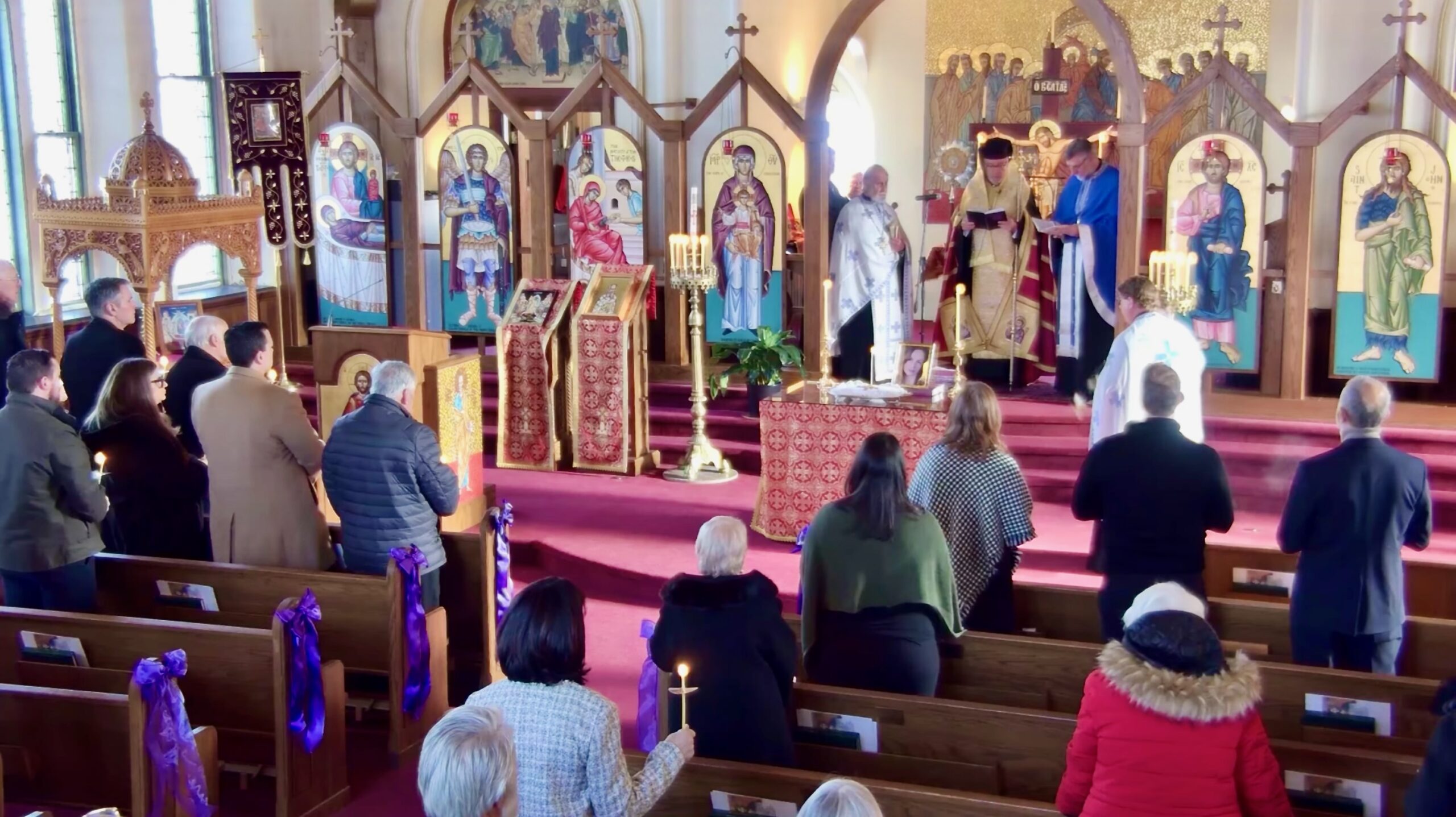
This morning, Nativity Assumption of the Virgin Mary, the Greek Orthodox church in Cohasset informally known as Panagia church, held a memorial prayer service for Ana Ljubicic Walshe. If you live in eastern Massachusetts, you’ll remember that Ana Walshe is the Cohasset woman who disappeared on January 1, 2023. Last month, her husband, Brian Walshe, was found guilty of first degree murder; he also pleaded guilty to misleading the police and improperly disposing of a body. When sentencing Brian Walshe to life imprisonment without the possibility of parole, the judge called his acts “barbaric and incomprehensible.” With the sentencing, a truly grisly murder case had finally come to an end.
Yet even with Brian Walshe’s sentencing, Ana Ljubcic Walshe’s family still didn’t have complete closure. There is an oddity in Massachusetts state law that a death certificate cannot be issued when there is no body. Brian Walshe pleaded guilty to disposing of her body in various dumpsters around eastern Massachusetts, and none of her remains was ever found. That means no death certificate can be issued.
Ana’s mother is Serbian Orthodox. In that faith, a full funeral can’t take place without a death certificate (that is, without a body). Various Massachusetts officials are now trying to get the law changed so that in certain circumstances, a death certificate can be issued when there is no body. In the mean time, the Serbian Orthodox bishop based in Cambridge arranged to come down to the Greek Orthodox church in Cohasset to celebrate a memorial prayer service for Ana Walshe. A memorial service, in the Orthodox tradition, doesn’t require a body. The memorial service was livestreamed so that Ana’s mother in Belgrade, and her sister in Canada, could participate from a distance.
Panagia church opened the service to the entire Cohasset community; they know how this murder has impacted everyone in the community. They also issued a special invitation to the other congregations in Cohasset, so of course I had to attend. I would have gone anyway, because domestic violence prevention is one of the issues that I care most about. I’m also grateful that the Cohasset community has not tried to forget, or to cover up, this horrendous incident of domestic violence — something that happens all too frequently.
The interior of the Greek Orthodox church is beautiful, filled with icons. Even though I’m part of an iconoclastic religious tradition, personally I love icons, and I found it peaceful and calming to look at them before the service began. The service was led by the local Greek Orthodox bishop (who used to be the pastor of Panagia church, the Serbian Orthodox bishop, the current pastor of Panagia, and his immediate predecessor. It was a beautiful service, filled with (as they put it) the hope of eternal life.
We can only Ana’s family got at least some measure of comfort from this service.
Screen grab from the livestream of the memorial service for Ana Ljubicic Walshe, at Panagia church in Cohasset
I went for a walk at Black Rock Beach late this afternoon. A large quantity of seaweed had been left behind by the ebbing tide, mostly Sugar Kelp (Saccharina latissima), but also some wrack (Fucus spp.), some Sea Lettuce (Ulva lattuca), and a few other odds and ends.
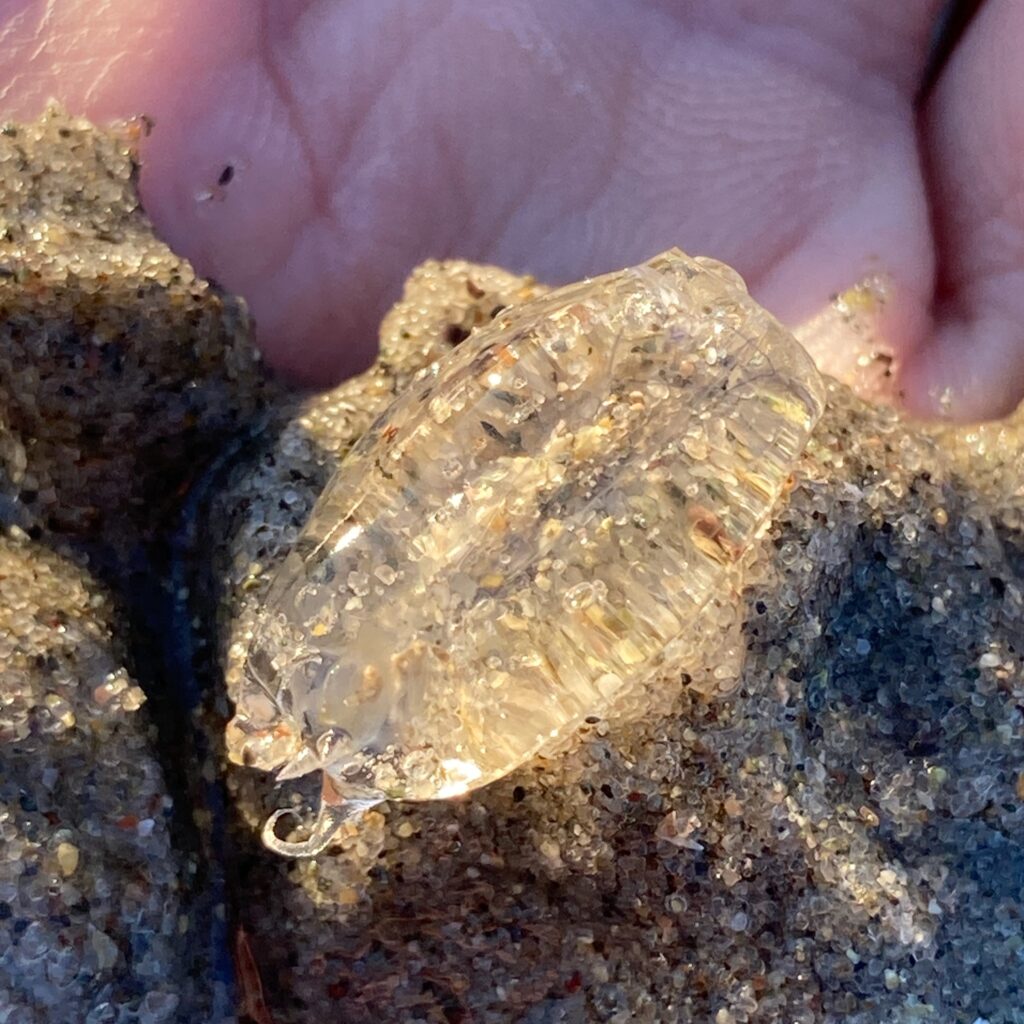
There were also hundreds of small (2-3 cm long), almost transparent jelly-like objects washed up above the line of seaweed. At first glance I thought they were Sea Gooseberries (Pleurobrachia pileus), a species of comb jellies. But when I put my photos on iNaturalist, user ja-fields corrected me — they were salps.
What is a salp, you ask? It’s an organism in Family Salpidae. The Salpidae are in Subphylum Tunicata, which is a part of Phylum Chordata — animals with spinal cords. Human beings are also in Phylum Chordata, so this odd little animal is more closely related to us than are crabs, sea urchins, or starfish.
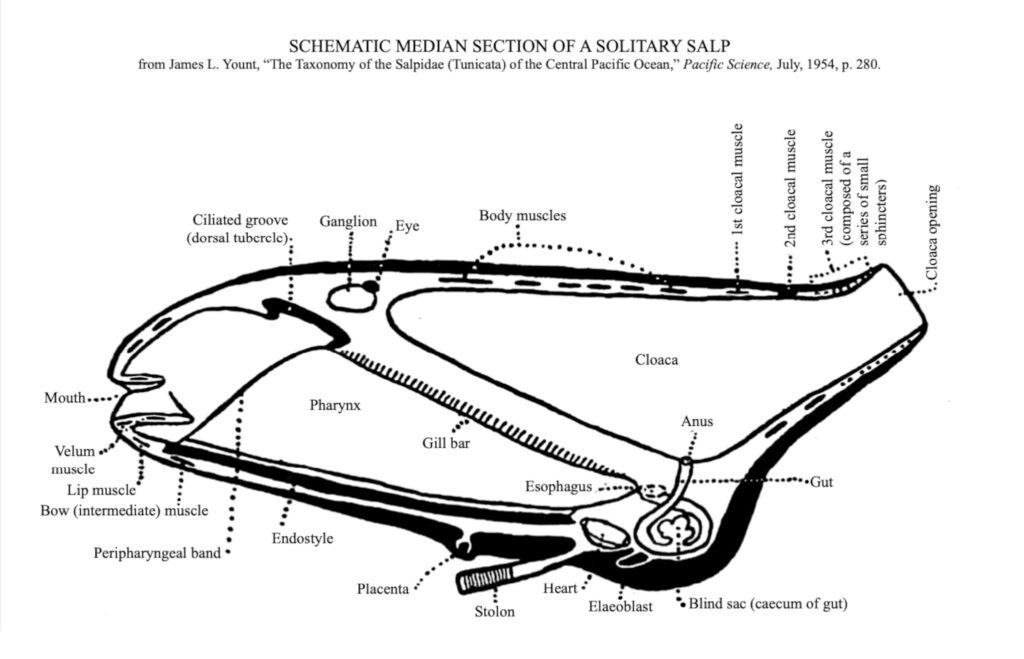
This made me curious — how does one identify Salpidae, if not to species level, then at least to genus? James L. Yount, “The Taxonomy of the Salpidae (Tunicata) of the Central Pacific Ocean,” Pacific Science, July, 1954, has a “Key to world species and reproductive forms of Salpidae,” pp. 280 ff. Identification requires looking at the internal structures, and Yount provides a “Schematic median section of a solitary salp (after Ihle, 1935).” I digitally enhanced his sketch, and identified the body parts in easy-to-read type:
After Yount (1954).Click the image above for a PDF version.
At some point, perhaps I’ll type up Yount’s key. In the mean time, you can find it yourself here.