Macedonia, Ohio, to Joliet, Ill.

I got up at 6:30 and went to the gas station across the street from our motel to buy a newspaper. They stocked three, and I got a copy of each — the Akron Beacon Journal, the Cleveland Plain Dealer, and USA Today — and went to the Bob Evans restaurant to spend an hour eating breakfast and reading newspapers.

The lead paragraph of one of the front page articles in the Beacon Journal declared: “Amid sirens and cheers, the 77th Annual All-American Soap Box Derby kicked off its weeklong festivities with the opening ceremony Monday.” I remembered seeing a small black trailer hitched to a car in the parking lot outside our motel, with a sign that Kara’s something-or-other soapbox derby team. Sure enough, just as I was coming out from the restaurant, the car and trailer drove past me. Someone had taken white chalk and written on the side of the trailer: Honk for Luck!” I was walking so I couldn’t honk, but I silently wished Kara (whoever she may be) the best of luck in the world championships.

We left Macedonia and drove along Interstate 80 until we reached Illinois Route 53 — also known as Historic Route 66 — and headed south a dozen miles to the Midewin National Tallgrass Prairie. Midewin was established eighteen years ago on what used to be the old Joliet Arsenal. The prairie is still being restored by the National Forest Service, which maintains huge seed beds of native prairie plants, protected from deer by nine foot high fences. I stopped to look at a bed of Wild Bergamot (Monardo fistulosa) in full bloom.
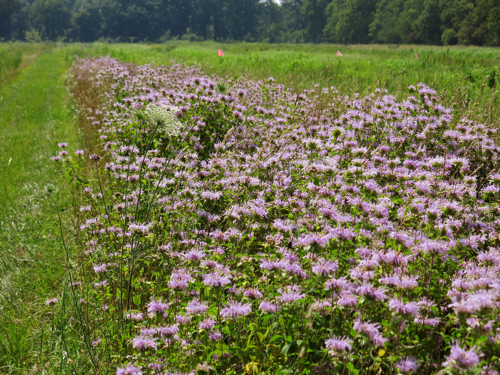
Seed beds, Midewin National Tallgrass Prairie

Above: Seed beds with Wild Bergamot (Beebalm) at Midewin National Tallgrass Prairie

We walked along an access road lined with trees to get to the trailhead; stopping to eat some perfectly ripe mulberries. It was hot and humid, too hot to walk in the sun. We headed down Prairie Creek Trail, one of the few shaded trails at Midewin. When we emerged from the woods an hour later, the sun was partly blocked by clouds, but it was still too hot. I walked slowly, paying attention to the birds — that was my excuse for walking slowly. Carol pointed to a Ring-necked Pheasant walking along the trail behind us. A Sedge Wren called from the top of a shrub. A bright blue Indigo Bunting landed on a fence, not fifty feet from me.

Carol walked faster than I. She disappeared out of sight into the shaded access road. I stopped and turned to look out over the prairie and the woodlands. Even though I could hear the constant rumble of trucks along nearby Interstate 55, I felt as though I were far from that world.
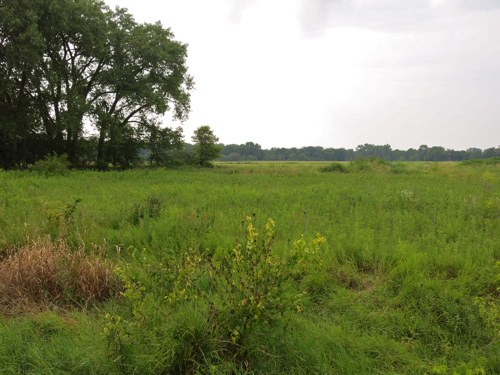
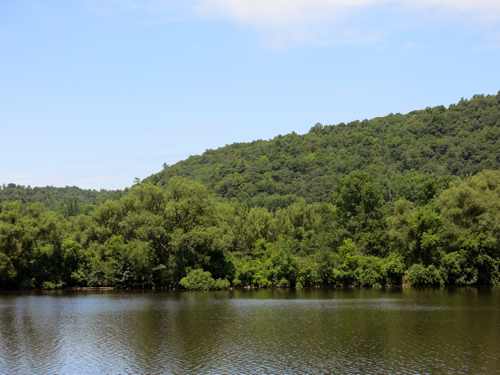
Midewin National Tallgrass Prairie

Above: Midewin National Tallgrass Prairie

After we checked in to our motel in Joliet, we went out to eat at a little Chinese restaurant in a half-abandoned mall. That big empty mall parking lot resembled the tallgrass prairie in an eerie, slightly sinister way — the way the Fetch of Irish folklore resembles a living human being.
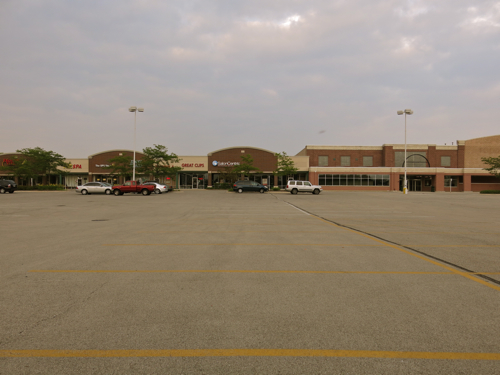
Mall in Joliet, Ill.

Above: Mall in Joliet, Ill.
Fredonia, N.Y., to Macedonia, Ohio

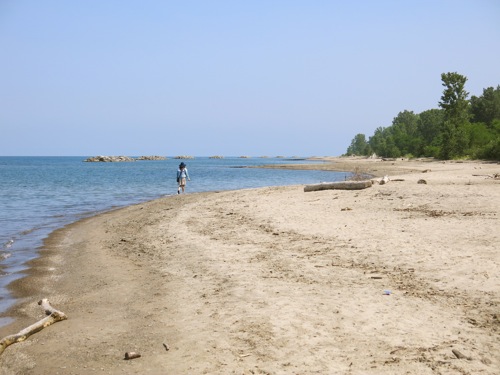
We had a short drive today because we are visiting relatives this afternoon and evening. We got an early start, and as we were driving along we realized that it was a perfect beach day: hot, but not too hot, sunny, a light breeze. So we decided to go to the beach in western Pennsylvania.

Presque Isle, Penna.

Above: Presque Isle, Penna.

There are miles of beaches on Presque Isle, just north of Erie, with sand, seagulls, the occasional seashell, and reasonably warm water. If you’re willing to walk five minutes, you can get away from the crowded swimming beaches and have long stretches of sand pretty much to yourself.

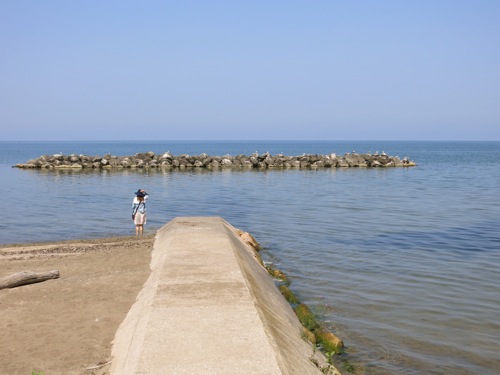
Carol stood at the end of a low concrete wall, presumably there to control erosion, and looked across Lake Erie. If you looked carefully, you could just see a few big buildings on the opposite shore shimmering through the humidity.

BlogJul2114c

Above: Presque Isle, Penna.

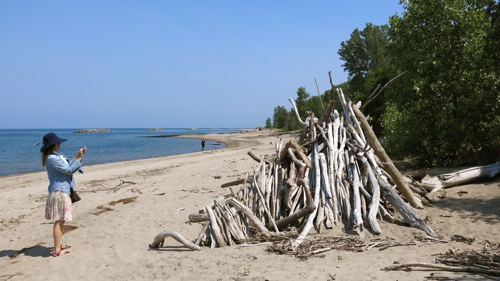
We walked for over an hour on the beach. There were lots of small flat stones that were perfect for skipping, and I managed to skip one stone seven times before it sank into the water. We saw lots of interesting driftwood, too, and someone had built a couple of lean-to structures out of big pieces of driftwood, sort of like the forts kids build in the woods.

Preque Isle, Penna.

Above: Presque Isle, Penna.

It was pretty idyllic.

Stow, Mass., to Fredonia, N.Y.

We left Stow, Massachusetts, at nine o’clock this morning. Stow lies on the edge of the coastal plain of southeastern New England, and we drove west through the hills of central New England, into the Berkshire Mountains, through the Taconic Mountains of New York, up the Mohawk River valley through the dramatic gap between the foothills of the Adirondack Mountains to the north and the Catskills to the south. I said goodbye to the last little foothills along the freeway.

Mohawk River valley

Above: The Mohawk River along Interstate 90, looking north towards the last of the Adirondack foothills.

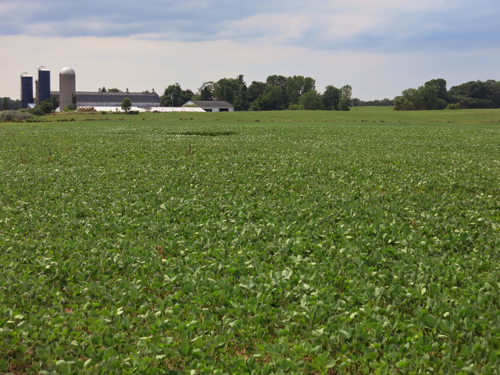
We will see no more mountains — nothing but plains and rolling land — until we reach Wyoming, some 1,500 miles from here. We stopped at a rest area near Waterloo, New York, and already the landscape began to look like the Midwest or the Great Plains: a big field of legumes, a line of trees in the distance, some farm buildings, and a big outlet mall on the other side of the interstate.

Nine Foot Road, Waterloo, N.Y.

Above: Farm off Nine Foot Road, near Waterloo, N.Y.

When we got to Fredonia, N.Y., where we will spend the night, we took a long walk from our hotel to the campus of SUNY Fredonia. Although the university was founded in 1829, it obviously saw a big building boom beginning in the 1960s, when lots of big bland institutional brick buildings got built. I imagine it can look pretty bleak in the long gray winters, but everything was beautifully green today.

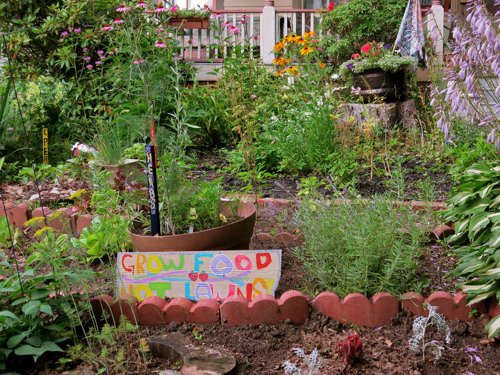
Fredonia obviously has a big student population. Lots of the attractive older houses in the center of town have been split up into student apartments, and we saw lots of evidence that this is a university town: a peace sign in a window, a poster proclaiming allegiance to Bob Marley, and a lovely garden with a handpainted sign that read “GROW FOOD NOT LAWNS.”

Garden in Fredonia, N.Y.

Above: Garden in Fredonia, N.Y.

Gosport Harbor

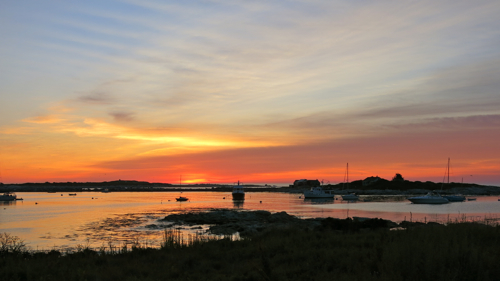
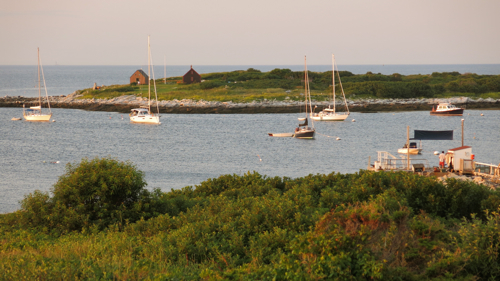
Gosport Harbor is protected by several islands connected by breakwaters: Appledore Island to the north west, then Malaga Island, Smuttynose Island, Cedar Island, and Star Island. The boundary between Maine and New Hampshire goes through the harbor; Star Island is in New Hampshire, and the other islands are in Maine. Here are three photos of Gosport Harbor, taken from Star Island over the past week:

BlogJul1914b

Above: Sunrise over Smuttynose Island (at left) and Cedar Island, Friday morning at about 5 a.m.


BlogJul1914a

Above: Looking across the harbor towards Appledore Island, Thursday morning at about 5 a.m.


BlogJul1914c

Above: West end of Smuttynose Island, late afternoon on Friday — the brown house (left of center, near the horizon line) is perhaps the oldest still-standing house in Maine.

Oldwick, N.J., to Stow, Mass.

Yesterday evening in Oldwick, we saw a spectacular thundershower go through: sheets and waves of wind-blown rain, spectacular lightning right overhead, and through it all the fireflies rising out of the brilliant green grass.

Oldwick, N.J.

Above: Oldwick, N.J.

There were a few showers this morning before we left New Jersey. By the time we were in Connecticut, the rain was coming down steadily. It was going to be a wet Independence Day in southern New England.

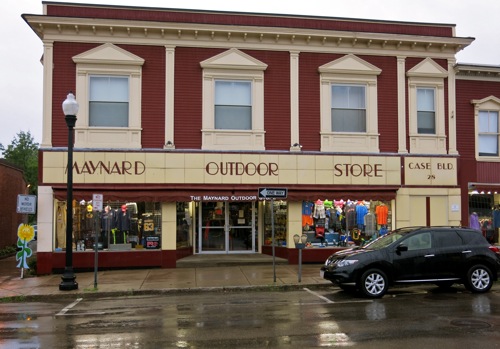
We arrived in Stow, Mass., at about four o’clock, just in time for an indoor picnic lunch with Carol’s dad and stepmom and some of their friends. After dinner, we tried to go for a walk in downtown Maynard, Mass.

Maynard, Mass.

Above: Maynard, Mass.

At first it was pleasant walking. We stopped in at a combined video rental and used book store, called “Movie Signals and Art Signals,” that was open on Independence Day. They had more customers than I would have thought; but then, what else are you going to do on a rainy Fourth of July? — you’re certainly not going to go watch fireworks. We stayed for a while, then tried to keep walking, but the rain was coming down even harder, and my pants were soaked through and my rain coat started to leak — Carol was fine under her umbrella — so we gave up and went home.

Alexandria, Va., to Oldwick, N.J.

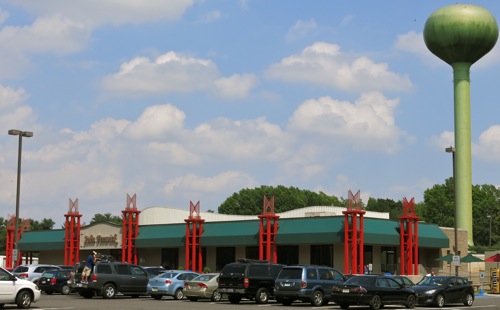
Most of the middle of the continent is empty enough that driving can be a pleasure: you can actually look at the scenery without having to worry about looking out for other cars. But today, we drove through the northeastern U.S. megalopolis: one big city after another, the roads always full of cars, I had to concentrate all my attention on driving. But when we pulled in to one rest area along the New Jersey Turnpike, my friend E and I both pulled out our cameras to take a photo of the rest area building painted bright red and vivid green, with a tall greenish water tower behind it, and fluffy white clouds floating in a bright blue sky above.

BlogJul0214

Asheville, N.C., to Alexandria, Va.

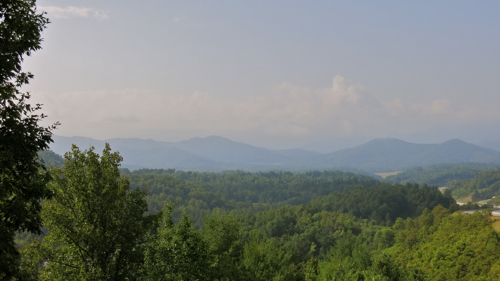
We left Asheville and drove up over the Appalachian Mountains along Interstate 26, passing through Sam’s Gap at 3,760 feet above sea level. We stopped at a “Scenic Overlook” along the highway, and looked back at the Great Smoky Mountains, mysterious and blue behind us.

BlogJul0114a

The peaks around us were obscured by low drifting clouds. “They shouldn’t be called the Great Smoky Mountains,” Carol said. “They should call them the Misty Mountains.” I agreed.

BlogJul0114b

The rest of the drive to Alexandria wasn’t particularly notable: we just drove through Western Virginia, turned east, and watched as the population density crept up and up, until at last we were in Alexandria. We sat up late talking with a college friend of Carol’s who works for Pew Charitable Trust, doing research on American religion. He said that Pew Charitable Trust, which has long been known for its helpful mix of quantitative and qualitative research, will be de-emphasizing qualitative research and focusing almost exclusively on quantitative research. I told him why I thought that was a bad idea, and he wisely did not engage with me. Instead, he and Carol talked about old college friends while his wife and I listened and enjoyed their stories.

Asheville, N.C.

Carol went off to visit her co-author Dave, while i wandered around downtown Asheville. I liked Malaprops bookstore, and I liked the public library (which has a good used bookstore), but the rest of downtown Asheville seemed to me to be dominated by two kinds of people: white middle-aged and overweight tourists who lumbered from gourmet restaurant to fancy gift shop, and white twenty-somethings who asserted their individuality in anxiously loud voices.

Carol picked me up, and we began to drive back to our motel when we saw a huge garden, half an acre or more, in front of Grace Covenant Community Church, Presbyterian Church USA. We decided to stop and walk through the garden.

Grace Covenant Church PC-USA, Asheville, N.C.

Above: Community Garden at Grace Covenant Church PC-USA, Asheville, N.C.

We saw tomatoes, squash, beans. A woman who was also walking around stopped Carol and said, “What is that?” Carol looked and said, “I think it’s watermelon — something in the squash family, probably a melon.” We asked her if she were part of the church, but she said, “No, i just love looking at this garden, and since I had a few free minutes, I thought I’d walk around in it.”

I went in and asked in the office about the garden. Leah, one of the church staff members, told me that seventy percent of the harvest goes to alleviate food insecurity in the region. It is a cooperative project with church members, and members of the wider community. She gave me the email address of someone who was instrumental in making the garden happen.

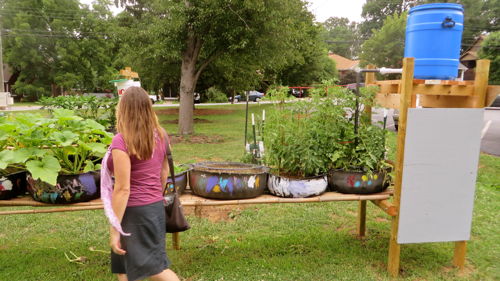
Just outside the church office was a “World Garden,” a demonstration garden showing tire gardens and bag gardens to grow a lot of food in small spaces.

World Garden at Grace Covenant Church PC-USA, Asheville, N.C.

Above: “World Garden” at Grace Covenant Church PC-USA, Asheville, N.C.

We made one more stop before we went back to the motor court for dinner: the giant Goodwill store in Asheville. We skipped the furniture outlet and went in the retail side. I looked at their used books while Carol shopped for t-shirts. They had an eclectic mix of books: a book on choral conducting, several copies of Stephanie Meyer’s Twilight series, Great Expectations by Charles Dickens, a book about schnauzers, a children’s book of train stories which I had read as a child; I bought a cheap science fiction paperback.

BlogJun3014c

Above: Interior of Goodwill retail store, 16161 Patton Ave., Asheville, N.C.

Alpharetta, Ga., to Asheville, N.C.

Yesterday evening and this morning we had to complete some necessary tasks — do the laundry, get the oil changed in the car, and so on. We grabbed a quick and unexciting lunch in a fast food place in Alpharetta, then started driving north.

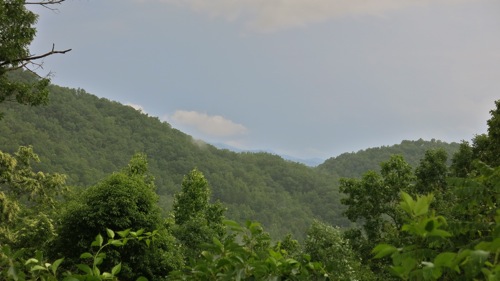
Pretty soon we were in the Blue Ridge Mountains, the highest mountains in North America east of the Mississippi River. Compared to the mountains in California, these are not high mountains — the highest is Mt. Mitchell in North Carolina, at 6,684 feet — but they are just as beautiful. Perhaps they are more beautiful, because they are greener and shaped in more interesting ways by glaciers, and because the air here has more moisture which lends a mysterious bluish cast to objects in the distance, and because the weather is more variable at any season, with passing sunshine and rain showers and thunder showers and mist and fog in the summer, and snow and sleet and hail and hail and freezing rain and even occasional sunshine at other times of the year. And as a result of all that variable precipitation, everything is so brilliantly green.

BlogJun2914a

Above: the Blue Ridge Mountains in North Carolina, from U.S. 23

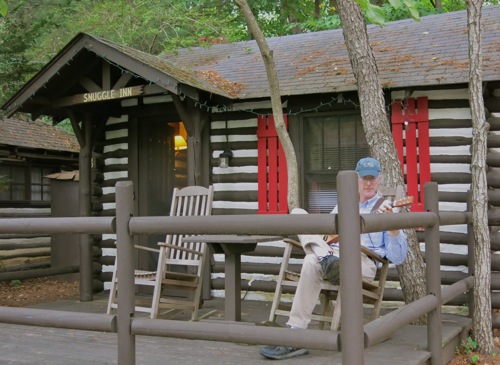
After driving through thunder and lightning and showers and downpours and sunshine on winding and sometimes steep mountain highways, we arrived in Asheville, N.C., where we are staying in a 1930s-era motor court, where each of the bedrooms is a little log cabin — not a conventionally-framed building with fake log cabin siding, but an actual log cabin. When you stay in an actual log cabin, the first thing you want to do is get out your guitar and sit in the rocking chair on the front porch, and play a little something while you rock back and forth.

BlogJun2914b

But it looked like it was going to rain, so we walked down to the Bavarian restaurant at the entrance to the motor court, and had some gourmet turkey bratwurst.

Big Creek Primitive Baptist Church, Alpharetta, Ga.

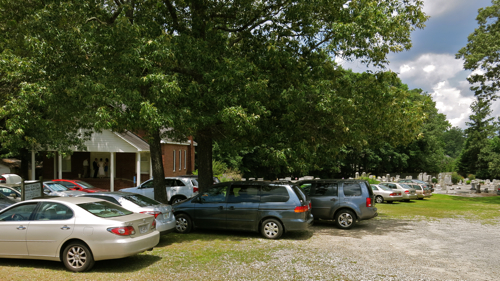
A little before ten this morning, Carol dropped me off at Big Creek Primitive Baptist Church in Alpharetta, Georgia. The church has been engulfed by upscale suburban sprawl — office parks, gated communities, tasteful shopping malls, impeccably maintained four-lane roads — but once you get on the church grounds, you enter into a different cultural landscape. The church, a plain and attractive brick building, is surrounded on two sides by moss-covered gravel parking areas shaded by trees; quite a few cars were already nestled in shady parking spots. Behind the church was a cemetery with quite a few older gravestones, and some gravestones that looked very new.

BlogJun2814b

Above: Big Creek Primitive Baptist Church, Alpharetta, Ga.

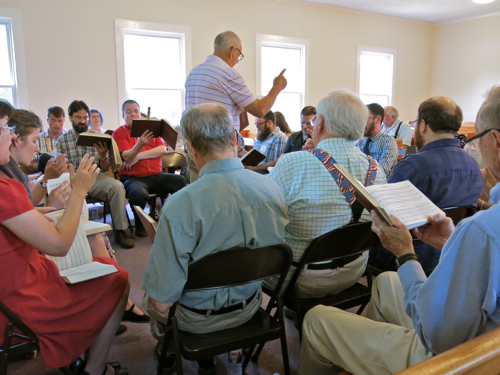
Inside, the church was quite plain, as you’d expect in a Primitive Baptist Church: little ornamentation, plain white walls, simple but attractive pews — and no musical instruments. Fifty or so singers were gathered up at the front of the church. I went to sit in the bass section, and noticed that in the hymnal racks on the backs of the pews were hymnals, Bibles, and fans in case it got too hot. I opened up my copy of The Sacred Harp, and got ready to sing.

The singing, the 146th session of the annual Union Musical Sacred Harp Singing Convention, belonged to this other cultural landscape, removed from the gated communities and office parks. It’s music that’s meant to be performed and shared, not consumed; it’s a democratic musical tradition where everyone sings, and anyone can lead a tune if they want to. The singing rose up into that plain white sun-washed church, loud and triumphant. It had that old-time lonesome sound that lets you know that in spite of all the sorrow and troubles we face, God is in heaven and all is right with the world.

Union Musical Sacred Harp Singing Convention

Above: View from the bass section, 146th session of the Union Musical Sacred Harp Singing Convention

A seven year old girl got up to lead “Africa,” an old Isaac Watts hymn — a hymn seems to me to express a Universalist theology of hope and assurance — set to music by William Billings in the late eighteenth century. Between the words to the hymn and that self-possessed girl leading the other singers so well, I got a little choked up and couldn’t sing for a bit, and maybe there were some tears running down my cheeks.

Lunch was served in the time-honored custom of dinner-on-the-grounds. There was a small kitchen building behind the church. Extending from that was a long table, perhaps fifty feet long, built on concrete blocks. Everyone who had brought food to share laid it out on this long table. Over the table was a roof to keep the sun and rain showers off, and between the posts holding up the roof were boards set at a height where you could put your plate while you stood and ate and talked with everyone around you. The woods stood near at hand, and some people from the church instructed us to through any food that was left on our plates out to the varmints in the woods.

Carol had come to the singing by now, and we got our dinners: ham, pulled pork, collard greens, fried okra, perfectly ripe cantaloupe, broccoli casserole, and some of the best layer cake I’ve ever eaten. We stood and ate and talked. I talked with Henry from Alabama, with whom I talked universalist theology. I talked with Nathan, an art historian who’s moving to North Dakota, who specializes in spiritual painters in the southwestern U.S. in the early 20th century. We talked with Shawn and Natalie, who live in Melbourne, Australia, and who sing Sacred harp there. I can’t remember who all we talked with.

The singing was just as good in the afternoon session, if not a little better. During the afternoon break, I got involved in a brief and somewhat technical discussion with a couple of fourth- or fifth- or maybe sixth-generation Sacred Harp singers on the proper tempo for “David’s Lamentation,” a William Billings composition. The piece has become a standard in the repertoire of college choirs, where it is often sung at a slow tempo, and apparently some people have tried leading it slowly at Sacred Harp singings. But the three of us all agreed it should be led at a fast pace (not that my opinion counts), which is both the traditional way to sing it in the South (and not coincidentally, the way Billings clearly preferred it to be sung).

The singing ended. Jeff offered to give me a ride back to the motel. We pulled out of the parking lot, leaving behind a cultural landscape devoted to shared experience, democratic traditions, and matters of the spirit, and re-entered a cultural landscape dominated by consumption and competition.