Amaterasu and Susano-o

This lovely sword guard, made in 1874 by Tozan (no other name given), shows the Japanese deities Amaterasu and Susano-o.

A sword guard (tsuba) depicting Amaterasu and Susano-o, Walters Art Museum, Baltimore, accession no. 51.244

Amaterasu was the Sun-goddess, and Susano-o was the ruler of the Underworld; they were siblings by virtue of both being the offspring of Izanagi and Izanami. Here’s a story about the two of them, adapted from W. G. Aston, Shinto: The Way of the Gods (London: Longmans, Green, and Co., 1905), chapter VI — in the West, this is probably the best known story of these two deities.


Before Susano-o took up his duties as the ruler of the underworld, he asked his elder sister, Amaterasu, if he could come to heaven to take leave from her. She agreed. At first, all went well. But then Susano-o became rude and unseemly.

Susano-o broke down the divisions between the rice-fields belonging to his sister, sowed them over again, and let the piebald colt who lived in Heaven run through the fields, trampling them. Then Susano-o misbehaved in the great hall where Amaterasu was celebrating the solemn festival of the first fruits to be harvested. Finally, Susano-o killed a piebald colt of Heaven, skinned it, and threw the dead body into the sacred weaving-hall where the Sun-Goddess was at her loom weaving the garments of the deities.

Amaterasu was so offended by this last insult that she entered the Rock-cave of Heaven and left the world to darkness.

When Amaterasu hid herself in the Rock-cave of Heaven, the other deities grew worried, for there was no light any more. Everything was in complete darkness. All the other deities met on the dry bed of the River of Heaven to figure out a way to bring Amaterasu out of hiding.

First, Omoikane, the god of wisdom, brought roosters to the cave to crow, hoping to bring Amaterasu out that way.

Then Ame-no-Koyane, whom Amaterasu had put in charge of the divine mirror, and who was in charge of divine affairs in the palace, dug up a five-hundred branched Sakaki tree of Heaven. He hung strings of jewels on its higher branches, a mirror on its middle branches, and on its lower branches pieces of cloth. Then all the deities recited prayers in honor of Amaterasu.

Finally, Ame-no-Uzume, the goddess of Dawn and the Dread Female of Heaven, dressed herself in strange and fantastic clothing. She kindled a fire and pounded on a tub, danced wildly, and spoke inspired words. The Plain of High Heaven shook, and the eight hundred deities all laughed together.

The Sun-Goddess wondered how Ame-no-Uzume and the other gods could be so jolly while the world was wrapped in complete darkness. She peeped out from the half-opened door of the cave. She was at once seized by Ame-no-Tajikarao, or Heaven-Hand-Power. He kept her from slipping back into the cave, to the great joy of all the deities.

After the Sun Goddess was out of the cave and once more lighting up the world, a council of the deities put Susano-o on trial. He was found guilty, and caused to pay an enormous fine. They also pulled out the nails of his fingers and toes, and banished him to the land of the underworld. Finally Ame no Koyane, the ancestor of the Nakatomi, recited his Oho-harahi or “Great purification” liturgy.


It’s not clear to me whether the sword guard depicts a moment in this story, or is merely a depiction of these two deities.

Noted without comment: What an artist thinks about AI art

Artist Matt Inman has a long cartoon/blog post on his website The Oatmeal, in which he sets forth his feelings about AI-generated art. He is thoughtful, while at the same time he pulls no punches (including the use of some salty language). Here’s an excerpt:

This was posted to MetaFilter, where one commenter noted:

Screenshot of the blog post on The Oatmeal

Salps

I went for a walk at Black Rock Beach late this afternoon. A large quantity of seaweed had been left behind by the ebbing tide, mostly Sugar Kelp (Saccharina latissima), but also some wrack (Fucus spp.), some Sea Lettuce (Ulva lattuca), and a few other odds and ends.

There were also hundreds of small (2-3 cm long), almost transparent jelly-like objects washed up above the line of seaweed. At first glance I thought they were Sea Gooseberries (Pleurobrachia pileus), a species of comb jellies. But when I put my photos on iNaturalist, user ja-fields corrected me — they were salps.

A small jelly-like object held in the palm of my hand.

What is a salp, you ask? It’s an organism in Family Salpidae. The Salpidae are in Subphylum Tunicata, which is a part of Phylum Chordata — animals with spinal cords. Human beings are also in Phylum Chordata, so this odd little animal is more closely related to us than are crabs, sea urchins, or starfish.

This made me curious — how does one identify Salpidae, if not to species level, then at least to genus? James L. Yount, “The Taxonomy of the Salpidae (Tunicata) of the Central Pacific Ocean,” Pacific Science, July, 1954, has a “Key to world species and reproductive forms of Salpidae,” pp. 280 ff. Identification requires looking at the internal structures, and Yount provides a “Schematic median section of a solitary salp (after Ihle, 1935).” I digitally enhanced his sketch, and identified the body parts in easy-to-read type:

Sketch of a schematic median section of a solitary salp
After Yount (1954).Click the image above for a PDF version.

At some point, perhaps I’ll type up Yount’s key. In the mean time, you can find it yourself here.

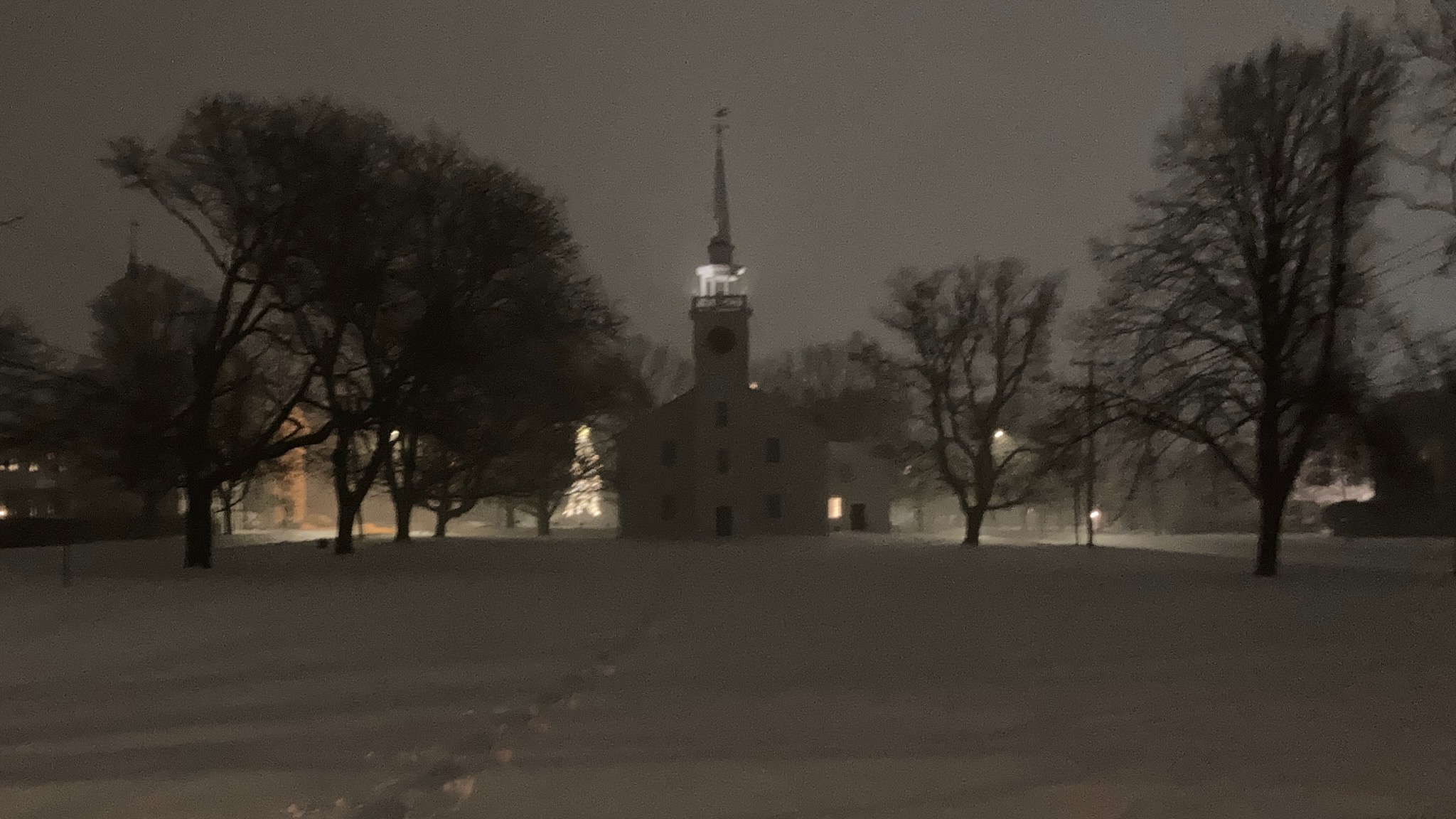
View from the bell tower of a 1747 meetinghouse

I climbed up to the bell level of the tower of the Cohasset Meetinghouse, because someone wanted to know if our bell was cast by Paul Revere (it was not). While I was up there, I took a panoramic photo. Not much of a view, to be honest — the tower isn’t all that tall, and it doesn’t have the dramatic view the you get from First Parish in Lexington (from which you can see the skyscrapers of Boston), or from First Unitarian in New Bedford (from which you can see New Bedford Harbor). But it’s still a charming view.

Click on the image above for a higher resolution version.

Fall flowers

It’s a crazy world out there, and sometimes you just need to forget about the human world and get in touch with the beauty and subliminty of the non-human world. And on a walk today, I saw more than a dozen species of wildflowers in bloom….

The color of late summer plants

We’re past Lughnasa now, and the days are noticeably shorter. At this time of year, I always look for a few plants with spectacular colors.

Delicately formed flowers.
Lobelia cardinalis

The Cardinal Flower grows in wet ground — in swamps, or along streams, rivers and ponds. I don’t often find a cardinal flower blooming where I can get close enough to see the details of the flowers, but this one was growing in a wet place along one of the paths around Aaron River Reservoir. The vivid red color, and the dramatic structure of the flower, makes it especially memorable.

Butterfly on a flower head.
Danaus plexippus on Asclepias tuberosa

Butterfly Milkweed grows in open fields and meadows. The bright orange is pretty enough by itself, but when an orange and black Monarch Butterfly lands on it, it’s truly spectacular.

Thin orange stems twining around a green plant.
Cuscuta gronovii

At this time of year along one of the inlets of Cohasset Harbor, I always see marsh plants covered in strange-looking orange filaments. Common Dodder is a parasitic plant that has no chlorophyll; it gets all its nutrients by sucking the sap out of a host plant. Parasites always creep me out a little — though I suppose letting your food source live is better than killing it, the way we humans kill carrots and potatoes, or cows and chickens. Nevertheless, the showy orange stems of Common Dodder twined in among green leaves is quite a beautiful sight.

Revolutionary War stories, part 3

Continuing a series of Memorial Day posts — part one part two

I started out this series by saying that sometimes the stories of Revolutionary War heroes and heroines have been partially forgotten, or details have been obscured. In this follow-up post, I’ll tell a little about how I researched the stories of Persis and Allen Lincoln, and the story of Briton Nichols. Maybe this will inspire other people to do some research into ordinary Revolutionary War veterans — a worthwhile thing to do as we celebrate the 250th anniversary of the start of the American Revolution.

One place to start researching an individual is by looking through the local history of a given town or city. During the middle part of the 19th century, many municipalities from the 13 original colonies had local histories written. And in most cases, whoever wrote that local history would be sure to record any local traditions about those who served in the Revolution. So, for example, for the town of Cohasset where I live, Victor Bigelow wrote a history of the town in 1898, and he provided lists of those who served and told many stories of the town’s participation in the Revolution.

That being said, local histories may contain local traditions that have gotten muddled over time, and most local histories contain lots of small errors of fact. So the next step is to see if you can find corroborating evidence from other sources. Which can be a huge job. Cohasset is a small town, but there were more than 125 men from the town who did military service during the Revolution. Volunteer local historians like me don’t have time to research all 125+ individuals who served in the Revolution. You have to narrow your focus to research a few individuals in depth.


But how do you narrow your focus? Here are some strategies:

(1) Research a college graduate, who would be far more likely to appear in the written record than non-college graduates. For example, you can find brief biographies of Harvard graduates in the series Sibley’s Harvard Graduates.

(2) Research famous or semi-famous persons, or persons who are part of prominent families. For example, if you were researching persons from Braintree or Quincy, you could start with anyone related to John Adams; there are lots of published genealogies and published histories of the Adamses.

(3) To research ordinary people, start with unusual person names (such as Briton Nichols) and unusual place names (such as Cohasset). Those will be easiest to find information on.

(4) As you’re researching one person, you might run into a lead from someone else altogether (e.g., when researching Briton Nichols, I discovered Ambrose Bates kept a war diary). Keep note of those other leads so you can follow up later.


Next, here are some research strategies:

(A) Use the power of internet search. More and more 18th century documents are being digitized, making information easily available online. This works best with Search using several different search tools — I start with DuckDuckGo, first with the person’s name and place name along, then adding the following to the search string: site:.archive.org (which searches through the many books digitized by the Internet Archive) and site:.loc.gov (which searches the Library of Congress website). Next, I’ll search Google Books. Finally, I’ll try regular Google search (Google seems to turn up a lot of crap these days, which is why I leave it till last).

(B) Search genealogy sites. I use FamilySearch.org, which is free, although it does require you to set up a free account. Paid genealogy sites may give you more information, but FamilySearch.org is a good place to look for Revolutionary War military service records. Additionally, amateur genealogists may have done additional research on some individuals — but be cautious about trusting the work of amateur genealogists. Always click through to look at the sources they cite, and then click through and look at the actual digitized images for those sources (which is how I found out that Persis Lincoln and Allen Lincoln were married by Rev. John Browne of Cohasset).

(C) Don’t forget your local library. Many local libraries have local history sections. If there’s a librarian who has responsibility for the local history section, get to know that person, and ask for help when you need it.

EXCEEDINGLY IMPORTANT: For each little tidbit of information you find, make sure you record where you found it, including full bibliographic information. Footnote everything! You want other people to be able to review your research. You want citations for every single fact. If you don’t have citations for everything, others will assume you’re a sloppy researcher, and discount your work accordingly.


That’s a very brief overview of how you might begin to research individual people to find out their stories. Good luck — and don’t forget to share your research, so others can appreciate it, and correct any errors you might make, and generally help further our knowledge of Revolutionary War veterans.

Revolutionary War stories, part 2

(Continuing with yesterday’s Memorial Day post.)

Briton Nichols, a Life of Adventure

The second story of a Revolutionary War veteran is especially interesting because of the way historians have been able to connect separated facts in the historical record, and then tell a fuller story of one person. This is the story of Briton Nichols.

In the historical record, you can find a list dating from July 19, 1780, giving the names of nine men from Cohasset who began six month’s military service on that day.(10) One name on that list, the name of Briton Nichols, stands out for two reasons. First, he had a very unusual name; the written record shows no other man in Massachusetts with the first name of Briton. Second, Briton Nichols is identified as being Black, the only person on that list whose race is given, and (as near as I can tell) the only Black man from Cohasset who served in the American Revolution.

Because Briton Nichols had such an unusual first name, and because his race is given, historians have been able to trace his life in more detail.(11) Historians discovered that in 1760, he published a book in which he told of thirteen years worth of adventures.(12) As a boy, he was enslaved by the Winslow family of Marshfield. At that time, he called himself Briton Hammond. On December 25, 1747, with the permission of his master, Briton left Marshfield to go on a sea voyage; perhaps his master hired him out as a sailor, taking a cut of his salary, a common practice in those days. Briton doesn’t say how old he was when he sailed, but later sources give his birth year as roughly 1740, so he may have been a boy or a young teen. The ship Briton was on sailed for Jamaica, took on a cargo of wood, and sailed north. Having struck a reef off Florida, the ship was attacked by Native Americans who killed everyone except Briton, and then set the ship on fire. After being held captive by the Native Americans for five week, he was able to make his escape on a Spanish schooner, whose captain recognized him, and took him to Havana, Cuba. The Native Americans followed and demanded the Governor of Havana return Briton to them, but the Governor paid ten dollars for him and kept him. A year later, Briton was caught by a press gang, but he refused to serve in the Spanish navy and was thrown in a dungeon.

Title page of an old book.
Title page of the book written by Briton Hammond (later Briton Nichols), from a digitized version on the Library of Congress website.

Briton was finally released from the dungeon four years later, though he was still trapped in Havana. Then a year after his release from the dungeon, he managed to escape from Havana aboard a ship of the British Navy. It appears Briton served in the British Navy for some time thereafter, aboard several different ships, until 1759 when he was wounded in the head by small shot during a fight with a French ship. Briton was put in Greenwich Hospital, where he recovered from his wounds. After additional service on British Navy ships, this time as a cook, he managed to find a berth on a ship bound for New England. By coincidence, his old master, one General Nichols, was on the same ship. Through that chance meeting, Briton was finally able to return to his home in Marshfield after a thirteen year absence.

Soon after his return from Marshfield, Briton’s account of his adventures was published in Boston, perhaps the earliest published memoir written by an African American. Two years later, in 1762, Briton married Hannah, a Black woman who was a member of First Church in Plymouth (today this a Unitarian Universalist congregation). In the late 1770s, Briton left the Winslow family, possibly upon the death of his master, and moved to Cohasset to join the Nichols family; at this time he changed his last name from Hammond to Nichols.

In 1777, Briton joined the Continental Army.(13) He must have been around forty years old when he enlisted. We can only speculate as to why he decided to enlist at that age. Most likely, enlisting in the military was a way for him to free himself from slavery. Ambrose Bates, who was one of Briton’s messmates, left a diary that tells a little about their military service.(14) Briton Nichols, Bates, and the rest of their contingent left Cohasset on August 27, 1777, and finally reached Saratoga, New York, in early September. There they joined the conflict between the Continental forces and General Burgoyne’s forces. Much of their military service was filled with boredom. Several days were filled with monotonous marching back and forth from one place to another. On other days, Bates simply records, “Nothing new today.” Those days of boredom were interspersed with days where they had more than enough excitement. To give just one example, on October 7, Bates recorded: “today we had a fight we were alarmed about noon and the fight begun, the sun two hours high at night and we drove them and took field pieces and took sum prisners.” The tide of battle was with the Continental forces, and Burgoyne finally surrendered on October 16. Soon thereafter, Bates and the other Cohasset men marched down to Tarrytown. Their service in Tarrytown was less exciting. Finally, on November 30 their term of military service ended, and they began marching home. They finally arrived back in Cohasset on December 7. So ended Briton Nichol’s first term of military service.

Briton Nichols enlisted again in 1780, giving his age at the time as forty years old.(15) I suspect he lied about his age, presenting himself as younger than he was. I could find no details of his 1780 military service. The next time I found him in the historical record was in the 1790 federal census. At that time, he was living in Hingham as a free Black man, along with his second wife Experience and one other household member, probably their child.

The story of Briton Nichols shows how we can recover some of the lost knowledge of Revolutionary War veterans. Briton Nichols was little more than a name on a list of soldiers, until historians were able to deduce that he was almost certainly the same person as Briton Hammond who had had such amazing adventures from 1747 to 1760.

Of special interest to those of us who are currently part of First Parish, Briton Nichols would have attended Sunday services right in our historica Meetinghouse. We can imagine him sitting upstairs in the balcony, where people of color and White indentured servants had to sit. We can imagine Briton sitting in that gallery on Sunday, August 24, 1777, a few days before he marched off to Saratoga. We can imagine the prayers of the entire congregation centering on the hope that all nine of the Cohasset men marching off as soldiers that week would return home safe and sound.

We today think of all those from this congregation who have served in the military. We think of all those veterans who are now members and friends of First Parish. We also think of those who grew up in this congregation and went off to join the armed services. And we think of those people from First Parish who died in military service. It is good for us to keep alive the memories of all those who served in our armed forces. It is good to keep those memories alive, because it reminds us of the bonds of love which transcend even death.

Tomorrow: a follow-up post sharing my research tips, in the hopes that others will be inspired to do more research into Revolutionary War veterans.

Notes

(10) Victor Bigelow, Narrative History of Cohasset (1898), p. 308.

(11) An introduction to a narrative by Briton Nichols, who earlier in life was called Briton Hammond, gives an overview of what historians conclude about his life: “It is accepted that in 1762 Hammon married Hannah, an African American woman and member of Plymouth’s First Church, with whom he had one child. For many years this was all that was known of Hammon’s life after his return to New England. More recent research, however, has revealed that Hammon probably changed his name to Nichols some time in the late 1770s, after the family with whom he and his master were living when Winslow died in 1774. Briton Nichols is listed as having fought for the Continental Army in the American Revolutionary War, as did many members of the white Nichols family…. In later census records, Briton Nichols is described as a free husband and father.” Derrick R. Spires, editor, Only by Experience: An Anthology of Slave Narratives (Broadview Press, 2023), p. 54.

(12) In this paragraph, the details of the earlier life of Briton Nichols/Hammond are taken from his book, A Narrative of the Uncommon Sufferings, and Surprizing Deliverance of Briton Hammon, A Negro Man (Boston: Green & Russell, 1760); as reprinted on the Pennsylvanian State Univ. website https://psu.pb.unizin.org/opentransatlanticlit/chapter/__unknown__-9/ accessed 22 May 2025.

(13) Victor Bigelow, p. 208.

(14) Victor Bigelow reprints the text of this brief diary, pp. 299-303.

(15) Entry for Briton Nichols, 19 July 1780, “Massachusetts, Revolutionary War, Index Cards to Muster Rolls, 1775-1783,” FamilySearch.org website https://www.familysearch.org/ark:/61903/1:1:QLLS-BBT3 accessed 22 May 2025.

Walk in the woods

It’s a stressful time in the world right now — what with brutal wars in Ukraine, Israel/Gaza, Sudan, Myanmar, and elsewhere — and with economic uncertainty and political instability in the U.S. — and a host of other problems, like looming ecological collapse.

As a result of all these stress-filled events, there are lots of pundits telling us how we can reduce our stress. Recently, I’ve heard a number of pundits tell me that if I want to reduce my stress I should take a walk in the woods. (Before you get all snarky, yes I know this advice makes unwarranted assumptions: that I live in a bioregion where there are woods to walk in; that I live in a human place where enough woodlands remain to walk in; that if there are woods to walk in, they’re safe enough that you can walk in them; that I don’t have physical limitations that preclude walking in the woods. As it happens, I do live in a bioregion which does have woodlands, I’m fortunate enough to live near a 3,000 acre state park which is mostly wooded and mostly safe, and I am physically able to walk in the woods.)

I hate to tell those pundits, but taking a walk in the woods is not going to reduce my stress.

Yesterday, I took a walk in our nearby state park. In many places in that park, American Beech (Fagus grandifolia) are the predominant tree species. But our American Beeches are under attack, and most of the beech trees I saw appeared to be in poor health. To be blunt, beech trees are being killed off by invasive organisms.

First, there’s Beech Bark Disease (BBD):

“BBD is an insect-fungus complex that involves the beech scale insect (Cryptococcus fagisuga Lind.) and the fungi Neonectria faginata and Neonectria coccinea…. It is predicted that BBD will spread across the entire range of American beech in the United States in the next 40–50?years.” (Catalina Salgado-Salazar et al., G3 (Bethesda) [Genes, Genomes, Genetics]. 2021 Mar 9;11(4). https://doi.org/10.1093/g3journal/jkab071 )

The scale insect, which arrived in North America in the early twentieth century, spreads the fungus. The fungus infects the tree causing unsightly canker sores on the bark:

Smooth beech tree bark, with rough canker sores running across it
Beech Bark Disease on an American Beech tree in Wompatuck State Park

There is no known cure for Beech Bark Diseases. It often proves fatal.

Second, beech trees are also under attack from Beech Leaf Disease:

“Symptoms of beech leaf disease (BLD), first reported in Ohio in 2012, include interveinal greening, thickening and often chlorosis in leaves, canopy thinning and mortality. Nematodes from diseased leaves of American beech (Fagus grandifolia) sent by the Ohio Department of Agriculture to the USDA, Beltsville, MD in autumn 2017 were identified as the first recorded North American population of Litylenchus crenatae (Nematology, 21, 2019, 5), originally described from Japan.” (Lynn Kay Carta et al., “Beech leaf disease symptoms caused by newly recognized nematode subspecies,” Forest Pathology, 27 Feb. 2020 https://doi.org/10.1111/efp.12580 )

Here’s what the leaves look like after the nematodes have attacked them (I took this photo last May):

Beech tree leaves that are curled and discolored
Curled leaves of American Beech, showing damage by Beech Leaf Disease

As I understand it, foresters and dendrologists are still learning about Beech Leaf Disease. But it’s very clear that Beech Leaf Disease causes trees to lose most of their leaves, and it’s equally clear that Beech Leaf Disease eventually leads to the death of the tree.

As with Beech Bark Diseases, there is no known cure.

The upshot is that we’re going to lose all, or nearly all, of our American Beech trees in the next decade or so — just as we lost nearly all of our American Chestnut trees in the early twentieth century (due to Chestnut Blight, an invasive fungus), and just as we lost nearly all of our American Elm trees in the mid-twentieth century (due to Dutch Elm Disease, an invasive fungus), and just as we lost nearly all of our ash trees in the early twenty-first century (due to Emerald Ash Borer, an invasive insect).

Invasive organisms are predicted to be one of the major causes of the calamitous decrease in biodiversity that we’re now facing. I suppose you could go for a walk in the woods and willfully ignore these evidences of global environmental disaster. If you’re going to do that, you might as well engage in one of those chic mindfulness practices that helps you forget that anything bad is happening. And what the hell, if you need to be in denial — if that’s what it takes to reduce your stress and keep your sanity — then I say, go for it. But please don’t tell me that I should take a walk in the woods to reduce my stress — what works for you doesn’t necessarily work for me.