Tracey got a comic zine for me at a recent comic convention. Drawn and written by Sanika Phwade — who bills herself as “an illustrator, cartoonist, and reportage artist” — it tells about a minister who has fun with the signboard outside her church. The zine opens with the words: “Pastor Jamie Washam changes the sign outside the First Baptist Church in America every week.”
The cover of Sanika Phwade’s comic zine about Rev. Jamie Washam’s signboard
According to Phwade, by putting short aphorisms on the signboard, Rev. Washam is continuing the tradition of her predecessor: “He would call it The Wayside Pulpit — that preaches a sermon to whomever is passing by. I love that! But I also like having fun with these.”
As the keeper of the Wayside Pulpit outside our meetinghouse, I was jealous when I learned that people actually talk to Washam about the things she puts in her Wayside Pulpit. But then, her Wayside Pulpit is edgier than ours is. I put up sayings like “The moral arc of the universe is long but it bends towards justice.” No one comments on things like that. When Washam put up the phrase, “God Is Non-Binary,” sixteen people made comments:
“I have learned that it is the same signs that evoke both positive and negative reactions in people. Fifteen have said positive things about ‘God Is Non-Binary,’ and one person said, Hey what are you thinking? And I said well, let’s sit down and read genesis together. Because the text does support that. They thought I was just popping off politically, and yes I totally picked that up from Pride Fest. But it is completely substantiated by the text.”
Genesis 1:27 does in fact say, “So God created man in his own image, in the image of God created he him; male and female created he them.” That is, both male and female are created in God’s image, which implies that God is (ahem) non-binary. Oh ye of little faith who try to place limits on God, limiting him to one gender (regardless of the pronouns we humans use to describe him).
When I heard about the “Melania” movie, I assumed it was yet another vanity project assembled by yet another ultra rich person. What I didn’t realize was that the film has actually been released in theatres. I also didn’t realize was that Amazon paid to have this movie produced. The BBC reports that it is believed that Amazon paid USD$35million to market the film, and another USD$40 million for the rights.
Now that I know it’s not a simple vanity project, I’m fascinated. What is going on here?
Reviews of the movie so far are mixed. It’s easy to find negative reviews in the usual liberal media outlets like The Guardian, The Atlantic, and so on. Conservative Fox News, by contrast, seems enthralled. The politically centrist USA Today is not entirely negative, but still says it’s not a good documentary, giving it 1.5 out of 4 stars:
“‘Melania’ doesn’t quite work as a documentary, though that doesn’t matter: People who don’t like the Trumps won’t go near the theater, and those who love the Trumps probably will. Just don’t expect much insight either way: While it does offer an extremely flattering view of all things Melania, outside of a few candid glimpses, you’re not going to learn a lot about who she really is.”
Meanwhile, audience reviews posted on Rotten Tomatoes are generally laudatory. It’s hard to know if the reviewers are real people (after all, this is an Amazon movie, and Amazon is the king of fake reviews), but in a typical review “Karen M” gushes:
“As a creative—writer, pianist, singer, perfectionist, lover of classical music and art—I found Melania unexpectedly moving. The documentary opens her inner sanctum, and in doing so, created a quiet sense of sisterhood. I didn’t see a distant public figure; I saw someone achingly real—like watching your sister on her wedding day or hearing your daughter’s name called at graduation. There she is. Her elegance is unmistakable, yet the vulnerability is what lingers. She is refined without artifice, reserved yet deeply expressive. The film is not about Donald Trump—au contraire. It feels more like peering into the private life of a royal from afar, and realizing with pride: she is my First Lady. It has been a long time since young women—and grown ones—had a woman of such standalone strength to admire. Her quiet power rivals that of any great woman who has ever held a throne. Highly recommend, regardless of political persuasion.”
Maybe that is a real review. I can see that for someone who is fascinated by Melania Trump, this could be a fun movie to watch. Unfortunately, Karen M is probably mistaken, while USA Today is correct — Democrats are going to stay away in droves, Republicans are going to love the film. I guess those of us who belong to neither party can be bemused.
At this stage, it’s hard to know if people are actually paying to see the film in movie theatres. A very strange ad was posted on the gigs section of Boston Craigslist, offering people $50 if they would see “Melania” in a movie theater. This ad has since been changed to read:
“…due to widespread coverage and backlash surrounding this offer in the fake news media, counsel has advised us that proceeding would run afoul of campaign finance laws. Considering the funding of the film by Amazon, we were shocked to hear this, but cannot take the risk….On the bright side, this incredible film is now SOLD OUT everywhere, with box office success like no one has EVER seen.”
Even Snopes can’t decide if this was a fake ad, or a real ad. I mean, was this a bunch of Trump haters trying to make the movie look bad, or was this a serious offer to get people to attend the movie? Either way, it’s bizarre. And if ticket sales turn out to be good, we’ll be wondering — did the audiences pay to see the film, or did someone pay them to see the film? That uncertainty says less about the film, and more about the lack of trust in the United States today.
So far, Rolling Stone seems to have the most balanced, in-depth reporting I’ve seen about the film. They report that Melania Trump herself received 70% of the licensing fee, or USD$28 million, for herself — in other words, she got paid some big bucks, so this isn’t exactly a vanity project. They also report that the film crew liked Melania Trump, describing her as “friendly and very engaged in the process.” On the other hand, Rolling Stone also says that no one should expect any deep insight into Melania Trump: “‘Some people are boring,’ one crew member said. ‘Some people also never let their guard down.’” It sounds like Melania Trump fits in the latter category.
Something about this movie, and the varied reactions to it, seem to capture the zeitgeist of our times. And maybe part of the zeitgest is feeling that you can never let your guard down.
Update 2/1/2026: The movie has become even more zeitgeist-y. The BBC reports that the latest release of the Epstein files has a photo of the film’s director sitting next to Epstein, both with their arms around young women. It’s a fairly creepy photo….
(Eventually, this will turn out to be about progressive spirituality — bear with me….)
Scott Adams, the creator of the “Dilbert” cartoon (and the Dilbert merchandise empire) has died of prostate cancer, at age 68. Cancer deaths are often unpleasant, and Adams’s last months sound like they were especially painful and debilitating, not something you would wish on anyone.
Adams left behind a very mixed legacy. His “Dilbert” comic strip was syndicated from 1989 until 2023. For the first few years, the strip often offered a fresh and funny take on what it’s like to be a lower-level white collar worker in corporate America. But Adams’s career went downhill from there.
Although, who am I to judge? I guess I can call myself a cartoonist, insofar as I drew a regular strip for the weekly newspaper of the undergraduate college I attended. My drawings were good enough, but my weakness was writing the strips. I depended on my friend Mike (who’s now a rabbi) to write the strips, and after he graduated I never drew another weekly strip. I manage to write acceptable nonfiction prose, but when it came to writing comic strips, I was a failure.
By contrast, Scott Adams was a wildly successful cartoonist, even though he drew badly. His characters show no particular expression, and he had little understanding of how to represent three dimensional space. But his writing was good, or it was in the first few years of the strip, because in writing for the strip he managed to capture some of the more frustrating aspects of corporate bureaucracy. He came out with a strip that appealed to the white collar cubical worker at a time when there were lots of white collar cubical workers. His success as a cartoonist was probably due more to lucky timing than anything else.
Yet after half a dozen years, in the late 1990s, “Dilbert” was getting repetitive. By the 2000s, none of the characters was likable; or maybe Adams no longer liked any of his characters. And by the 2010s, the strip was just plain boring, as well as mean-spirited. I think what happened was simple. In 1995, Adams quit his white collar cubical job in order to work full-time as a cartoonist; once he stopped working in a cubical, he stopped being funny.
Furthermore, by the 2000s, Adams was becoming an unlikeable person. My take on it is that he let his success go to his head, deluding himself into thinking he was pretty hot stuff even though he couldn’t draw and he wasn’t much of a writer. He became pompous and self-righteous. You can read a brief summary of his online sockpuppetry, trolling, and bad behavior here. His bad behavior kept getting worse, culminating in 2023 when he said in his podcast:
“If nearly half of all Blacks are not okay with white people—according to this poll, not according to me, according to this poll—that’s a hate group. And I don’t want to have anything to do with them. And I would say, based on the current way things are going, the best advice I would give to white people is to get the hell away from Black people. Just get the –– away. Wherever you have to go, just get away. Because there’s no fixing this. This can’t be fixed.” [Expletive deleted by me.]
(Full disclosure: I admit I didn’t listen to the podcast myself; I depended on this transcription.)
In fact, as early as 2000, Adams had turned into one of the least likable characters in his strip. He founded Scott Adams Foods to manufacture a frozen burrito that he called “the blue jeans of food.” What a stupid phrase. It’s a phrase that is classic corporate gobbledy-gook; it is exactly the sort of meaningless utterance made by the Pointy-Haired Boss of the early “Dilbert” cartoons. Adams had become the Pointy-Haired Boss.
I told you that eventually we’d get around to religion. In the last few weeks of his life, when he was in hospice, Adams apparently became a Christian. According to TMZ, in a final episode of his podcast his ex-wife read a letter from him which stated “he’s converting to Christianity because of the ‘risk-reward’ calculation.” (For an in-depth discussion of this philosophical stance, see Pascal’s Wager on the Stanford Encyclopedia of Philosophy; there is little evidence that Adams understood any of the philosophical complexities.) Calling his conversion to Christianity a “‘risk-reward’ calculation” sounds like more corporate gobbledy-gook. Again, it’s the sort of thing the Pointy-Haired Boss would say, which is kind of sad.
Crucially, he did not say what form of Christianity he converted to. Did he become a Roman Catholic? a Latter Day Saint? Russian Orthodox? an evangelical Protestant? “Dilbert” had grown so mean-spirited in its last couple of decades that it’s hard for me to imagine what form of Christianity finally attracted him. Or maybe he just didn’t know all that much about Christianity, and just called himself a Christian without knowing quite what he meant. However, from my religious point of view, he didn’t have to worry about the afterlife. If he had become almost any form of progressive Christian, he would have understood God as love and forgiveness, and he wouldn’t have had to worry so much about formal conversion. Instead, he seems to have understood God as a sort of deified Pointy-Haired Boss, and Christianity as a corporate bureaucracy. Which is too bad.
But despite all your flaws, thank you Scott Adams, for a half dozen years of a good comic strip. Not a great comic strip — you weren’t a Herriman, or a Mauldin, or a Johnston. And maybe you should have done what Bill Watterson did, refusing to sell related merchandise, then quitting while you were still fresh. Nevertheless, your half dozen good years remain a legacy that surpasses what most people manage to do. So thank you for the good stuff, and we’ll try to forget about the rest of it.
From one cartoonist to another: Adams as the Pointy Haired Boss. Maybe the Pointy-Haired Boss was more likable than we all thought….
In its Dec. 6-12 edition, The Economist has an article has an article in which it proposes its “word of the year.” The article has no byline, and cites no sources — typical for The Economist, and one of the reasons I do not fully trust it — but this particular article is mostly humorous so I guess I don’t need a byline. The anonymous author begins the article by naming words-of-the-year that were runners-up:
“Finance is a good place to look for words of the year because trends move fast, and its denizens like neologisms. TACO is this year’s favorite. Coined by Robert Armstrong, a journalists at the Financial Times, it stands for ‘Trump Always Chickens Out’ and points to the many tariff fights Donald Trump has picked and then backed down from….”
For the record, The Economist’s winning word of the year is “slop,” as in “AI slop.”
The long title of the article pretty much tells the whole sick story, but some of the quotes are revealing. The author interviews Tsunami Turner, who works as an educational psychologist at a company in San Jose that provides “child-centered therapy” as well as IQ testing services:
“‘Some parents come in with an IQ number in mind. They are really wanting to have their child hit a specific number,’ she said. Their kids are often very accomplished, taking dace, soccer, art, and music — and know they ‘have to get a certain number.’ They show up ‘highly anxious,’ she said. If scores come in lower than expected, Turner gets pushback and requests for retests.
“‘There’s a lot of societal pressure. The family is incredibly busy and wants their kid in a school that challenges their intellect and supports their development,’ she said. It can spiral quickly. ‘The goal is that a child will get into a good primary school, and that will lead them to getting into a good college, which will lead them to getting a good job and doing really well in the world.'”
In my 13 years working as a minister of religious education in Silicon Valley, I saw some of this — not so much among the families in the UU congregation there, because if you’re trying to fast-track your kids in this way, you don’t waste time on things like moral and spiritual education — but I did see it happening. It really is true, some well-to-do Silicon Valley parents start trying to build their child’s resume starting when the child is 2 years old. I feel this phenomenon is bad for children, and tends to result in accomplished but stunted and less-than-fully-human adults.
One of my favorite holidays of the year is Pee on Earth Day. This delightful holiday is celebrated on the longest day of the year — June 21 in the northern hemisphere, and December 21 in the southern hemisphere.
Why should you pee on earth? If you live in a part of the world where there are no diseases spread through urine (which means most of my readers), peeing on earth is a way to get rid of your urine in a sanitary and ecological manner. Your urine contains valuable nutrients that plants can use, and as long as you don’t eat too much salt, your urine (diluted, or in small amounts) is good for plants. Peeing on earth is a way to remind yourself that you are a part of the great cycle of nature. As Carol puts it, “Don’t throw it away, grow it away!”
Why on the longest day? Because it’s unlikely there will be snow on the ground, and it’s likely the weather will be more conducive to peeing outdoors.
We’ll be on the train from Baltimore back home to Cohasset for much of Pee on Earth Day. I’ll wait to pee on earth until we get home.
Kara brought back White Rabbit candy from her visit to China. She gave me a small bag to try.
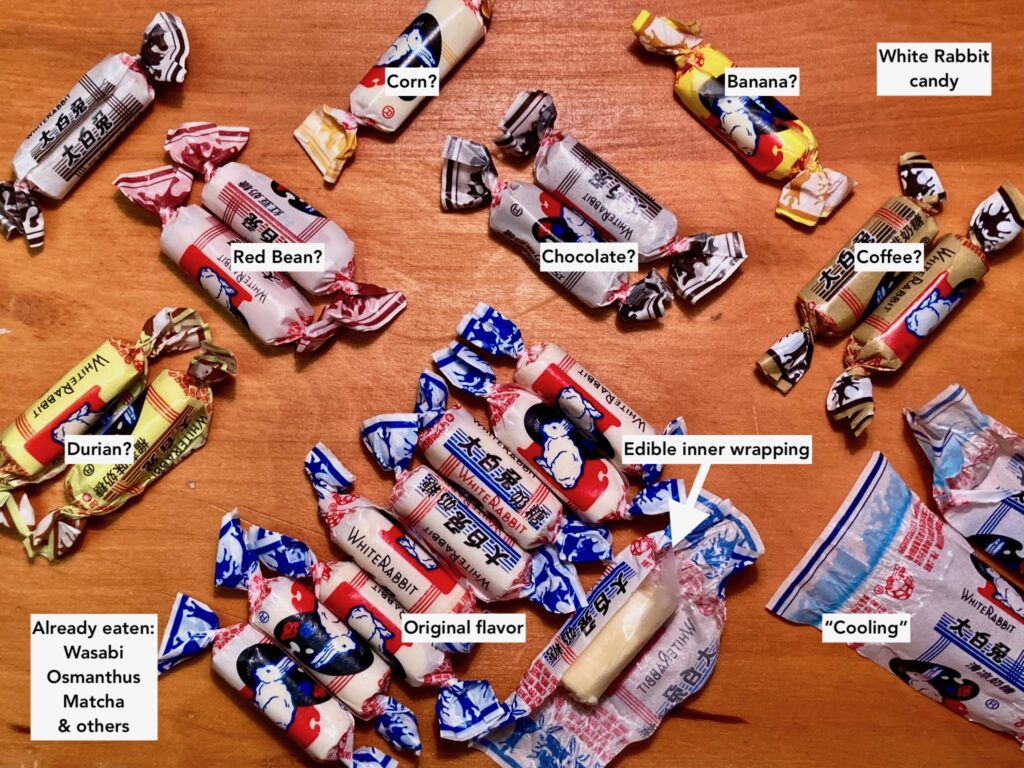
The candy starts off as very firm, becoming chewy as it warms up in your mouth. There’s an edible inner wrapping made of glutinous rice, which addes to the texture. The original flavor is very mild, milky and vanilla-y, and not very sweet. Interesting. I found out that the candy originated in Shanghai, and I find it reminiscent of the mildness of other Shanghai cuisine.
There were many flavors in the small bag Kara gave me, not just the original flavor. From what I can find out online, there are at least 16 flavors: Original plus Banana, “Brown creamy,” Chocolate, Coffee, “Cooling” (mint), Durian, Lychee, Maize (corn), Mango, Matcha, Osmanthus, Salty plum, Wasabi, Red Bean, Yogurt.
Some of the flavors I liked a lot. One of my favorite flavors was wasabi — it had just a touch of wasabi, not too spicy, a nice contrast to the underlying milky mildness of the candy. My other favorite flavor was what’s called “cooling” (what I’d call mint) — which also provided a nice contrast to the underlying flavor of the candy. Red bean was a little odd to my Western palate, but I did like the way it reminded me of dim sum red bean buns.
Other flavors I didn’t care for as much. Osmanthus was only faintly floral, and overall too bland for my tastes. Matcha didn’t work for me — I guess if you like boba tea this would be good, but I like my matcha unsweetened and with no milk.
The best thing about White Rabbit candy is its mildness. It’s not too sweet; by contrast, I find most American candy far too sweet. And the flavors are subtle, not overpowering like some American candies.
The Religious Education Association is holding an online talk this evening. One of the presenters will be on ecological board games:
“Paul H. Van Straten, Memorial University of Newfoundland: ‘Anticipating the Opportunities and Challenges of Using Commercial-off-the-Shelf Games to Educate People on Environmental Sustainability in a Christian Context.’ Some studies show that digital games and board games can be used to facilitate religious learning in Christian post-secondary settings. Would game-based learning be a viable option for educating Christians on environmental sustainability in a congregational church environment? This paper analyzes several commercially-available ecological digital games and board games to explore potential learning opportunities and challenges for integrating such games in a Christian small-group study environment.”
Although the paper will tell about games in Christian communities, I imagine the findings will be applicable to Unitarian Universalist communities as well (perhaps with some tweaking and language changes).
This is actually a topic that I’ve been working for some years now. I’ve used various ecological games in Unitarian Universalist religious education for children and teens since at least 2006. Recently, I’ve been working on ecology games for adults. To this end, I recently attended an online talk by Thomas Maiorana, professor of design at U.C. Davis, where he introduced a board game he’s developing that’s intended to promote wildfire resiliency in local communities. (You can watch a recording of the talk here.)
Local congregations and faith communities should be ideal settings for ecology board games. So I’m looking forward to tonight’s presentation, in hopes that I’ll learn about some new games, and more importantly learn about implementation strategies.
For the record, some of the ecology board games I’ve used in UU settings include:
Wildcraft: A Cooperative Herbal Adventure Game teaches players about some common wild herbs. It plays well with mixed age groups, and in my experience kids up through middle school have fun with it. At approx. $50, it’s expensive.
NOAA’s Carbon Cycle Game shows how burning fossil fuels affects the carbon cycle. You can play this as a tabletop game, or as a run-around game.
Family Pastimes publishes several board games with ecological themes. I’ve played three of their games — A Beautiful Place, Earthquake, and Dragonfly with young children, and all three were fun and well-designed. Better yet, they were inexpensive, just $12-15 each. (But these aren’t adult-friendly games.)
Promoting Wildfire Resilience. Thomas Maiorana hasn’t yet made the board game publicly available, but will do so soon on this website.
In addition, the following are run-around games, not board games, but worth playing:
Lynxes, Hares, and Leaves is an active run-around game I got from environmental educator Steve van Matre’s book Acclimatizing. I’ve played this successfully with mixed age groups including adults and kids. Here’s an old version of my adaptation of this game. Someday I’ll get around to posting my updated rules.
The Food Chain Game is another run-around game that I’ve played successfully with mixed age groups. This is my heavily adapted version of a game from the old Project WILD curriculum. Again, one of these days I’ll post my rules.
Other games I’m intrigued by, but haven’t yet played, include the following:
Although I’m not a philosopher, I was trained in philosophy. So when I hear arguments, I tend to want to ask some questions about any given argument. What’s the origin of this argument — is it a perennial argument, or did it begin at some point in time? What’s the purpose of this argument? Since most arguments do not reduce to Boolean logic, what are some of the diverse positions taken in this argument?
Currently, there are arguments in pop culture about sex and gender. Pop culture usually reduces these arguments to a simple binary: traditionalists vs. progressives. But even a cursory examination shows that the so-called “progressive” camp includes a diversity of opinions.
Especially useful are the tidbits of intellectual history scattered through this essay. Take, for example, the origin of the current distinction between sex and gender, which dates only to the 1960s:
“…Psychologists writing on transsexuality were the first to employ gender terminology in this sense. Until the 1960s, ‘gender’ was often used to refer to masculine and feminine words, like le and la in French. However, in order to explain why some people felt that they were ‘trapped in the wrong bodies’, the psychologist Robert Stoller (1968) began using the terms ‘sex’ to pick out biological traits and ‘gender’ to pick out the amount of femininity and masculinity a person exhibited. Although (by and large) a person’s sex and gender complemented each other, separating out these terms seemed to make theoretical sense allowing Stoller to explain the phenomenon of transsexuality: transsexuals’ sex and gender simply don’t match. Along with psychologists like Stoller, feminists found it useful to distinguish sex and gender. This enabled them to argue that many differences between women and men were socially produced and, therefore, changeable….” [Section 1.2]
So “gender” is a relatively recent concept. But our concept of “sex” is also fairly recent:
“…Our concept of sex is said to be a product of social forces in the sense that what counts as sex is shaped by social meanings. Standardly [sic], those with XX-chromosomes, ovaries that produce large egg cells, female genitalia, a relatively high proportion of ‘female’ hormones, and other secondary sex characteristics (relatively small body size, less body hair) count as biologically female. Those with XY-chromosomes, testes that produce small sperm cells, male genitalia, a relatively high proportion of ‘male’ hormones and other secondary sex traits (relatively large body size, significant amounts of body hair) count as male. This understanding is fairly recent. The prevalent scientific view from Ancient Greeks until the late 18th century, did not consider female and male sexes to be distinct categories with specific traits; instead, a ‘one-sex model’ held that males and females were members of the same sex category. Females’ genitals were thought to be the same as males’ but simply directed inside the body; ovaries and testes (for instance) were referred to by the same term and whether the term referred to the former or the latter was made clear by the context…. It was not until the late 1700s that scientists began to think of female and male anatomies as radically different moving away from the ‘one-sex model’ of a single sex spectrum to the (nowadays prevalent) ‘two-sex model’ of sexual dimorphism.” [Section 3.2; emphasis is mine]
Thus, our current understanding of “biological sex” is not an ageless, universal concept. To use Theodore Parker’s terminology, “sex” and “gender,” then, are transient concepts rather than permanent concepts. All this is useful to know when someone tells you, with great sincerity, that a certain definition of “sex” or “gender” is the one true and correct definition. That may be true at this moment, but it was not necessarily true in the past, and it won’t necessarily be true in the future.
None of this should distract us from the very real injustices that stem from widely-held concepts of “sex” and “gender.” But this may helps explain why we humans seem to take such a long time to achieve justice. Remember what Parker said about justice:
“I do not pretend to understand the moral universe, the arc is a long one, my eye reaches but little ways. I cannot calculate the curve and complete the figure by the experience of sight; I can divine it by conscience. But from what I see I am sure it bends towards justice.”
Indeed, our eye reaches but a little ways along the arc of the moral universe. And nor can we yet “calculate the curve.”
Louisiana state law now requires that the Ten Commandments shall be posted in every classroom. But if you compare the Ten Commandments found in the Bible with Louisiana’s Ten Commandments, you quickly see that they are not the same Ten Commandments.
In other words, the Louisiana version of the Ten Commandments may be inspired by the Bible, but it is not Biblical. If you’re a Biblical purist, you could say that Louisiana’s rewriting of Exodus 20:2-17 is actually a type of graven image or idol — something that seems like it comes from God, but is actually made by fallible humans.
Below the fold, I’ll include several translations of the relevant Bible passages so you can compare them.