Noted with comment

I’ve been rereading Dave Van Ronk’s memoir The Mayor of MacDougal Street (2006). Van Ronk was a musician best remembered for his fingerstyle guitar and his interpretations of blues music, although he thought of himself as more of as a jazz musician manque. He was one of the core musicians of the 1960s Folk Revival, though he never hit it big like his friend Bobby Dylan. Van Ronk was also a serious leftist. He started out as an anarchist, joined the IWW, and wound up as a Troskyite. In his memoir, he reflected on the politics of the 1960s:

Interestingly, I feel the current Republican party actually does have a serious theoretical grounding. I disagree violently with the Republican party’s economic policies, but you have to admit that they are firmly grounded in Milton Friedman’s economic theories. Even if today’s Republicans have drifted away from Friedman in some respects, still a great deal of their agenda — doing away with Social Security, privatizing the National Park System, getting rid of the Post Office, etc. — comes straight out of his work.

Who on the American left offers any theoretical grounding to compete with Friedmanism? If Dave Van Ronk were still alive he’d no doubt advocate for Trotskyism, although to my mind that’s a non-starter in 2025 America. Personally, I’d vote for William J. Barber’s Poor People’s Campaign. However, I suspect Barber’s Christian affiliation is a dealbreaker for many of today’s pissed-off liberals; plus it has proved difficult to get pissed-off liberals to focus on poverty as a central issue.
Noted without comment

From “The American Taboo on Socialism” by Robert N. Bellah in The Broken Covenant: American Civil Religion in Time of Trial, 2nd Edition (Chicago: Univ. Chicago Press, 1992), chapter 5, pp. 112-138:

Alternate definitions for “socialism”

Sometimes I wonder why the religious right, and the political conservatives, express so much disdain for “Marxism” and “socialism.” It kinda makes sense that the religious right might dislike “Marxism” and “socialism” so intensely, because Marx called religion “the opiate of the masses,” and because many Marxist-Leninists promote a crusading atheism that wants to get rid of religion entirely.

But wait. The definitions for “socialism” and “Marxism” are not always the definitions you’ll find in the dictionary. For an example of what I mean, let’s go back in time to 1963.

Not long after Martin Luther King, Jr., was released from the Birmingham jail, White terrorists bombed the house of King’s brother. This violent act provoked a violent response from the Black community, which in turn prompted the infamously racist Governor George Wallace to respond with even more violence: he sent in state troopers who mercilessly beat Black people. Jonathan Riedler takes up the story in his book Gospel of Freedom: Martin Luther King, Jr.’s “Letter from Birmingham Jail” and the Struggle That Changed a Nation (New York: Bloomsbury, 2013), p. 124:

Note that in the above example, Art Hanes is not using the dictionary definition of socialism. For him, “socialism” has an alternative definition: it is government action that prevents him from committing acts of racial violence. He perceives this as infringing on his rights as an American, and he defines anything that infringes on his rights as an American as “socialism.”

This helps me understand some of the visceral emotion I sense when people reference “Marxism” and “socialism” in today’s political debates. There are times when opponents of “socialism” and “Marxism” are not using the dictionary definitions for those words, but rather more emotionally-loaded meanings pertaining to race.

Voting

Carol and I are getting ready to cast our vote in the upcoming election. Early voting starts today at Cohasset Town Hall, and we wanted to be ready. So we sat in the kitchen and did some research on the candidates and the ballot questions.

We no longer have a real newspaper in Cohasset. There’s the Coastal Mariner, but it’s a typical Gannet local paper, with very little actual local news. There’s the online Cohasset Anchor, which has some good lifestyle stories but it’s not a place I’d look for hard news on local elections. As for the regional newspapers, the Quincy Patriot-Ledger used to be an OK source for local news, but it’s yet another Gannet paper where staff has been cut to the point where there’s not much local coverage any more. As for the Boston Globe, they pretty much ignore southeastern Massachusetts.

So we turned to the League of Women Voters for information about state and local elections. We went to https://www.vote411.org/ and entered our address. Up popped a list of every candidate for every race. We looked at the Massachusetts Information for Voters booklet, which is mailed to everyone in Massachusetts and contains comprehensive information about the five ballot measures we vote on this year.

In this post, while I’ll offer some opinions about the election, more importantly I’m going to reflect on democracy and the democratic process. And my first reflection is this — we hear a great deal about the presidential election, both in the news, on social media, and in face-to-face interactions. This emphasis on the presidential election makes it seem like we’re voting for emperor or king. But U.S. democracy encompasses far more than Harris vs. Trump (and before you complain, I listed those two candidates in alphabetical order). In fact, the overemphasis on the presidential election is harming our democracy. So let’s talk about all those other elections.

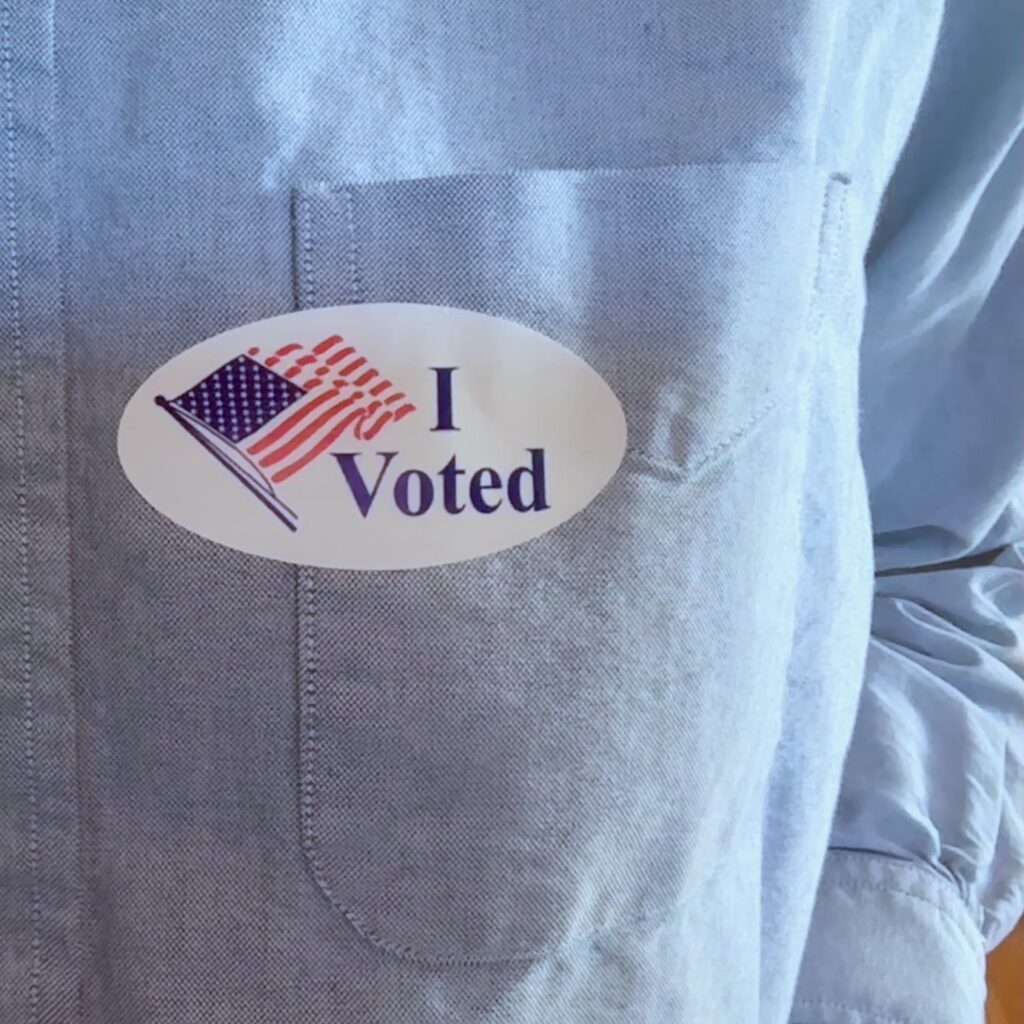
A sticker saying "I voted" on a blue shirt.
After I wrote this post, I walked over to Town Hall to cast my ballot…and got my sticker.

We started by looking at the candidates for the U.S. Senate. The League of Women Voters sends out these standard questions for all Senate candidates to answer:

Continue reading “Voting”

Noted with minimal comment

The following sentence by J. M. Berger has been widely quoted: “If you believe that only ‘the other guys’ can produce extremists and that your own identity group cannot, you may be an extremist yourself.”

The original context of the quote provides more nuance:

— from the book Extremism by J. M. Berger (Cambridge, Mass.: MIT Press, 2018), p. 2.

Why the debate shouldn’t matter

I’ve read three or four recent news stories claiming that some large percentage of voters are going to place a lot of weight on the debates.

My personal opinion is that this seems silly. Skill in debating doesn’t necessarily correlate to skill in governing. Furthermore, a president of the United States is really only as good as their team. Debating skill tells me nothing about the ability of someone to put together a good management team. (Besides, we’ve already seen both of the two major presidential candidates govern for several years; we already know how they’re going to perform.)

But the United States seems obsessed with high stakes performance evaluations like the presidential debate. For high school kids, we love our high stakes school tests, and our SAT scores. For sports teams, we love our playoff games. For Unitarian Universalist ministers, we love our “candidating week,” seven days in which to evaluate a candidate for a years-long tenure.

We United Statesians also love our hyper-individualistic take on leadership. We love to imagine that the Great Man theory of leadership is correct. We like to believe that one person in a leadership role has a huge impact on an organization, which is why we pay Chief Executive Officers of for-profit corporations millions and billions of dollars. Even though the Great Man theory of leadership is obviously wrong, we fervently cling to our belief in it; we are leadership theory fundamentalists.

And people wonder why United States democracy is in such trouble….

Things that you’re NOT liable to find in the Bible

Louisiana state law now requires that the Ten Commandments shall be posted in every classroom. But if you compare the Ten Commandments found in the Bible with Louisiana’s Ten Commandments, you quickly see that they are not the same Ten Commandments.

Where did Louisiana’s Ten Commandments come from? Apparently, in the 1950s “representatives of Judaism, Protestantism, and Catholicism developed what the individuals involved believed to be a nonsectarian version of the Ten Commandments because it could not be identified with any one religious group” — Anthony Flecker, “Thou shalt make not law respecting an establishment of religion: ACLU v. McCreary County, Van Orden v. Perry, and the Establishment clause”, St. John’s Journal of Legal Commentary, vol. 21:1, p. 264 footnote 136. (This Patheos post gives another take on the same story.)

In other words, the Louisiana version of the Ten Commandments may be inspired by the Bible, but it is not Biblical. If you’re a Biblical purist, you could say that Louisiana’s rewriting of Exodus 20:2-17 is actually a type of graven image or idol — something that seems like it comes from God, but is actually made by fallible humans.

Below the fold, I’ll include several translations of the relevant Bible passages so you can compare them.

Continue reading “Things that you’re NOT liable to find in the Bible”

Christians against Christian Nationalism

You’ve probably already seen this, but I just discovered the Christians against Christian Nationalism website. The tagline of the website is “We believe that Christian nationalism threatens our faith and country.” Amen to that.

For my co-religionists, and any other readers, who are Christians: you can read and sign their statement against Christian Nationalism. It’s just so refreshing to see Christians standing up against this pervsion of the Christian faith.

For everyone: that website has great printable resources you can share with your Christian friends. Plus there’s a related TikTok account, @EndChristianNationalism, which might also be worth sharing.

Police departments vs. labor

Starting with the George Floyd protests in 2020, we began hearing calls to defund police. Police departments, so the thinking went, mostly served White interests, and thus tended to support White supremacy. This argument may have been valid, but it ignored other interests that have controlled police departments in the U.S.

“On May 28, 1937, a strike of seventy-eight thousand steelworkers spanned seven states in the Steel Belt from Homestead to Chicago. The Little Steel Strike of 1937 showed that business would not accommodate unionization even in the face of federal directives. Little Steel companies came prepared. They each bought tens of thousands of dollars’ worth of tear gas, gas grenades, pistols, and rifles to supply to local police and corporate guards to stop a strike. A congressional investigation found that the companies together had purchased $178,000 worth of such armaments. Bethlehem Steel had directly paid the policemen’s salaries. In Chicago, on Memorial Day, came the climax of the strike, when a thousand strikers took American flags and began to walk toward the steel mill. When told to disperse by police, they refused. The police fired on the crowd in what was reported as the Memorial Day massacre, killing seven and wounding ninety. Most of the injured were shot in the back. The strike fell apart soon after….” (Louis Hyman, Temp: How American Work, American Business, and the American Dream Became Temporary [Viking, 2018], p. 35)

That’s just one small example of how police have always served the interests of corporate employers over the interests of working people. Police departments are still serving corporate interests over worker interests. I’ve never heard of a police department protecting striking union members from corporate security. I’ve never heard of a police department raiding a company’s premises to stop unsafe and exploitative work practices. You will never, ever hear of a police department shooting and killing CEOs. Police departments get paid to support bosses, not workers. (And please notice that I’m referring to “police departments” and not “police” — many police officers are ethical people working a tough job; but, like other workers, they have to do what their bosses tell them.)

The key point is that police departments serve the existing power structure. If the existing power structure includes systemic racism, then the police departments will support that systemic racism. If the existing power structure wants cheap labor to maximize corporate profits, then the police departments will suppress workers who go on strike.

Which raises an interesting point: It might be that the interests of Black and other non-White people, and the interests of working class people of whatever race, have some significant overlap.

What to do

The war in Israel and Gaza is horrific. Here in this country, there is disagreement about what to do. People are staking out positions; to even name the positions is to take a position, because of the way you describe the different positions. I’m not particularly adept at politics, and I feel the proverbial deer in the proverbial headlights: no matter which way I go, it looks bad. Thus I was relieved to read this on The Velveteen Rabbi’s blog:

“One recent day on social media, comments from two people I respect crossed my transom within about an hour. One said (I’m paraphrasing both) that any rabbi who doesn’t call for an immediate ceasefire in Gaza is morally bankrupt. The other said that any rabbi who would call for a ceasefire, given Hamas’ stated goals of destroying Israel, is betraying the Jewish people. I’ve been sitting with that tension, and it feels like a black hole inside my heart. How am I supposed to know which path is most likely to lead to a future of peace and justice and coexistence in that beloved land? How would I know whether more military response or a ceasefire is likelier to bring about the just peace both peoples need? I can’t possibly know….”

Like the Velveteen Rabbi, I never studied political science, international relations, or military strategy. Yet she knows more than I — at least she’s been to Israel, and clearly has a better sense of the issues than I do. I’m glad that someone else is willing to say, “I can’t possibly know.”

All I know for sure is that the war in Israel and Gaza is really deadly (on the order of 10,000 fatalities so far, depending on which source you’re willing to trust). And this war is happening at the same time as the really deadly war in Ukraine (around 32,000 fatalities in the last 12 months). Then there are the really deadly wars that don’t get talked about much in the U.S. — Sudan, Myanmar, the Mahgreb insurgency — each of which has seen about 12,000 fatalities so far this year.

I don’t know what the path to peace is for any of these major ongoing wars. I’m not one of those religious leaders who will tell you with great self-assurance what we should do. I can’t possibly know….