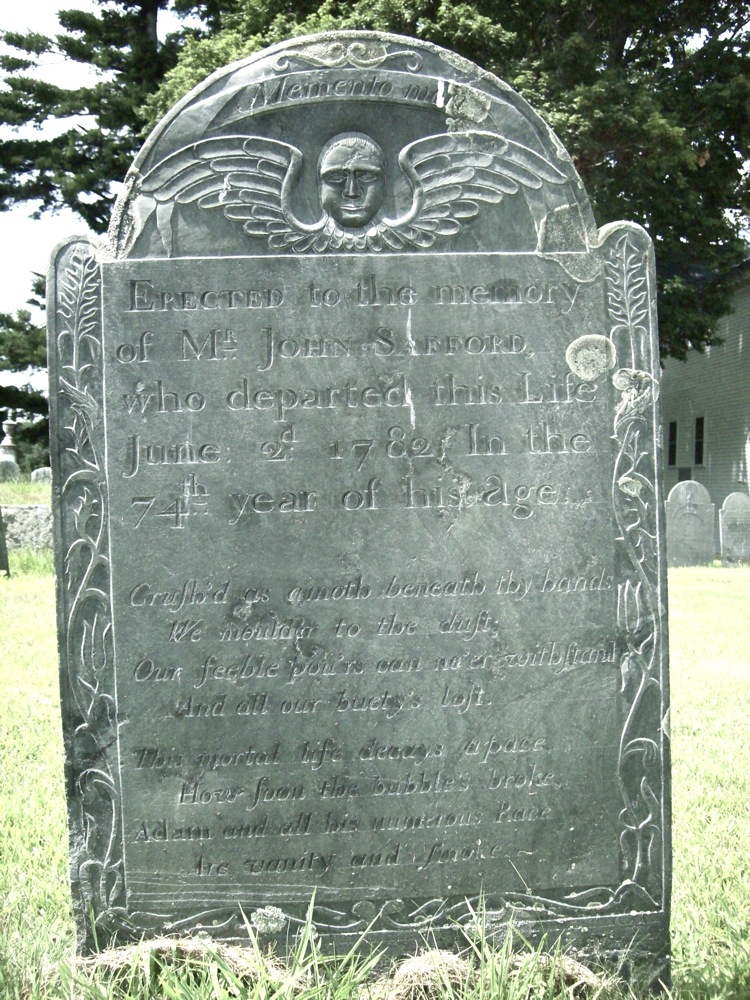
Happy birthday, or, Vanitas

This gravestone, commemorating John Safford who died in 1782, stands in the old burying ground off the town common in Harvard, Massachusetts. The poetry at the bottom is two verses from Isaac Watts’s metrical version of Psalm 39:3, part three. As rendered by the gravestone carver, it reads as follows:

Crush’d as a moth beneath thy hands
    We moulder to the dust;
Our feeble pou’rs can ne’er withstand
    And all our beuty’s lost.

This mortal life decays apace
    How soon the bubble’s broke
Adam and all his numerous Race
    Are vanity and smoke.

“Murdoch is worse than Hearst”

Over in the U.K., Metropolitan Police head Sir Paul Stephenson resigned yesterday, and Met Police Assistant Commissioner John Yates has just announced that he too is resigning. I’m watching a live press conference on the BBC Web site with Boris Johnson, the Mayor of London. The press are asking very pointed questions, like sharks circling bloody meat. “Do you regret being so whole-heartedly in support of the Murdochs?” “Er, well, in light of what New of the World … democracy … we’ve begun … nothing has been proved, by the way, against any of these officers … blah blah blah.” “It is a question of your judgement that is in question as well here, as mayor of London.” “I gave an answer based on what I knew then … blah blah blah [defensive coverage of his rear end]….” “Do you apologize mocking the people who brought this up, those people who were right all along?’ No he doesn’t, next question please.

I asked Dad yesterday about this Murdoch phone hacking mess. Dad’s father was a newspaperman, so Dad has been watching the news business for a long time. Dad’s answer: “Murdoch is worse that Hearst.” That’s really bad. So it’s looking like British democracy is owned by the rich corporations just as is American democracy, which is a chilling thought.

Neuroscience and religious education

Outline of an informal talk given July 10, 2011, at Ferry Beach Religious Education Week, held at the Universalist conference center in Saco, Maine.

Welcome to this porch chat on neuroscience and religious education. What I’d like to do in this porch chat is this — First, find out what you know about neuroscience as it applies to religious education. Second, to tell you a little bit about what I have been learning about the exciting new developments in this area. And third, to talk about ways we can all continue our own education in this area.

(1) Let’s begin with what you know about neuroscience and religious education. And before you say “nothing,” I suspect at least some of you know something about Howard Gardner’s theory of multiple intelligences. How many of you have run into multiple intelligences work before?

What you may not realize (or may forget) is that Gardner drew upon new scientific insights in the way brain works to develop this theory. According to a paper by the Multiple Intelligences Institute, “to determine and articulate these separate faculties, or intelligences, Gardner turned to the various discrete disciplinary lenses in his initial investigations, including psychology, neurology, biology, sociology, anthropology, and the arts and humanities.” [p. 6] So Gardner represents one attempt to apply scientific insights into the brain to educational practice.

So now let me ask: what (if anything) do you know about neuroscience and religious education?

[summary of some of the responses]

  • the brain’s plasticity
  • answering the question: is there a genetic quality to empathy?
  • the god gene
  • how like things like mediation, music, etc., can change the brain
  • kids who have deficits with empathy
  • you can make new neural pathways
  • visualing brain pathways through brain imaging

(2) Now let me tell you a little bit about what I’ve been learning about how to apply scientific understandings of the brain to religious education.

I’d like to begin by reading you a paragraph from a 2000 report by the National Academy of Sciences titled “How People Learn: Brain, Mind, Experience, and School.” (You can download a free PDF of this book here.) I was introduced to this book by Joe Chee, a teacher educator and UU who is currently pursuing a Ph.D. in education and technology; Joe recommended this as a great introduction to the topic. And right at the beginning of this book, the authors tell us why we should care about the topic:

The revolution in the study of the mind that has occurred in the last three or four decades has important implications for education. As we illustrate [in this book], a new theory of learning is coming into focus that leads to very different approaches to the design of curriculum, teaching, and assessment than those often found in schools today. Equally important, the growth of interdisciplinary inquiries and new kinds of scientific collaborations have begun to make the path from basic research to educational practice somewhat more visible, if not yet easy to travel. Thirty years ago, educators paid little attention to the work of cognitive scientists, and researchers in the nascent field of cognitive science worked far removed from classrooms. Today, cognitive researchers are spending more time working with teachers, testing and refining their theories in real classrooms where they can see how different settings and classroom interactions influence applications of their theories.

Continue reading “Neuroscience and religious education”

Google+!

So I got an invite to Google+ (thanks, Scott). First impressions: it looks well-designed and fairly easy to use. But there also appears to be some real depth to Google+: Will posted a link to an online article titled “How Google+ ends social networking fatigue,” which outlines ways to use Google+ to replace Facebook, Twitter, blogs, and even email. One big lack: Google+ still doesn’t support RSS; I’m assuming that will be added.

So far, so good. The real test will come as I see if Google+ takes up more of my time, or whether it makes my life easier.

Back in the homeland

Carol’s flight into Boston was on time, but mine was delayed, and it was late when i got to the hotel. I went straight to the hotel bar to get a burger.

The Red Sox game was showing on the TV in the hotel bar. Bottom of the eighth, the Sox leading the Orioles 9 to 3, and big David Ortiz is at bat. Gregg, the Baltimore pitcher throws a pitch so far inside that Ortiz has to take a step back. “Didja see that look Ortiz gave him?” says the guy next to me in his Boston accent. Two more pitches exactly like that, and Ortiz yells something at Gregg. The guy sitting next to me says, “Jeez, Ortiz is not happy with that.” One more pitch, Ortiz pops up to center field, Gregg makes some kind of gesture at him, next thing you know both dugouts and both bullpens are out in the field mixing it up — desultory commentary provided by two guys with Boston accents sitting at a Boston bar.

OK, I live in the Bay Area now, and of course I like northern California weather better, and yes everyone is friendlier there, and people don’t drive like crazed maniacs the way they do in Boston. But for someone who grew up in eastern New England, there’s nothing like sitting in a bar watching the Sox with other people who speak God’s own English. It’s like being back in the homeland or something.

Google+?

I’m watching the slow launch of Google+ with very cautious optimism. On the one hand, Google has a bad habit of introducing a new product, handling it badly, and then abruptly abandoning it; remember Google Wave? On the other hand, we desperately need a solid competitor to Facebook, a social networking product which is buggy, clunky, and not at all trustworthy.

Those of us in the religion world already know that we will be using social networking tools more and more as time goes on — it would be really nice if we had additional social networking options, and it would be even nicer if there were popular social networking options that were well-designed. Facebook is not particularly well designed; it’s better than MySpace, perhaps, but not by much. Will Google+ provide a better-designed social networking option?

More than a sermon

Scott Wells has started me thinking about what I’d like to do to introduce an online component to sermons. Here are some preliminary ideas:

  • On Thursday (the day I usually write a sermon), post a reading and a question for reflection on a sermon blog; the reading would be used during the service three days hence.
  • On Sunday morning, just before preaching, post the reading text of the sermon on the same sermon blog. The sermon would have embedded hyperlinks, and bibliographic references for further reading as relevant.
  • In addition to comments on the sermon blog, the order of service would give a hashtag for a Twitter conversation. The sermon would be streamed live online, so shut-ins and people who were traveling could hear the sermon, and participate through Twitter and online comments.
  • After the Sunday service, comments would remain open on the sermon blog, and I’d join in the online conversation when it made sense to do so.

This would fit into my normal weekly work flow: I have often posted a reading or reflection question a few days before I preach a sermon, and I already post a text of my sermons online before I preach them. At present, I don’t have comments enabled on my sermon blog (because I got too many comments by evangelical Christians and Hindus who wanted to argue without listening to anyone else), but it wouldn’t be a big deal to enable comments once again. The only thing listed above that I can’t do right now is stream the sermon live online (yes, I know I’m at a Silicon Valley church, but we don’t have the volunteers who could oversee the streaming, and our Internet connection is woefully slow). And for you diehard Facebook people, there could be a Facebook page with the sermon blog’s RSS feed.

The real question is: would anyone actually participate in a Twitter conversation, or read the sermon online and comment on it? Would you? Or is there some other online enrichment strategy that I’m missing?

Prime number days and consecutive odds days

Today’s date is made up entirely of prime numbers: 7, 5, and 2011. I’m sure you already noticed that, because you’re already aware that 2011 is a prime number, and so you’re watching for the fifty-two dates this year made up entirely of prime numbers. Which means that you have also noticed that there are three prime number Sundays this month, which is the greatest number of prime number Sundays you can have in any month.

However, you may not have thought about the fact that Saturday’s date is made up of consecutive odd numbers (if, that is, you define the number of the present year to be 11, as it is often written, rather than 2011). Ron Gordon of Redwood City has thought about it, and has received national press in his efforts to promote what he calls Odd Day. I’d have to say that a more precise name would be Consecutive Odds Days, but I recognize that “Odd Day” is a catchier name.

Using Gordon’s definition, there are six Odd Days per century. For purists who believe that a number is a number, dammit, and you can’t just arbitrarily chop off the digits to the left of the tens place, there were only six true Odd Days ever using our present system of numbering years, and those happened even before our present system was in place. While this notion might disturb you, it is probably more satisfying to the pure mathematician, for the pure mathematician prefers things that don’t actually exist.