World Ukulele Day

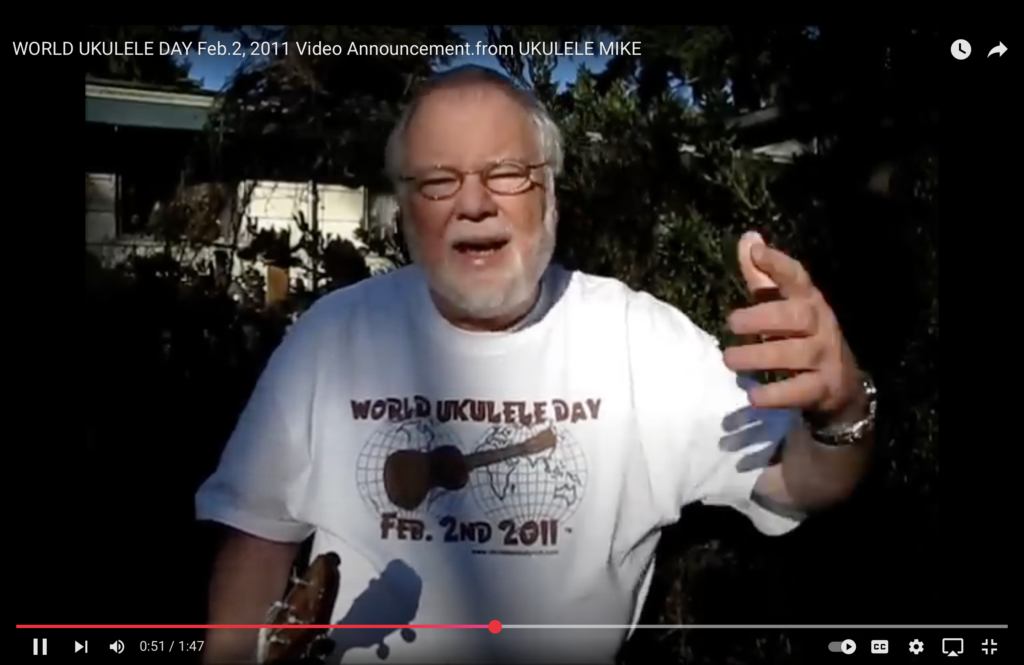
February 2 is “World Play Your Ukulele Day.” This holiday was established in 2011 by Mike Lynch (a.k.a. “Ukulele Mike”; see below). In the original announcement, Mike Lynch kept his expectations low. “Take your uke out of its case,” he said, “and play it.”

Simple enough.

Screen shot from a video showing a man holding a ukulele and talking
Screen grab from Mike Lynch’s original Youtube video announcing World Ukulele Day. Click the image to see his video on Youtube.

OK. I did that.

What else can I do?

Mike had a suggestion: “Find someone who needs a smile. You might take it to an elder care, you might take it to a shut-in….” In other words, try to make the world a better place by playing your ukulele. But I went on a field trip with teens from our congregation’s youth group, which didn’t leave time for ukulele excursions.

Since I don’t have time to do anything else, I’ll share a ukulele song sheet for “It Was a Lover and His Lass,” Thomas Morley’s 1600 setting of poetry by William Shakespeare. Before you get all critical, yes I know it’s a pretty primitive song sheet. And no, I didn’t attempt to transcribe Morley’s lute accompaniment for ukulele (way above my pay grade), I just put in chord indications based on a simplified form of Morley’s harmony. Yet even in this simplified form, it’s kind of challenging. We tried it at our Cohasset ukulele circle, and people noted the nine different chords you have to know, the fast chord changes, and the tricky rhythm in mm. 22-23. Whatever, it’s a great song — and this is the best I’ve got for World Ukulele Day 2025.

(N.B.: Public domain music, public domain words, and I’m releasing my mediocre typesetting into the public domain. Go ahead and copy it all you want.)

More about Ukulele Mike

Michael B. Lynch (1945-2018) was a career music educator and an accomplished ukulele player. As a youth, he played in a ukulele ensemble led by the legendary ukulele educator Chalmers Doane. Beginning in 2009, he produced a popular series of instructional Youtube videos under the name “Ukulele Mike.” He also published a number of instructional CDs and books, still available through his website that his wife continues to maintain.

Web, c. 2007

I’ve been spending too much time online for the past two decades. But recently I’ve been reducing my screen time, and — surprise, surprise — I feel better. That’s why I’ve reduced my posting schedule to about once a week.

But back in 2007, I lived way too much of my life online. I spent way too many hours writing daily blog posts, commenting on other people’s blogs, hanging out on Twitter, producing a weekly video, watching other people’s videos (back then, blip.tv was the place to really hip creative videos), and on and on.

I also created several random websites, just for fun. Recently, I found the HTML code for a whimsical website I created in 2007. What happened was this: Carol had a website called fishisland.net which she used to publicize ecological projects. Last year, that site got taken over by malicious actors. Our web host shut it down for us. I told Carol I’d restore it but never got around to it (I’m limiting my screen time, remember?).

Well, this week I came down with a nasty head cold. I couldn’t sleep last night because my cough kept waking me up. So I wrapped myself up in a sleeping bag, and tried to resuscitate the hacked web site. And lo and behold, I discovered what I had forgotten — that fishisland.net had originally been my website, that I had hand-coded it in HTML 3.0 with state-of-the-art CSS. The hackers had trashed everything else, but plain old HTML is pretty robust, and I was able to resuscitate the website pretty much as it looked in 2007.

Here’s the resuscitated website. The only real problem I ran into was that the full-size photos had disappeared; I had to take the 200px-wide thumbnails and scale them up in GIMP. Actually, the whole website looks so primitive today, but back then it looked pretty slick. If you’re into HTML, check out the CSS — can you believe how few lines of code it required?

However, don’t try to look at this website on your phone — it will look like crap. And that’s really the big change in the web since 2007. Back then, no one looked at websites on their phones. Now, more than half of all web views are on phones.

Screenshot of website.
A screenshot showing what the resuscitated website looks like.

Update (1/31/25):

A little bit of thought and research revealed that it is in fact possible to have a static HTML website render reasonably well on different sized screens (e.g., laptop, smartphone) without building a responsive site using Javascript. In the case of this website, my CSS originally had an ID selector that styled the second nested div (the first div sets the background color, this div sets size on the screen) as follows:

#wrap {width: 42em; margin: 0 auto;} 

I simply changed that to:

#wrap {width: 95%; max-width: 42em; margin: 0 auto;}

Duh. So obvious. Of course I also had to change padding and margin for various other CSS elements so the site would look OK on a smartphone, which took some time. I also added the following line to the header:

<meta name="viewport" content="width=device-width, initial-scale=1">

Now the site works reasonably well on various sized screens. Is it as good as a responsive website? No. And I’m sure I’ll find more problems. But I had fun, and I like that the CSS is compact and manageable.

And now I’ve spent waaaaay too much time staring at screens today.

If you’re near Cohasset and enjoy ukulele…

…I’m helping organize a free ukulele workshop. The online registration form is now live. Here are the details:

FREE Ukulele Workshop with Anne Ku

Sun., Feb. 9, 2025, 2-4 p.m.

What: Free ukulele workshop led by Anne Ku. Anne says: “I’ll teach you the 20% you need to know, to play 80% of what you want to play.”

WhoAnne Ku is a well-known Boston-area ukulele teacher and workshop leader.

Where: Location: 23 N. Main St., Cohasset, Mass. Parking map (PDF).

Downloadable flyer (PDF)

More info about the Cohasset ‘ukulele circle, who are hosting this event.

The workshop

2 p.m.: Fun with Ukulele — for all levels, but especially useful for beginners.
3 p.m.: Common Chord Progressions — what you need to know to play your favorite songs.

Doors open at 1:40 p.m. Be ready to start at 2 p.m. with a tuned ukulele. Need help tuning? Show up early and we’ll help!

Bring your ukulele, music stand (if you have one), and water bottle. Tea and snacks will be provided.

Registration

Please register at the link below. This workshop is customized to workshop participants, catering to all levels. The more you describe yourself, the better the fit.

CLICK HERE TO REGISTER

Alternate definitions for “socialism”

Sometimes I wonder why the religious right, and the political conservatives, express so much disdain for “Marxism” and “socialism.” It kinda makes sense that the religious right might dislike “Marxism” and “socialism” so intensely, because Marx called religion “the opiate of the masses,” and because many Marxist-Leninists promote a crusading atheism that wants to get rid of religion entirely.

But wait. The definitions for “socialism” and “Marxism” are not always the definitions you’ll find in the dictionary. For an example of what I mean, let’s go back in time to 1963.

Not long after Martin Luther King, Jr., was released from the Birmingham jail, White terrorists bombed the house of King’s brother. This violent act provoked a violent response from the Black community, which in turn prompted the infamously racist Governor George Wallace to respond with even more violence: he sent in state troopers who mercilessly beat Black people. Jonathan Riedler takes up the story in his book Gospel of Freedom: Martin Luther King, Jr.’s “Letter from Birmingham Jail” and the Struggle That Changed a Nation (New York: Bloomsbury, 2013), p. 124:

Note that in the above example, Art Hanes is not using the dictionary definition of socialism. For him, “socialism” has an alternative definition: it is government action that prevents him from committing acts of racial violence. He perceives this as infringing on his rights as an American, and he defines anything that infringes on his rights as an American as “socialism.”

This helps me understand some of the visceral emotion I sense when people reference “Marxism” and “socialism” in today’s political debates. There are times when opponents of “socialism” and “Marxism” are not using the dictionary definitions for those words, but rather more emotionally-loaded meanings pertaining to race.

Another niche hobby

An entry under the category of Niche Hobbies: handbell change ringing.

If you’ve read Dorothy Sayers’s murder mystery Nine Tailors (or watched the TV version), you know what change ringing is. It’s very English: you have a tower with eight or so bells, and a bunch of people stand around and ring the bells in certain defined patterns. If you don’t have a tower full of bells? Then you can use handbells, and you get handbell change ringing.

One musician describes handbell change ringing like this: “A series of 4-12 bells are rung in a series of mathematical permutations. Remember work with 12-tone tone rows in 20th-century music theory class? This is similar in practice, but with diatonic notes.” Also, to my ears it sounds much better than most twelve-tone music.

Click on the image below to see a video of handbell change ringing in action.

Four people sitting in a circle, each ringing two handbells.
Screen grab from the video. Note the looks of intense concentration on the faces of the ringers.

This is the kind of niche hobby that’s going to appeal to a certain kind of person: someone who likes mathematical patterns, someone who likes cooperative efforts in small groups, someone who likes the meditative effect of intense concentration, and so on. OK, I admit it: that someone could probably be me. Since the last thing I need right now is yet another niche hobby, I’m fortunate that there’s no handbell change ringing group near me.

General info on handbell change ringing:
handbell change ringing bloglinks to change ringing websites

Math and change ringing:
a bit about math and change ringing — Prof. Sarah Hart of Gresham College gets into group theory and change ringing

Instructional materials:
quick overview for conventional handbell ensemblesthe cross-and-stretch techniquethe ringing on bodies technique (ringers move, not bells) — instructional bookhandbell change ringing for beginners (booklet) — change ringing for handbells (more advanced) — instructional websitehandbell change ringing online simulator (for solo practice) — methods for three bell ringing (with a tenor behind, that would be 4 bells = 2 handbell ringers) — cross and stretch demonstrated (the video with stuffed animals is particularly clear, believe it or not)

Performance videos:
3 people (easy to follow the changes) — blindfold handbell change ringing4 person cross and stretch (watch closely) — 6 person cross and stretch

The year in music

I have to spend a lot of time thinking about music for my job. Honestly, though, much of what passes for sacred music in Unitarian Universalist circles these days is pretty dreary stuff. To avoid dreariness and boredom, this will not be a post about UU sacred music. Instead, here’s some of the more obscure music I’ve encountered this past year.

I’ll start with the ‘ukulele. This under-appreciated instrument still gets no respect, but there are some stunning players out there. Like jazz great Benny Chong, now in his eighties and still going strong. Here he is with bassist Byron Yasui on “Just the Way You Are.” Chong is also a fabulous solo player. Here he is playing “My Romance.”

Two men playing musical instruments
Benny Chong and Byron Yasui performing in Hawai’i (screen grab from video)

I’ve also been listening to Carmen Souza, who mixes traditional Cape Verdean music with contemporary styles. Here she is with “Amizadi” from her latest album. Souza writes: “For this song, I composed a Funaná [a traditional Cape Verdean genre] based on the story of Francisco Cruz, a.k.a B.Leza. This genre promotes fun and social interaction, so I called it Amizadi (Friendship).” Next, here she is solo, singing “Confiança & Bonança”, a video released on International Women’s Day 2024.

A woman singing
Carmen Souza, performing live in France (screen grab from video)

One of my musical obsessions this year has been handbells, because I started playing in our congregation’s handbell choir. Sadly, much of the handbell music you find online tends towards dreary Christian sacred music. Yawn. But if you look, you can find more interesting stuff. Like the Double Mallet Ringers, based in Hong Kong. Most of their ringers are professional music educators, they commission compositions, and they even have a resident composer. In addition to more serious music, they also do goofy covers like this.

Double Mallet Ringers, Hong Kong (screen grab from video)

Finally, So Percussion and Caroline Shaw released another new album together this year. What they do could be described as singer-songwriter meets avant-garde. Do their lyrics actually mean anything? Whatever, it’s incredibly refreshing music. Here’s the title track from their new album Rectangles and Circumstance.

There’s a lot of great musical creativity out there, from a variety of different cultures, in a variety of styles. Maybe the new year will bring some new creativity and variety to UU sacred music….

Addendum: I just have to throw in this piece I found today, by Kenyan sound artist Nyokabi Kariuki, “Raw Sugar” performed by the Brooklyn Youth Chorus.

Sex ed in poetry

One of the sessions in the Our Whole Lives comprehensive sexuality education curriculum for grades 7-9 involves inviting a couple with a baby to visit the class. The couple tell the teens what it’s like to have a baby in the house. Topics that usually come up include parent sleep deprivation, the sense of tremendous responsibility, and of course how much work it takes.

With that in mind, here’s a poem by William King (1663-1712).

The Beggar Woman

A gentleman in hunting rode astray,
More out of choice, than that he lost his way,
He let his company the Hare pursue,
For he himself had other game in view.
A Beggar by her trade; yet not so mean,
But that her cheeks were fresh, and linen clean.
“Mistress,” quoth he, “and what if we two shou’d
“Retire a little way into the wood?”
      She needed not much courtship to be kind,
He ambles on before, she trots behind;
For little Bobby, to her shoulders bound,
Hinders the gentle dame from ridding ground.
He often ask’d her to expose; but she
Still fear’d the coming of his Company.
Says she, “I know an unfrequented place,
“To the left hand, where we our time may pass,
“And the mean while your horse may find some grass.”
Thither they come, and both the horse secure;
Then thinks the Squire, I have the matter sure.
She’s ask’d to sits: but then excuse is made,
“Sitting,” says she, “’s not usual in my trade
“Should you be rude, and then should throw me down,
“I might perhaps break more backs than my own.”
He smiling cries, “Come, I’ll the knot untie,
And, if you mean the Child’s, we’ll lay it by.”
Says she, “That can’t be done, for then ’twill cry.
“I’d not have us, but chiefly for your sake,
“Discover’d by the hideous noise ’twould make.
“Use is another nature, and ’twould lack
“More than the breast, its custom to the back.”
“Then,” says the Gentleman, “I should be loth
“To come so far and disoblige you both:
“Were the child tied to me, d’ye think ’twould do?”
“Mighty well, Sir! Oh, Lord! if tied to you!”
      With speed incredible to work she goes,
And from her shoulders soon the burthen throws;
Then mounts the infant with a gentle toss
Upon her generous friend, and, like a cross,
The sheet she with a dextrous motion winds,
Till a firm knot the wandering fabrick binds.
      The Gentleman had scarce got time to know
What she was doing; she about to go,
Cries, “Sir, good b’ye; ben’t angry that we part,
“I trust the child to you with all my heart:
“But, ere you get another, ’ten’t amiss
“To try a year or two how you’ll keep this.”

Now you can see why this poem reminded me of a sex ed lesson. The beggar woman just taught the gentleman that there’s more to sex than he knew.

Ella Jenkins

Today I got to listening to Ella Jenkins songs on Youtube. I was mostly curious how she used her ‘ukulele when she was singing with children.

But as I watched the few videos there are of her actually singing with kids, I began to appreciate how good she is working with children. She was especially good with preschoolers and early elementary grades. There’s a great photo on her website showing her sitting on the floor in the middle of a circle of young children leading a song. Of the 18 children visible in the photo, every single one appears engaged with the music — even the ones who are looking away are clapping along with the song.

Her music is also just right for young children. Her singing is understandable and straightforward, and she’s brilliant at using call-and-response techniques to get kids singing. Her skillful ukulele accompaniment is understated, so that it supports but never overwhelms the singing. Both the songs she has written, and the folks songs she has found, are prefect for singing along. Pretty much everything she does seems designed to get kids to sing along with her.

You can watch her in action in a video where she sings “Who Fed the Chickens” with another group of preschoolers. This is a call-and-response song with hand motions. Ella sings, “Who fed the chickens?” and the children respond with “I did,” or “she did,” or “they did,” or “we did,” while pointing at the appropriate person or group of people. Ella makes it all fun, and the children respond. It’s also worth noting that the video was recorded in 2012, when Ella was 88.

Woman seated on a low chair holding a ukulele, with a group of young children in front of her.

Ella Jenkins is pretty fabulous. Makes me want to play the baritone ukulele.

Ecological board games

The Religious Education Association is holding an online talk this evening. One of the presenters will be on ecological board games:

Although the paper will tell about games in Christian communities, I imagine the findings will be applicable to Unitarian Universalist communities as well (perhaps with some tweaking and language changes).

This is actually a topic that I’ve been working for some years now. I’ve used various ecological games in Unitarian Universalist religious education for children and teens since at least 2006. Recently, I’ve been working on ecology games for adults. To this end, I recently attended an online talk by Thomas Maiorana, professor of design at U.C. Davis, where he introduced a board game he’s developing that’s intended to promote wildfire resiliency in local communities. (You can watch a recording of the talk here.)

Local congregations and faith communities should be ideal settings for ecology board games. So I’m looking forward to tonight’s presentation, in hopes that I’ll learn about some new games, and more importantly learn about implementation strategies.

For the record, some of the ecology board games I’ve used in UU settings include:

  1. Wildcraft: A Cooperative Herbal Adventure Game teaches players about some common wild herbs. It plays well with mixed age groups, and in my experience kids up through middle school have fun with it. At approx. $50, it’s expensive.
  2. NOAA’s Carbon Cycle Game shows how burning fossil fuels affects the carbon cycle. You can play this as a tabletop game, or as a run-around game.
  3. Family Pastimes publishes several board games with ecological themes. I’ve played three of their games — A Beautiful Place, Earthquake, and Dragonfly with young children, and all three were fun and well-designed. Better yet, they were inexpensive, just $12-15 each. (But these aren’t adult-friendly games.)
  4. Promoting Wildfire Resilience. Thomas Maiorana hasn’t yet made the board game publicly available, but will do so soon on this website.

In addition, the following are run-around games, not board games, but worth playing:

  1. Lynxes, Hares, and Leaves is an active run-around game I got from environmental educator Steve van Matre’s book Acclimatizing. I’ve played this successfully with mixed age groups including adults and kids. Here’s an old version of my adaptation of this game. Someday I’ll get around to posting my updated rules.
  2. The Food Chain Game is another run-around game that I’ve played successfully with mixed age groups. This is my heavily adapted version of a game from the old Project WILD curriculum. Again, one of these days I’ll post my rules.

Other games I’m intrigued by, but haven’t yet played, include the following:

  1. Several ecology games in this listicle on the Edge Effects website
  2. Wildfire: A Learning Game, a free game which you download and print yourself
  3. Two adult-friendly games from Family Pastimes: Climate Crisis and Somewhere Everywhere Water Rising

Voting

Carol and I are getting ready to cast our vote in the upcoming election. Early voting starts today at Cohasset Town Hall, and we wanted to be ready. So we sat in the kitchen and did some research on the candidates and the ballot questions.

We no longer have a real newspaper in Cohasset. There’s the Coastal Mariner, but it’s a typical Gannet local paper, with very little actual local news. There’s the online Cohasset Anchor, which has some good lifestyle stories but it’s not a place I’d look for hard news on local elections. As for the regional newspapers, the Quincy Patriot-Ledger used to be an OK source for local news, but it’s yet another Gannet paper where staff has been cut to the point where there’s not much local coverage any more. As for the Boston Globe, they pretty much ignore southeastern Massachusetts.

So we turned to the League of Women Voters for information about state and local elections. We went to https://www.vote411.org/ and entered our address. Up popped a list of every candidate for every race. We looked at the Massachusetts Information for Voters booklet, which is mailed to everyone in Massachusetts and contains comprehensive information about the five ballot measures we vote on this year.

In this post, while I’ll offer some opinions about the election, more importantly I’m going to reflect on democracy and the democratic process. And my first reflection is this — we hear a great deal about the presidential election, both in the news, on social media, and in face-to-face interactions. This emphasis on the presidential election makes it seem like we’re voting for emperor or king. But U.S. democracy encompasses far more than Harris vs. Trump (and before you complain, I listed those two candidates in alphabetical order). In fact, the overemphasis on the presidential election is harming our democracy. So let’s talk about all those other elections.

A sticker saying "I voted" on a blue shirt.
After I wrote this post, I walked over to Town Hall to cast my ballot…and got my sticker.

We started by looking at the candidates for the U.S. Senate. The League of Women Voters sends out these standard questions for all Senate candidates to answer:

Continue reading “Voting”