Over the years, I’ve written blog posts on several obscure topics. Some of those obscure topics — making your own burial shroud, washtub bass, composer A. B. Windom, etc. — result in some interesting correspondence.
Most recently, Don O. was looking through my collection of information about the Perry Mason books (not the TV show, mind you, but the books). I have a complete listing of the Perry Mason books, and have gradually been adding notes to each book about recurring characters, plot devices, and legal matters. Turns out Don is a professor of physics, and he sent me email pointing out how Erle Stanley Gardner, the author of the Perry Mason series, used some pretty good science in one of his novels. Thank you, Professor Don!
While I was updating that Perry Mason information with Professor Don’s contribution, I wound up rebuilding that corner of my blog, and I was able to add notes for several more of the books. If you’re a Perry Mason fan, check it out.
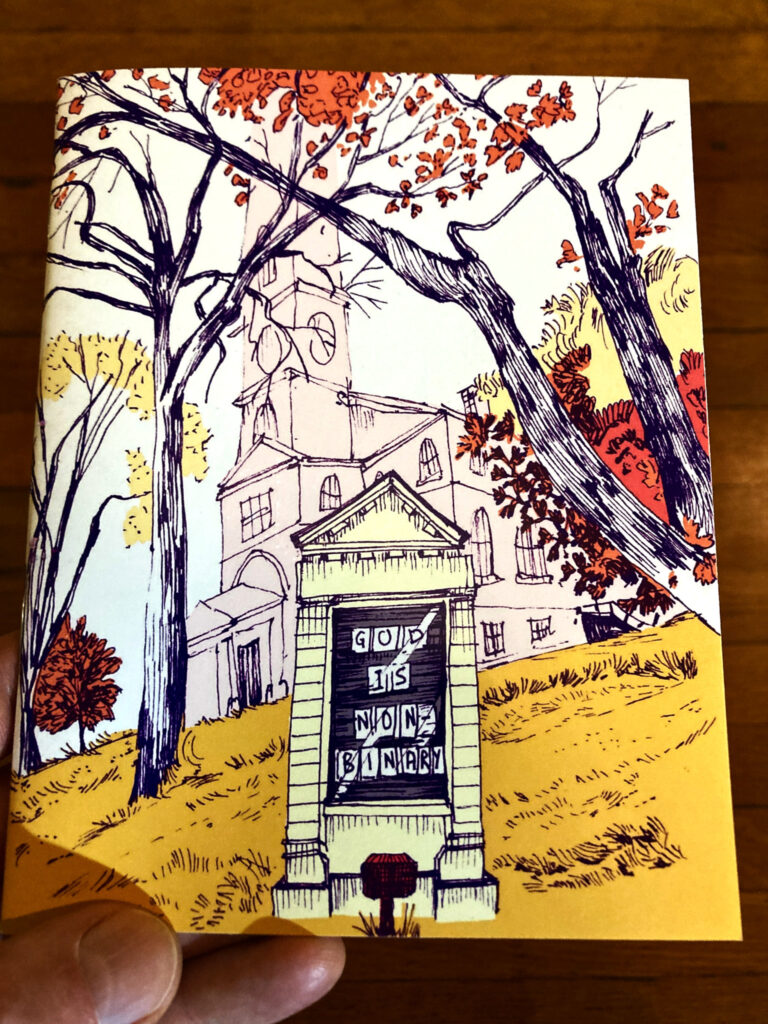
Tracey got a comic zine for me at a recent comic convention. Drawn and written by Sanika Phwade — who bills herself as “an illustrator, cartoonist, and reportage artist” — it tells about a minister who has fun with the signboard outside her church. The zine opens with the words: “Pastor Jamie Washam changes the sign outside the First Baptist Church in America every week.”
The cover of Sanika Phwade’s comic zine about Rev. Jamie Washam’s signboard
According to Phwade, by putting short aphorisms on the signboard, Rev. Washam is continuing the tradition of her predecessor: “He would call it The Wayside Pulpit — that preaches a sermon to whomever is passing by. I love that! But I also like having fun with these.”
As the keeper of the Wayside Pulpit outside our meetinghouse, I was jealous when I learned that people actually talk to Washam about the things she puts in her Wayside Pulpit. But then, her Wayside Pulpit is edgier than ours is. I put up sayings like “The moral arc of the universe is long but it bends towards justice.” No one comments on things like that. When Washam put up the phrase, “God Is Non-Binary,” sixteen people made comments:
“I have learned that it is the same signs that evoke both positive and negative reactions in people. Fifteen have said positive things about ‘God Is Non-Binary,’ and one person said, Hey what are you thinking? And I said well, let’s sit down and read genesis together. Because the text does support that. They thought I was just popping off politically, and yes I totally picked that up from Pride Fest. But it is completely substantiated by the text.”
Genesis 1:27 does in fact say, “So God created man in his own image, in the image of God created he him; male and female created he them.” That is, both male and female are created in God’s image, which implies that God is (ahem) non-binary. Oh ye of little faith who try to place limits on God, limiting him to one gender (regardless of the pronouns we humans use to describe him).
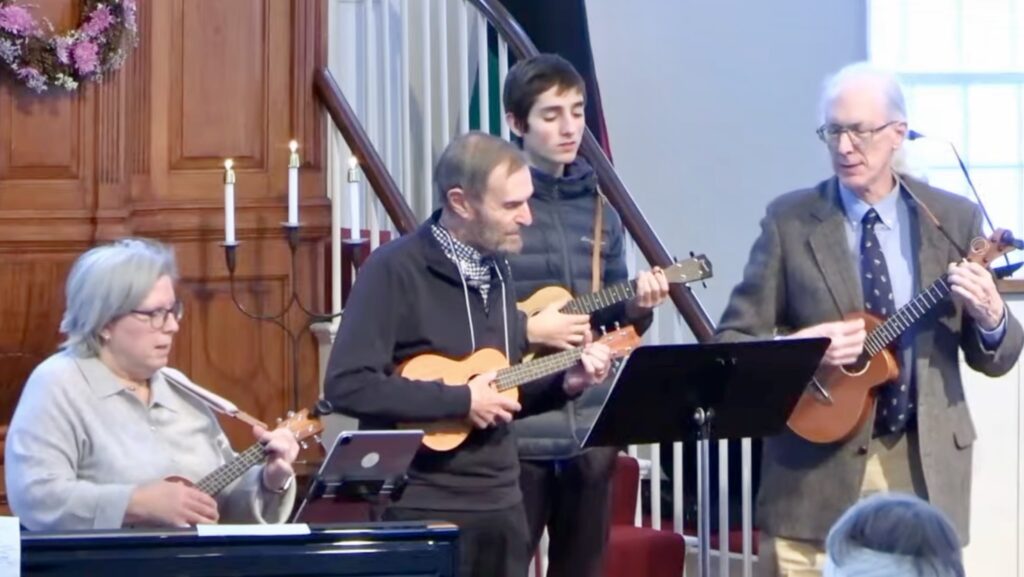
Actually, February 2 is World Ukulele Day. But Mary Beth, our music director, decided we would celebrate it today, by accompanying the first hymn in our Sunday service. We had maybe two minutes of rehearsal, which is why the photo below shows us all looking at the song sheets on the music stands. But we played it through, we didn’t totally suck, and we had fun.
Screen grab from the livestream. L-R: Mary Beth, Steve, Micah, me.
Mike Lynch, who organized the first World Ukulele Day, said the goal was simple: “Take your uke out of its case and play it.” Beyond that, he said you could use your ukulele to bring some fun and joy into the world. I don’t know how much joy we brought into our Sunday service, but we certainly brought some fun. Besides, Mike Lynch often played uke at his church, so what we did was very much in the original spirit of the day.
The real World Ukulele Day is tomorrow. Plan now to take your uke out of the case and play it….
When I heard about the “Melania” movie, I assumed it was yet another vanity project assembled by yet another ultra rich person. What I didn’t realize was that the film has actually been released in theatres. I also didn’t realize was that Amazon paid to have this movie produced. The BBC reports that it is believed that Amazon paid USD$35million to market the film, and another USD$40 million for the rights.
Now that I know it’s not a simple vanity project, I’m fascinated. What is going on here?
Reviews of the movie so far are mixed. It’s easy to find negative reviews in the usual liberal media outlets like The Guardian, The Atlantic, and so on. Conservative Fox News, by contrast, seems enthralled. The politically centrist USA Today is not entirely negative, but still says it’s not a good documentary, giving it 1.5 out of 4 stars:
“‘Melania’ doesn’t quite work as a documentary, though that doesn’t matter: People who don’t like the Trumps won’t go near the theater, and those who love the Trumps probably will. Just don’t expect much insight either way: While it does offer an extremely flattering view of all things Melania, outside of a few candid glimpses, you’re not going to learn a lot about who she really is.”
Meanwhile, audience reviews posted on Rotten Tomatoes are generally laudatory. It’s hard to know if the reviewers are real people (after all, this is an Amazon movie, and Amazon is the king of fake reviews), but in a typical review “Karen M” gushes:
“As a creative—writer, pianist, singer, perfectionist, lover of classical music and art—I found Melania unexpectedly moving. The documentary opens her inner sanctum, and in doing so, created a quiet sense of sisterhood. I didn’t see a distant public figure; I saw someone achingly real—like watching your sister on her wedding day or hearing your daughter’s name called at graduation. There she is. Her elegance is unmistakable, yet the vulnerability is what lingers. She is refined without artifice, reserved yet deeply expressive. The film is not about Donald Trump—au contraire. It feels more like peering into the private life of a royal from afar, and realizing with pride: she is my First Lady. It has been a long time since young women—and grown ones—had a woman of such standalone strength to admire. Her quiet power rivals that of any great woman who has ever held a throne. Highly recommend, regardless of political persuasion.”
Maybe that is a real review. I can see that for someone who is fascinated by Melania Trump, this could be a fun movie to watch. Unfortunately, Karen M is probably mistaken, while USA Today is correct — Democrats are going to stay away in droves, Republicans are going to love the film. I guess those of us who belong to neither party can be bemused.
At this stage, it’s hard to know if people are actually paying to see the film in movie theatres. A very strange ad was posted on the gigs section of Boston Craigslist, offering people $50 if they would see “Melania” in a movie theater. This ad has since been changed to read:
“…due to widespread coverage and backlash surrounding this offer in the fake news media, counsel has advised us that proceeding would run afoul of campaign finance laws. Considering the funding of the film by Amazon, we were shocked to hear this, but cannot take the risk….On the bright side, this incredible film is now SOLD OUT everywhere, with box office success like no one has EVER seen.”
Even Snopes can’t decide if this was a fake ad, or a real ad. I mean, was this a bunch of Trump haters trying to make the movie look bad, or was this a serious offer to get people to attend the movie? Either way, it’s bizarre. And if ticket sales turn out to be good, we’ll be wondering — did the audiences pay to see the film, or did someone pay them to see the film? That uncertainty says less about the film, and more about the lack of trust in the United States today.
So far, Rolling Stone seems to have the most balanced, in-depth reporting I’ve seen about the film. They report that Melania Trump herself received 70% of the licensing fee, or USD$28 million, for herself — in other words, she got paid some big bucks, so this isn’t exactly a vanity project. They also report that the film crew liked Melania Trump, describing her as “friendly and very engaged in the process.” On the other hand, Rolling Stone also says that no one should expect any deep insight into Melania Trump: “‘Some people are boring,’ one crew member said. ‘Some people also never let their guard down.’” It sounds like Melania Trump fits in the latter category.
Something about this movie, and the varied reactions to it, seem to capture the zeitgeist of our times. And maybe part of the zeitgest is feeling that you can never let your guard down.
Update 2/1/2026: The movie has become even more zeitgeist-y. The BBC reports that the latest release of the Epstein files has a photo of the film’s director sitting next to Epstein, both with their arms around young women. It’s a fairly creepy photo….
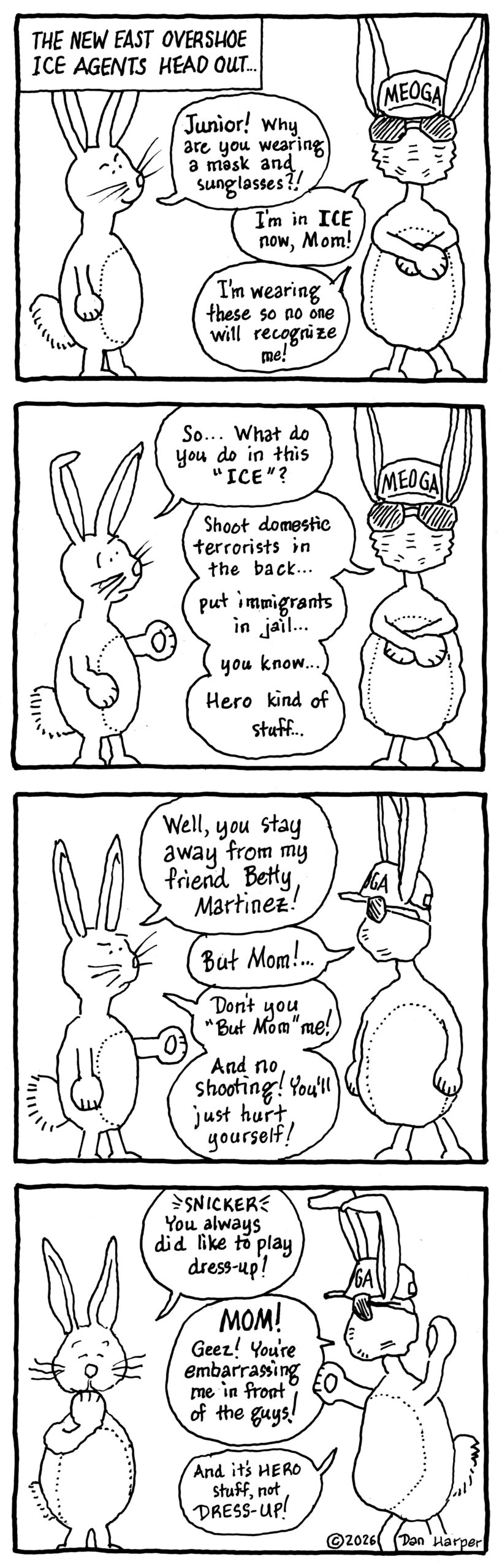
When we last visited East Overshoe, a small town nestled in the hills of central New England, three local law enforcement officers had agreed to do double duty as ICE agents. Having been outfitted with their new ICE equipment…
My older sister suggested drawing a cartoon about ICE. At first I couldn’t think of anything I wanted to draw (plus it’s a pretty depressing topic). Then she told me about a small town where local law enforcement officers signed up to work with ICE…
(Eventually, this will turn out to be about progressive spirituality — bear with me….)
Scott Adams, the creator of the “Dilbert” cartoon (and the Dilbert merchandise empire) has died of prostate cancer, at age 68. Cancer deaths are often unpleasant, and Adams’s last months sound like they were especially painful and debilitating, not something you would wish on anyone.
Adams left behind a very mixed legacy. His “Dilbert” comic strip was syndicated from 1989 until 2023. For the first few years, the strip often offered a fresh and funny take on what it’s like to be a lower-level white collar worker in corporate America. But Adams’s career went downhill from there.
Although, who am I to judge? I guess I can call myself a cartoonist, insofar as I drew a regular strip for the weekly newspaper of the undergraduate college I attended. My drawings were good enough, but my weakness was writing the strips. I depended on my friend Mike (who’s now a rabbi) to write the strips, and after he graduated I never drew another weekly strip. I manage to write acceptable nonfiction prose, but when it came to writing comic strips, I was a failure.
By contrast, Scott Adams was a wildly successful cartoonist, even though he drew badly. His characters show no particular expression, and he had little understanding of how to represent three dimensional space. But his writing was good, or it was in the first few years of the strip, because in writing for the strip he managed to capture some of the more frustrating aspects of corporate bureaucracy. He came out with a strip that appealed to the white collar cubical worker at a time when there were lots of white collar cubical workers. His success as a cartoonist was probably due more to lucky timing than anything else.
Yet after half a dozen years, in the late 1990s, “Dilbert” was getting repetitive. By the 2000s, none of the characters was likable; or maybe Adams no longer liked any of his characters. And by the 2010s, the strip was just plain boring, as well as mean-spirited. I think what happened was simple. In 1995, Adams quit his white collar cubical job in order to work full-time as a cartoonist; once he stopped working in a cubical, he stopped being funny.
Furthermore, by the 2000s, Adams was becoming an unlikeable person. My take on it is that he let his success go to his head, deluding himself into thinking he was pretty hot stuff even though he couldn’t draw and he wasn’t much of a writer. He became pompous and self-righteous. You can read a brief summary of his online sockpuppetry, trolling, and bad behavior here. His bad behavior kept getting worse, culminating in 2023 when he said in his podcast:
“If nearly half of all Blacks are not okay with white people—according to this poll, not according to me, according to this poll—that’s a hate group. And I don’t want to have anything to do with them. And I would say, based on the current way things are going, the best advice I would give to white people is to get the hell away from Black people. Just get the –– away. Wherever you have to go, just get away. Because there’s no fixing this. This can’t be fixed.” [Expletive deleted by me.]
(Full disclosure: I admit I didn’t listen to the podcast myself; I depended on this transcription.)
In fact, as early as 2000, Adams had turned into one of the least likable characters in his strip. He founded Scott Adams Foods to manufacture a frozen burrito that he called “the blue jeans of food.” What a stupid phrase. It’s a phrase that is classic corporate gobbledy-gook; it is exactly the sort of meaningless utterance made by the Pointy-Haired Boss of the early “Dilbert” cartoons. Adams had become the Pointy-Haired Boss.
I told you that eventually we’d get around to religion. In the last few weeks of his life, when he was in hospice, Adams apparently became a Christian. According to TMZ, in a final episode of his podcast his ex-wife read a letter from him which stated “he’s converting to Christianity because of the ‘risk-reward’ calculation.” (For an in-depth discussion of this philosophical stance, see Pascal’s Wager on the Stanford Encyclopedia of Philosophy; there is little evidence that Adams understood any of the philosophical complexities.) Calling his conversion to Christianity a “‘risk-reward’ calculation” sounds like more corporate gobbledy-gook. Again, it’s the sort of thing the Pointy-Haired Boss would say, which is kind of sad.
Crucially, he did not say what form of Christianity he converted to. Did he become a Roman Catholic? a Latter Day Saint? Russian Orthodox? an evangelical Protestant? “Dilbert” had grown so mean-spirited in its last couple of decades that it’s hard for me to imagine what form of Christianity finally attracted him. Or maybe he just didn’t know all that much about Christianity, and just called himself a Christian without knowing quite what he meant. However, from my religious point of view, he didn’t have to worry about the afterlife. If he had become almost any form of progressive Christian, he would have understood God as love and forgiveness, and he wouldn’t have had to worry so much about formal conversion. Instead, he seems to have understood God as a sort of deified Pointy-Haired Boss, and Christianity as a corporate bureaucracy. Which is too bad.
But despite all your flaws, thank you Scott Adams, for a half dozen years of a good comic strip. Not a great comic strip — you weren’t a Herriman, or a Mauldin, or a Johnston. And maybe you should have done what Bill Watterson did, refusing to sell related merchandise, then quitting while you were still fresh. Nevertheless, your half dozen good years remain a legacy that surpasses what most people manage to do. So thank you for the good stuff, and we’ll try to forget about the rest of it.
From one cartoonist to another: Adams as the Pointy Haired Boss. Maybe the Pointy-Haired Boss was more likable than we all thought….
In its Dec. 6-12 edition, The Economist has an article has an article in which it proposes its “word of the year.” The article has no byline, and cites no sources — typical for The Economist, and one of the reasons I do not fully trust it — but this particular article is mostly humorous so I guess I don’t need a byline. The anonymous author begins the article by naming words-of-the-year that were runners-up:
“Finance is a good place to look for words of the year because trends move fast, and its denizens like neologisms. TACO is this year’s favorite. Coined by Robert Armstrong, a journalists at the Financial Times, it stands for ‘Trump Always Chickens Out’ and points to the many tariff fights Donald Trump has picked and then backed down from….”
For the record, The Economist’s winning word of the year is “slop,” as in “AI slop.”
The long title of the article pretty much tells the whole sick story, but some of the quotes are revealing. The author interviews Tsunami Turner, who works as an educational psychologist at a company in San Jose that provides “child-centered therapy” as well as IQ testing services:
“‘Some parents come in with an IQ number in mind. They are really wanting to have their child hit a specific number,’ she said. Their kids are often very accomplished, taking dace, soccer, art, and music — and know they ‘have to get a certain number.’ They show up ‘highly anxious,’ she said. If scores come in lower than expected, Turner gets pushback and requests for retests.
“‘There’s a lot of societal pressure. The family is incredibly busy and wants their kid in a school that challenges their intellect and supports their development,’ she said. It can spiral quickly. ‘The goal is that a child will get into a good primary school, and that will lead them to getting into a good college, which will lead them to getting a good job and doing really well in the world.'”
In my 13 years working as a minister of religious education in Silicon Valley, I saw some of this — not so much among the families in the UU congregation there, because if you’re trying to fast-track your kids in this way, you don’t waste time on things like moral and spiritual education — but I did see it happening. It really is true, some well-to-do Silicon Valley parents start trying to build their child’s resume starting when the child is 2 years old. I feel this phenomenon is bad for children, and tends to result in accomplished but stunted and less-than-fully-human adults.
I use AI tools for certain tasks. But there are other tasks I would never use them for. Bloomberg News has an article on how AI-generated recipes are taking over both the web and social media. And it’s not going well, neither for the food bloggers, nor for the people trying to use AI-generated recipes. They interview Eb Gargano, who writes the Easy Peasy Foodie blog:
“Instead of sending home cooks to her decade-old, well-tested recipes, Google increasingly inserts AI-generated summaries stitched together from bits of her work and others’ that often get the basics wrong. An AI-assembled version of Gargano’s Christmas cake, for instance, would have people cooking a 6-inch cake for 3 to 4 hours at 320°F (160°C). ‘You’d end up with charcoal!’ she said. Meanwhile, traffic to her turkey recipe is already down 40% year over year….
“All of this, food bloggers say, erodes the simple promise of a recipe: that someone has actually cooked it before you have. To Gargano, this is the core issue. ‘No matter how clever the AI is,’ she said in a recent interview, ‘it can never actually test a recipe in a real kitchen and see how it works.’”