I finally finished writing a short essay titled “Reimagining Sunday school” for my curriculum website. This essay has been in the works for a while, both as a response to the “death of Sunday school” movement, and as a response to the de-funding of religious education programs that we’ve been seeing denomination-wide. I’m copying the entire essay in below the fold, or you can read it on my curriculum website.
Continue reading “Reimagining Sunday school”Author: Daniel Harper
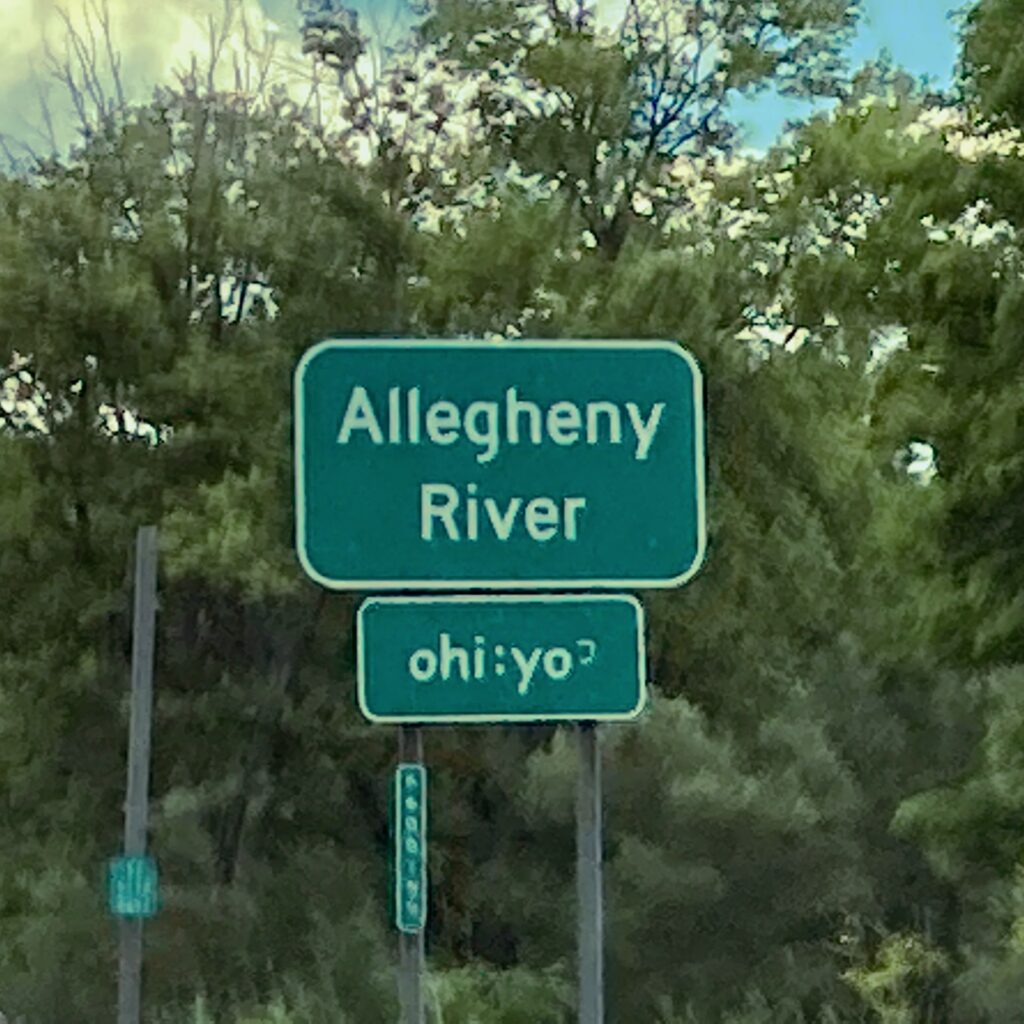
Roseland, Ind., to Conneaut, Ohio
I got up early to attend an online session of the Religious Education Association (REA) annual conference. The presentationby Heesung Hwang of Chicago Theological Seminary, on how religious education could address burnout, was thought-provoking, to say the least. I’ll try to summarize her presentation in a later post.
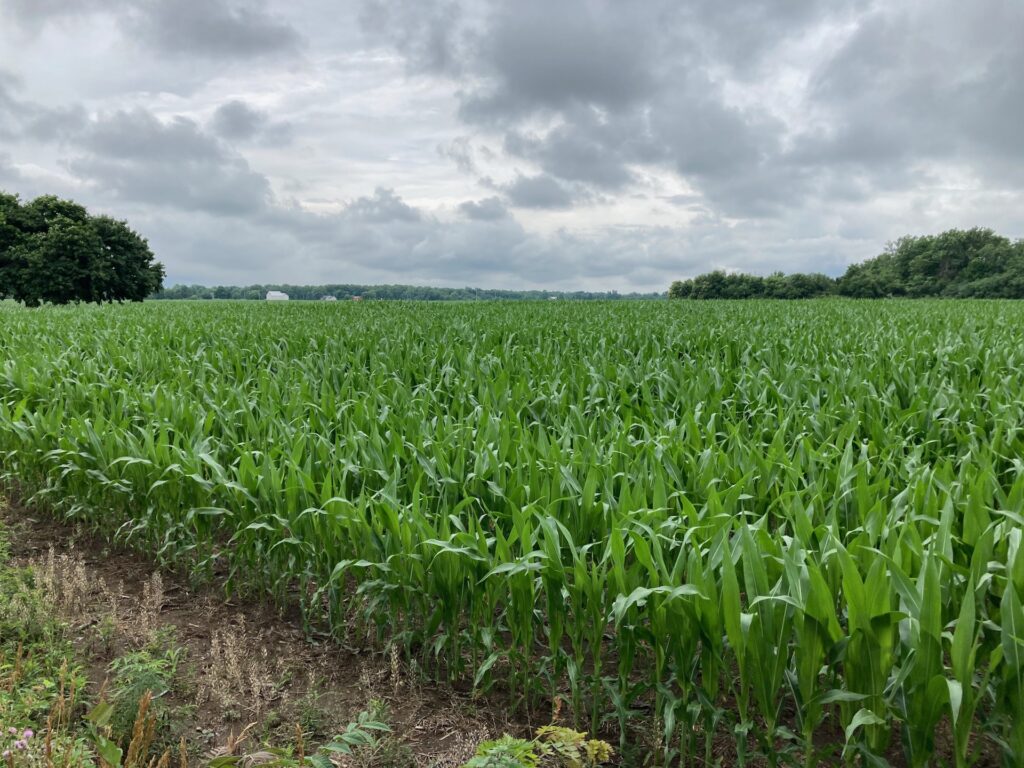
Then it was time to hit the road for another dreary drive. The roadway of Interstate 80/90 through Indiana and Ohio is dominated by tractor-trailer rigs; at times, I estimated that half the vehicles on the road were big rigs. We drove through an industrial landscape. The industrial landscape continued on either side of the highway. Weary Midwest industrial landscapes alternated with industrial agriculture of soybeans and corn. An industrial corn field is green, and at first it looks pretty, but up close it is as bleak as a mall parking lot.

We checked into our motel in Conneaut, on the Ohio-Pennsylvania border, at 3:30, just in time for me to attend another online session of the REA annual conference. This session, titled Sacred Pedagogic Texts in Dialogue, looked at non-Western religious educational philosophies by means of reading non-Western sacred texts (Analects, Bhagavad Gita, Guru Granth Sahib, Dao de Jing, and a Buddhist text.
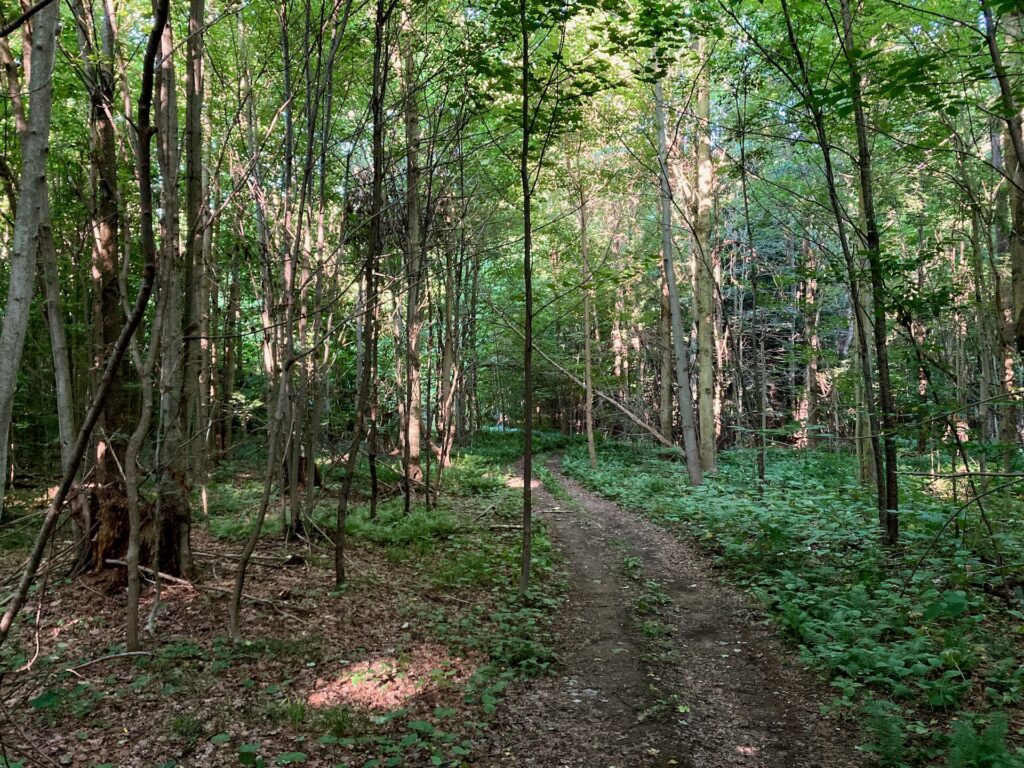
It was an interesting presentation, but at the end of it I was ready to get outside. I started walking down the road next to our motel, saw a dirt road heading off to the left — no “No Trespassing” signs — and walked into the woods.

None of the trees looked older than 50-75 years old, so presumably this land was either farmed or logged off in the mid-twentieth century. Under the older trees there was a fair amount of coppice growth, and on the ground growing in the shade were non-woody plants ranging from ferns to skunk cabbage to poison ivy to plants I wasn’t able to identify.

I wanted to stay in the woods longer, but I was scheduled to attend a session titled “Educating of Ecological Awareness” at the REA online conference. Carl Procario-Foley presented based on his paper “Good Ancestors Practicing a Holistic Vision for Ecological Conversion, and Vaughan Nelson presented on his paper “How Food Teaches and Why It Matters for Religious Education.”Again, two thought-provoking sessions — and again, I’ll try to summarize these presentations in another post.
It’s late now. There’s an REA conference session at 7 a.m. tomorrow morning. I better get to sleep.
Oshkosh, Wis., to Roseland, Ind.
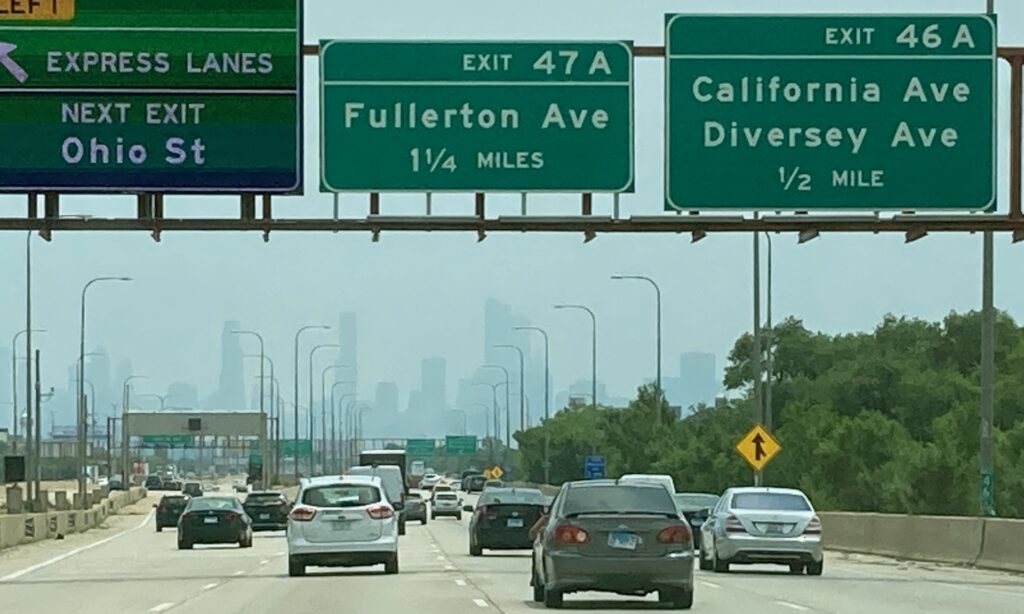
After a good visit with Ed and Nancy, it was time to start heading east again. Which meant getting through Chicago. The traffic started getting heavier north of the Illinois border, then was heavy and slow through most of Chicago. Eventually the skyscrapers of downtown Chicago rose up out of the hot, humid summer air.

The traffic got even worse south of Chicago, where Interstate 80, 90, and 94 merge together. This stretch of road always has heavy traffic. Maybe half the vehicles on the road were tractor-trailer rigs. It didn’t matter that we were driving in the middle of the day on a summer weekday, the traffic was still bad.
Eventually we got free of Chicagoland, and got off the interstate to take a walk in Indiana Dunes National Park. It was about a mile and a half walk to the lakeshore. We crossed a wetland area on a boardwalk and continued through some oak savannah. Carol pointed out a Red-headed Woodpecker in an oak tree. We crossed the narrow part of a pond on a foot bridge. I saw some Bluegills swimming in the water below us.
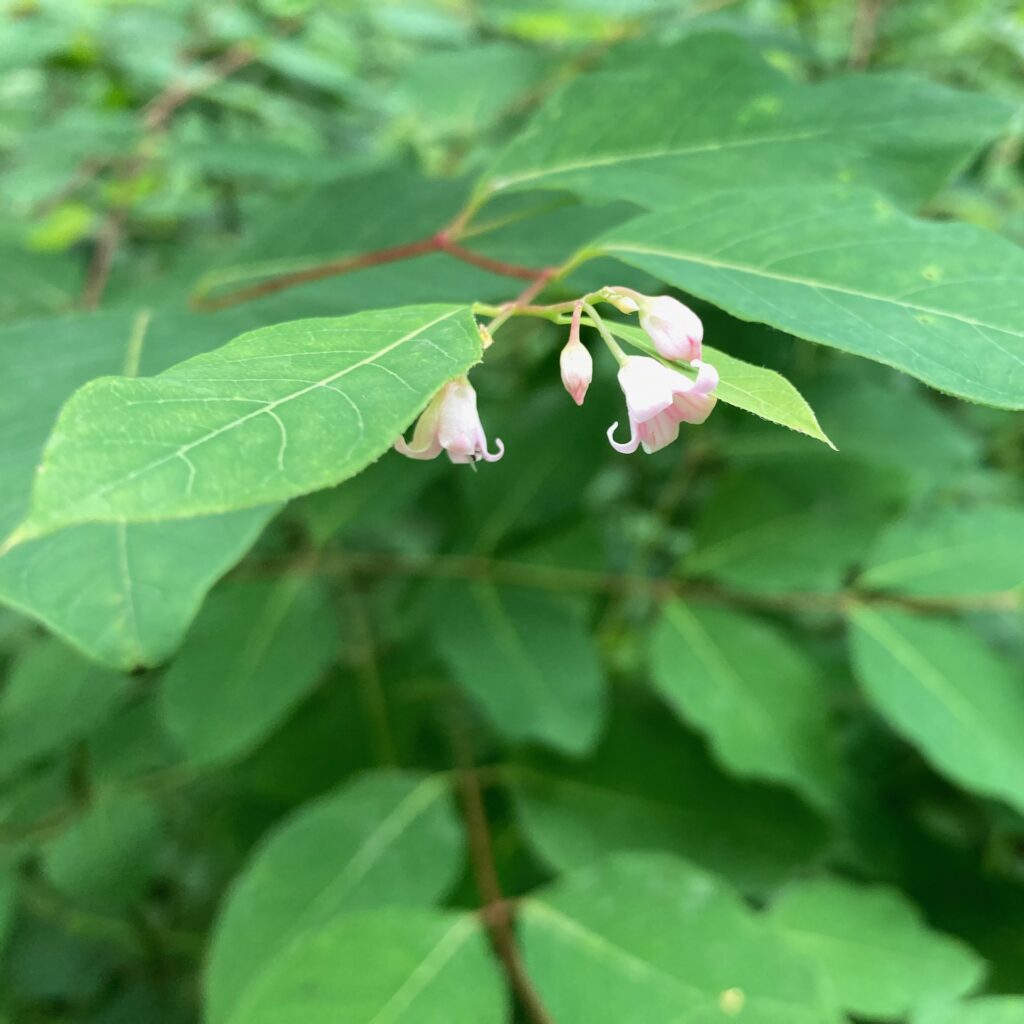
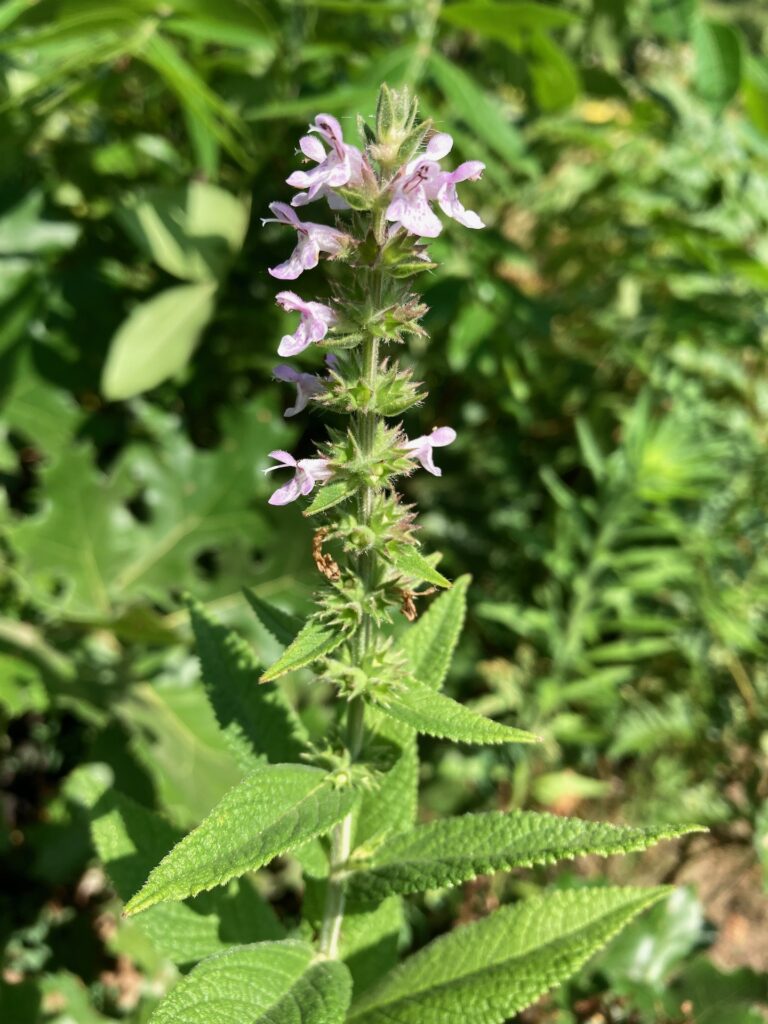
We continued to follow the path over some dunes, and there was Lake Michigan. The clouds had burned away by this time, and it was a bright sunny day. We both began to feel the heat, so we headed back to the car. I noticed some prickly-pear cactus growing on the sand dunes. I was beginning to get a bit of a head ache from the heat. Carol walked quickly ahead, under the theory that the quicker she got back to the car the better. I walked more slowly on the theory that there was no need to overheat myself. I plucked a sassafras twig and chewed on the sweet-tasting slightly narcotic inner bark. I found two or three huckleberries that were ripe, and ate them. I stopped to photograph the small delicate pink flowers of a hedgenettle (Stachys sp.).

When I got back to the trail head, Carol was sitting in the car drinking water. The car thermometer said it was 95 degrees. My shirt was soaked through with sweat. But even with the high temperature and humidity, walking through a bio-diverse landscape was better than driving through Chicagoland traffic.
In Sawyer Creek
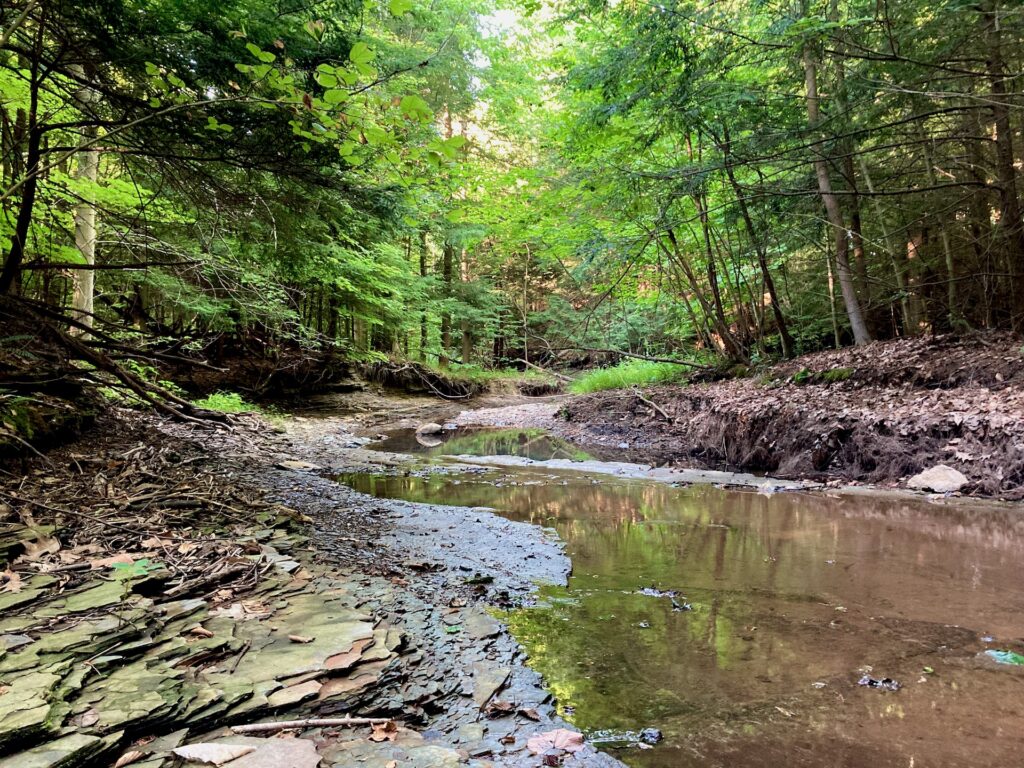
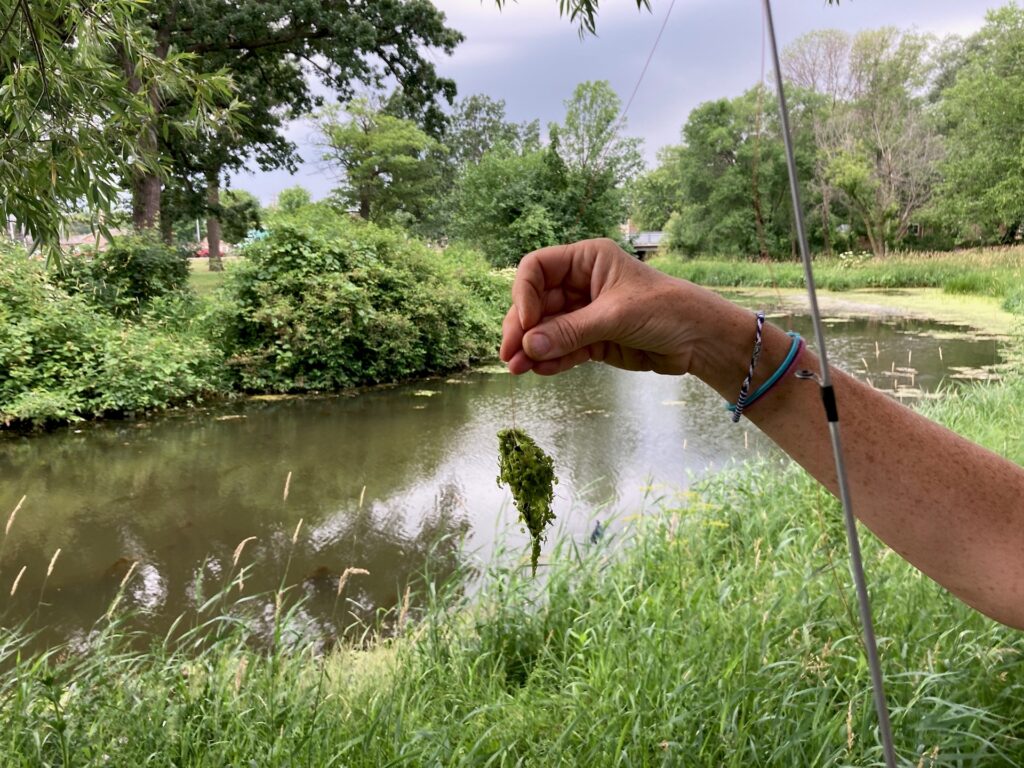
Carol and I wanted to get outdoors one last time before the rain came in. “Let’s go fishing,” I said. So we grabbed our fishing tackle and went down to Sawyer Creek. We didn’t catch anything except weeds.

A man walking by told us, “You’ll probably do better if…”
“If we go buy fish at the market,” I said.
“If you go downstream to the bridge,” he said good-humoredly.
“Honestly, we don’t really want to catch fish,” I said. “We just wanted to get out of the house.”
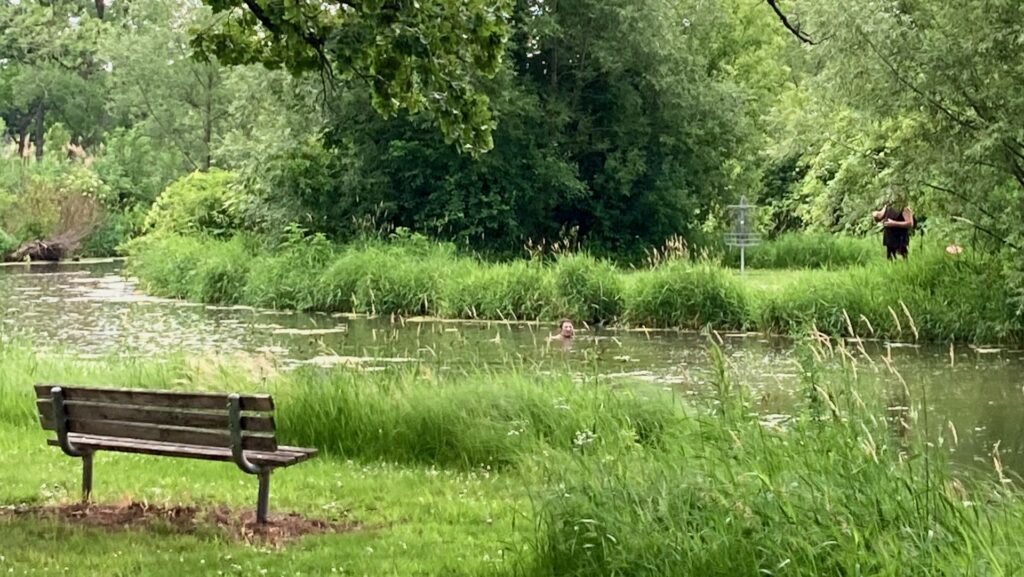
Somehow that got us in a conversation with a man who was wading in the creek. He was wearing swim goggles, the water almost up to his chin. He was pulling out flying discs lost in the creek by golfers on the disc golf course on the opposite bank.
“You probably heard about me on the radio,” he said. “I’m the homeless guy who sells the discs he pulls out of the creek.” He’s no longer homeless, he told us, but he still makes good money selling the golfing discs he recovers. “That’s my son over there,” he said, pointing to a man who’d been in the water with him earlier. A friend of theirs was helping out, too.
“What do you make, 25 or thirty dollars a disc?” I asked.
He said he’d sold some discs for more than a hundred dollars. One particular disc he sold for over two hundred dollars.
He wanted to move down into the section of creek we were fishing, so we moved upstream. We didn’t catch anything there, either. Which was still just fine with us.
“I just felt a drop of rain,” said Carol.
The sky looked threatening. “Let’s get going,” I said. I quickly broke down my rod, and we walked quickly down the creek.
We saw our friend still in the water. “I’d tell you to get out before you get wet, but that won’t work,” I said.
He laughed. “If you see lightning, you’ll see me get out of the water quick,” he said. We all agreed that a day on the creek — or in his case, in the creek — was a good way to spend a day.

The rain started coming down harder. We got pretty wet before we got back to Carol’s dad’s place. It was still a good day on the creek.
On Sawyer Creek, Oshkosh, Wis.
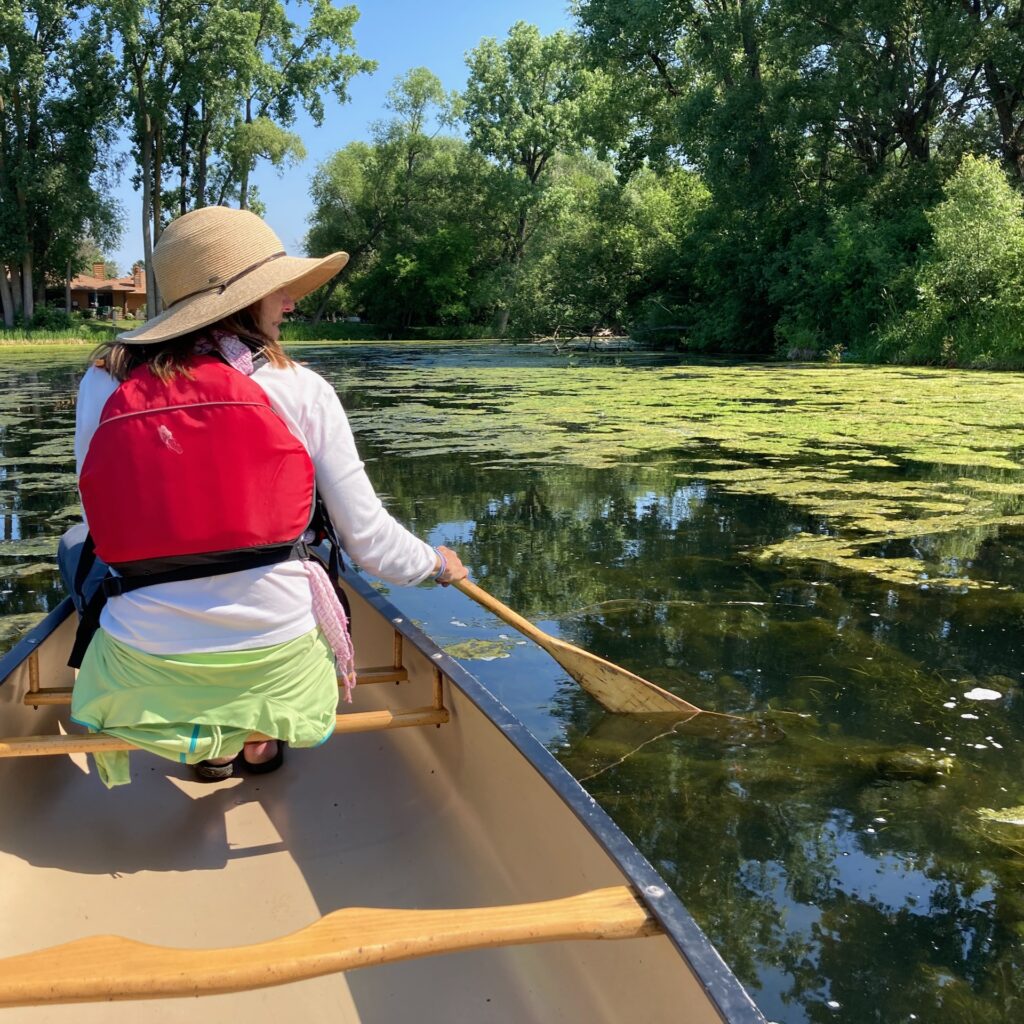
We’ve been carrying a canoe across the country. Here we are in Wisconsin, right on the Fox River. It was time to put the canoe in the water.
Misty and Darren lent us some life vests. We decided to start with Sawyer Creek, a tributary of the Fox River. We drove to West Algoma Park, where there’s a nice grassy put-in for canoes and kayaks.
We’ve been walking along Sawyer Creek almost every day, and I went fishing in the creek a couple of days ago. But seeing the creek from a canoe is a very different experience.

We saw Black-crowned Night Herons and Great Egrets fishing along the banks of the creek. (We saw some humans fishing along the banks, too.) I turned just in time to see a small Yellow Perch roll up to the surface of the water, then dart away into the thickly-growing aquatic plants: Milfoils (Myriophyllum sp.), Pondweed (Potamogeton sp.), and Raccoontail (Ceratophyllum demersum).
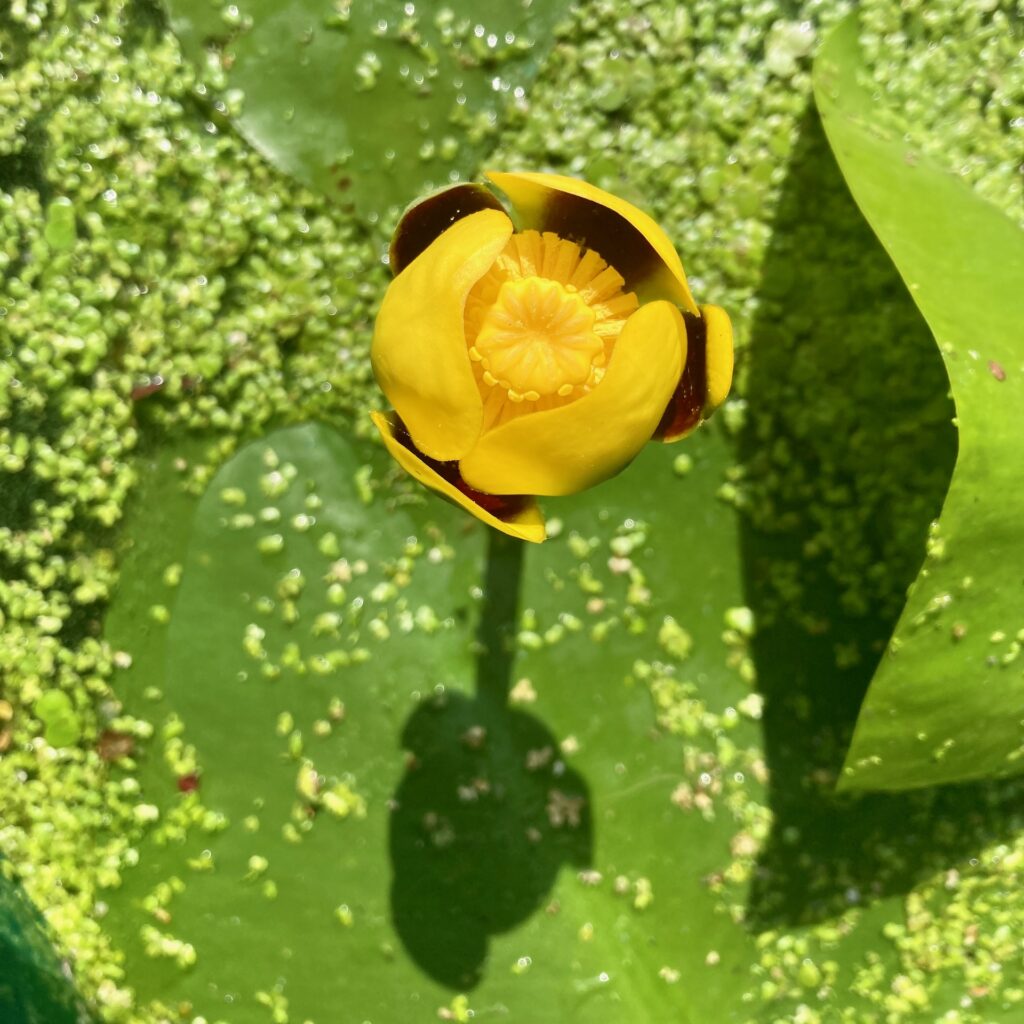
Algae choked the surface in many places; but in the center of the channel, in the deepest part of the creek, the water was clear enough that we could see the sandy bottom among the plants. At least three species of aquatic plants were blooming: American White Waterlily (Nymphaea odorata), Common Water-Crowfoot (Ranunculus aquatilis), and Yellow Pond-Lily (Nuphar sp.). Common Water-Crowfoot, to my surprise, turns out to be a close relative of ordinary buttercups. And I have never seen Yellow Pond-Lilies before.

Sawyer Creek, Oshkosh, Wis.
Dad-in-law and Nancy live near Sawyer Creek near where it drains into the Fox River. So that’s a natural destination when we go out for walks. I went out walking around Sawyer Creek this morning, starting along the north side near Eagle Street, crossing the creek at North Westfield, then following along the south bank through Red Arrow Park. Quite a few plants were in bloom, including attractive but invasive flowers Foxglove Beardtongue (Penstemon digitalis) and Creeping Bellflower (Campanula rapunculoides). Purple Crownvetch (Securigera varia), another invasive species, were everywhere, with their feathery leaves and clover-like pink-and-white blossoms. I was interested to see flowers of the invasive species Flowering Rush (Butomus umbellatus), a plant I’d never seen in bloom before. Actually, most of the flowers I saw were invasive species.

I did see one or two native species blooming. There were some elderberry (Sambucus sp.) in bloom, which were probably native. And some of the small scrubby willows (Salix sp., prob. Salix interior, or Sandbar Willow) growing along the south bank of the creek still had some catkins in bloom.

In the early evening, I went fishing along this stretch of Sawyer Creek. I couldn’t see any evidence that the water was flowing. The turbidity was high, and in some places the acquatic plants were pretty thick. I found a place with few plants, and at my first cast a small Yellow Perch (Perca flavescens), a native species, chased the lure right up to the bank. It was so small that it couldn’t actually get its mouth around the lure. I could see I wasn’t going to catch anything, and that was fine with me. I spent a happy half hour trying to read the stream, casting, and changing lures every once in a while. For me, fishing is better than mindfulness meditation: it clears my mind, and I have no concerns about whether I’m engaging in Whitened Buddhism.
Coaches
I thought I overheard someone say, “The Supreme Court backed coaches preying on the field.” Preying? You mean, preying on children and teens…?
It took me a moment to realize that the Supreme Court was not supporting child-molesting coaches, but was instead allowing coaches to offer supplication to their deity before and after sports games.
Sadly, given the ongoing sexual abuse crises in some conservative Christian denominations, my momentary confusion is somewhat understandable. Even I — and I should know better — subconsciously associate organized religion with unsavory unethical actions of male leaders.
Oshkosh, Wis.
What we learned from our road trip so far:
Driving just five hours a day means you have two or more hours each day for a visit with a friend or relative, or a hike in a park or wildlife refuge. Much better than driving 8-10 hours a day, as we used to do.
When you go hiking, use insect repellent. Then check carefully for ticks before you get in the car.
The Best Western motel in Chamberlain, S.D., has really fast internet service.
Widespread acceptance of videoconferencing means you can do the following on a road trip: attend a civic meeting; lead a General Assembly workshop; attend a committee meeting; attend a professional conference.
Driving with a canoe tied on top of your car lowers your gas mileage by about 15%.
If you have a soprano ukulele in the car, whoever’s sitting in the passenger seat can play it while you sing together. Much better for staying awake than audio books.
Albert Lea, Minn., to Oshkosh, Wis.
We made only one stop on today’s drive — aside from short stops at rest areas or gas stations — and that was at Necedah National Wildlife Refuge in Wisconsin. Necedah N.W.R. is best known because Whooping Cranes have been reintroduced there. We did not see any Whooping Cranes, though we did see a dozen Sandhill Cranes. We also saw Trumpeter Swans, which breed here.

What I most enjoyed about Necedah N.W.R. was seeing eastern bird species I haven’t seen since I was in Massachusetts last summer. Seeing a Chipping Sparrow, for example, hopping on the sidewalk outside the refuge visitor center was a thrill for me — though they’re so common in the east they’re almost boring. I suppose after a year or so I too will be bored by Chipping Sparrows.

Also next to the visitor center, I saw a Five-lined Skink (Plestiodon fasciatus). This is a common eastern lizard, but for someone who’s spent the last dozen years living in the land of Western Fence Lizards, it was a thrill to see a Five-lined Skink.

After leaving Necedah N.W.R., we drove straight through to Oshkosh, Wis. We’ll be staying here for a week, visiting Dad-in-law and his wife Nancy. Seeing them this evening was the highlight of the day!
Update, June 28: Yesterday and today, we’ve found 3 dog ticks on us or our clothing. So that’s yet another species of organism we found in Necedah NWR.
Chamberlain, S.D., to Albert Lea, Minn.
We left Chamberlain at about 9:30, and headed to Yankton, South Dakota, to see Carol’s Aunt Rose. Our route took us off the interstate highway and onto a two-lane state highway. We passed through one or two small towns (with populations of a few hundred people), but mostly we drove through an agricultural landscape. We still saw cattle being grazed, but we also began to see vast fields of soybeans.

This is not an idyllic pastoral landscape, as it may first appear, but rather an industrial landscape. Monocultural agriculture requires large inputs of chemicals: fertilizers, herbicides, and pesticides. Self-sufficient family farms raising a variety of crops have mostly disappeared — as evidenced by the many abandoned barns and farm houses in the landscape — replaced by impersonal agribusiness devoted to commodity crops like soybeans. This is the culmination of a trend noticed by Henry Thoreau back in the 1840s. Thoreau noted that the emergence of agriculture and farming in his day replaced the old values of “husbandry”; the former devoted to extracting the maximum dollar value of crops from the land, the latter devoted to stewardship of the land. Implied in this distinction is a vast difference in ethics: the ethics of agriculture and farming prioritize the maximizing of immediate profit for the individual landowner; the ethics of husbandry has a much broader understanding of the value of the land.
We arrived in Yankton in time for brunch. Aunt Rose cooked a lovely brunch for us. While we ate, Carol and her aunt talked about family. It was the highlight of our day. As we left, we apologized for taking Aunt Rose away from church, but she said she didn’t mind because everyone was busy planning her church’s vacation Bible school that starts tomorrow.
Soon after leaving Yankton, we crossed the border into Minnesota. We stopped at Blue Mounds State Park in Luverne, Minn., for a hike. The park includes an escarpment of red Sioux quartzite that’s as tall as a hundred feet in places, as well as over a thousand acres of tallgrass prairie. A small herd of bison lives in a fenced-in area of several hundred acres of prairie. We did see the bison, but they were so far away that they appeared as little more than dark splotches.

A thousand acres of prairie sounds like a lot. But seeing the little herd of bison stuck in that patch of prairie gives another perspective.Two hundreds years ago there would have been millions of bison roaming over millions of acres. From that perspective, the park seems small. Only about 1-4% of the original tallgrass prairie still survives in North America; the rest of the land has been turned to agriculture.
But I enjoyed myself in Blue Mounds State Park. Pricklypear cactus (Opuntia sp.) were in bloom, as were native roses (Rosa sp.) and sumac (Rhus sp.). Western Meadowlarks sang throughout the grasslands; this could be the last time I see and hear Western Meadowlarks on this trip, for soon we’ll be in the range of Eastern Meadowlarks. In fact, we’re already seeing the transition to eastern North American species: Stellar’s Jays have been replaced by Blue Jays; Poison Oak (Toxicodendron diversilobum) has been replaced by Poison Ivy (Toxicodendron radicans rydbergii — turns out this was Western Poison Ivy, which does grow in the east, and in fact interbreeds with Eastern Poison Ivy, T. radicans).
We spent a couple of hours walking through the park. Maybe that was too long, because it was after ten when we arrived at our motel in Albert Lea, Minn. But we both felt we needed a long walk after all the hours we’ve spent driving in the past week.

My iNaturalist observations for June 26