The long title of the article pretty much tells the whole sick story, but some of the quotes are revealing. The author interviews Tsunami Turner, who works as an educational psychologist at a company in San Jose that provides “child-centered therapy” as well as IQ testing services:
“‘Some parents come in with an IQ number in mind. They are really wanting to have their child hit a specific number,’ she said. Their kids are often very accomplished, taking dace, soccer, art, and music — and know they ‘have to get a certain number.’ They show up ‘highly anxious,’ she said. If scores come in lower than expected, Turner gets pushback and requests for retests.
“‘There’s a lot of societal pressure. The family is incredibly busy and wants their kid in a school that challenges their intellect and supports their development,’ she said. It can spiral quickly. ‘The goal is that a child will get into a good primary school, and that will lead them to getting into a good college, which will lead them to getting a good job and doing really well in the world.'”
In my 13 years working as a minister of religious education in Silicon Valley, I saw some of this — not so much among the families in the UU congregation there, because if you’re trying to fast-track your kids in this way, you don’t waste time on things like moral and spiritual education — but I did see it happening. It really is true, some well-to-do Silicon Valley parents start trying to build their child’s resume starting when the child is 2 years old. I feel this phenomenon is bad for children, and tends to result in accomplished but stunted and less-than-fully-human adults.
Sikhs are strongly monotheistic. The first words in the Guru Granth Sahib, their collection of holy writings, say “Ek Onkar,” or “God is one.” Furthermore, God is transcendent and has not been incarnated in some physical form. Guru Nanak, the founder of the Sikh religion, wrote a statement of belief that can be translated as follows (reference: Pluralism Project):
There is one God whose name is True. God is the Creator. God is without fear. God is without enmity. God is of eternal form. God is unborn, uncreated, beyond incarnation. God is self-existent and self-sufficient. God is attained by the grace of the Enlightener.
Thus within the Sikh worldview, it would be wrong to say that there is more than one deity. The Sikh religion does recognize a series of ten holy persons, the gurus, of whom Guru Nanak was the first. These human beings are not considered deities by Sikhs — even though from the perspective of other worldviews they may seem to take on some of the qualities of lesser deities — but rather they may thought of as humans who had a special connection to God and who are tehrefore worthy of veneration.
Guru Nanak lived in the Punjab region of South Asia, a place where Hindus and Muslims both claimed their religion was true. Guru Nanak said that God transcends such divisions, and famously proclaimed that there is no Hindu, there is no Muslim.
The story is told that Guru Nanak once visited Mecca, the most holy city for Muslims. Sayad Muhammad Latif, in a history of the Punjab, tells what happened there:
“He (Guru Nanak) travelled over the whole of India, visited Persia, Kabul and other parts of Asia, and it is said even Mecca. A story is related by both Hindus and Muhamadans [sic] in connection with Nanak’s visit to Mecca. It is said that while at Mecca, Nanak was found sleeping with his feet to the Kaba, before which the Muhamadans prostrate themselves when performing their devotions. The Kazi Rukan-ud-din, who observed this angrily remarked: ‘Infidel, how dare you dishonour God’s house by turning your feet towards it.’ ‘Turn them if you can,’ replied Nanak, ‘in a direction where the house of God is not.'” (quoted in Kazhan Singh, History and Philosophy of the Sikh Religion: Part I: History, Lahore: Newal Kishore Press, 1914, p. 99)
This story gives a sense of the Sikh conception of God — transcendent, omnipresent.
A lovely painting on paper from West Bengal, painted in the mid-eighteenth century and currently in the Asian Art Museum in San Francisco, depicts Guru Nanak sleeping with his feet towards the Kaba:
Labeled in the museum as follows: “Guru Nanak and his disciple encounter a Muslim cleric at Mecca, from a manuscript of the Janam Sakhi (Life Stories)” / Approx. 1755-1770 / India; probably Murshidabad, West Bengal state / Opaque watercolors on paper / Gift of the Kapany Collection, 1998.58.23. [N.B.: While there are many photos of this painting online, I took this photo myself on Sept. 18, 2015, and digitally edited it in 2025; photo copyright (c) 2025 Dan Harper.]
In another version of the story, a Muslim cleric kicks Guru Nanak for sleeping with his feet pointed towards the Kaba, then grabs hold of the guru’s legs and tries to turn his feet away, but “lo and behold the miracle the whole of Mecca seemed to be turning.” (Vaaran: Bhai Gurdas, Pauri 32, At Mecca)
According to tradition, the Nicene Creed turns 1,700 years old tomorrow.
I was born into a Unitarian family, and as old-school New England Unitarians, we didn’t think much about the Nicene Creed. I mean that literally, and not in a snide sense: obviously the Nicene Creed was never recited in our Unitarian church, but beyond that no one even talked about it; it just wasn’t something we ever thought about.
If we ever thought of the Nicene Creed, we thought about it in negative terms, much the same way Professor Francis Christie of Meadville Theological School wrote about it in 1910:
“The symbol of Nicaea inaugurated a mania for fixed and irreformable definitions, a consequent scholasticism, a cessation of thought, a weakening of the moral force of the church, a period of superstitious ritualism.” (Francis A. Christie, “The Significance of the Nicene Creed,” The American Journal of Theology, vol. 14 no. 2, April, 1910, p. 271.)
Today, I’d be less doctrinaire about the Nicene Creed. Even though the Nicene Creed’s trinitarian theology has never made much sense to me personally, I have friends for whom it remains a profoundly moving statement of theology (including some good Universalist friends). Part of being staunchly non-creedal is remaining open to the possibility of truth in creeds you don’t feel much emotional sympathy with. Yet Transcendentalist that I am, I continue to feel that Thoreau got it right when he wrote:
“…in dealing with truth we are immortal, and need fear no change nor accident. The oldest Egyptian or Hindoo philosopher raised a corner of the veil from the statue of the divinity; and still the trembling robe remains raised, and I gaze upon as fresh a glory as he did, since it was I in him that was then so bold, and it is he in me that now reviews the vision. No dust has settled on that robe; no time has elapsed since that divinity was revealed.…”
To use Theodore Parker’s terms, when it comes to religiou, there is that which is transient, and that which is permanent. Using these terms, Thoreau is talking about that which is permanent: “no time has elapsed since that divinity was revealed.” A creed, on the other hand, is a fallible human invention, and while it is useful for a time, it is nonetheless transient. The Nicene Creed has been useful to many Christians for 1,700 years, which is a very long time indeed; but it only points toward the divine, it is not itself divine. — At least, so sayeth my Unitarian forebears, with whom I entirely agree.
With those caveats, happy birthday to the Nicene Creed.
I use AI tools for certain tasks. But there are other tasks I would never use them for. Bloomberg News has an article on how AI-generated recipes are taking over both the web and social media. And it’s not going well, neither for the food bloggers, nor for the people trying to use AI-generated recipes. They interview Eb Gargano, who writes the Easy Peasy Foodie blog:
“Instead of sending home cooks to her decade-old, well-tested recipes, Google increasingly inserts AI-generated summaries stitched together from bits of her work and others’ that often get the basics wrong. An AI-assembled version of Gargano’s Christmas cake, for instance, would have people cooking a 6-inch cake for 3 to 4 hours at 320°F (160°C). ‘You’d end up with charcoal!’ she said. Meanwhile, traffic to her turkey recipe is already down 40% year over year….
“All of this, food bloggers say, erodes the simple promise of a recipe: that someone has actually cooked it before you have. To Gargano, this is the core issue. ‘No matter how clever the AI is,’ she said in a recent interview, ‘it can never actually test a recipe in a real kitchen and see how it works.’”
As a follow up to a previous post on tumbaderos — a tumbandero is the washtub bass that’s played in the Caribbean and Central America — tumbandero player Axel D. Rodríguez sent links to some fabulous videos. If you’re interested in tumbanderos or washtub bass, you’ll be fascinated by these videos, both to hear the varied playing styles, and to see helpful visual cues for making your own instrument.
Thank you Axel! (Find Axel and his band on Spotify — and on Youtube.)
Tingo Talango — Cuba 1 — A must-watch video showing a musician building a Cuban version of the earth bow, called a “tingo tualango” or a “tumbandero.” The earth bow was the African instrument from which the washtub bass and the tumbandero are derived. Skip ahead to 2:50 to watch the building of the instrument, and then watch it being played both by plucking the single string, and playing rhythm on the soundboard. The musician frets the string rather than adjusting the tension on the bow.
Tumbandera or Kaolin — Cuba 3 — Another traditional Cuban earth bow. These musicians adjust the string tension by moving the bow, and get different notes. In the short demonstration of playing, it seems the instrument sometimes requires two musicians — one to play, and the other to adjust tension to keep the instrument on pitch.
Screen grab from the 3rd Cuba video. You can clearly see the bow which provides tension for the string.
Quijongo Caribeño — Costa Rica — The visuals show some adults showing kids of about middle school age how to build an earth bow-derived instrument out of a wood box, a string, and a neck. (The audio isn’t coordinated with the visuals.)
Screen grab from the Costa Rica video. The kids are learning how to play the instruments they just made.
Marengwen — Haiti — An earth bow-type instrument, but the string tension is fixed, and pitch is altered by fretting. In addition, rather than plucking the string, the musicians strike the string with a stick. A must-watch video.
Screen grab from the Haiti video. The stick used to hit the string is blurred in this image.
Tumbandero or Bajo De Palangana — Pureto Rico 4 — Tumbandero made with a plastic five gallon bucket. Once again, the tumbandero functions more like tuned percussion than a bass. You can hear the tumbandero from 0:00 to 2:45; and from 6:15 to the end.
Screen grab from the 4th Puerto Rico video. The tumbandero (at far left) is made out of a 5 gallon plastic bucket.
“Wherever the African diaspora is, you are going to find some sort of instrument similar to this one. In the case of [the musical genre] la plena, it’s an instrument that is complementary to the traditional panderetas [frame drums] and guiro [hollow gourd played with wire brush]. And it sounds close to a bass [in range]. But the pitch isn’t perfect, so it’s basically another percussive instrument.”
Screen grab from the 6th Puerto Rico video. This tumbandero, made from a metal washtub, looks like a classic American washtub bass.
Axel also sent some photos he found online — since I don’t know the source of them, and whether they’re copyrighted, I decided not to include them in this post. But if you do an image search for “tumbandero” you should turn up some interesting images.
A final note: I really want to make the Costa Rican instrument. I like the sound of the wood, I like the looks of it, and it would be fun to make. But we don’t have room for such a large musical instrument in our tiny apartment.
The whole disgusting Epstein saga is really a story about how rich old white guys think they can do whatever they want. Jeffrey Epstein, as you recall, was the billionaire pedophile who died by suicide rather than go on trial for sex trafficking girls. And he had lots of rich old white guys as friends. People like Donny Trump, who up until a couple of days ago resisted releasing the Epstein files with all his political might — even though he had promised to release those files during his campaign. People like Larry Summers, who had a nasty email exchange with Epstein in which Larry asserted that women have lower IQ than men. People like No-longer-prince Andrew, who was photographed with his arm around a 17 year old girl that Epstein was trafficking. People like Peter Thiel, who was glad to have Epstein’s investments — an amount that now totals $170 million, none of which will go to Epstein’s victims — and who apparently got tax advice from Epstein.
In their relationships with Epstein, none of these rich old white guys demonstrated what I’d call a strong sense of morality. And now, they are all doing whatever they can to avoid any consequences for making friends with a billionaire pedophile. Donny Trump claims he was mad at Epstein and ended the friendship before anything bad happened. Andy Winsor denies everything, even as his brother the King of England strips him of all his titles. Larry Summers offers a hollow apology that he’s sorry for what he did — while enjoying his $40 million net worth in a very comfortable retirement. Petey Thiel offers no apology whatsoever for accepting Epstein’s money, because (I guess) his business is a realm where morality need not intrude.
As an old white guy myself, I feel it’s incumbent on people like me to call out other old white guys when they behave badly. Not that it will do any good with these guys; their actions show they don’t care about morality. Nevertheless, their lack of accountability makes me want to try (in my ineffectual way) to puncture their aura of smugness. So here goes nothing:
While researching the old Unitarian Church of Palo Alto (1905-1934), I came across someone who is famous enough to be featured on Wikipedia. He’s an entomologist, so he’s not famous famous. He’s not even that famous as scientists go. Still, he’s on Wikipedia so I think it’s worth drawing the attention of today’s Unitarian Universalists to him.
John Merton Aldrich
A renowned entomologist, he was born January 28, 1866, in Rochester, Minnesota. In 1870, he was living with his parents L. O. and Mary, and his older brother and younger sister, in Quincy, Olmsted County; his father was a farmer. In 1880, he was still in Quincy with his family, which now included another younger sister and a servant.
In 1881, John’s family moved to a farm in South Dakota. He attended the new South Dakota Agricultural College in Brookings, S.D., graduating in 1888 after just three years of study. It was in his last year of college that he first took a course in entomology.
Following his graduation, he taught school for a term, then went to study at the University of Minnesota. Although there was then no formal course in entomology at the university, John was able to study with Otto Lugger. Station Entomologist at St. Anthony’s Park. Then in the autumn of 1889, John went to Michigan State University to study entomology. It was there he first turned his attention to Diptera; as he later recalled, his professor advised him “to select a single order as a specialty, and to proceed at once to get together a library and collection; he also suggested the Diptera as a large order in which there were but two workers…at the time in the country.” John began his lifelong study of Diptera in the spring of 1890; this was also the start of his massive collection of Diptera which eventually included some 45,000 specimens.
In November of 1890, John traveled east, both to meet other entomologists and to find work. After failing to obtain a job at Harvard, he traveled to Washington, D.C., and worked for several weeks at the Smithsonian Museum on the insect collections there. However, lack of money forced John to return home, and he spent the winter of 1890-91 working on classifying his growing Diptera collection. He moved to Brookings, and worked worked at the South Dakota Experimental Station, making his first major collecting trip that summer. He received his master’s degree from South Dakota State College in 1891, and had an assistantship the following year. Due to faculty infighting, John lost his assistantship, and he went to to the University of Kansas in 1892; he received a second master’s degree there in 1893.
The University of Idaho was founded in 1893, and John was hired to found the department of zoology. He moved to Moscow, Idaho, to work at the university. There he began working on his catalogue of North American Diptera.
Before leaving South Dakota, he married Ellen J. “Nellie” Roe (b. 1870) of Brookings, S.D., in 1893. Ellen had received her B.S. degree from South Dakota Agricultural College in 1889; she and John had first met while they were both students. At the time of their marriage, Nellie was the assistant principal of the Brookings High School. John and Nellie settled in Moscow, Idaho, where they had a child, Spencer, who died the day he was born, May 17, 1895. Nellie died two years later, on December 3, 1897. To cope with his sorrow after these two deaths, John lost himself in his research. He completed his monumental A Catalogue of North American Diptera (or Two-winged Flies) (Washington, DC: Smithsonian Inst., 1905) on January 1, 1904.
A comment by Axel D. Rodríguez, a musician and cultural researcher from Puerto Rico (his band on Spotify — Youtube), recently appeared on one of my old posts about the washtub bass. He gives some interesting information about the washtub bass that I wanted to highlight:
“For the past few years [he writes], I’ve been studying a Puerto Rican one-string bass known locally as the tumbandero. It appears historically in the northeast of the island — Loíza, Canóvanas, Río Grande, and Fajardo — and shares a clear lineage with African earth bows and the broader family of one-string, tension-controlled basses found across the Caribbean and the Americas.
“Through workshops, fieldwork, and conversations with older musicians, I’ve documented several Puerto Rican variants — the traditional washtub with stick and string, also a 5-gallon pail version used by plena musicians, and an older earth-bow-type form described in ethnographic literature. I’ve also traced connections with related instruments such as the Haitian mosquito drum (karolín/kalori-n), the Dominican gayumba, the Cuban tingo talango, the Makalapo y Seychells Islands, Gayumba Dominicana in the Dominican Republic….”
Since the washtub bass derives from the earthbow, an African instrument, it should be no surprise to find related instruments throughout the African diaspora. Nevertheless, I was fascinated to learn about the tumbandero.
Screen grab from the Facebook video. They’re attaching the neck to the bucket.
I feel like such a grouch. I keep writing blog posts about ways the Unitarian Universalist Association (UUA) could be more transparent in the ways it handles clergy misconduct. But I’m not one of those people who post criticism of the UUA but who aren’t looking for actual improvement, they just want to badmouth the UUA. My purpose is different. I actually like the UUA. But like all human institutions, the UUA could be better, and I’d like to contribute in some small way to making it better. Since I have no skills for committee work or denominational governance, what I do is write about possibilities for improving the UUA.
So I’m really not a grouch. I hope.
Anyway, I’ve been thinking about ways the UUA could be more transparent in its handling of clergy misconduct. And I’d like to point out three other religious groups who inspire me with their attempts to be more transparent.
First, I’d like to point out the website of the Episcopal Church here in the U.S. Take a look at the screenshot below that shows the front page of their website:
It’s a little hard to see in my screen grab, but in the upper right hand corner there’s a prominent button that reads “Report Misconduct.” If you click on that button, you are taken to another webpage with detailed and (to my mind) confusing instructions about how to report misconduct by clergy. Indeed, there has been criticism from within the Episcopal Church about how their actual processes are not especially transparent.
But forget about their problems with their internal processes for a moment. I applaud their decision to post a prominent link on the very front page of their website that takes you right to instructions on how to initiate a complaint about clergy misconduct. Contrast that with the UUA website, which has no such prominent link. I find it very difficult to locate any information on the UUA website about how to initiate a complaint regarding clergy misconduct.
One final point — given all the publicity around clergy sexual misconduct in the past twenty years, it seems to me to be a smart marketing move by the Episcopal Church to have that prominent link on their front page. It says to people who are looking for a religious home — “We’re serious about stopping clergy misconduct.” It signals that they might be a safer religious home than, say, Unitarian Universalism.
On this page, freely visible to anyone visiting their website, the Rabbinical assembly lists the names of seven rabbis who were expelled from the Rabbinical Assembly since 2004. This is exactly what should happen — if a clergy is expelled from a denomination of association of congregations, then the denomination-level website should make their names freely accessible in the interests of transparency.
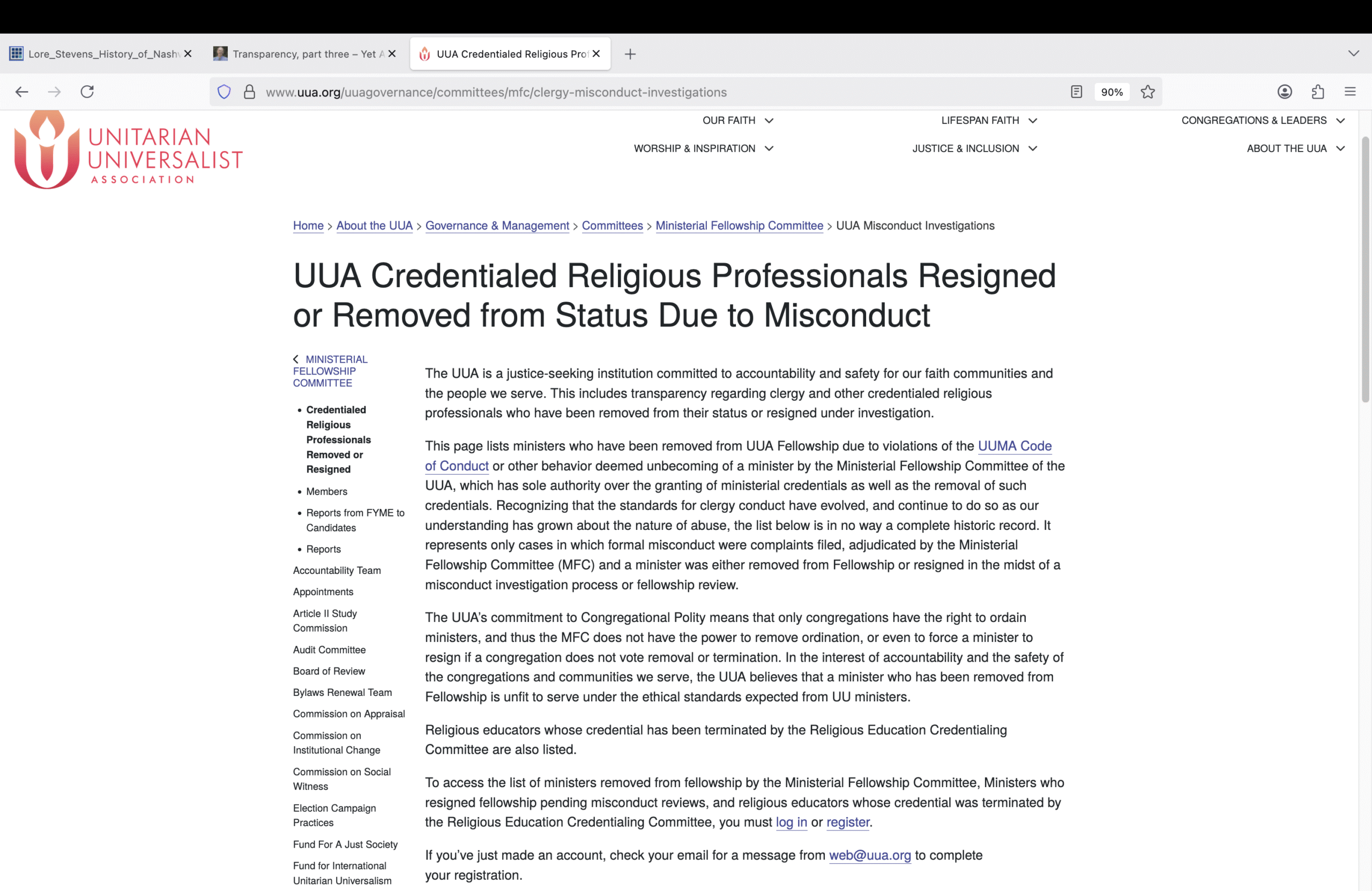
The UUA tried doing this for a while, beginning in 2021. Then, a couple of years ago, that list was hidden from public view. You can still see a webpage titled “UUA Credentialed Religious Professionals Resigned or Removed from Status Due to Misconduct” on the UUA website — but when you get to that page, you are instructed: “To access the list of ministers removed from fellowship by the Ministerial Fellowship Committee, Ministers who resigned fellowship pending misconduct reviews, and religious educators whose credential was terminated by the Religious Education Credentialing Committee, you must log in or register.” You can just about read these instructions on the screen grab below:
I can understand why this page has been restricted —I imagine that in an era of increasing violence, the UUA has the admirable goal of keeping names and personal information hidden. But there are several names that do not need to be hidden, such as ministers who have been convicted of sex offenses, so that their misconduct is a matter of public record. Examples include David Kohlmeier, Ron Robinson, and Mack Mitchell. In addition, this webpage should clearly state why access to the list is restricted — I’ve imagined a charitable reason why the UUA has hidden this page, but someone else could imagine the UUA has hidden the list for nefarious reasons.
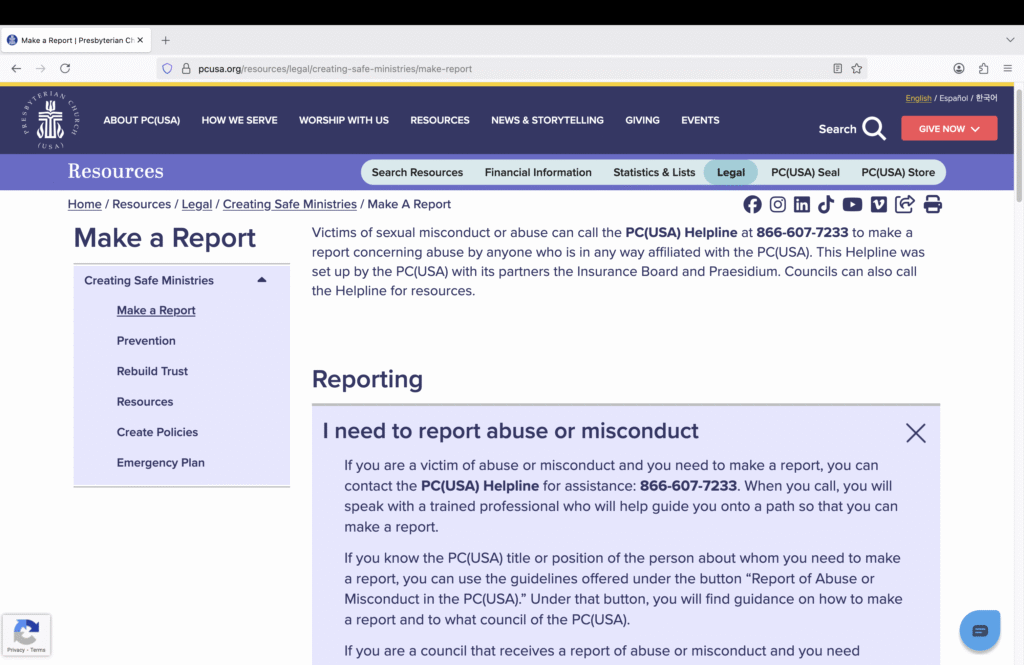
Third, the Presbyterian Church USA actually has a phone hotline that you can use to report abuse, as shown on this screen grab:
Admittedly, there are all kinds of potential problems with this helpline. Most obviously, who is the “trained professional” who answers the helpline? If it’s a denominational staffer, someone paid by the denomination, I’m going to be skeptical of their ability to remain neutral; I’d hope the “trained professional” is actually employed by their insurance carrier (which seems to be implied here), because an insurance carrier is somewhat more likely to take misconduct allegations seriously. Also, I could wish that the helpline would offer both voice calls and texting (I hate talking on the phone, but I love texting). And finally, I would like to see a guarantee of confidentiality — please tell me that if I call, and I feel uncomfortable with the “trained professional,” that you’re not going to track me down through my phone number.
Nevertheless, this makes it really easy to report misconduct, and I applaud this attempt at making the reporting process as transparent as possible. (I also applaud the fact that the “trained professional” can also provide information about abuse prevention resources — great idea.)
How might this apply to the UUA? Here are three practical suggestions — and the first two are actually very easy to implement.
First, the UUA should have a prominent link on the landing page of their website that with one click provides specific, actionable instructions on how to report misconduct.
Second, at least a partial list of ministers removed from fellowship should be publicly accessible on the UUA website without requiring registration — and there should be a clear explanation of why seeing the full list requires registration.
Third, ideally the UUA would provide an easily accessible service for reporting misconduct. And ideally, this service will be provided by an independent contractor, not by a denominational employee.
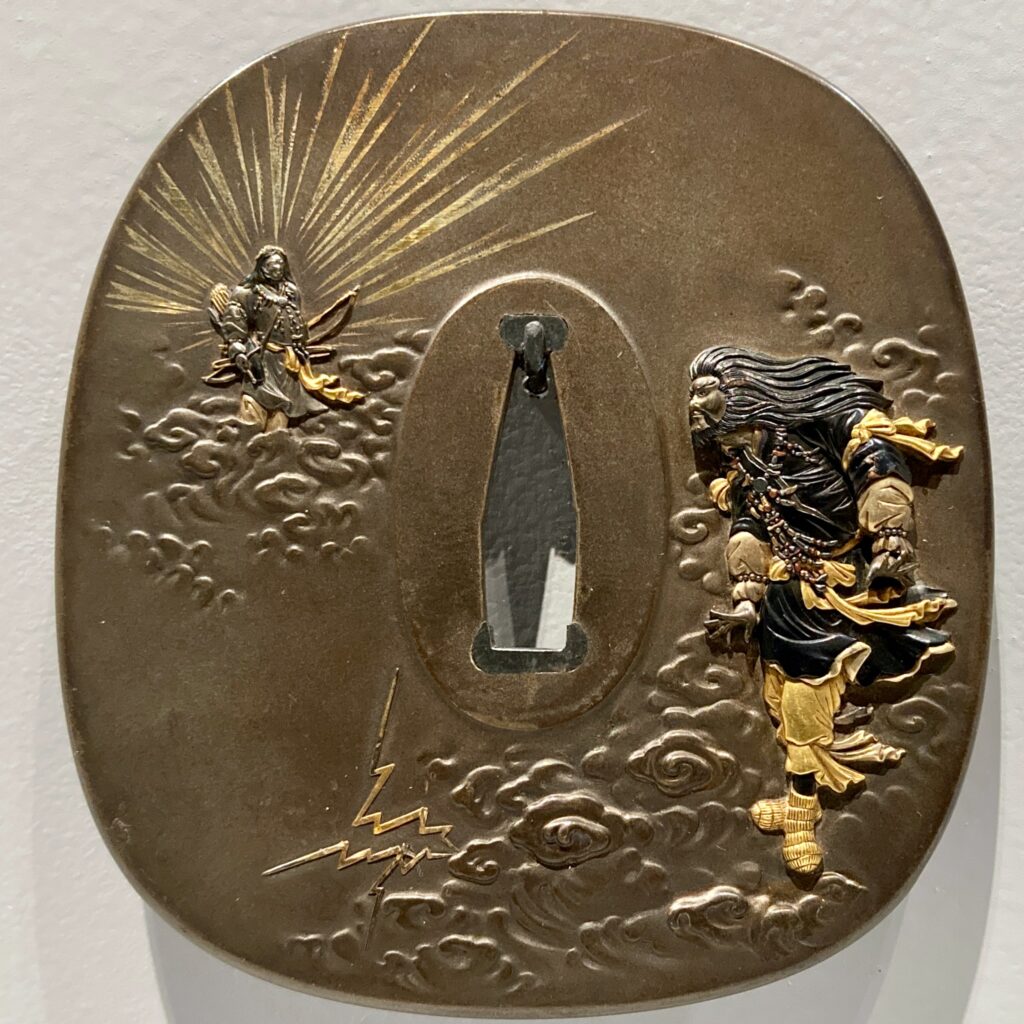
This lovely sword guard, made in 1874 by Tozan (no other name given), shows the Japanese deities Amaterasu and Susano-o.
A sword guard (tsuba) depicting Amaterasu and Susano-o, Walters Art Museum, Baltimore, accession no. 51.244
Amaterasu was the Sun-goddess, and Susano-o was the ruler of the Underworld; they were siblings by virtue of both being the offspring of Izanagi and Izanami. Here’s a story about the two of them, adapted from W. G. Aston, Shinto: The Way of the Gods (London: Longmans, Green, and Co., 1905), chapter VI — in the West, this is probably the best known story of these two deities.
Before Susano-o took up his duties as the ruler of the underworld, he asked his elder sister, Amaterasu, if he could come to heaven to take leave from her. She agreed. At first, all went well. But then Susano-o became rude and unseemly.
Susano-o broke down the divisions between the rice-fields belonging to his sister, sowed them over again, and let the piebald colt who lived in Heaven run through the fields, trampling them. Then Susano-o misbehaved in the great hall where Amaterasu was celebrating the solemn festival of the first fruits to be harvested. Finally, Susano-o killed a piebald colt of Heaven, skinned it, and threw the dead body into the sacred weaving-hall where the Sun-Goddess was at her loom weaving the garments of the deities.
Amaterasu was so offended by this last insult that she entered the Rock-cave of Heaven and left the world to darkness.
When Amaterasu hid herself in the Rock-cave of Heaven, the other deities grew worried, for there was no light any more. Everything was in complete darkness. All the other deities met on the dry bed of the River of Heaven to figure out a way to bring Amaterasu out of hiding.
First, Omoikane, the god of wisdom, brought roosters to the cave to crow, hoping to bring Amaterasu out that way.
Then Ame-no-Koyane, whom Amaterasu had put in charge of the divine mirror, and who was in charge of divine affairs in the palace, dug up a five-hundred branched Sakaki tree of Heaven. He hung strings of jewels on its higher branches, a mirror on its middle branches, and on its lower branches pieces of cloth. Then all the deities recited prayers in honor of Amaterasu.
Finally, Ame-no-Uzume, the goddess of Dawn and the Dread Female of Heaven, dressed herself in strange and fantastic clothing. She kindled a fire and pounded on a tub, danced wildly, and spoke inspired words. The Plain of High Heaven shook, and the eight hundred deities all laughed together.
The Sun-Goddess wondered how Ame-no-Uzume and the other gods could be so jolly while the world was wrapped in complete darkness. She peeped out from the half-opened door of the cave. She was at once seized by Ame-no-Tajikarao, or Heaven-Hand-Power. He kept her from slipping back into the cave, to the great joy of all the deities.
After the Sun Goddess was out of the cave and once more lighting up the world, a council of the deities put Susano-o on trial. He was found guilty, and caused to pay an enormous fine. They also pulled out the nails of his fingers and toes, and banished him to the land of the underworld. Finally Ame no Koyane, the ancestor of the Nakatomi, recited his Oho-harahi or “Great purification” liturgy.
It’s not clear to me whether the sword guard depicts a moment in this story, or is merely a depiction of these two deities.