Another excerpt from my long-delayed book on people who belonged to the Unitarian Church of Palo Alto between 1895 and 1934.
Oramanda Boring
An educator and field biologist, Oramanda (Ora) A. Boring was born October 12, 1854, in Carlinville, Illinois. Little is known about her younger years except a few bare facts in the public record. In 1860, she was living in Carlinville with her father John, a carpenter, her mother Mary, her older sister Mary E., and younger siblings Mary Myrtle and William. The family was still in Carlinville in 1870, living close to Blackburn University (called Blackburn College today), a co-educational college affiliated with the Presbyterian church. By this time, Mary E. had died, leaving Ora as the oldest child. By 1880, Ora was working a school teacher, now living with her parents and younger siblings Mary Myrtle (now age 23), William A., Ella L., Lewis H., Blanche M., Frank P., and Florence A. (age 4) in Greenfield, Ill., an unincorporated town just to the west of Carlinville.
After teaching high school in Greenfield, she moved to California in 1881. She was granted a provisional teaching certificate in Los Angeles in January, 1882; the State Board of Education granted her a “life diploma” (or permanent teaching certificate) in 1884. She probably taught in the Los Angeles schools for the next few years.
Ora met David Starr Jordan, the president of newly founded Stanford University, at a conference in Coronado, and he persuaded her to enter college at age 36. She began studying biology at Stanford University as a special student in 1891, the year the university opened, and was reportedly the first woman student. She participated in the first summer session of the Hopkins Seaside Laboratory in 1892.
After a year at Stanford, she returned to teaching school. She had gained enough experience, and enough of a reputation, that she was an instructor in the summer session of the “California School of [Teaching] Methods” in 1892, teaching other teachers about the history of education. After teaching school until about 1896, she then studied at Stanford again more or less full time from 1897 to 1899. In 1899, she returned to teaching school once again, and finally received her A.B. in zoology from Stanford in 1900, at age 46.
Ora had expertise in a wide range of subjects. In the biological sciences, she pursued both ornithology and botany. She became a member of the Cooper Ornithological Club, an early association of field ornithologists. She was also a serious botanist, and Harvard University Herbaria still has her collections of California plants. Although her degree was in biology, Ora taught several other subjects in her long career as a teacher and educator. In the 1893-1894 school year, she taught English, Latin, zoology, and history in the Coronado, Calif., high school. From 1894 to 1896, she was a supervisor in “primary and grammar grade work” in Stockton, in addition to teaching biology at Stockton High School.
Through the 1890s and into 1900s, she published a number of articles in the field of education. To give an idea of her range of interests, her article titled “Nature Study” was published in School Education in 1895; and “Theological Life of a California Child,” co-written with professor Earl Barnes of Stanford, was published in Pedagogical Seminary in 1892.
In her memoir of life at Stanford University, Ellen Coit Elliott witnessed Ora’s field methods for her educational studies:
“Dear Ora Boring appeared about that time. I saw her first at my front door, notebook in hand, asking modestly, like the gentlewoman she was, if she might make a few notes on my children’s reactions to the color element: she was taking one of Professor Barnes’ education courses. Oh, certainly! Louis and Christabel (little guinea pigs) were brought in from the sandpile and stood, big-eyed, in front of the strange lady on the lounge. She showed them strips of colored paper and asked them which they liked best. Christabel preferred bright red. Louis preferred bright red. The reactions were written down. Ora thanked me for the loan of my offspring and returned to her class. Dear Ora! Her lovely life and friendship were with us through the years.”
After her father died in 1893, her mother Mary moved from San Diego to Palo Alto. In 1897, Ora was living in Palo Alto with her mother, her sisters Blanche and Florence, and her brother Frank; both Blanche and Ora were studying at Stanford at this time. Her mother was an active member of the Methodist church; there is no record of Ora’s religious affiliation at this time. Her mother was an invalid by the time she died in 1901, and Ora may have been providing care for her. By 1910, Ora lived at 101 Waverly St. in Palo Alto with her sister Blanche, brother-in-law William Snow, and their children; Ora was working as a high school teacher.
Ora taught in many different school systems across California, so many that it proved impossible to trace them all. In 1899, she was teaching zoology at Palo Alto High School. She was one of the first teachers at the Clear Lake Union High School District in 1901. In 1903, she was teaching in the high school in Riverside. In 1910, she was living in Palo Alto, though it’s not clear where she taught. From April, 1912, to June, 1914, she taught in the Yosemite Valley School, a one room schoolhouse; the school year ran from April through December, and she may have lived elsewhere when the school was not in session, although as a biologist perhaps she chose to live in the Yosemite Valley year round.
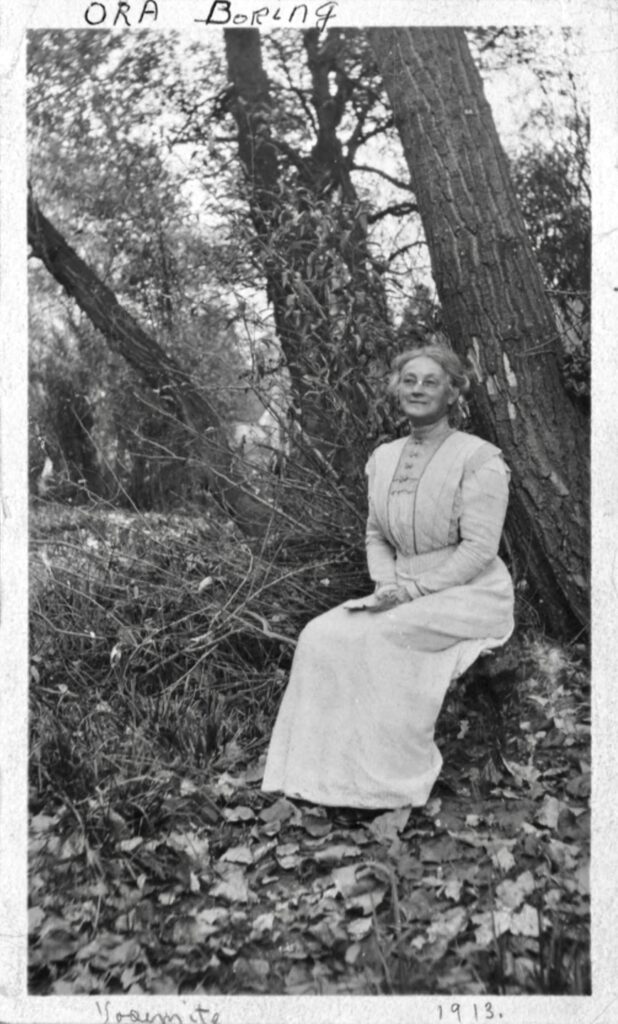
In autumn, 1914, at age 60, Ora began teaching school in Sunland, Calif., then a remote town in the mountains outside of Los Angeles. An unattributed typescript memory of Ora’s tenure in Sunland appears in “Sunland: A Scrapbook,” assembled by Enid A. Larson in 1983:
“Ora Boring was the next teacher [in the one-room school in Sunland]. She was an outstanding example of a teacher who instilled a love of learning, an ambition in children to improve, and above all, she respected each individual and developed their feelings of self worth. John Schober had been ridiculed for his slowness. With Miss Boring he was giving opportunities to show what he could do. He constructed a steam engine on the ditch bank and showed the school its power. He built a water wheel out of tin cans and ran it by diverting ditch water. Later, on Bishop Creek at Schober Lodge he built a water wheel that furnished power for the lodge…. Miss Boring say the need for music in the school and got the community to hold a Box Lunch Social to raise money for the purchase of a Victrola and records. She held a Letter Writing Contest for the best written letter to order the Victrola. Leora Larson’s letter was chosen to be sent. Finally the day came that the machine arrived. Much excitement! She planted wildflower seeds around the school.”
Another unattributed typescript in the same scrapbook tells the story of why Ora Boring had to leave Sunland:
“An unusually heavy snowfall came in late December that closed all roads in the northern end of the Valley…we were under at least 4 feet of snow…. That night the temperature dropped to 3 degrees below zero…. For more than six weeks roads were closed and we walked on the crust over fences…all brushes [sic] were covered and the expanse of white was awesome…. Ora Boring, teacher, walked on the crust to Bishop, from the Galen Dixon home where she boarded, to consult with Willie Chalfant at Inyo Register on an historic item concerning Owens Valley. Apparently due to the low daytime temperature she came down with pneumonia and had to be replaced.”
Ora would have been 62 when she walked from Sunland to Bishop. The Sunland scrapbook also gives the text of a note that Ora wrote to her sister Florence in February, 1915, presumably while she was recovering from pneumonia:
“Thank you for the little work-bag which has already proved a treasure and the case which I hope to use on Apr. 30 on my way home. There are a good many pheasants. They are all wild—i.e. bred in the open where they were freed some years ago. They are not so wild as the quail but are not domesticated. They thrive here. Our lowest temp. has been 3°- but that lasted only a short time. Had a good deal of 18° – 20° in Dec. and Jan.”
Not surprisingly for a biologist, Ora became involved with using nature study for sexuality education through the social hygiene movement. Her emphasis was on helping parents to become better sexuality educators, and she arranged for a female physician to talk with mothers of the children she was teaching.
In 1921, she was back in Palo Alto, living at 422 Tasso St. She apparently concluded her teaching career at Castilleja School, a private school for girls in Palo Alto. Ora seems to have been most active with the Unitarian Church of Palo Alto in the 1920s. She was a member of the Women’s Alliance from the late 1920s, until it finally dissolved in 1932, and served as secretary for a brief time. She was a Sunday school teacher in 1927-1928.
In 1930, she was living with her sister, Florence, and Florence’s son, in Palo Alto. Although she now listed her occupation as “none,” she didn’t sit still even in retirement, and she and her brother William traveled to Italy in 1930 when she was 75 years old. She also continued to be engaged in scholarly work. Enid A. Larson said: “When I went to work at Stanford University in 1933, [Ora] had retired, and was translating a book of the Bible from Greek into English.”
Ora died the next year, on April 7, 1934, in Palo Alto. Excerpts from her translation of the book of Luke were read at her memorial service. Latham True, a member of the defunct Unitarian Church of Palo Alto, played organ at her memorial service.
From her modest beginnings as the daughter of a Midwestern carpenter, and the second child in a large family, Ora was able to pursue an ambitious career as an educator and scientist. She had obvious intellectual gifts, and perhaps living near a co-educational college when she was a teenager helped her imagine that she might do something with her life besides marry and have children. At least one of her siblings was also ambitious — her brother William Alciphron Boring became an architect, studying in Paris, worked for the renowned McKim, Mead and White architecture firm, then started his own firm, designing most notably the federal Immigration Station at Ellis Island — so perhaps she came from an ambitious family.
Ora was also an adventurous person: to give one example, at age 58 she was adventurous enough to move to the remote Yosemite Valley for two years to live and work; or to give another example, she was willing to travel abroad when she was 75 years old, at a time when such travel meant a long ocean voyage and a certain amount of inconvenience. She must have been a stimulating and fascinating teacher. While not as famous as her brother William, she was an obviously brilliant woman who made the most of her life, even while remaining within the social conventions for women of her day.
Notes
1870, 1880, 1910, 1930 U.S. Census; Charles Walker, History of Macoupin Co., Ill., Chicago, 1991; History of Greene and Jersey Counties, Illinois, Springfield, Ill., 1885; Los Angeles Herald, Jan., 7, 1882; Sacramento Daily Union, Dec. 9, 1884; “Ora Boring Passes Away,” obituary, Palo Alto Times, 9 April 1934, p. 1; Leland Stanford Junior University Circulars 1 and 2 (Annual Register), 1891; Donald G. Kohrs, “Hopkins Seaside Natural History Laboratory,” ch. 4, p. 39 web.stanford.edu/group/seaside/pdf/hsl4 .pdf accessed Aug. 3, 2020; Kindergarten Magazine, vol. 5, Sept., 1892, p. 32; Pedagogical Seminary, 1892, vol. 2, no. 3, pp. 442-448; Pacific Education Journal, vol. 9, Oct., 1893, p. 423; Ellen Coit Elliott, It Happened This Way: American Scene, Stanford, Calif.: Stanford University Press, 1940; Palo Alto and Stanford University Directory, 1897-1898, F. D. Hunt, Stanford University Press, Oct., 1897; Aurelius O. Carpenter and Percy H. Millberry, History of Mendocino and Lake Counties, California, Los Angeles, Historic Record Co., 1914, p. 138; “Death of Mrs. Mary A. Boring,” Palo Alto Times, 1 March 1901; Stanford Daily, April 16, 1903, p. 4; Laurence V. Degnan, “The Yosemite Valley School,” Yosemite Nature Notes, Feb., 1956, p. 19; Enid A. Larson, “Sunland: A Scrapbook,” Inyo County Free Public Library, digitized by Internet Archive archive.org/details/cini_000121/page/n117/mode/2up accessed 3 Nov. 2025; Journal of Social Hygiene, vol. 1, no. 3, June, 1915, pp. 424-425; Alumni Directory, Stanford University, 1910, 1921; New York Passenger and crew Lists, 1909, 1925-1957, S. S. Saturnia, sailing from Naples May 16, arr. N.Y. May 26, 1930; Find-a-grave website, Oramanda Boring www.findagrave.com/memorial/ 144477229/oramanda-boring accessed 2 Nov. 2025.