
This deity is a yipwon figure, from the Yimam people who live along the Karawari River in East Sepik Province, Papua New Guinea. Since I know essentially nothing about the Yimam people and their deities, I’m going to quote from various authorities who claim to know something.
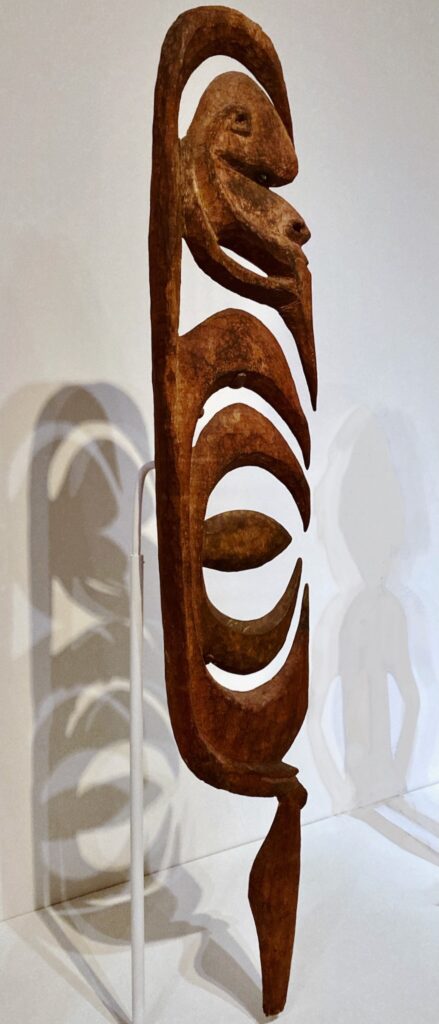
Maia Nuku, in the recent book Oceania: The Shape of Time (Metropolitan Museum of Art, 2023), says this about yipwon figures.:
“Depicting ancestral spirits, yipwon figures have long played a central role in hunting and warfare for Yimam people along the Korewori [sic] River in the Middle Sepik. The figures served as vessels into which spirits were summoned before a hunt or raid. The carvings were either large-scale or small enough to be portable, to be carried and deployed by their owners as powerful amulets or charms. Large figures were owned by the group and kept in the ceremonial house, close to the back wall, the most sacred area of the house. Each yipwon bore a name and was paired with one of the senior male members of the clan. Before its assistance was required, the yipwon spirit was summoned into the sculpture by activating it with a mixture of betel nut, ginger root, and a small amount of the blood of the man who was activating it…. On entering the yipwon figure, the spirit could also possess its human counterpart, speaking through him to the assembled men…. Yipwon were not intended to be representative portraits of individuals, but, rather, an activated vision of the exceptional nonhumans with whom the community was in relation….”
Christian Kaufmann, Korewori: Magic Art from the Rain Forest (University of Hawaii Press, 2003), pp. 70-71, gives a version of the myth they say underlies the yipwon figures:
“In 1963 Eike Haberland and Sigfried Seyfarth made a detailed study of the Yimam on the upper Korewori and its tributary the Wogopmeri as well as the hills to the north of them. These people name their hunting helpers yipwon, which Seyfarth and Haberland translate as ‘hunting demon.’ … The yipwon hunting helpers and the somewhat different older hook figures of the Yimam owe their existence to a mythical event which has been described in detail. They were created from the wood chips that were left when Sun, a male being, cared the first slit-gong. They have a human-like life, and enrage Sun by committing a murder. When this deed is discovered by the moon-woman, their shame is such that they transform themselves on the spot into stiff, thin wood figures and press themselves in the dark against the wall of the men’s house. Sun appoints them as hunting helpers at the moment when he takes leave of humans forever.”
The Metropolitan Museu of Art has photographs of several yipwon figures on their web site. On the web page for one of those figures, they give a somewhat different summary of the same myth, probably from the same source (Seyfarth and Haberland):
“…Local oral tradition describes the origin of these distinctive images. When the spirit of the Sun, who formerly inhabited the earth, was carving the first slit gong (a large musical instrument), the pieces of wood chipped from the carving came to life as spirits who lived with the Sun in the men’s ceremonial house. One day these spirits killed one of the Sun’s male relatives and drank his blood, after which they stretched themselves out against the wall of the house and turned back into wood. Angered by their act, the Sun ascended into the sky while the yipwon remained on earth as patron spirits of warfare and hunting….”
I found very little information online about the Yimam people, who are also called the Alamblak people. The Joshua Project, a Christian group that aims to spread their religion to other peoples, claims that there are 3,100 Alamblak people today; they claim that currently 90% of the Alamblak are Christian, and they link to a translation of the Christian Bible into the Alamblak language. The only other references I could find to the Yimam or Alamblak people was in relation to their artworks. It seems that the only value the Alamblak / Yimam people have to the First World is either to provide artworks (which sell for quite high figures), or to provide converts to Christianity. And I wonder how much remains of their old religion and mythology: are the yipwon still active?