On the brighter side…

This summer, a couple of people whom I knew and liked and respected have died; one of them was quite a bit younger than I. The news of their deaths really brought me down. On top of that, there’s the national and international news, which has also been bringing me down. Plus today I started feeling under the weather — I hate being sick in the summertime.

I needed something to pick me up. So I looked for music by Rio Saito, a young ukulele virtuoso who has been playing some hot jazz. And I found a Youtube video of the Rio and Dani Brazilian Jazz Trio, recorded last November, playing “Aquelas Coisas Todas” by Brazilian jazz great Toninho Horta. I recognize Rio Saito as the ukulele player and band leader, but since I don’t read Japanese I can’t tell you the names of the pianist, bassist, and drummer. All I can tell you is that they are all fabulous musicians who put across eleven minutes of bright, uptempo, very accomplished jazz that made me smile.

One of the reasons I love jazz is because of the international connections. This performance is a perfect example — a Japanese ukulelist playing a Brazilian composition that comes from the American tradition of jazz. In a world filled with hot wars and trade wars and cultural wars, it’s good to remember that we can build connections across our differences.

Rio Saito playing ukulele, with a pianist, bassist, and drummer behind him on a small stage.
Screenshot from the video. Click on the image above to view the video on Youtube.

And if you want more, here’s Abe Lagrimas Jr. and Rio playing Antonio Carlos Jobim together.
Quaker Checkers revisited

Back in 2012, I posted a game board and rules for playing “Quaker Checkers.” Photocopies of that game had been passed around for years between Unitarian Universalist Sunday schools. I decided to create a clean copy, and put it online where maybe more people could access it. And if you read the comments on that 2012 post, you’ll see that Quaker Checkers has been played with great success in Unitarian Universalists Sunday schools (and maybe in one or two Quaker First Day Schools as well).

This week, I received email from Sally Q Campbell, who invented the game. Sally said she’s currently talking with a friend of hers about developing an online version of Quaker Checkers. Actually, I would have loved to have an online version during the pandemic when Sunday school had to meet online.

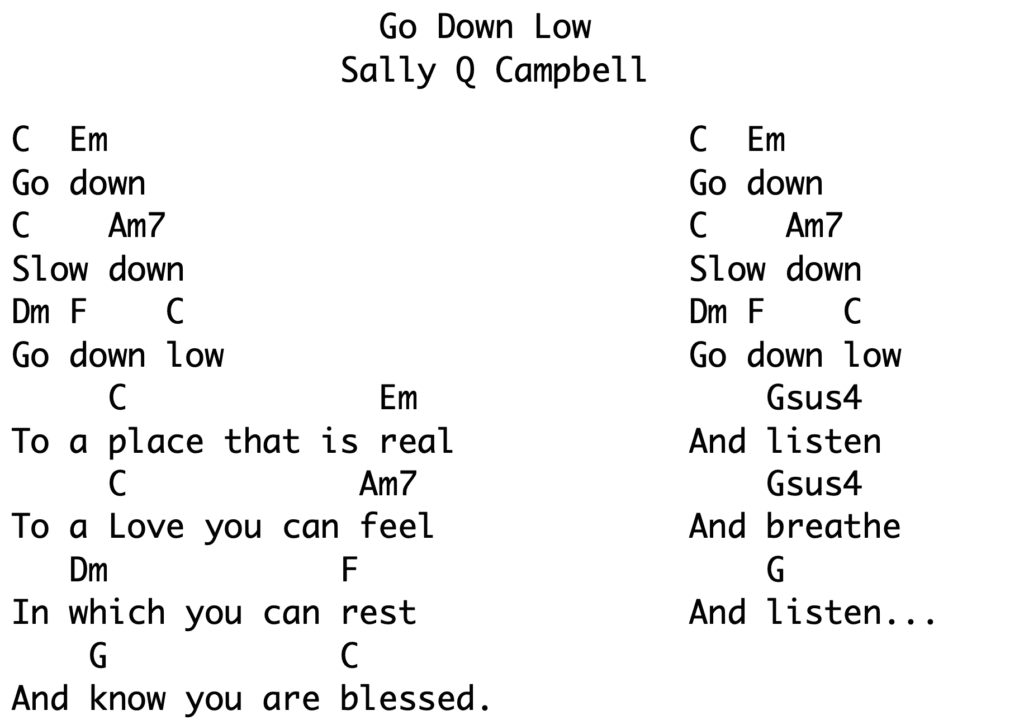
It appears that Sally is one of those endlessly creative people. She is also a songwriter, with a number of songs about peace and spirituality to her credit. On her her Youtube channel, she writes: “I’m a Quaker Singer/songwriter. Many of my songs are given to me in the silence if I will S l o w D o w n.” In fact, I especially like her song “Go Down Low,” which is all about slowing down and centering down. She hadn’t come up with chords for it, so I did. Here’s the standard warning for online chord/lyrics sheets: this is my interpretation of someone else’s song, posted here for educational purposes only; the songwriter Sally Campbell retains the copyright.

Graphic with lyrics and chords

(N.B.: she sings “Go Down Low” in B flat.)

All the above is by way of digression. My real point in writing this blog post is to correct something Sally pointed out in her email. She said: “You did make one error when you tidied it up. My board does not have dark and light squares, it’s just a grid. Makes it more of a challenge.”

She’s absolutely right. To make amends, here’s a corrected version of the game board:

Graphic of the game board for Quaker Checkers.
Click on the image above for a printable PDF of the game.

The color of late summer plants

We’re past Lughnasa now, and the days are noticeably shorter. At this time of year, I always look for a few plants with spectacular colors.

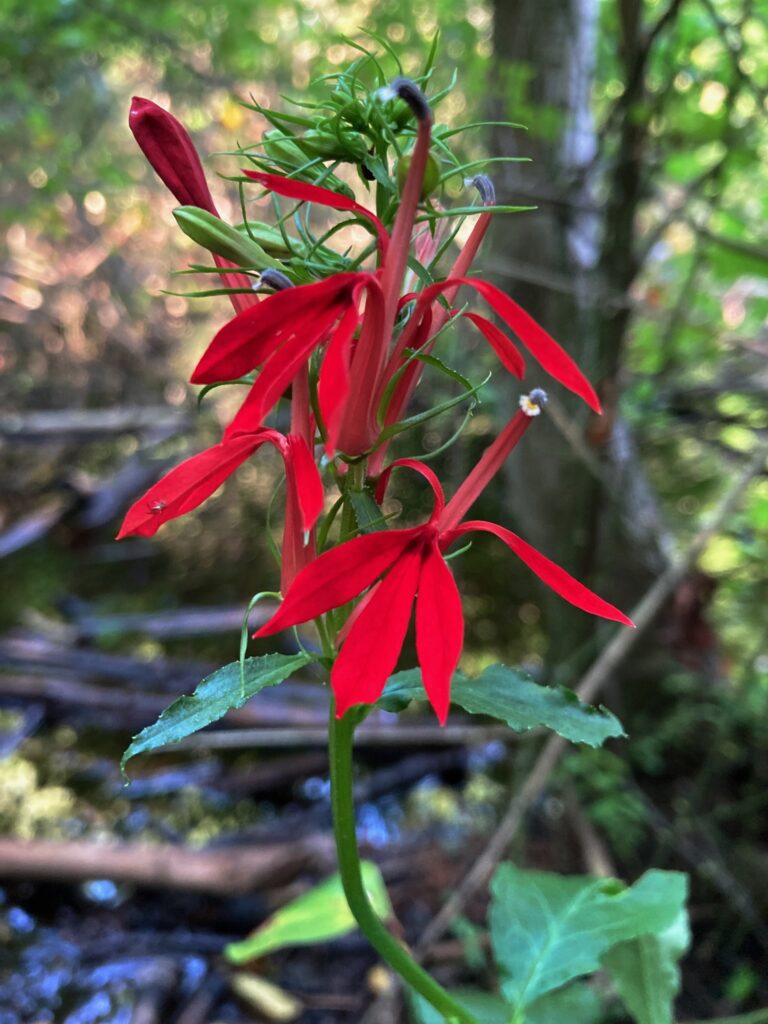
Delicately formed flowers.
Lobelia cardinalis

The Cardinal Flower grows in wet ground — in swamps, or along streams, rivers and ponds. I don’t often find a cardinal flower blooming where I can get close enough to see the details of the flowers, but this one was growing in a wet place along one of the paths around Aaron River Reservoir. The vivid red color, and the dramatic structure of the flower, makes it especially memorable.

Butterfly on a flower head.
Danaus plexippus on Asclepias tuberosa

Butterfly Milkweed grows in open fields and meadows. The bright orange is pretty enough by itself, but when an orange and black Monarch Butterfly lands on it, it’s truly spectacular.

Thin orange stems twining around a green plant.
Cuscuta gronovii

At this time of year along one of the inlets of Cohasset Harbor, I always see marsh plants covered in strange-looking orange filaments. Common Dodder is a parasitic plant that has no chlorophyll; it gets all its nutrients by sucking the sap out of a host plant. Parasites always creep me out a little — though I suppose letting your food source live is better than killing it, the way we humans kill carrots and potatoes, or cows and chickens. Nevertheless, the showy orange stems of Common Dodder twined in among green leaves is quite a beautiful sight.

What needs to be said

In a podcast on Religion News service, Rabbi Jay Michelson says that leaders among religious progressives have been avoiding talking about what we can only presume at this point is a government cover-up about the Epstein sex trafficking ring.

I’m not sure if I qualify as a religious progressive leader, but I haven’t been talking about Epstein, or about Ghislaine Maxwell, or about Donnie Trump’s possible connection to their pedophile ring, because I don’t like giving a lot of air time to human traffickers who got money and power trips out of exploiting girls. It always seems to be that the sexist assholes in this world take over all the conversations.

So let’s talk about Haley Robson, who was molested by Epstein when she was 16 years old. When she was 15, she had been raped, and her rapist was still stalking her and humiliating her; as a result she was probably extra vulnerable to Epstein’s emotional manipulation. So Epstein molested her, but stopped short of intercourse, telling her that she should go recruit other girls for him. An article in Psychology Today covers this part of Robson’s story — it’s a very ugly story.

In an interview with BBC News posted just a couple of hours ago, Robson talks about why we should not talk so much about Epstein and his accomplice, Ghislaine Maxwell. Instead of talking about them, Robson says:

The whole Epstein saga reminds me far too much of the sexual misconduct cases I’ve seen in smaller organizations (like organized religion, and sports teams, and schools, etc.). A person in a position of authority uses their power to sexually exploit vulnerable people — then when they get found out, everyone focuses attention on the person in the position of authority, neglecting or ignoring or forgetting the vulnerable people who got exploited.

So I respect Rabbi Michelson’s opinion that religious progressives should not cede the conversation about the Epstein cover-up to the religious right. But I feel that Robson has the right idea — I don’t want to sensationalize or glorify either Epstein, or his proven and alleged accomplices. If we do decide to talk about this case, let’s make sure our conversation is focused on the people who got molested and manipulated, and how we might get justice for them.

Hammer dyeing with sumac leaves

I was reading the chapter on mordants in the book Craft of the Dyer: Colour from Plants and Lichens (by Karen leigh Casselman, 2nd ed., Dover Publications, 1993), when I came across this: “Some dye plants are used in the pot as mordants. This is true with alder and with sumac leaves.” (p. 40). (In case you’re not familiar with the term, a mordant is a substance used to help fix dyes in the cloth; a mordant helps make the dye color more light-fast, and helps the color stand up to washing better.)

This summer, I got interested in hammer dyeing (also known as “plant pounding”). This process transfers plant colors to cloth by hammering the plant against the cloth (details on the process are in this blog post). One problem with hammer dyeing is that the colors are not always lightfast, and may not stand up well to washing. But if sumac leaves can act as both mordant and dye-stuff, I wondered if they might produce a more permanent color if used for hammer-dyeing.

So I hammer-dyed a t-shirt using sumac leaves. And yes, they did indeed stand up to washing. As for lightfastness, only time will tell.

To see photos and a description of the whole process, scroll down.

Continue reading “Hammer dyeing with sumac leaves”