Roadtrip: Missouri and Oklahoma

It was hot and humid yesterday when I arrived in Marshfield, Missouri. I went to bed early so I could get up early when it was cool enough to take a long walk.

I was out the door of the bed and breakfast at a quarter to seven. It was already in the high seventies, and the dew point couldn’t have been much lower than that. I walked up Clay street, across the one line railroad over which I’d seen three BNSF locomotives pull a mixed freight last night, up a block to the courthouse square. The Webster County courthouse, a gray Depression-era Art Deco building, is undistinguished. The courthouse square is neither pretty nor bustling; there are no trees to speak of; empty store fronts alternate with offices for lawyers and bail bondsmen, a small restaurant promising “Chinese Fast Food,” the Webster County Historical Society, and one attractive little grocery store in a far corner. It is far from the tourist stereotype of a Southern courthouse square.

I kept walking, and in another block I was on a tree-lined street. There was one big Victorian house, beautifully renovated and brightly painted, and then lots of small anonymous houses on big lots. I walked around the Webster County Fairgrounds. A damp sign lying in the grass told me that the county fair took place July 14-17; and a few pieces of carnival equipment were still parked on the fairgrounds. That was the only cheerful thing I saw on my walk, and it was really melancholy, for the fair was over for another year. Maybe it was just the heat, but I found the atmosphere of the town oppressive. I walked back to the courthouse square, and then, with some relief, walked back into the green and well-kept grounds of the bed and breakfast.

Today’s drive took me out of the rolling hills of southern Missouri into the flatness of western Oklahoma. I’m staying in Elk City tonight, and after dinner I walked around the center of the town. Downtown Elk City has no old buildings — it was founded in 1901 — and it is fairly flat and treeless. But it is an attractive town, with wide streets and the open feeling of the West. There is a pretty little Carnegie Library, and a couple of century-old brick buildings that are well-maintained. I got the impression of a lively mix of businesses: lawyers and accountants, a department store, several clothing stores, a boutique, a hair salon, the Elk City Cafe, buildings for two newspapers (looking at their buildings, I’d guess that the Elk City Daily News is considered more respectable than the Elk Citian), a large and bland but not unattractive post office, a small pharmacy and a big chain pharmacy, a hospice, a sewing machine and vacuum repair shop, a dollar store and a thrift store, a couple of medical supply stores, and various storefronts that had to do with farming and the oil business. One business had something to do with the oil business (the name was something-or-other oilrigging), and a sign on the door proclaimed, “Please take off work boots before entering office.”

Most everything was closed by the time I got there. It was still very hot, but I kept walking around the downtown, impressed by the sheer variety of the businesses. This was a downtown that had not yet been killed off by the malls; I’ll bet you can buy everything from hardwear to underwear to a ten gallon hat, and sell your oil well to boot. On my way back to the motel, I took some back roads. While there aren’t many trees, the countryside around Elk City is green and rolling, and pleasant to look at. It felt like a place that might be nice to live in.
Roadtrip: Indiana, Illinois, Missouri

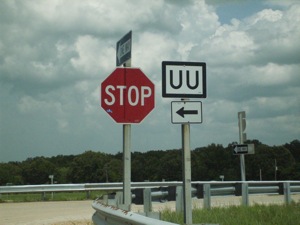
Two photographs from today’s drive:

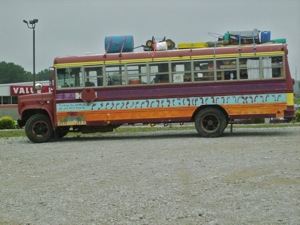
(1) Bus parked in gravel lot next to the Motel 6 Parking lot, Cloverdale, Indiana, 19 July 2010 at approximately 9 a.m.:

The text on the side of the bus reads: “Feeding the world so you don’t have to.” The designs on the light blue stripe on the side of the bus are footprints; above that in the purple strip are handprints. I could not make out what kind of equipment was tied to the roof of the bus; perhaps it was gardening equipment. Through the windows of the bus, I could see additional equipment. Unfortunately, there was no one around the bus whom I could ask.

(2) Signs at the junction of Interstate 44 and Missouri Route UU:

Roadtrip: Pennsylvania, Ohio, Indiana

I took three short trips off the interstate today, trying to find something other than rest areas and the usual fast food joints you find near interstates. The first two side trips were unsuccessful. The first led to malls and suburbia, and the second led to a place that wasn’t worth the trip.

But the third side trip led to the barn where my older sister is taking care of three horses. It led me past the Village Smorgasbord in the middle block of downtown Hagerstown. It wound down past a small creek bed, through woodlands, around a bend where a white clapboard church, Nettle Creek Friends Meeting, stands next to a little cemetery, then in between eight foot high walls of corn, and at last to a house where my sister fed me dinner, and then to the barn where her horse is stabled.

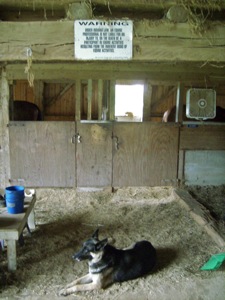
Jean and I and the two dogs, Tracer and Parker, walked from the house down to the barn. Already in the barn were several pairs of barn swallows, three horses, and a cat named Pumpkin who ate baby Barn Swallows when he could get them. Jean showed me how the timbers of the barn had been hand hewn, and pegged together with oak pegs. Tracer lay down on the barn floor and kept an eye on things:

All too soon, it was time for me to get on the road again, and I forgot to wish my sister a happy birthday. Happy birthday, Jean!

Roadtrip: Connecticut, New York, Pennsylvania

The price of the motel included a full breakfast. I brought yesterday’s New York Times to read. A man with glasses and carefully combed silver hair sat at a nearby table. He was wearing a dark polo shirt and neatly pressed white shorts. He eyed my paper. “You got that at the front desk?” he said. There was just a hint of a sharp tone in his voice; he was in obvious newspaper withdrawal. “No, I got it from my car,” I said. His face fell. The only newspaper available at the motel was USA Today.

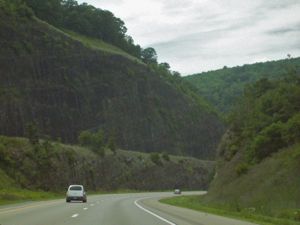
As I drove over the high point of the Taconic Hills, over the border from Connecticut into New York, a sign gave the elevation as 970 feet. Near the Pennsylvania border, we reached a high point of about 1250 feet. Then halfway across Pennsylvania, a sign told me that I had reached the highest point on Interstate 80 between the Atlantic Ocean and the Mississippi River, at about 2250 feet. Some of the scenery was spectacular, the road winding in among wooded hills and mountains that had clearly been shaped by glaciation. In many places, the road had to be cut through bedrock:

In the middle of the afternoon, I started getting fatigued. I had gone through several road construction projects where the road went to one lane, and at one point traffic had come to a complete stop due to an accident; when I passed the accident scene, they were trying to right an overturned car. I pulled into a rest area. Down behind the picnic area, a small stream wound through some woods. I walked along looking at the plants: big eastern hemlocks with young beeches pushing up around them, sassafras in the understory, and on the forest floor wintergreen, ground pine, jewel weed, trillium, all the familiar plants of the eastern woodlands. I picked a wintergreen leaf and smelled it. This would be the last of the eastern woodlands that I’ll see this year.

Towards evening, I decided to pull off the road to see if I could find a place to eat. I chose Reynoldsville, because I liked the look of countryside. It was seven miles away from the interstate, along a two-lane highway that was straight at first, then began to wind down an increasingly steep hillside, until suddenly I was on the main street of Reynoldsville. I parked the car and went for a walk. There were three or four restaurants, but they all seemed to feature pizza, except for one restaurant which promised “home cooking.” A woman was getting into her car in front of the Episcopal church. “Going for a walk?” she called out to me. “Yup, stretching my legs,” I said and smiled. Several of the houses had anti-abotion signs on their small front lawns: “Abortion stops a beating heart”; “Respect Life”; “Choose Life.” Reynoldsville did not seem like the kind of place where a middle-aged man with a pony tail would exactly fit in. I got in my car and drove back to the interstate.

Next I tried Brookville, because of a sign which mentioned the “Brookville Historic District.” When I got to Brookville, there were some impressive houses, most of which were carefully maintained. Right across from the big red courthouse with the brillian white trim, there was a little restaurant called “The Courthouse.” I would have been the youngest person there by a good twenty years. I decided that as pretty as the town was, I would not try to eat dinner there. I walked around a little bit, and came across a small manufacturing plant with a sign that said “Brookville Locomotive / Diesel Locomotives / Personnel Carriers.” This could not have been their main plant, though, for there were no railroad tracks anywhere nearby.

Roadtrip: Maine, New Hampshire, Massachusetts, Connecticut

Hot and humid at midafternoon, with a sky that threatened thunderstorms later. I drove out of the Ferry Beach Conference Center campground and headed towards Biddeford and Interstate 95. Slow going through Saco and Biddeford, moderately heavy traffic on the interstate. After I turned on to 495, I could see that the northbound side had very heavy traffic, which came to an almost complete stop at the approaches to 95 north, 93 north, and 3 north; presumably vacationers heading north. It was hazy, hot, and humid, and the thick hot air made distant hills look bluish. I made a quick stop in Stow to eat dinner with Carol and her dad, and then got back on the road. Lots of traffic through Worcester, then a little less through the eastern hills of Connecticut, then more traffic around Hartford, along with heavy rain and lightning. The rain ended leaving a faintly pink sky in the dying light, then light traffic through the steep hills of western Connecticut. A maddening construction delay, then at last I made it to the motel feeling frazzled. This morning I was awakened in my tent by the sound of a Wood Thrush singing.

Morning song

Ferry Beach, Saco, Maine

Sometime after first light this morning, I came partially awake when a Wood Thrush (Hylocichla mustelina) started singing not far from the campground: three or four or five flute-like notes followed by a sort of trill. Birds don’t have larynxes; instead they have syrinxes, which in some species can produce more than one note at a time. Wood Thrushes have an amazingly rich and complex song; the first flute-like notes change in pitch and duration and sometimes seem to include more than one note, and the final trill might incorporate a buzzy sound and flute-like tones and more. The basic structure of the song is always the same, but each iteration of the song is slightly different; I can listen to a Wood Thrush without boredom for a very long time.

I drifted off to sleep, but while sleeping kept listening to the song, which went on and on and on. I had a dream in which I was listening to a Wood Thrush. I kept coming partly awake and marveling at the song, and then telling myself that I had to get some sleep. At last I fell sound asleep, and the alarm awakened me right at 7:00. The Wood Thrush was still singing. I listened as I pulled on my socks and shoes. I kept listening as I walked over to the wash house. I took a quick shower, walked back to my tent, listening to the Wood Thrush, trying to figure out where it was. I thought I might walk over and try to see it. But by the time I got back to my tent, at about 7:15, it stopped singing.

Camaraderie

Here at Ferry Beach Conference Center, there’s always singing after dinner, led by the musician of the week. Although I usually duck out before the singing starts because it gets way too loud, tonight the decibel level promised to be bearable so I stayed.

The song leaders had us sing “The Garden Song” by David Mallet. Now, this is Heidi’s favorite song, and Heidi, who has been coming to Religious Education Week for decades, was unable to come this year. So when we started singing, Joyce called Heidi, got her voice mail, and held up her cell phone so we could all sing into it. We all knew Heidi would actually appreciate this gesture.

I started thinking: Do we have a similar sense of attachment to our regular congregations? –would you ever call someone who couldn’t come on Sunday morning, and hold up your phone so that person could hear the congregation singing a favorite hymn? What if we sent notes to a person who couldn’t come some Sunday morning — would that person appreciate those notes?

Volunteer management for religious education

Today in the New DRE (Director of Religious Education) workshop, one of the topics we addressed was volunteer management, and we focused on volunteer teachers. I said that the way I think about volunteer management is that it is a cycle that begins with supporting your current volunteers, then moves to recognizing volunteers at the end of a semester or year (or for volunteers completing service), then moves to recruiting new volunteers (or recruiting current volunteers to volunteer for another semester or year), then moves to training volunteers beginning service.

I asked workshop participants to brainstorm ideas for ways that we can support, recognize, recruit, and train religious education volunteers (especially volunteer teachers). Below is the list of ideas they generated:

Continue reading

Outdoor classroom

Here at Ferry Beach Conference Center, the Ferry Beach Ecology School has established an organic garden that also serves as a place to teach children. I’ve uploaded photos of this outdoor classroom to Flickr, with lots of explanatory captions. It’s both attractive, and well-designed for teaching.

Seeing this has really gotten me excited. Now I want to establish something like this for my own congregation!