Category Archives: Ecology, religion, justice

War? What war?

Over on her blog, Dani has a really nice post on the Iraq War. She talks about how many Americans seem perfectly able to forget the fact that we’re at war:

Thich Naht Hahn has been an author and peace activist that I’ve been reading about a lot lately. I have been practicing mindfulness, and as of yet I have discovered one thing that I realized; I have been quite unaware that we are still in a war. Some discussions in my group of aquaintances or friends have, as of late, the question “We’re still in that war?”

The post continues with some wide-ranging thoughts on the intersection of war, religion, and the individual activist. It’s a little rambling at times, but a passionate and thoughtful post worth reading. Link.

Citizen science for urban dwellers

I just discovered the Cornell Lab of Ornithology’s Urban Bird Studies program. Urban Bird Studies consists of a number of interesting citizen science projects observing birds and bird behaviors in cities: Pigeon Watch, Crows Count, Dove Detectives, and Gulls Galore. As you might have guessed from the names of the individual projects, the target audience for these projects appears to be kids, and they have lots of photos of school groups full of cute kids with clipboards.

Nonetheless, it looks like there’s some pretty interesting science underlying each of these projects. For example, the Gulls Galore project aims to gather data to help ornithologists understand when and in what ways adult gulls relate to subadults and juveniles. And just looking at the tally sheets and the study site habitat form help me better understand what ornithologists do.

Better yet, Cornell Lab of Ornithology understands that it’s a Good Idea to help us urban dwellers to observe and understand our urban ecosystems, through careful observations of selected species. Now I’m trying to decide if I have the time to work on the gull project — it sounds like fun.

Friday video: Peace rally

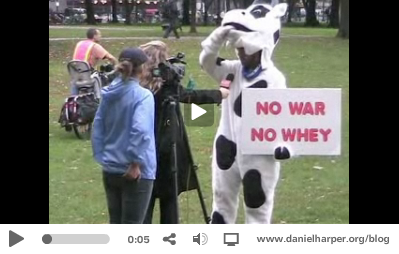
Last Saturday (27 October), I went to the New England Mobilization To End the War in Iraq. It felt — strange. Very 1960’s, and not necessarily in a good way. Ranting through megaphones, hippies, people curiously dressed. Blah.

There was at least one speaker who inspired me, however…. (2:32)

The fellow who inspired me, who is featured at the end of the videoblog post above, is actually from the Unitarian Universalist Service Committee. Unfortunately, I didn’t catch his name. His positive, humane vision stood out among all the shrill-voiced “We’ve got to stop the killing now!” and “No more blood for oil!”

And I don’t want to trash the entire peace movement. Last year’s Christian Peace Witness for Iraq felt meaningful (and they’re already planning another one for March 8th, assuming that the United States is still in Iraq). I like some of what the Quakers are doing. But the old-fashioned 1960’s-style peace rallies have got to go.

(Happy birthdays,Abs!)

Note: video host blip.tv is defunct, so this video no longer exists.

Advice to new vegetarians

After the vigil in support of victims and survivors of domestic violence was over last night, I wound up talking to a twenty-something woman who had been a vegetarian for two weeks. She was having difficulty adjusting to her new way of eating, and when she found out I had been a vegetarian for years, she wanted some advice.

My advice for her wasn’t all that good. While for the most part I still am a vegetarian, now my priority is eating organic and/or locally-grown food, and I realized that I’ve lost touch with the reasons for and mechanics of vegetarianism. So I recommended that she read Diet for a Small Planet, but then I realized that book was written before she was born, and is probably horribly dated. She said she had been reading a book called Skinny Bitch, but she wondered if there were other, easy-to-read, books on vegetarianism.

I was able to give her one piece of advicae based on my own experience as a vegetarian: be sure to take vitamin B-12 supplements (not the mega-doses — it’s a fat-soluble vitamin, and too much of it won’t do you any good). I also told her to be sure to get complete protein, and asked if she was a vegan or a vegetarian who would eat eggs and cheese. She hadn’t thought that through, and I couldn’t think of a good resource to help her figure out what kind of vegetarian she was.

In short, I realized that I’m out of touch with the world of vegetarianism and veganism. But I know that many of my readers are sure to be vegans and vegetarians, and you will be able to give me some good advice. Here are my questions for you:

  • If you were giving advice to a new vegetarian, what one book would you recommend? The book should give some of the moral, ethical, and political implications of vegetarianism — and it should provide enough recipes (or cookbook recommendations) to get someone through the first month.
  • Same question for a new vegan: If you were giving advice to a new vegan, what one book would you recommend?
  • What are the top three pieces of advice you’d give to a new vegetarian?
  • Same question for vegans: top three pieces of advice to a new vegan.

Or any other comments or help you think would be pertinent to new vegetarians/vegans….

Union organizers

My partner, Carol, found a video online showing a lunch-time protest staged by local unions two months ago outside City Hall here in New Bedford. The city wants to tear down the Cliftex building, a historic mill building on the waterfront. Local unions want the mill building renovated for housing and buisnesses — the renovation will provide union jobs, whereas if the building gets torn down we’ll be lucky to get a parking lot, or a big-box retail store providing minimum wages jobs.

In any case, I went and stood with the union people, and I was impressed with the quietly effective way they made the protest happen. No chanting, no screaming. They talked to passers-by, they distributed flyers to passing motorists, they button-holed people coming and going from City Hall, they were politely articulate about why the city should save the building.

During that lunch hour, they reached a lot of people. They did it without the street theatre that usually characterizes demonstrations done by leftists since the 1960’s. They did it without polarizing opposition, as most leftists today seem to do. The emphasis was on making face-to-face connections with as many people as possible.

Link, if you want to watch the video.

Mr. Crankypants takes on Al Gore

Mr. Crankypants is so pleased that Al Gore has won the Nobel Peace Prize. What self-respecting liberal isn’t? All the conservative pundits are foaming at the mouth, rabidly furious at the thought that some crazy Swedes (who are probably Commies anyway) dared to give any kind of public recognition to Evil Al, the Climate Change Kid. Mr. Crankypants just loves the thought of conservative pundits foaming rabidly at the mouth.

However. While Mr. Crankypants is amused at his effect on conservative pundits, Mr. C. thinks Al Gore has missed a key point. The world doesn’t really need carbon offsets. The world doesn’t really need that Kyoto treaty they all talk about. The world doesn’t even really need hybrid automobiles. What the world really needs is about five and a half billion fewer human beings.

Stanley Schmidt makes this point in the November, 2007, issue of the magazine Analog: Science Fiction and Fact: “If population continues to increase, it will overwhelm any per capita decrease we make in any of the problematic variables associated with it, like resource use, increase in greenhouse gases, and other forms of pollution.” Elementary arithmetic will show you that this is a true statement. Schmidt goes on to make this statement: “All places will need to think about controlling population growth. It will be controlled, sooner or later, whether because of voluntary restraint, government-imposed limits, or catastrophic collapse because a stability limit has been passed.”

Three options: (a) voluntary restraint, (b) government-imposed limits, or (c) catastrophic collapse. Which one of these do you think is the most politically palatable option? Which option do you think Al Gore would choose? Remember that Al Gore has not publicly advocated for either voluntary population restraint, or for government controls on population growth. Therefore, if you chose (c), catastrophic collapse, as the preferred political option for controlling population growth, you are correct! Your prize will be ocean-front property in the state of Arkansas.

And which of those three options do you think is the most religiously palatable option for most of the world? A few religious liberals would vote for option (a), voluntary restraint of population growth — indeed, some religious liberals deliberately limit their offspring to one, or adopt children rather than procreate themselves, or have no children at all, as a matter of religious principle. But most of the world’s religions seem to prefer option (c), catastrophic collapse — presumably under the untested theory that their deity/deities, or other supernatural power, will come to rescue them.

Mr. Crankypants doesn’t want this to be completely depressing. So he will point out some more good news — after the sea level rises, Arizona might just have oceanfront property as well!
25,000 for Peace — 100,000 for Peace

Rev. Bill Sinkford, the president of the Unitarian Universalist Association (UUA), and Rev. John H. Thomas, the president of the United Church of Christ (UCC), will be headed to Capitol Hill in Washington, D.C. on October 10. They’ll be visiting the offices of elected representatives to deliver the message that religious liberals want to end the war in Iraq. Continue reading

September 20 in Jena, Louisiana

Meg Riley, Board President for Faith in Public Life and Director of Advocacy and Witness at the Unitarian Universalist Association, was in Jena, Louisiana, on Thursday for the big demonstration in support of the Jena Six. A letter from Riley describing the demonstration is on the Faith in Public Life blog here.

Riley brought her eleven year old daughter, which sounds like some of the best religious education you could give.

Two trees

The last thirty days have been dry here. The dirt in our little garden beside our building is powder dry, and half of the flowers have died from thirst. When you walk around our neighborhood, you can tell which people have automatic watering systems for their lawns, because their grass is green and soft, while everyone else’s grass is golden brown and crisp.

At church today, we had our usual ingathering worship service, where everyone is invited to bring a small amount of water from their summer adventures and add it to a communal bowl. When the worship service was over, we took the bowl out beside the church, and the children of the church helped spread the water around the big old cedar tree growing there.

More water probably got on the children than got to the tree, and as soon as we were done, the children tore off to run around in circles once again. Cora and I stood there watching them, and we talked about how dry the last month or so has been. Cora said that she had heard that trees older than a hundred years are beginning to have a hard time with the lack of water. She pointed out some of the signs of lack of water on our big old cedar tree: loosened bark and cracks in the wood, which can provide access to insect pests.

Trees are having a tough time of it in general these days. Trees face a variety of invasive pests — the Eastern Hemlocks are dying from Woolly Aldegid infestations, and if the Asian Longhorn Beetle escapes its present quarantine in New York City, we’ll lose the maples, willows, horse chestnuts, and more. There’s global climate change, which some people predict will adversely impact many trees. And trees face other human-caused problems, like road salt which builds up near roads and kills trees. It makes sense to keep our trees as healthy as possible, so that they will have a better chance of surviving road salt, global climate change, and invasive insect pests.

So I said to Cora that I guessed it would be a good idea to ask our church sexton to put a hose out this week and water our big old cedar, and the oak tree, too. She said she thought that would be a good idea. We went back to watching her daughter and the other children run around under the trees, and it occurred to me that Cora had played under those same two trees back when she was a child growing up in our church.