New book on religious naturalism

Jerry Stone, adjunct faculty at Meadville Lombard Theological School, and retired professor of philosophy at William Rainey Harper College in Chicago, sent this email message today:

“Friends — I have just found out that my new book, Religious Naturalism Today: The Rebirth of a Forgotten Alternative is now available from SUNY Press for orders placed in December for a 20% discount plus free shipping (WOW!). I apologize for the late notice. Orders can be placed at sunypress.edu.”

“Discounted price” means it’s US$60 instead of US$75. Big bucks for a book, but those who are interested in process theology (Bernard Loomer apparently looms large in this book), or contemporary humanism, or connections between religion and environmentalism, might want this book. I know my local library isn’t going to get it, so I just ordered my copy. (It’s also available in a downloadable version for US$20.)

If you want to know more about Jerry’s work in this area, try this article from Process Studies, or this article on the Meadville Lombard Web site, or my report on a 2006 lecture by Jerry. For those who might be interested, I’m placing Jerry’s abstract of the book below. Continue reading

How the Christmas tree came to New England

Hey, it’s Christmas day, and for the last hour you’ve been sitting and watching your cat rip ornaments off your Christmas tree. Suddenly you ask yourself, “But wait, how is it that the German custom of Christmas trees got imported to North America?” Well, different people brought it to different regions, but here in New England it was a Unitarian, Charles Follen (1796-1840), who introduced the huge green cat toy custom of the Christmas tree to us.

Follen was born in Germany, was a professor there for awhile but was too radical for the political authorities. He fled to escape political persecution, and arrived in the United States in 1824. By 1829 he was a professor at Harvard. Harriet Martineau, a prominent British Unitarian, visited him at his house in Cambridge, and she wrote this account of the first Christmas tree in New England (although as you will see, it was really a New-Year’s-Eve tree):

“I was present at the introduction into the new country of the spectacle of the German Christmas-tree. My little friend Charley [Follen], and three companions, had been long preparing for this pretty show. The cook had broken her eggs carefully in the middle for some weeks past, that Charley might have the shells for cups; and these cups were gilt and coloured very prettily. I rather think it was, generally speaking, a secret out of the house; but I knew what to expect. It was a New-Year’s tree, however; for I could not go on Christmas-eve; and it was kindly settled that New-Year’s-eve would do as well.

“We were sent for before dinner; and we took up two round-faced boys by the way. Early as it was, we were all so busy that we could scarcely spare a respectful attention to our plum-pudding. It was desirable that our preparations should be completed before the little folks should begin to arrive; and we were all engaged in sticking on the last of the seven dozen of wax-tapers, and in filling the gilt egg-cups, and gay paper cornucopia; with comfits, lozenges, and barley-sugar. The tree was the top of a young fir, planted in a tub, which was ornamented with moss. Smart dolls, and other whimsies, glittered in the evergreen; and there was not a twig which had not something sparkling upon it. When the sound of wheels was heard, we had just finished; and we shut up the tree by itself in the front drawing-room, while we went into the other, trying to look as if nothing was going to happen. Charley looked a good deal like himself, only now and then twisting himself about in an unaccountable fit of giggling.

“It was a very large party; for besides the tribes of children, there were papas and mamas, uncles, aunts, and elder sisters. When all were come, we shut out the cold: the great fire burned clearly; the tea and coffee were as hot as possible, and the cheeks of the little ones grew rosier, and their eyes brighter every moment. It had been settled that, in order to cover our designs, I was to resume my vocation of teaching Christmas games after tea, while Charley’s mother and her maids went to light up the front room. So all found seats, many of the children on the floor, for ‘Old Coach.’ It was difficult to divide even an American stage-coach into parts enough for every member of such a party to represent one: but we managed it without allowing any of the elderly folks to sit out. The grand fun of all was to make the clergyman [i.e., Charles Follen] and an aunt or two get up and spin round. When they were fairly practised in the game, I turned over my story to a neighbour, and got away to help to light up the tree.

“It really looked beautiful; the room seemed in a blaze; and the ornaments were so well hung on that no accident happened, except that one doll’s petticoat caught fire. There was a sponge tied to the end of a stick to put out any supernumerary blaze; and no harm ensued. I mounted the steps behind the tree to see the effect of opening the doors. It was delightful. The children poured in; but in a moment, every voice was hushed. Their faces were upturned to the blaze, all eyes wide open, all lips parted, all steps arrested. Nobody spoke; only Charley leaped for joy. The first symptom of recovery was the children’s wandering round the tree. At last, a quick pair of eyes discovered that it bore something eatable; and from that moment the babble began again. They were told that they might get what they could without burning themselves; and we tall people kept watch, and helped them with good things from the higher branches.

“When all had had enough, we returned to the larger room, and finished the evening with dancing. By ten o’clock, all were well warmed for the ride home with steaming mulled wine, and the prosperous evening closed with shouts of mirth. By a little after eleven, Charley’s father and mother and I were left by ourselves to sit in the New Year. I have little doubt the Christmas-tree will become one of the most flourishing exotics of New England.”

[Retrospect of Western Travel, Harriet Martineau (London: Saunders and Otley, 1838), volume III, pp. 182-184. I added several paragraph breaks for onscreen readability.]

And that is how the Christmas-tree (which was actually a New-Year’s-tree), was introduced to New England.

Not long after that, Charles Follen lost his professorship at Harvard because of his radical abolitionist views. Influenced by William Ellery Channing, Follen then became a Unitarian minister. He served for many years in East Lexington, Massachusetts, at what is now known as the Follen Community Church — it’s still a Unitarian congregation, they still meet in the octagonal meetinghouse that Follen designed for them, and every year they sell Christmas trees out in front of the church.

OK, now you can go back to watching your cat rip the ornaments off your Christmas tree.
The story behind “The Mary Ellen Carter”

I’ve always liked the song “The Mary Ellen Carter” by Stan Rogers, but I didn’t realize until today that Rogers wrote this song as a sort of gospel hymn for atheists. According to a posting by Charlie Baum on the Mudcat folk music Web site, this is why Rogers wrote the song:

I saw Stan Rogers give a concert at the Sounding Board in West Hartford, Connecticut, [writes Baum], and I still remember his introduction to “Mary Ellen Carter.” When he was young, he saw the Grand Ole Opry (or some such show) and remembers at the end of the show, Tennessee Ernie Ford looking up and staring into the blinding spotlights and singing with earnestness and large voice, a gospel hymn of great inspiration, of triumphing over all odds with the help of the Almighty. He decided then and there that he wanted to write a hymn of great inspiration, except without god in it.

Now I know there are plenty of you out there who still have a traditional God to lean on, but please don’t criticize this song because it doesn’t have God in it. You folks already have lots of good songs, but those of us who don’t lean on your God can have our own good songs. Anyway, you might like this song too, because it’s a song that literally saved someone’s life. When the ship “Marine Electric” went down in the Atlantic on the stormy night of February 13, 1983, her chief mate, Robert Cusick, kept himself alive by singing “The Mary Ellen Carter.” Here’s how he tells the story on a documentary film:

I was on a ship that,– we were carrying coal from Norfolk Virginia to a place near Fall River, Massachusetts [Somerset], and we got caught in a very bad storm. It was an old ship, and we didn’t have very much warning — about two o’clock in the morning we saw the ship was starting to get into trouble and go down by the head. And we called the Coast Guard and they were on their way out as quick as they could. And the ship cracked up and rolled over at four fifteen a.m.

The water was very cold, it was thirty-nine degrees. I had heard enough stories about a vortex and whirlpools sucking people down when a ship sunk, so I started trying to swim away as fast as I could. So it was prob’ly the best part of an hour that I’d been doing this, that I ran across a swamped life boat, and I managed to get into it. As the night wore on, and the seas kept smashing down on top of me, and I fin’lly got the feeling that I just couldn’t make it any more. And I was just about ready to give up, when all of a sudden the words came into my mind, “Rise again, rise again. No matter what you’ve lost, be it a home, a love, a friend, like the Mary Ellen Carter, rise again.”

And I just kept saying that over, and the water cleared away, and I’d shout it out, and sing it out. Then another sea would come down on top of me. And I firmly believe that if it wasn’t for that happening to me, I just was in a position where I couldn’t have come through. And that song made the difference, and me living through that night. There isn’t any question in my mind whatsoever about it.

You can watch Cusick tell the story on YouTube, in his comforting southeastern New England accent. After Cusick tells his story, there’s concert footage of Rogers singing the song.

So what’s the song you’d sing if you were in Cusick’s position? What song would carry you through such adversity?

Bible cheat sheet

I’ve been using the “Bible Study Cheat Sheet” below in my Unitarian Universalist Bible study groups. I’m about to put it through another revision, and thought I’d post it here and see what kind of reaction it gets from you, dear readers….

Bible Study for Religious Liberals ~ Cheat Sheet

Ask: Where are the women? Often, those who wrote the Bible tend to diminish the role of women. Yet often the women are there, if you just look for them. (And sometimes the Bible gives us the actual words women wrote or spoke or sang.) Our assumption: the Bible was not originally intended to keep women down, but later editors and commentators and churchmen have interpreted it that way.

Ask: Where are the poor and the dispossessed? Some of the stories in the bible are about kings, and queens, and rich and powerful people. But frequently Bible stories tell about ordinary people like shepherds, carpenters, and laborers. Our assumption: originally the Bible was written to be meaningful to all people, no matter what their socio-economic status, but later editors and commentators and churchmen have interpreted it differently.

Ask: How are the experts biassed? Various self-proclaimed experts have interpreted the Bible as supporting slavery in the United States, subjugation of women, ongoing racism, homophobia, etc. Such experts include: scholars who translate the Bible out of the original languages; preachers; pundits. Our assumption: any time you come across a person who claims to know something about the Bible (including Unitarian Universalist ministers; including yourself!), that person is going to have some kind of bias.

Above all, ask: What does this have to do with my life? Lots of people claim they have the exclusive right to interpret the Bible. These people will claim their interpretation is the only correct one and then try to shove it down our throats. But there’s no reason to pay any attention to those people. Great literature like the Bible does not have one simple-minded interpretation, because great literature interacts with the specifics of our individual lives. Our assumption: the Bible, like any great work of literature, is supposed to make our lives better — richer, more humane, more grounded in compassion.

Notes for Bible geeks: The first item is basic feminist theology, making the case for a feminist hermeneutic of suspicion. The second item is basic liberation theology, introducing the hermeneutical privilege of the poor to a First World audience. The third item uses tools from critical theory for a critique of domination and power in Biblical studies. The fourth item is standard Gadamerian philosophical hermeneutics. The whole cheat sheet comes out of a functionalist view of religion, and a critical theory perspective.

Winter

“This is unbelievable,” said the woman coming down the hill.

I was headed up the hill. Whoever owns the property on the southwest corner of William Street and Acushnet Avenue never bothers to shovel the sidewalks. This weekend’s storm left those sidewalks covered in about an inch and a half of solid slippery ice. The woman and I were both walking very carefully; the footing was bad that I did not look up at her when she spoke; but then she wasn’t talking to me, she was complaining to the absentee landlord.

“Look at this shit,” she muttered. “This is unbelievable.”

Down the street, I could hear the whir of automobile tires spinning on ice, as a driver tried to get traction pulling out of a parking space. A man came walking down the middle of the road, because at least there was sand and salt on the road. Winter is here, with a vengeance.

Progress of a winter storm in New England

Friday

All of a sudden, it’s snowing heavily, and blowing like sixty. 11:21 a.m.

On State Pier, heavy snow. 1:05 p.m.

Snowing heavily. 4-6 inches already. It looks very Christmas-y. 4:15 p.m.

It stopped snowing half an hour ago. Carol went skiing on the city sidewalks. I put a carrot nose on someone else’s snowman. 8:30 p.m.

Saturday

Now we’re getting ocean-effect snow: big, fat, fluffy flakes lazily falling, covering the sidewalks with crystalline white. 6:35 p.m.

Sunday

Snow mixed with sleet, making ankle-deep slush on the sidewalks and streets. 1:36 p.m.

The snow has turned to rain. Yuck. What a mess. 1:44 p.m.

Out for a walk. Slop, slush, half-frozen puddles, cars splashing us. It’s good to be outdoors. 4:12 p.m.

The rain stopped, cold wind
blew in; now wet snow and slush
get frozen solid.
11:16 p.m. Dec. 21st

Problem with RSS feed corrected

This morning at about 1:00 a.m. EST, one of the plug-ins I use on this blog created about 50 iterations of the same post. Problem has been solved: I have deactivated this plug-in, and deleted the extraneous posts. If you use RSS to subscribe to this blog, I apologize for clogging up your RSS reader.

That was a surprise…

I officiated at a wedding this afternoon, and during the service one of the wedding party fell over in a dead faint. Yes, it was just a faint — the groom’s father had had EMT training, and checked to be sure — and yes, a visit to a medical professional has been promised. I have to say that it was a very well-done faint — it happened just before the vows so it was at a convenient break in the service; and far more importantly, no permanent damage resulted.

Now that I think about it, a wedding has all the ingredients for fainting — uncomfortable, restrictive clothing that keeps you from breathing properly; not getting enough sleep the night before; forgetting to eat before the service; standing for long periods of time; and plenty of emotional tension — so it seems to me that people should faint at weddings, and on a fairly regular basis. Yet somehow this is the first time I happen to have seen someone faint at a wedding.

Later note: Still don’t really know what happened, but I’ll bet this faint was actually the first signs of the stomach bug that’s been going around….

Snowstorm

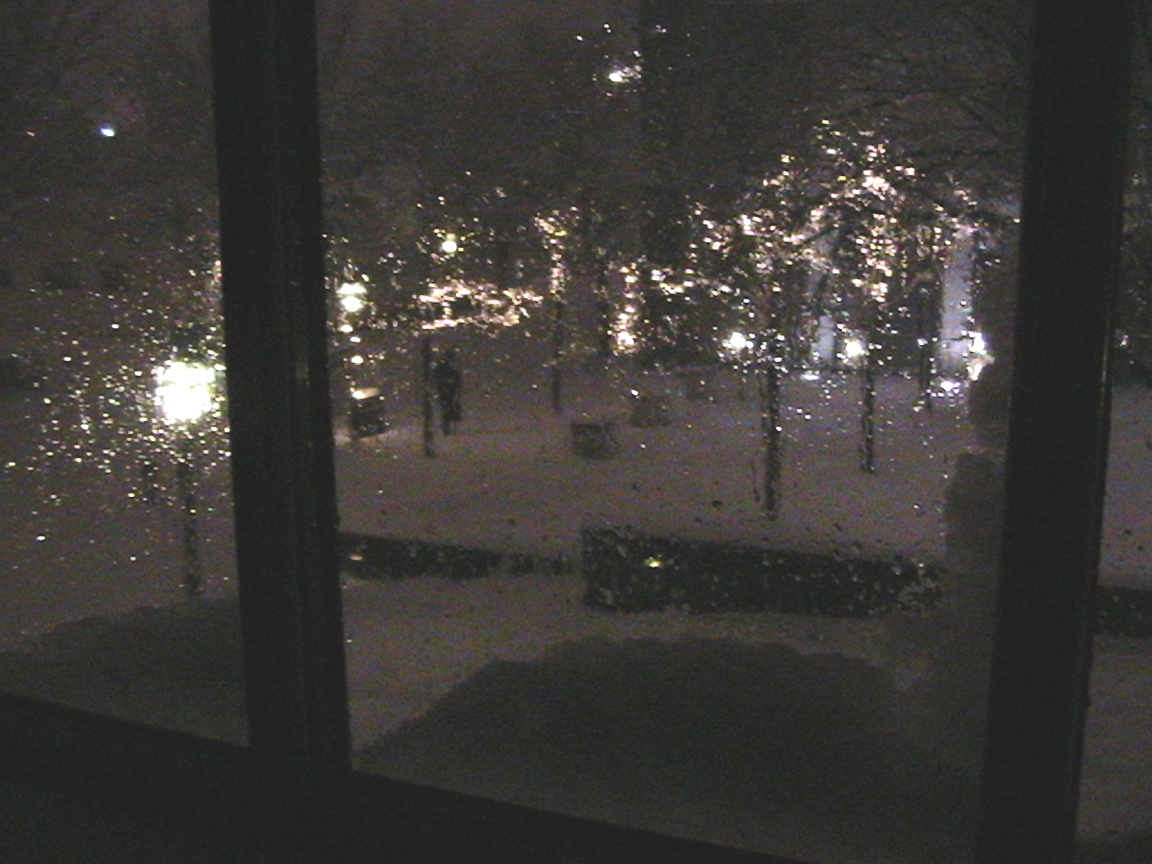
Here’s a photo taken from one of the windows of our apartment about five minutes ago. You’re looking at the lights on the trees outside the Whaling Museum. (You can also just make out the figure of Carol walking down William Street.) We have about six inches of snow so far — but now the snow seems to be tapering off, and mist and fog are mixed in with the snow.