…on this post at the Palo Alto CRE blog. Joe Chee and I talk about the skills associated with being a Unitarian Universalist, and how to teach ’em to kids.
Crab season
Carol and I both noticed the sign in Trag’s supermarket: cooked and cracked Dungeness crabs at $4.99 a pound; winter is crab season in the Bay area. We asked the man behind the counter how big a crab to get, and he said, “Sounds like you haven’t bought a crab before.” We said we had just moved from the Massachusetts coast. “Oh yeah, lobster and all that,” he said. He picked out a crab, cracked the legs, and wrapped it up for us. We took it home and ate it right away…
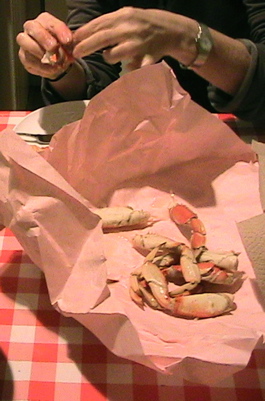
Carol had never had Dungeness crab before; I’d only had it once in a restaurant. We ate the whole crab in one sitting. It’s better than lobster, with a lighter, more delicate flavor (and no icky green stuff in the guts that you have to decide whether eat or throw away).
20th C. UU history timeline
I’m in the middle of preparing a timeline of North American Unitarian and Universalist (and Unitarian Universalist) history for an adult class. I’d love to hear from you:– in your opinion, what are the dozen or so most important 20th C. events in U, U, and UU history? (I’ll give my attempt at such a timeline later on.)
Rainy season
Thanks to El Niño, we’re getting a string of winter storms this week: high winds, cloudbursts, lightning, threats of flooding. The San José Mercury News reported at midnight last night that “effects [of yesterday’s storm] on the Peninsula were mostly minor, but widespread.”
I woke up yesterday to find that power had gone off briefly last night. The commute from San Mateo to Palo Alto was long and slow. It was raining lightly when I left San Mateo, just hard enough to run the windshield wipers. In Belmont and Redwood City, there was no rain but the announcer on the radio said there was heavy rain in the Mid-Peninsula. Within five minutes, I had driven into a cloudburst: the windshield wipers could not keep up with the rain even at the fastest setting; lightning lit up the sky; the road was an inch deep in water; and with the exception of a few idiots who chose to risk hydroplaning, traffic crawled along at 30 miles an hour. South of University Avenue in Palo Alto, the rain stopped.
I’d guess we got well over an inch of rain in the morning, most of it in a few heavy downpours. In the middle of the day, we saw the sun for a brief moment before dark clouds rolled in over the coastal range and let loose another heavy shower which turned the church’s rose garden into a two-inch deep pool of water. The rain has tapered off now, but the weather service predicts that a low pressure system will move into our area over the weekend, bringing “substantial rainfall, and with the ground already saturated hydro problems are possible.” That means more creek flooding is expected.
I wouldn’t wish flooding on anyone — but speaking as a New England expatriate, I’d rather have El Niño flooding than ice storms, blizzards, and hurricanes.
Holding one’s nose
My sister Jean sent a link to an interesting map that tries to explain why Martha Coakley lost to Scott Brown.
For me, the most important piece of information is that Democrats stayed home, while independents turned out in force. If I were still living in Massachusetts, I would have had had to hold my nose in order to vote for Coakley. Her law-and-order rhetoric sounded like she was getting paid by the prison lobby. She’s quixotically stubborn at times, so that even after Hillary Clinton released delegates to vote for Obama, Coakley refused to vote for him. While Coakley claims to support equality (broadly construed), including marriage equality, I never saw that she was much of an advocate for people who were poor or economically disadvantaged. While I could stomach her as attorney general (and yes, I voted for her in that post), I did not see here someone who would fill Ted Kennedy’s role as an advocate in the U.S. Senate for those who are poor and oppressed; indeed, she seemed no better than Scott Brown. Given those comparisons, I’m not entirely surprised that Massachusetts Democrats stayed home.
As a religious and spiritual progressive, I’m finding it more and more difficult to distinguish between political liberals and political conservatives. Both political stances seem like shallow ideologies motivated solely by party unity and retention of power, rather than humane political philosophies concerned with making life better for all people. U.S. politics seems to be driven in large part by fairly unimportant wedge issues — abortion, gun ownership, same-sex marriage, testing in schools — rather than by truly important issues like feeding the hungry, caring for children, preventing usury and exploitation of the poor. In those few areas where U.S. politics currently concerns itself with substantial issues — health care, war — the big issues are so narrowed down that they are almost meaningless.
I better stop ranting now, before my blood pressure goes up too much. As ideologues, neither Coakley nor Brown deserved to win; neither one would bother much with the real problems. And so we will continue to not feed the hungry, and not help the suffering, and not be peacemakers; and the last shall not be first because those who are first plan to stay right where they are.
Corrected 21 January, thanks to Philocrites. See comments below.
Sex, food, and giving money away
Last Sunday, we took up a collection for Haiti relief work here in the Palo Alto church; next Sunday is the formal beginning of the annual canvass, or fundraising drive. In the midst of all this, a member of the church happened to send me a column by Nicholas Kristoffy titled “Our Basic Human Pleasures: Food, Sex, and Giving.” Kristoffy writes:
“Brain scans by neuroscientists confirm that altruism carries its own rewards. A team including Dr. Jorge Moll of the National Institutes of Health found that when a research subject was encouraged to think of giving money to a charity, parts of the brain lit up that are normally associated with selfish pleasures like eating or sex.”
I’d argue that sex is not a selfish pleasure (at least, not when it involves another person). Nevertheless, giving money does feel awfully good to me — better than food, maybe not quite as good as sex. Actually, this might be a good rebuttal to the whole doctrine of original sin — if helping others makes us feel so good, doesn’t that mean we are essentially good?
Thanks to Dick D. for sending me the column.
Go, Brits!
The Newington Green and Islington Unitarians (“300 years of dissent”) in London formally inducted Rev. Andy Pakula (Britspeak for installed) as their minister yesterday — and raised £1,000 for Haiti relief.
How cool is that?
Kage Baker not doing well
Locus Online reports that science fiction author Kage Baker is in “very serious” condition, and links to a letter stating she probably has less than a year to live.
When an author is dying, what better thing to do than to read something they have written? Here’s a long story by Baker, available free online.
The new pests
Mr. Crankypants just came back from a stroll through downtown San Mateo, where, to his surprise, he saw a few smokers standing outside a bar. You hardly ever see smokers any more, and now that they are a strictly controlled species, Mr. Crankypants feels an odd sort of affection for them, especially when they are out standing in a drizzle. Remember when smokers used to blow smoke right in your face? Only those of us who are middle-aged, or who are from South Carolina, have seen people blowing smoke in the faces of others and getting away with it.
The aggressive smokers who used to blow smoke smoke in your face have been controlled, but now another invasive pest comes along to fill that ecological niche — the oblivious cell phone user. The National Safety Council says oblivious cell phone users cause at least 1.6 million traffic accidents a year, but Mr. Crankypants is talking about something less deadly. He is talking about the stupid man talking loudly on a cell phone while standing right in front of the potato chips who does not move. He is talking about the stupid woman pushing a stroller while mumbling into a cell phone and dragging a toddler (faster than the toddler can comfortably walk) who almost hits a passerby in the shins with the toddler. He is talking about the stupid man riding a bicycle while talking on a cell phone who blows through a stop sign, swerves around a car that stopped just in time, almost picks off a pedestrian in a crosswalk, and blithely keep on peddling and talking.
Like you, Mr. Crankypants is, of course, perfect, and never talks on his cell phone when he is walking on a crowded sidewalk, or while the cashier is totaling up his groceries, or while he is picking up his dog’s poop, or when he is in a one-on-one meeting with someone. A good long-term solution for the oblivious cell phone users is neutering; that will eventually put an end to their species (that, and traffic fatalities), but in the mean time Mr. C. is uncertain how to control these noxious pests.