Shared online documents as a planning tool

I’ve been using online shared spreadsheets (through Google Docs) as a congregational planning and scheduling tool for three years now. I thought I’d share some of what I’ve been doing, in hopes that others will share what they’ve been doing along these lines.

First, take a look at the Palo Alto churches “RE Grid 0910” (religious education planning grid for 2009-2010). This is an example of a moderately complicated planning grid using an online spreadsheet. Congregational planning in a mid-sized church like ours is focused on Sunday events, so moving up and down in the spreadsheet each row is designated with successive Sunday dates (the only exception is Christmas Eve, which gets its own row). Moving from left to right in the spreadsheet, we start off with columns for various Sunday morning time slots, and move into columns for specific programs (i.e., Children’s Choir, teacher training, youth programs, etc.). The religious education committee, the leaders of various programs, the church administrator, and I use this RE Grid for more efficient communication and coordination. From my point of view, what I like best is that other people can get answers to scheduling questions without having to ask me; furthermore, when we do planning, everyone is literally on the same (online) page which increases efficiency and reduces confusion.
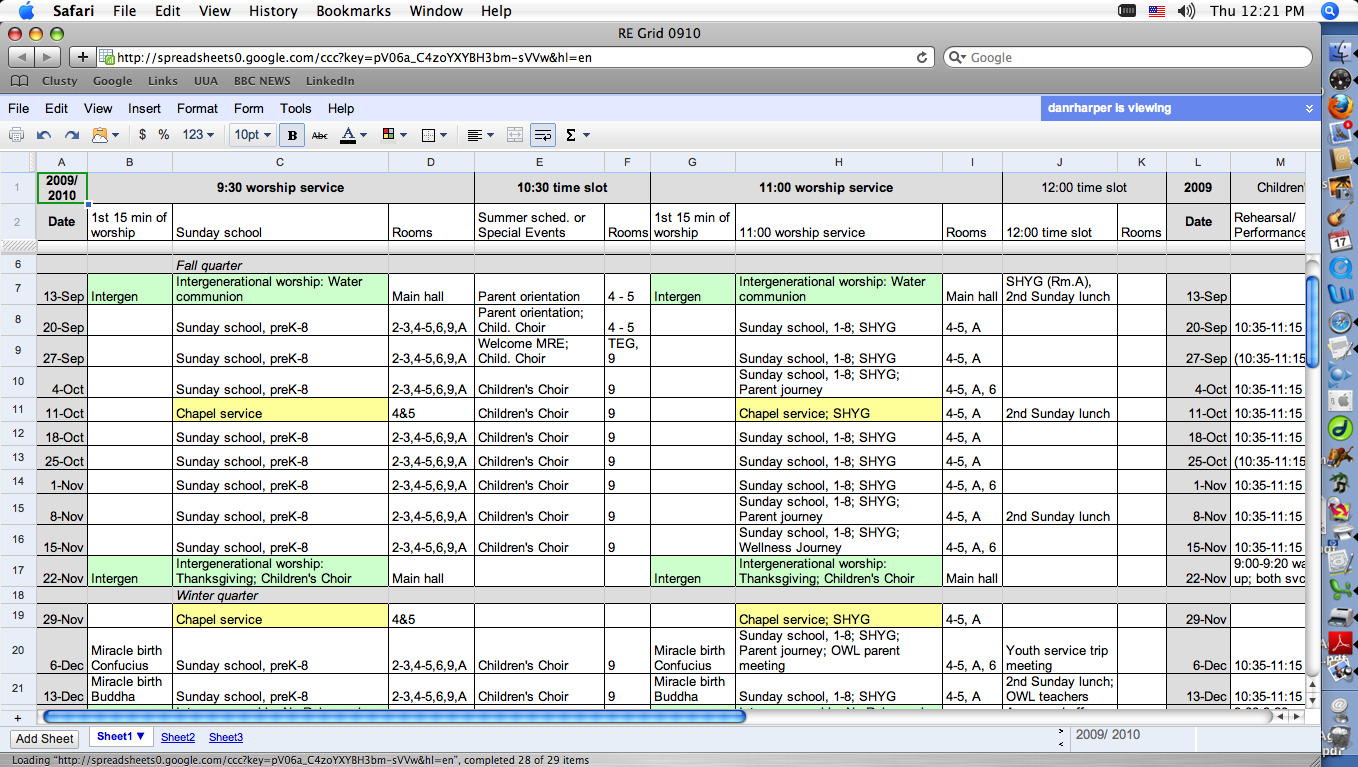
Screen shot of RE Grid mentioned above

Next, here’s a worship planning grid from a small congregation. In this congregation, the musicians were very part-time, and usually could not meet with me with me to plan worship; I used the worship planning grid to share information about sermon topics, and they used the grid to share with each other the music they were playing so we didn’t get duplication. The lay worship associates used the grid to keep track of when they were scheduled. Staff and volunteers tend to be stretched thin in small congregations, and introducing this online spreadsheet as a planning tool made all our lives easier.

Two downsides to online documents for planning: (1) there’s a strong temptation to include too much information (no good solution for this); (2) there’s a tendency to delete old information without saving a copy for future reference (I export Excel versions of Google Docs spreadsheets for archives).

I’d love to hear how other congregations have used online shared documents for planning. Tell us what you’re doing in the comments, and give us a link if your online document is public.
What do you call your children’s librarian?

In a comment, children’s librarian Abs notes that parents “insist on calling the children’s librarian ‘Miss Abby’.” Abs lives in New England, so this form of address is not sanctioned by any cultural norms. Furthermore, Abs is married and calls herself “Abs,” making this completely nonsensical. What’s going on here? Why do people use such icky, stilted, obviously incorrect forms of address?

Mr. Crankypants believes he knows what is going on. Many adults today feel that they don’t want their children to refer to other adults with such formal forms of address as “Mr. Soandso” or Ms. Soandso.” Yet these adults also feel that they don’t want their children to get too chummy with other adults, and therefore refuse to tell the child to address another adult by first name only. Therefore, these adults make up icky stilted forms of address like “Miss Abby” for married middleaged women.

Mr. Crankypants can solve this problem. If you are an adult trying to figure out what your child should call another adult, don’t just make something up; have the decency to ask that other adult. Like this: “How should my child address you?” Isn’t that easy?

And if some other adult tells their child to refer to you using some icky stilted form of address, it is perfectly correct to say, “Please tell your child to refer to me as Ms. (or Mr.) Lastname,” or “Please tell your child that s/he may refer to me as Firstname.”

If an adult persists in telling their child to refer to you with an improper form of address, Mr. Crankypants gives you permission to slap them with a fresh wet trout.

Spring

The rain stopped, the clouds went away, the plants and trees are incredibly green, and today the sky seemed impossibly blue. Right now that blue sky is beautiful.

Four months from now, after we’ve had nothing but blue sky day after day, after grasses go dormant and turn the hillsides brown, after the leaves of trees fade to dull green, I’ll be longing for the rain to return.

Mr. Crankypants is peeved but not Rev.

Mr. Crankypants has been reading Unitarian Universalist blogs, and has been noticing how many bloggers misuse the honorific “reverend.”

The most common honorifics are used separately from each other. Thus we speak of “Dr. Smith,” or “Mr. Smith,” but after Mr. Smith becomes a doctor we do not speak of “Dr. Mr. Smith.” The honorific “Reverend,” however, like “Honorable,” belongs to a group of honorifics that most properly appear with other honorifics. Thus when Dr. Wang is ordained she becomes Rev. Dr. Lily Wang; when Mr. Jones is ordained he becomes Rev. Mr. Jenkin Lloyd Jones. We commonly understand that “Rev.”, like “Mr.”, is an abbreviation; completely spelled out, “Rev. Ms. Cuervo” abbreviates “the Reverend Ms Cuervo,” just as “Hon.” abbreviates “the Honorable.”

Note that the honorific “Reverend” is used only the first time a person is mentioned; thereafter that person is referred to as Mr., Ms., or Dr. Soandso. For clarity, it is best when the first mention of the clergyperson uses both “Rev.”, followed by Mr., Ms., Dr., etc., followed by the person’s first name and last name, i.e., “Rev. Mr. Supply Belcher”.1

Mr. Crankypants has observed many improper uses of the honorific “Reverend” in the Unitarian Universalist blogosphere (and in the wider blogosphere, for that matter, an interesting case where Unitarian Universalist bloggers are no worse than other religious bloggers). Below are three hypothetical examples of ways the honorific “Reverend” is misused, along with Mr. Crankypants’s comments and corrections. Continue reading

One interpretation of the Easter story

Elaine Pagels gives this summary of the events leading up to Easter Sunday:

“Jesus’ passionate and powerful presence aroused enormous response, especially when he preached among the crowds of pilgrims gathered in Jerusalem to celebrate Passover. As the Jewish and Roman authorities well knew, tensions were high during the religious holidays when Jewish worshipers found themselves face to face with the Roman soldiers. Jesus’ near contemporary the Jewish historian Josephus, himself a governor of Galilee, tells of a Roman soldier on guard near the Temple who contemptuously exposed himself before just such a crowd, an outrage that incited a riot in which twenty thousand died. When Jesus dared enter the Temple courtyard before a certain Passover, brandishing a whip, throwing down the tables of those changing foreign money, and quoting the words of the prophet Jeremiah to attach the Temple leaders for turning God’s house into a ‘den of robbers,’ the Gospel of Mark says, ‘he would not allow any one to carry anything through the temple’ (Mark 11.16). But soon afterwards the authorities took action to prevent this firebrand village preacher from fanning the religious and nationalistic passions already smoldering among the restless crowds. The Jewish Council, eager to keep the peace, and hoping to avoid recrimination from their Roman masters, collaborated with the Roman procurator to have Jesus arrested, tried, and hastily executed on charges of having threatened to tear down the Temple single-handedly, and having conspired to rise against Rome and make himself king of the Jews (Mark 14.58-15.26).

“Jesus himself, according to the New Testament, saw himself very differently, not as a revolutionary but as a man seized by the spirit that inspired Isaiah and Jeremiah — the spirit of God — as a prophet sent to warn humankind of the approaching Kingdom of God and to offer purification to those who would listen. Repeatedly, according to the New Testament accounts, Jesus chose to risk death rather than allow himself to be silenced.” Adam, Eve, and the Serpent (New York: Random House, 1988), pp. 6-7.

Based on this Easter reading, here are two my two Easter thoughts this year:

(1) In today’s Western culture, religio-political leaders (and politico-religious leaders) like to style themselves as successors to Jesus, and followers of prophets like Jeremiah. However, history tells us that we have seen very few such leaders who actually were successors to Jesus, and many more who were instead successors to the Jerusalem’s religious leaders who were tools of the Romans. The difference between the two? Jesus answered to moral truth and to a God of humane justice; Jerusalem’s religious leaders answered to political expediency and to their political puppet masters.

(2) After Jesus was executed on trumped-up political charges, Jesus’s message was not silenced. Maybe it got seriously transmogrified by later philosophers (Augustine and Paul come to mind), but if we listen carefully we can still hear Jesus’ basic message of righteousness and humanity. Two thousand years later, that message is still very much alive; Easter is a good holiday to remember that message, and to remind ourselves to look for the strings by which many religious leaders are controlled by their puppet masters.

iPad mania in Silicon Valley

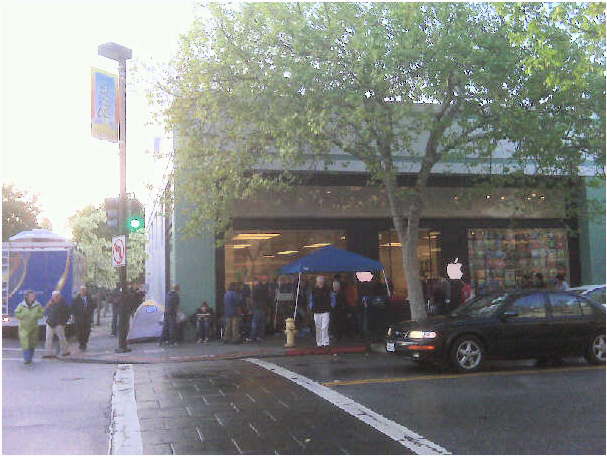
Carol took this picture of the line outside the Apple store last night. Yes, it was raining. Yes, someone brought a tent.

Right after she took this photo, Carol saw Steve Jobs getting into a silver Mercedes without a license plate. She turned to some people near here, and said, “Was that really Steve Jobs?” “Yes,” they said. “His car didn’t have a license plate,” she said. “Steve Jobs doesn’t need a license plate,” one of them said, “he has the iPad.” “We need a life,” one of the others muttered.

Unsystematic liberal theology: eschatology

Third in an occasional series of essays in unsystematic liberal theology, in which I assume theology is a literary genre more than a science, a conversation more than a monologue, descriptive rather than prescriptive.

Eschatology is that branch of theology that asks questions like: What will happen at the end of time? What will happen after death? What is our final destination?

Religious liberals tend to avoid the questions associated with eschatology, and one of the ways we avoid these questions is by allowing science to provide answers; e.g., we might say that what will happen at the end of time is governed by the second law of thermodynamics. However, such answers are often not satisfying to many religious liberals; the question as asked is usually not a question about physics or cosmology, it is a personal question related to the meaning (or lack thereof) of one’s own existence. Thus, some religious liberals with an existentialist bent might say that when you die, that’s it, that’s the end, there is nothing more; while that might not sound very comforting, that’s just the way it is.

Religious liberals who have been influenced by the Universalist tradition may draw on their tradition for a more theological answer to eschatological questions. A more traditional Universalist could say that at the end of time, all souls will be reconciled to God, and that there is no such thing as hell where eternal punishment awaits sinners. A less traditional Universalist might generalize from this Christian standpoint, and say something to the effect that we, like all living beings, will be recycled by the interdependent web of existence and the molecules that make us up will become parts of other living beings.

Some religious liberals have been strongly influenced by other religious traditions, e.g., various eastern religious traditions, and they may adopt the eschatologies of their favored tradition. Thus, for example, those who have a connection with Buddhism or Hinduism may believe that after death we are reborn into another body; those with Buddhist inclinations might say that eventually we can hope for nirvana, or nothingness, when the cycle of rebirth comes to an end.

Many religious liberals do not see any connection between our morality while we are alive, and what happens to us after we are dead. Some religious liberals, however, might see some connection between our actions in this life and what happens to us after we die: if we don’t behave well in this life we will not achieve nirvana; if we don’t behave well in life, there will be some limited period of punishment after death before our soul is reconciled to God; etc.

In general, though, religious liberals don’t worry as much about eschatology as do many other religious traditions. The emphasis of liberal religion tends to be placed strongly in the here and now, in this life. What will happen at the end of time? — that’s the wrong question to ask, ask instead what we might do here and now to make the world a better place.

Ark for sale in Acton, Mass.

Massachusetts and Rhode Island were hit by heavy rainstorms in March. Bristol County, where we were living last year, has been declared a federal disaster area; Middlesex County, where we lived seven years ago, is also a disaster area, as are Essex, Norfolk, Plymouth, Suffolk, and Worcester counties.

The photographs of flooding on the Boston Globe Web site show places that we know well: water pouring over the dam at Moody Street in Waltham, broken culvert at Route 119 in Littleton, Cambridge Turnpike in Concord closed due to flooding, Route 140 in Freetown closed due to flooding, duck boats helping people get to their houses in Wayland, flooding in Peabody, and on and on. My favorite photo was from Acton, the town where my sister lives — someone took a piece of plywood and some red spray paint to make a big sign: “ARK FOR SALE.”

If you’re in Massachusetts, I’d love to hear from you. Are you flooded out? Has it stopped raining yet?

Isaac Watts, nonconformist and… Unitarian?

The Newington Green Unitarian church have, in the past, claimed that the great English language hymnodist Isaac Watts was a Unitarian. The congregation’s Web site used to suggest that since Watts lived the last years of his life in the neighborhood, and since their chapel was the only dissenting congregation nearby, that Watts likely attended services there. The Wikipedia article on Watts quotes a 1958 history of the congregation, published on the occasion of the 250th anniversary of its founding (Trust in Freedom: The Story of Newington Green Unitarian Church 1708-1958, Michael Thorncroft, 1958), which states that Watts “in later life was known to have adopted decidedly Unitarian opinions.”

This revives what is apparently an old, old argument. In The Life of the Rev. Isaac Watts, D. D. by Samuel Johnson, LL.D., London: 1785, there are notes containing amniadversions and additions; to which are subjoined… an authentic account of his last sentiments on the Trinity”; this last-named account denies that Watts was an “Arian,” and claims him for the Trinitarian party:

“It has been confidently asserted by some Anti-trinitarians, that the Doctor before his death was come over to their party, and that he left some papers behind him, containing a recantation of his former sentiments, which his executors thought it most prudent to suppress. A report of this kind was lately revived, with the mention of some remarkable circumstances in confirmation of it, in the Monthly Review….”

All of which leads me to wonder what Watts’s theology actually was. He was a Nonconformist, of that there is no doubt. He was allied with the Congregationalist nonconformists. But did he have unitarian leanings? And if he did, wouldn’t it be deliciously ironic that the favorite hymn writer of many of today’s Christian evangelicals was in fact an Arian — a unitarian?