“Seek peace, and pursue it.”

Every Saturday at noon for the past four years, a small group of Quakers and other peaceniks have gathered on the lawn in front of the Capitol building in Washington D.C. to witness for peace. A couple of people have always brought a banner that reads: “Seek peace, and pursue it. Ps. 34:14.” The format is similar to silent meeting for worship in the manner of the Religious Society of Friends (Quakers): everyone stands in silence together; but the only spoken ministry for these public gatherings is when a passer-by happens to ask someone why they’re standing there, in which case a quiet explanation is given.

Elizabeth and I were greeted by a man who shook hands with each of us and said, “Welcome, friend”; though he could have meant meant “Friend,” which is another name for a Quaker. We stood in silence, and I centered down and meditated on the words on the banner. Near the end of the hour, a man standing next to Elizabeth started crying; she comforted him and another man brought him tissues. When the hour was over, we all shook hands with the people on either side of us, saying, “Peace,” or “Peace be with you.”

Then everyone started chatting. Elizabeth talked to the people she knew from Friends Meeting of Washington. I saw a man who was wearing a “Christian Peace Witness for Iraq” button, and we talked about the peace witness in front of the White House yesterday. The older Quakers greeted a group of students from Sidwell Friends School: “Welcome, young Friends!” The students had a group picture taken with the Capitol building as a back drop. Then we all went home to get warm.

It was a good way to observe the fourth anniversary of the invasion of Iraq. (If you’re curious, you might look up the reference to Psalm 34:14 in the King James Version of the Bible, and read the whole verse.)

My impressions of the Christian Peace Witness on Friday: Link.

Friday video: Peace witness for Iraq

Although this was originally posted on Monday, March 19, I’m backdating this post to Friday, March 16, so you can find the video by looking for the date of the event. This “street videography” gives my take on the Christian Peace Witness for Iraq that took place on March 16. The video is maybe a little too impressionistic, but I wanted to try to capture the feeling of what it was like to actually be there — boredom and all.

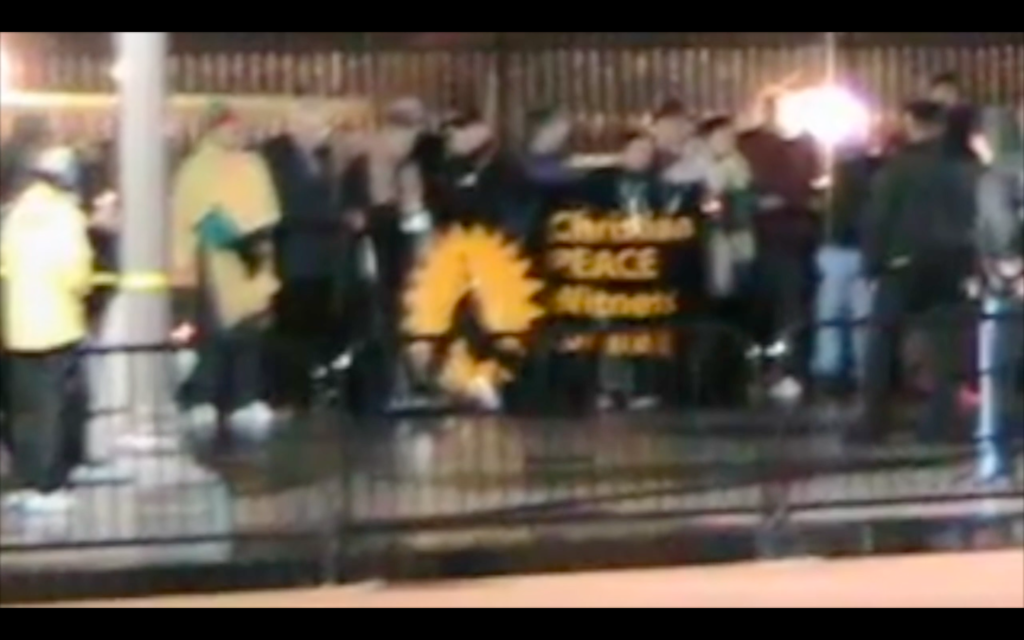
Screenshot from the video, showing demonstrators at night.

Quicktime video — Click link, and where it says “Select a format” choose “Source — Quicktime”. Wait until the file downloads to your computer, and then click play. This should work for dial-up connections, and offers higher-resolution for all connections.

Update: Lots of links to blog and media coverage of the Peace Witness at the Faith in Public Life blog.

Update: Coverage from the Washington Post, Saturday, March 17, 2007 (front page of Metro section):

Rousing emotional start for war protest
Arrests made at White House…

by Steve Vogel and Clarence Williams

Dozens of demonstrators, many of the Christian peace activists, were arrested outside the White House late last night and early this morning as a part of a protest against teh war in Iraq.

About 11:30 p.m., police began handcuffing the first of about 100 protesters who had assembled on the White House sidewalk to pray in a planned act of civili disobedience. [Note: arrests continued after reporters left, and over 200 people were eventually arrested.]

The protesters were part of a larger group that had assembled at the Washington National Cathedral for a service on the fourth anniversary of the start of the war. From the service, demonstrators marched through the wind, cold, and dampness to the White House.

The demonstration began a weekend of protest that is to include a march on the Pentagon today. Last night’s event, which was sponsored by more than two dozen religious groups, was not part of today’s antiwar rally at the Pentagon.

Those who were arrested had been among almost 3,000 people who assembled at the cathedral at 7 p.m. for a rousing, emotional service that lasted more than 90 minutes. [The reporters apparently missed the fact that there were between 500-700 people gathered at N.Y. Ave. Presbyterian Church who were also worshipping.]

Participants, whom the cathedral staff numbered at 2,825, heard speakers including Celeste Zappala of Philidelphia, whose son was killed in Iraq in 2004.

“I am here tonight as a witness to the true cost of war,” she said, “the betrayal and madness that is the war in Iraq.”

“We lay before God the sorrow that lives in all of us because of the war,” she said.

Last night’s procession was sponsored by Christian Peace Witness for Iraq….

The rest of the article (more than half of it) goes on to preview the ANSWER coalition action scheduled for Saturday.

Happy 200th, Henry

I managed to miss the two hundredth birthday of Henry Wadsworth Longfellow (27 February 1807 – 24 March 1882). A poet who is perhaps best known for his poem “Paul Revere’s Ride,” it also happens that Longfellow was a Unitarian. If you go up to visit First Parish in Portland, Maine, they will show you the pew which he and his family rented.

Longfellow’s reputation has fallen on hard times. Today, the critics dismiss his poetry as too sentimental. And the historians rightly point out the gross inaccuracies in his poems;– when I was a licensed tourist guide in Concord, Massachusetts, I had to constantly explain to people that despite what Longfellow wrote in “Paul Rever’s Ride,” Revere never made it to Concord because His Majesty’s Regulars captured him in the town of Lincoln.

Nevertheless, Longfellow’s straightforward language and imagery helped create the political mythos of the United States. I still get chills as I read the last lines of “Paul Revere’s Ride”:

In the books you have read
How the British Regulars fired and fled,–
How the farmers gave them ball for ball,
From behind each fence and farmyard wall,
Chasing the redcoats down the lane,
Then crossing the fields to emerge again
Under the trees at the turn of the road,
And only pausing to fire and load.
So through the night rode Paul Revere;–
And so through the night went his cry of alarm
To every Middlesex village and farm,–
A cry of defiance, and not of fear,
A voice in the darkness, a knock at the door,
And a word that shall echo for evermore!
For, borne on the night-wind of the past,
Through all our history, to the last,
In the hour of darkness and peril and need,
The people will waken and listen to hear
The hurrying hoof-beats of that steed,
And the midnight message of Paul Revere.

…although, in the context of the current political and military adventures of the United States, it is worth noting that Longfellow was a pacifist.

So happy 200th, Henry. Sorry I missed the actual date. But according to the Web site of the Longfellow Bicentennial, I’ll have plenty of other opportunities to celebrate — including an “evening conversation” at 6:30 tonight, at the Longfellow National Historic Site in Cambridge.

Sunday school teachers can find activity kits here: Link (scroll down and follow the link labeled “Activity Kits,” which brings up a pop-up window).

Works by Longfellow at Project Gutenberg: Link.

This just in…

Those of my readers who are able to get to Washington, D.C. this weekend, and who follow the peace witness of Jesus of Nazareth, might be interested in this:

Christian Peace Witness for Iraq will begin with a worship service on Friday, March 16 at Washington National Cathedral to be attended by more than 3,500 people of faith from 48 states, followed by a candlelight procession through the center of our nation’s capital, where thousands will surround the White House bearing the light of peace, and 700 will risk arrest by remaining in prayer in front of the White House. The service begins at 7 p.m., and the White House vigil will begin at 10:30 p.m. It will be the largest Christian peace demonstration, as well as the largest single civil disobedience action at the White House, since the beginning of the Iraq war four years ago.

More than 190 Christian and interfaith peace vigils and actions will also be held around the country in conjunction with Christian Peace Witness for Iraq– including large-scale acts of moral civil disobedience organized by Christian Peace Witness coalition member group the Declaration of Peace.

I just got an email message about this today from Katie Barge at Faith in Public Life, and am happy to pass it along to you. Want to attend, and help surround the White House with prayers? — Friday, March 16, 2007, 7 pm, at the National Cathedral, Massachusetts and Wisconsin Avenues, NW, Washington, D.C. 20016-5098. More info.

Update: My Quaker friend, Elizabeth, who lives in Washington, said she can put me up for this event, so I’ll be there. Hope to see some of you there, too!

Free wifi in North Cambridge

We’re cat-sitting again in north Cambridge, but the cat’s house only has dial-up access to the Internet. Being a cheapskate, I refuse to pay for wifi. Fortunately Carol found a great place with free wifi — Grand Prix Cafe at 2257 Mass. Ave. Good panini, huge slices of apple pie, decent coffee, and they don’t try to chase you out after an hour.

Spring watch

The incredibly warm weather this week still hasn’t melted all the ice in Cambridge — we still have to walk over a thick slab of ice when we go out the back door of the house where we’re cat-sitting. But most of the ice is gone, and I saw big fuzzy catkins on a pussywillow tree over by Alewife Brook this afternoon.

Now an unashamed intellectual

It finally hit me today. I was taking a long walk, from North Cambridge down to Lechmere Square, thinking about nothing in particular, when I realized why I have a visceral dislike of the current president of the United States. It’s not because he’s an evangelical Christian, because I get along quite well with other evangelicals. It’s not because I’m a fiscal conservative, because you can make the case that wartime calls for deficits and besides I can understand that the temptation for deficit spending is more than most politicians can resist. It’s not because I’m a pacifist, because I know full well that most politicians do not follow the non-violence teachings of Jesus of Nazareth, my spiritual leader. These are areas where I simply happen to disagree with policies that can be justified.

No, the reason I have a visceral dislike of Mr. Bush is that he is an anti-intellectual. I know, it’s ironic that he’s an anti-intellectual given that he is the product of an elite university that practically oozes intellectualism. Even so, he affects that down-home I’m-really-not-that-smart attitude, and he makes his affectation implicitly condemn anyone who claims to be smart. Not that I blame him for affecting an anti-intellectual attitude. Anti-intellectualism has always been a minor part of the United States mythos, and in the past couple of decades it has become a dominant element in the political life of this country. Mr. Bush is just one of many United States politicians who have decided to affect anti-intellectualism in order to win votes.

This prevalent anti-intellectual attitude has even managed to influence me — I’ve become more and more cautious about claiming to be an intellectual. So I’ve changed the tag-line for this blog to “Adventures of a post-Christian heretic and unashamed intellectual.”

Let’s all go out and remember to be openly smart, OK? No matter what the president says, smart is good.

A conversation you might have in Cambridge

There was only one chair open on the third floor of the Harvard Coop. I took it, sat down to read through Clear blogging: How people blogging are changing the world and how you can join them. Since I was in Cambridge, I politely ignored the man sitting in the chair on the other side of the small table from me.

A third man, a tall well-spoken man, walked up, and spoke to the other man. “Hey, how you doing? Mind if I join you?”

The well-spoken man pulled up a chair and they began talking in low voices. I was deep into the blogging book, but even so couldn’t help noticing when the well-spoken man pulled a tabloid newspaper out of his day pack and showed it to his friend. I became aware of the conversation.

“I asked him if he wasn’t fearful, saying this kind of thing,” said the well-spoken man.

“What do you mean?” said his friend, who had a West Indian accent.

“Well,” said the well-spoken man, shaking the tabloid newspaper, “what this says about the history of racism in the United States, and international African revolution…”

“But wasn’t he a white man?” said his friend.

“Yes he was a white man, but he should still be worried,” said the well-spoken man. “I talked for a while to his friend, who was also white, and he admitted that he felt some fear talking like that on the street.”

I saw that the tabloid was Burning Spear, the “Voice of the International African Revolution,” offering “real political analysis of the crisis of parasitic capitalism.” I wasn’t going to break in, but after all they were waving around a revolutionary newspaper and having this conversation in a public place within four feet of me. “He probably should be worried,” I said.

“Yes,” said the well-spoken man, encouragingly. From his vocabulary and manner of speaking, I had thought him to be a graduate student, but from his face I decided he was middle-aged.

Continuing with what they had just been saying, I said, “In today’s political climate, it’s not necessarily wise to assert that the slave economy in the U.S. allowed American businesses to develop the capital that led to our current economy we now have.” I smiled. “That’s the kind of thing that can win you an FBI file.”

The well-spoken man grinned back. But the man with the West Indian accent remained skeptical. “But you’re talking openly about this.”

“It’s Cambridge,” I said, shrugging. “And we’re sitting in the Harvard Coop. In some other place like, oh, Indiana I might feel differently.”

The well-spoken man said, “I’m glad those two white men were willing to talk openly about this. But what gets me is when black people deny what’s going on.”

That led to a discussion of which American intellectuals are willing to talk openly about race and racism. I said I admired Cornel West for taking a public stance in Race Matters and Democracy Matters. The well-spoken man was dismissive of West, and instead championed a professor of sociology currently at Harvard (who of course was African American), who apparently is more radical than West.

We talked a little about the current political climate in the United States, they asked where I had come from, and the man with the West Indian accent said, “New Bedford is a pretty rough place, isn’t it?” I told him that the murder rate in Boston was higher than in New Bedford. Before I went back to my book on blogging, it came out that the well-spoken man was not a graduate student, and was actually unemployed and living in a homeless shelter.

Then I said I shouldn’t interrupt their conversation any more, and I went back to the book on blogging, which at last I decided to buy. When I got up to leave, they were deep in a conversation about the nature of human intelligence, and whether intelligence could be accurately tested and quantified.
Splog!

Thanks to a link on Academic Blogs Wiki, I found an online article in the Harvard Journal of Law & Technology titled “Splog! or How to stop the rise of a new menace on the Internet.” I was particularly interested because of my own battles with comment spam on this blog. The article starts out with a concise definition of comment spam (which they call “link spam”) and spam blogs, and an overview of the extent of the problem. Then the authors explore the legal ramifications of trying to regulate comment spammers and spam bloggers. They conclude that some regulation would be both constitutionally allowable and realistically enforcable….

…Congress should enact a law proscribing the use of automated software to post to blogs, wikis, and blog comments. Because this approach would not target speech directly, the government can constitutionally attack the incentives of spammers. First, the proscription should codify the Central Hudson test for commercial speech. The government has a substantial interest in protecting the “user efficiency” of bloggers and Internet readers and the vitality of an important new method of speech. Also, this method of furthering the government’s interest is a “reasonable fit.” It directly advances the government’s interests by limiting the quantity of spam blogs and freeing up the blogosphere for productive free speech activity. Furthermore, it is not more extensive or intrusive then it needs to be, since it prevents spam blogs from proliferating in great numbers but does not prevent any particular type of speech from being posted to the Internet. In fact, the law would function much like certain portions of the CAN-SPAM Act, already enacted into law.

A ban on automatically created spam blogs and link spam should withstand constitutional analysis even if some spam is found to be non-commercial speech. The proposed regulation is content-neutral in that it is “justified without reference to the content of the regulated speech” posted to the Internet. Any currently posted spam blog could be re-posted without offending the new law, as long as it is not reposted with automated software. As such, the law is a content-neutral manner restriction on posting material to the Internet. Furthermore, it is an acceptable manner restriction because it is narrowly tailored to the problem being addressed — the large quantity of spam blogs and comment spam — and “leave[s] open ample alternative channels for communication of the information.” As noted, the spammers can still use the same forums and avenues for spamming, just without the benefit of automated programs and open proxies. Indeed, such a regulation would be akin to laws that prevent the use of loudspeakers on city streets or limit decibel levels at concerts. Spammers can still get their “message” across, just at lower “volumes.”

[pp. 483-484, Harvard Journal of Law & Technology, vol. 19 no. 2, spring 2006.]

The authors are fairly realistic about the possibility of enforcement — such legislation won’t eliminate comment spam and spam blogs, but at least it provides a minimal level of legal protection. Or I’d say this: at least it would show that Congress is committed to protecting authentic free speech on the Internet, which would in fact mean a lot to me as a blogger.

Right now, the Bad Guys are winning the range war here in Blogger Gulch, and the Good Guys (like me) are feeling like the Marshall in our little town is more interested in catching rustlers in the next county, than catching the rustlers stealing our cattle right under his nose. It almost feels as if the Marshall isn’t really interested in protecting free speech at all, he’s just interested in shooting off his gun (to hopelessly mix metaphors).

The complete article is worth reading for anyone interested in the intersection of free speech and new technology.

Link.