No assumptions

Thinking about UU Emergence (an awkward term, but there it is) means thinking about what will draw emerging generations to our churches. I remember when I was a 20-something attending a UU church, many of the cultural references in sermons had no emotional resonance for me: I didn’t get why the Korean War was fought, I didn’t remember the day JFK was shot, etc. Fast forward two decades: now I read Beloit College’s very useful Mindset List, which attempts to help us older folks understand the worldview of this year’s 18-year-olds:

Beloit College’s Mindset List® for the Class of 2011:

Most of the students entering College this fall, members of the Class of 2011, were born in 1989. For them, Alvin Ailey, Andrei Sakharov, Huey Newton, Emperor Hirohito, Ted Bundy, Abbie Hoffman, and Don the Beachcomber have always been dead…. [etc….]

Beloit’s list is a little tame. Over on the blog Charlie’s Diary, Charles Stross and commenters offer their own additions to the Beloit College list, often from a U.K. perspective:

Nobody they know expects to ever hold a job for more than three years.
Homosexuality has always been legal. Abortion has always been legal….
Nobody they know who is under 36 and not already a home-owner expects to ever be rich enough to buy a house….

Not that preachers can’t make references to Watergate and Sid Vicious, it’s just that we can’t assume that anyone will know what we’re talking about. Maybe that’s a more general issue with postmodern culture: there are fewer things we can assume that everyone knows….

Universalism in New Bedford

I’m on study leave this week, and today I’ve been doing a little research on 19th C. Universalism in New Bedford.

There’s some good stories buried in the mass (mess?) of data below: material about the Universalist Hosea Knowlton, who was the prosecutor during the Lizzie Borden trial; about Nathan Johnson, an African American who was a member of the Universalist church in New Bedford c. 1840; about Rev. W. C. Stiles, who converted from Universalism to “orthodox” Congregationalism in 1880; and more.

Since this won’t appeal to everyone, I’ll put the bulk of the material after a jump…. Continue reading

Mr. Crankypants is a fiscal conservative

Over on FUUSE, Bart Frost reports that the Steering Committee of Young Religious Unitarian Universalists (YRUU) have announced that their funding will be cut off as of June 30, 2008. Bart reprints the letter from the YRUU Steering Committee Facebook page which announces the funding cut. Bart adds that this effectively means the end of YRUU Steering Committee; and presumably this also means the end of YRUU as a semi-autonomous entity. Fiscal conservative that he is, Mr. Crankypants is quietly pleased by this announcement.

It’s too bad this had to happen, but Mr. C. has the sense that the continental YRUU hierarchy has made itself increasingly irrelevant over the past decade or so. YRUU-sponsored continental events, such as the now-defunct Continental Conference (ConCon), looked like insider events, restricted to the very few teens who could afford to attend; continental YRUU offered local congregations few or no services; and in general, YRUU has been largely irrelevant to the lives of the teens that Mr. Crankypants has gotten to know in local churches. So it makes sense to cut off denominational funding to YRUU, since that money served only a small minority of all Unitarian Universalists; better to reallocate that money to a line item in the denominational budget that serves more people.

Of course, if you’re a fiscal conservative like Mr. Crankypants, you’ll see some parallels here between the YRUU situation, and General Assembly (GA). GA serves a few people very well, but they are a tiny minority of all Unitarian Universalists. GA can feel like an insider event that is often restricted to those who can afford to attend (very few congregations can afford to send lay leaders to GA every year). Although it often does provide a great experience to the lay leaders who can manage to attend, GA offers little in the way of direct services to congregations (and congregations, not individuals, should be the primary stakeholders, since they are the entities that foot the bill for GA). So it makes sense to cut back on funding to GA, since that money only serves a minority of all Unitarian Universalists.

As a fiscal conservative, Mr. Crankypants is fond of appropriate budget cuts (especially when such cuts are made in conjunction with an increased emphasis on fundraising, and in reference to needs of stakeholders). Shall we be pleased that the denomination’s Board of Trustees is taking a hard look at where they might cut fat in the budget? We shall, as much as we may miss that fat when it’s cut. Perhaps the Board will next turn their attention to cutting fat out of GA….

Update, Feb. 14: Follow-up post here. Before you post a comment, please go read the follow-up post.

Singing together

In the spirit of thinking out loud…

Today’s New York Times has an earnest article about community singalongs (on the front page of the Arts and Leisure section), which got me thinking. The article, “Shared Song, Cultural Memory” by Ben Ratliff, starts off like this:

EAST LANSING, Mich. They meet on the first Monday of the month at the Universalist Unitarian [sic] Church here, not to worship but to sing. Just to sing. There are song leaders, some with a guitar or banjo or an autoharp, but this isn’t a class or a choir; the singers, not the leaders, choose the tunes. Most hold copies of a spiral-bound songbook of folk music called Rise Up Singing. They perform songs like “Keep On the Sunny Side” and “This Land Is Your Land.” No one minds a voice gone off-key.

From Hawaii to Santa Cruz to the Philadelphia suburbs, in living rooms, churches, and festival tents, similar gatherings — called community sings, or singalongs — draw together the average-voice and bring old songs into common memory.

Anyone who has hung around mainline churches, or folk music circles, long enough will recognize the phenomenon Ratliff describes — although I have heard them called “song circles,” or even “Rise Up Singing” after the book that is commonly used, but not “community sings” (which is perhaps a midwestern term?). The Unitarian Universalist church I grew up in has a monthly song circle they call “Rise Up Singing,” which last I heard was attracting about twenty people a month. Summer church camps of all denominations frequently feature informal group singing sessions. It’s a fairly widespread phenomenon, worth paying attention to.

This is a long post, so I’ll put a break here — read on if you’re interested! Continue reading

Death’s heads and sunrises

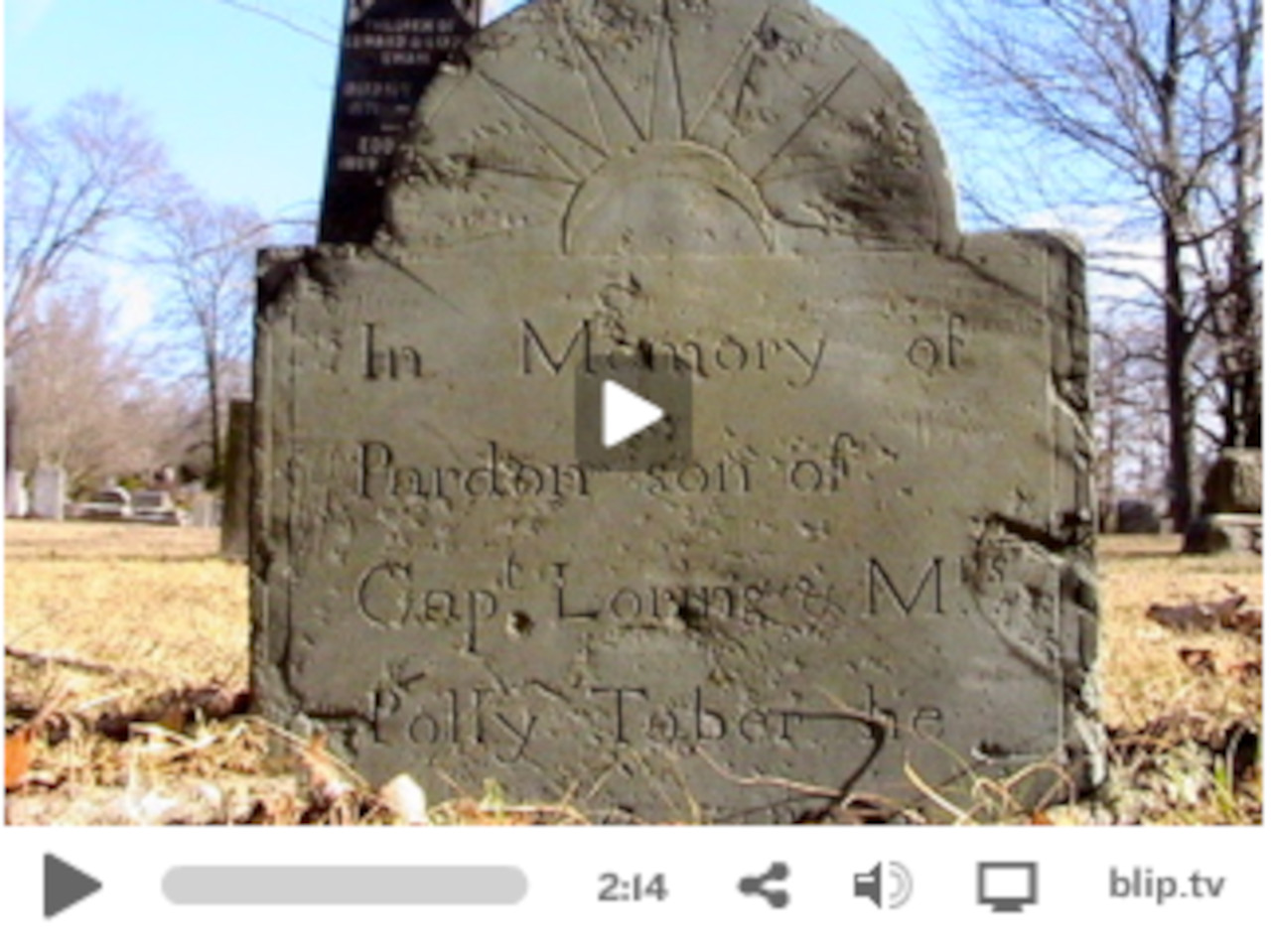
Screen grab from the video showing a gravestone.

I’m giving a talk on Puritan-era gravestones this Thursday, and I’ve been obsessing over the slides I’m going to show during the talk. So I had this idea of doing a sort of music video with death’s heads and cherubs and other images from gravestones, all jumping around to the music. Well, I don’t have the time to do something like that, so I made this video instead… which I admit is a little quirky.

[For you gravestone geeks out there, the stones were photographed at Old Hill Burying Ground in Concord, Mass. (most of the ones in the first third of the video, including those carved by the Lamson family and the Worcester family), the old burying ground in Acushnet, Mass. (many of the broken stones are from there, including the one that appears to be carved by one of Stevens family from Newport), the Naskatucket graveyard in Fairhaven, Mass. (including another possible Stevens stone and the phenomenal sunrise stone towards the end), and Westport Friends burying ground (the granite stone marked “R.B” comes from there).]

2:13.

Note: video host blip.tv is defunct, so this video no longer exists.

Winter memory

This must have happened when I was in fourth or fifth grade; my older sister Jean would have been in sixth or seventh grade, and my younger sister Abby would have been a baby. We had all finished dinner, and we were sitting around the dinner table talking. We must have been talking about school and our teachers, because somehow we asked dad about the teachers he had had when he was a kid. (Mom didn’t get involved in this conversation; perhaps she was dealing with Abby.) Dad said he could only remember a few of his teachers. Jean and I said we could remember all of our teachers, and then we each proceeded to name them all. And I have a vivid memory of sitting there at one end of that dining room table thinking to myself, “How can Dad possibly forget his teachers? I’ll always remember my teachers.”

Here I am, now about the same age as Dad was at the time of that dinner table conversation. Can I remember all my elementary school teachers now? Here are the ones I can remember: Miss Sheehan (whom I didn’t like one bit), Mrs. Blanchard (whom I adored, and who read to us from the “Twilight Animal Series” books every day), Mr. Hoffman (whom I had two years in a row, and whom I liked, but who failed to teach me arithmetic). But who was my first grade teacher? was her name Mrs. Witcher? or was that my kindergarten teacher? — So much for always remembering all my elementary school teachers.

How old was I when I began to forget my teachers?

To go, or not to go?

I’ll be going to General Assembly, the annual gathering of United States Unitarian Universalists, this June. Many other Unitarian Universalists have decided not to attend this year, because General Assembly will be held at the Fort Lauderdale convention center — which, as it happens, is within the security boundaries of Port Everglades, a bustling port that requires government-issued identification for anyone who enters — which means that “for better or for worse, it will be the United States government that decides who can or cannot be with us — in worship, in community, and in our plenary sessions,” according to Rosemary Bray McNatt. That’s a pretty creepy thought.

I’ll be going, in spite of the creepiness of the United States government checking my identification before I can enter a worship service. I guess I have never believed that General Assembly is an open meeting. For more than half my working life, I have worked jobs where I would have found it difficult to find the money to pay to travel long distances and stay in hotels for five days while attending General Assembly — assuming that I could have even gotten the time off from work.

General Assembly has always erected huge economic barriers to participation by many (probably most) Unitarian Universalists. Every once in a while, that fact is mentioned in passing, but it is usually dismissed offhandedly. I find it harder to dismiss this fact. The central purpose of General Assembly is for duly appointed delegates from congregations to transact the business of the Unitarian Universalist Association in an allegedly democratic process. The economic barriers to attendance at General Assembly — barriers which keep many potential delegates from attending — mean it’s not a real democracy.

Then there’s the undeniable fact that having thousands of people travel each year to General Assembly releases huge amounts of greenhouse gases into the air. Other denominations, much bigger than ours, get along fine with general meetings every second year, or even every four years. With the latest projections that the Arctic ice cap will melt by 2013, how can I in good conscience get on a jetliner to attend a meeting that I feel does not need to be held every year? How can I in good conscience contribute to the desertification of central Africa and the flooding of Bangladesh, just so I can attend General Assembly every year? (I’ll be taking the train again this year instead of flying, which will cut my pollution enormously — about 990 lbs. of CO2, as opposed to about 1,930 lbs. if I flew, or 1,160 if I drove, according to carbonfund.org.)

So why am I going to General Assembly this year? For the simple reason that I volunteered to serve as a reporter for the UUA Web site. From a selfish point of view, this is a fantastic learning experience for me, a chance to hang out with geeks, videographers, photographers, writers, and editors who are all far more talented than I. Less selfishly, I feel that reneging on my commitment at this late date would be worse than tolerating the insanity of security checkpoints.

As for next year, I don’t know. The insanity of security checkpoints hasn’t stopped me this year, but the idiocy of an effective economic oligarchy and the heavy environmental cost may well keep me away from General Assembly next year.
Just the facts, ma’am

As the United States news media focuses on campaign minutiae — like the ongoing New York Times in-depth coverage of campaign advertisements (who cares?), and the fluffy personality pieces about candidate spouses — it’s hard to find solid factual information. So I turn to the BBC news Web site, which now features US elections map: state-by-state guide, an interactive map which shows who won (or is projected to win) how many delegates in which states.

Speaking of terrible election coverage, our local daily newspaper, the New Bedford Standard Times, never seems to have reported the result of many of our local elections last fall. They give us in-depth coverage of the Patriots (which is covered far better by the big regional papers like the Boston Globe), but ignore such important news stories as who won the New Bedford school committee race. I learned who was elected to the school committee from the local freebie paper, The Weekly Compass.

No wonder newspaper readership is rapidly declining in the United States. They feed us pundits and pablum, and expect us to suck it down and like it. When readers like me turn to the Web for our news — because that’s where we can get the facts we’re looking for, instead of pundits and pablum — the newspapers howl that blogs don’t provide “real journalism.” As it happens, blogs like Justin Webb’s BBC blog have given me more real news and factual information on the U.S. election than the New York Slime or the Wall Street Urinal.

Too bad, because I’m actually very fond of newspapers. But it seems to me they’re doing the damage to themselves, by not providing the facts readers want.