Nice piece by a white writer on writing and race here.
Via.
This judgment of Ralph Waldo Emerson is reported by Julia Ward Howe in her Reminiscences: 1819-1899:
“Theodore Parker once said to me, ‘I do not consider Emerson a philosopher, but a poet lacking the accomplishment of rhyme.’ ”
Coming from Parker, who could at least pretend to be a philosopher/theologian, that’s a fairly harsh thing to say. After she reports Parker’s bon mot, Howe, who considered herself a poet, goes on to add her own judgment:
“This may not be altogether true, but it is worth remembering…. The deep intuitions, the original and startling combinations, the sometimes whimsical beauty of his illustrations,– all these belong rather to the domain of poetry than to that of philosophy…. Despite his rather defective sense of rhythm, his poems are divine snatches of melody….”
I think Howe and Parker are right: Emerson is more of a poet than a philosopher. Since Emerson remains the most important philosopher/theologian of North American Unitarianism, that has some interesting implications for who we are today.
We have a Folk Choir here at First Unitarian in New Bedford, and I’ve been searching out repertoire for this group. My general criteria: songs that are easily singable, songs that are good for untrained voices, songs that sound good when accompanied by guitar or other folk instrument, well-known songs by folkish singer-songwriters, and/or songs with robust folk harmonies.
So I scanned the current Unitarian Universalist (UU) hymnal, Singing the Living Tradition, and the UU hymnal supplement Singing the Journey, for folkish songs. I also went through Rise Up Singing, the popular group singing songbook, and found quite a few songs there that were worth considering for liberal religious worship services. Finally, I found shape note songs in Singing the Living Tradition that are also contained in The Sacred Harp, the widespread shape note hymnal, and/or contained in the online Southern Harmony, another easily-available shape note hymnal.
All told, I came up with more than a hundred folkish hymns, which are listed on three pages (links below). I value your corrections and additions — simply add a comment to one of the specific pages below. If you have suggestions of other folkish songs that would do well in a UU worship service, add them to the comments on this page.
Folkish hymns and songs in Singing the Living Tradition and Singing the Journey. 70+ songs that are also included in Rise Up Singing (which has guitar chords for most songs). Another dozen songs in SLT and STJ but not in RUS which are fairly folkish-sounding.
Rise Up Singing as a UU hymnal. 30+ songs from this songbook that are suitable for use in UU worship services. List includes songs by Bob Dylan and the Beatles, and classic songs like “Never Turning Back” and “All God’s Critters.” (Does not include the 70+ songs listed on the above page).
Shape note hymns in Singing the Living Tradition. With references to The Sacred Harp (1991 edition), and references and links to The Southern Harmony (online 1854 edition, with MIDI files and some live recordings of these tunes). In many cases, the tunes in Singing the Living Tradition have been slightly altered (often not for the better); and generally speaking, the arrangements in SLT pale in comparison to the robust harmonies of the shape note hymnals.
Other folkish songs suitable for use in worship: Songs not contained in any of the above sources, some including sheet music and/or lyrics.
This afternoon, when I walked out to my car, it was covered in pollen: spots of yellow about an eighth of an inch or less in diameter all over the burgundy paint of the car. It looked as though the tree under which it had been parked had dropped little pollen bombs all over it.
When Bill and I were setting up for tonight’s concert at the church, he heard me coughing. “New Bedford is number three in the state for high pollen count,” he said.
No wonder I felt slow and out-of-it all day. I’ve been breathing pollen soup, not air.
A discussion of tactics between the lawyer Perry Mason and the private detective Paul Drake that occurs on page 128 of The Case of the Amorous Aunt by Erle Stanley Gardner:
“ ‘Tomorrow I’m going to be dignified, injured, and perhaps just a little dazed by the rapidity of developments.’
“ ‘Are you going to be an injured martyr or are you going to get mad?’ Drake asked.
“ ‘It depends on which way will do my client the most good,’ Mason told him.
“ ‘My best hunch is that you should get mad,’ Drake said.
“ ‘We’ll think it over,’ Mason said.
“ ‘Won’t you get mad anyway?’ Drake said.
“ ‘A good lawyer can always get mad if somebody pays him for it, but after you’ve been paid a few times for getting good and mad, you hate like the deuce to get mad on your own when nobody’s paying you for it.’
“Drake grinned. ‘You lawyers,’ he said.”
Well. I feel a little odd agreeing with a fictional lawyer, but it occurs to me that that religious professionals are wasting their time if they get mad while at church, unless they’re getting paid to get mad. I guess what I mean to say is this: while getting mad is a natural reaction to many things that happen in church life, you rarely get anything out of getting mad, except getting mad.
Not that I think we should draw life lessons from a pulp fiction hero.
I’ve been looking through some shape-note hymnals, and came across this interesting tidbit in The Norumbega Harmony, in the introductory essay by Stephen Marini*:
“The greatest musical influence in Maine… was Supply Belcher…. Belcher’s primary successor was Abraham Maxim, a native of Plymouth County, Massachusetts, who settled during the 17090s in Turner [Maine], where he taught singing schools and converted to Universalism. Maxim’s Oriental Harmony (1802) and Northern Harmony (1805) reflect the [William] Billings-Belcher influence that thoroughly dominated Maine’s singing school tradition.”
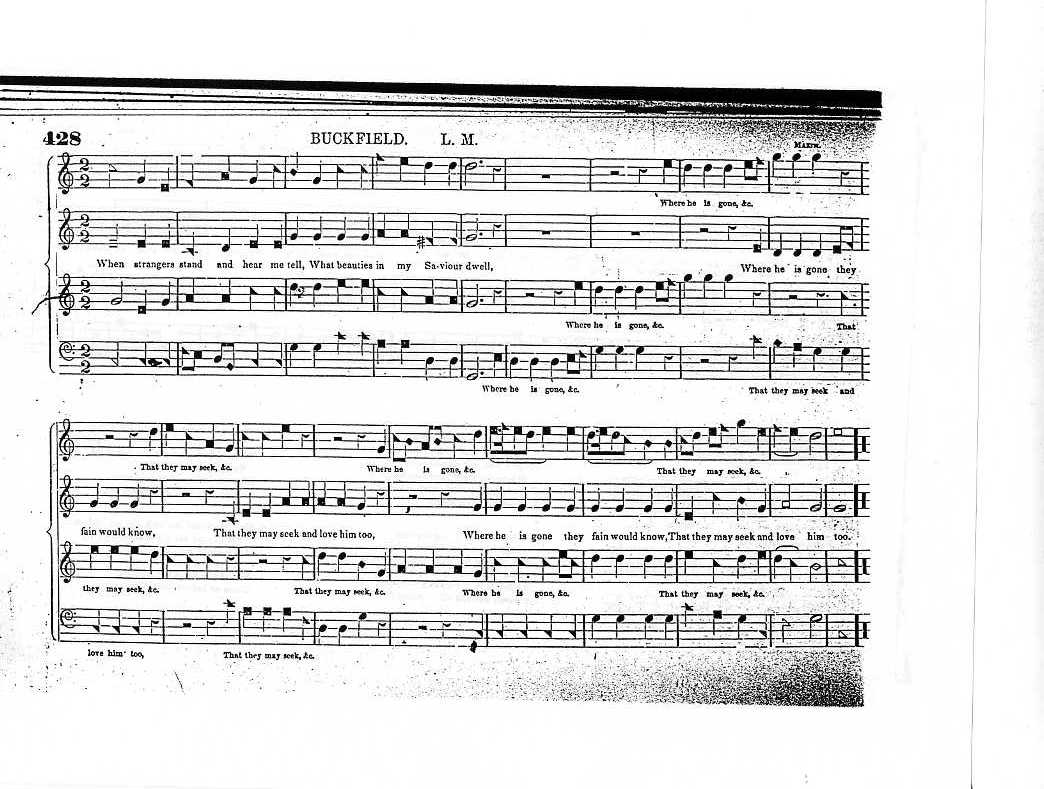
Although he is little more than a footnote today, Maxim (b. 1773 – d. 1829 Palmyra, Somerset County, Maine) must be the earliest North American Universalist composer whose works survive today. The Norumbega Harmony contains two compositions by Maxim, settings of hymns by Isaac Watts. Both compositions are fuguing tunes (for the record, Buckfield, p. 166 is an L.M. tune; Machais, p. 169, is a P.M. tune), and a quick look reveals that both seem musically interesting. Universalist hymnodists and choirs, take note!
* Stephen Marini is the historian who wrote the ground-breaking Radical Sects of Revolutionary New England, a third of which book covered the indigenous Universalism of central New England; thus Marini knows his early New England Universalism. Marini’s other major scholarly publication is Sacred Song in America: Religion, Music, and Public Culture.
Check out this Cthulhu diorama.
Martin Marty writes about the Barack Obama / Jeremiah Wright ruckus in the most recent issue of Christian Century magazine. Marty begins by saying: “This spring a certain Christian layperson has been criticized for not exiting his local church when he disagreed with something his pastor preached.” Just framing the Obama/Wright ruckus in this way shows how silly the whole thing is. Good grief, if everyone who disagreed with something I’ve preached left First Unitarian in New Bedford, the pews would be empty.
Perhaps Obama is just showing what is probably true of every American politician — that he values his political ambitions more than he values a religious community that has nurtured him and his family. Maybe that’s just the price you have to pay to become president of the United States, and maybe if you’re a black man playing politics in the United States the price is a lot higher — after all, we have heard nothing about McCain’s minister, or Clinton’s minister, yet surely they have each said things that would be politically embarrassing. And none of this reflects well on the American political process.
Well, you should go read Marty’s column (Link) — it’s funny and made me laugh. Given the sorry state of this presidential election, I needed a good laugh.
This afternoon, the First Universalist Society in Franklin, Mass., installed Rev. Ann Willever as their Family Minister. I’ve know Ann since both of us were non-ordained Directors of Religious Education, so of course I went to this installation (Ann even asked me to give the opening words!). This is a big step for First Universalist — they had dwindled away to almost nothing by the early 1970s, and sold their old church building. But unlike the many churches that closed down during that decade of economic downturn and social turmoil, First Universalist managed to hold on. They met in rented space, and persevered, and grew big enough to afford one full-time minister, and grew some more and added a very part-time Director of Religious Education, and then a few years ago they got big enough and bold enough to build a new church building, and then they needed space for Sunday school and weekday meetings so they held a “Miracle Sunday” and raised enough money on one Sunday to pay for the new building, and now they have added a second called minister to their staff.
You may say, This is no miracle, this is simply an example of perseverance and hard work. That is true. But one thing I noticed this afternoon at the installation service: everyone in that church was pleasant, and kind, and they obviously cared for one another, and the children and teenagers were obviously loved and cared for by the adults. It was just a lovely community to be a part of, even for just a couple of hours on one Sunday afternoon. It is a loving community, not in the sappy sense, but in the real honest sense of a community that loves one another through respect and care. That’s the real miracle: the means by which this was all accomplished was actually not hard work (though hard work was required) nor perseverance (though that too was required); the means by which all this was accomplished was love. Call me maudlin, but that’s what I call a Universalist miracle.