Category Archives: Ecology, religion, justice

Marriage equality in Mass.

This just in from the Religious Coalition for the Freedom To Marry:

SJC can’t force legislature to vote
Email Your Legislators Today
Come to the State House on Jan. 2

Good News. The Supreme Judicial Court ruled today that it cannot force the legislature to vote on the anti-gay amendment on Jan. 2nd. Troubling News. But legislators are feeling pressured. The Boston Globe today reported that Romney is threatening legislators into advancing the anti-gay amendment by holding up their pay raises, which are supposed to be automatic.

It’s crucial to email your legislators , urging them stop the ballot initiative amendment when they reconvene on January 2, the last day of the session, by adjourning the convention.

Please email your legislators today. We have only 5 days to the ConCon. Click here to quickly find the contact information for your legislator(s).

Rally for Equality
State House
Tuesday, January 2, 2007
7:30 AM – all day

Bring your banners and wear your equality stoles and/or vestments. Encourage your congregants and friends to join you.

Consider yourself hereby encouraged to join me on January 2 outside the State House!

Election Day snippets

Our polling place is in the old New Bedford Hotel. But Carol had not changed her place of residence properly (no, it wasn’t voting fraud or conspiracy, it was Carol’s mistake). So I’m the only one in our house who voted. And then I was the only voter in the polling place at 7:30 p.m. — me, seven poll workers, and one cop. I asked if it was a good turnout in our precinct. The poll workers just shrugged.

Since this blog is my private blog, with no connection to the congregation I serve as minister, I can safely express political opinions here that would give the IRS conniption fits if I said them at church….

I voted to re-elect Ted Kennedy even though his stand against the Cape Wind project is utterly selfish and immoral. Global warming is real, it’s happening, and wind power makes sense here in windy Massachusetts. I cannot imagine why Kennedy, usually so strong on environmental issues, is throwing all of his weight (and probably a fair amount of his money) into ending Cape Wind — unless it’s because he selfishly doesn’t want to see a wind farm from the Kennedy family compound in Hyannis on Cape Cod. Ted, Ted, Ted:– wind farms are the new chic landscape feature; all the rich people like you want to be able to see a wind farm these days.

The thing is, Ted Kennedy is also one of the few senators who can be counted on to stand up to the current administration’s handling of the Iraq war. As a pacifist who takes the teachings of Jesus seriously, I believe all war is bad. But this current war is beyond bad:– in my opinion, it can no longer be justified by the standard Western criteria for just wars; therefore, we are currently engaged in an immoral war. The immorality of Kennedy’s stand on wind power is more than balanced by the morality of his stand against the Iraq war.

For the second time in my life, I got to vote for congressman Barney Frank (the first time was when I was in seminary at Andover Newton, which through the miracles of gerrymandering is in the same congressional district as New Bedford). So what if he’s running unopposed again — I enjoyed voting for Barney Frank.

State senator Mark Montigny and state representative Tony Cabral got my votes, in large part because of their strong stands in favor of same-sex marriage.

I did vote for a Green-Rainbow party candidate — Jill Stein for Scretary of State in Massachusetts. Interstingly, she was endorsed by the New Bedford Standard-Times, who wrote: “We recognize that Jill Stein, the Green-Rainbow Party candidate for Secretary of State, is a long shot to unseat Democratic incumbent William Galvin. But our endorsement of the physician and open government advocate from Lexington and your vote for her will send an important message. The voters need an activist secretary of state who will open up government on Beacon Hill….” I have to admit that my vote was as much a vote against Galvin as it was a vote in support of Stein.

Deval Patrick better win… that’s all I’m going to say about the governor’s race.

Election Day is not my biggest political concern right now. I’m more worried about the constitutional convention here in Massachusetts on Thursday, conveniently scheduled after Election Day so the pols can vote as they please and not suffer any consequences at the polls (grr…). If the opponents of same-sex marriage get fifty votes on Thursday, there will be another constitutional convention in 2008, and at that time the convention could vote to put an anti-same-sex-marriage question on the ballot. I’ll be attending the big rally in support of same sex marriage in front of the State House on Thursday [Link] — I’ll be there in the morning, and I hope to see you there, too.

On reading Kenko

The colder autumn weather has finally begun. While I was on spiritual retreat in Wareham early in the week, I managed to take a couple of long walks. My morning walk on Tuesday took me through an old tennis court at the retreat center, now unused except for one small corner where someone has painted a classical, concentric labyrinth. A line of milkweed stalks had managed to grow up through a crack in the pavement during the summer. By the time I walked past them, the stalks were yellowed, and the few leaves that were left were gray, curled, and dead. I find milkweed plants to be most beautiful when they have died from frost:– the curled leaves take on fantastic shapes, the gray pimpled seed pods burst open releasing the seeds with their white downy parachutes that will enable the wind to spread the seeds far afield.

In the middle of the woods — I had gotten off the path chasing some small brown woodland bird — I came across a few ferns that still had a little green. Most of the ferns in the forest had been bitten by frost, curled and brown. Yet in this one clump, presumably more sheltered, I found one frond mostly green, another frond mostly yellow with a touch of faded green, another frond brown at the top and yellow lower down, and the rest of the fronds brown and curled and dead. A month of autumn visible in one clump of ferns.

On my way to Agawam Cemtery, a couple of miles away, I passed a cranberry bog looking reddish purple in the slanting afternoon light. The berries had already been ahrvested, but the bog had a quiet beauty nonetheless.

In 1330 in the Tsurezuregusa, the Japanese writer Kenko said:

Are we to look at cherry blossoms only in full bloom, the moon only when it is cloudless? To long for the moon while looking on the rain, to lower the blinds and be unaware of the passing of the spring — these are even more deeply moving. Branches about to blossom or gardens strewn with faded flowers are worthier of our admiration. Are poems written on such themes as “Going to view the cherry blossoms only to find they had scattered” or “On being prevented from visiting the blossoms” inferior to those on “Seeing the blossoms”? People commonly regret that the cherry blossoms scatter or that the moon sinks in the sky, and this is natural; but only an exceptionally insensitive man would say, “This branch and that branch have lost their blossoms. There is nothing worth seeing now.” In all things, it is the beginnings and ends that are interesting….

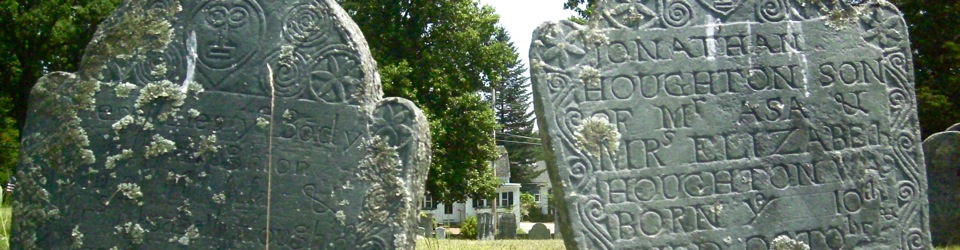
When I got to Agawam Cemetery, I searched out the oldest gravestones. You can tell the general age of New England gravestones from their shapes, and the type of stone from which they are cut. I found twenty or thirty slate stones that clearly dated from the last half of the 18th C., mostly from the Federal era but some earlier. Most of the 18th C. stones in Agawam Cemetery are shallowly carved and covered more or less in lichen, and in most cases the lichens completely obliterate the inscription. The inscriptions half seen, half guessed at and half covered in lichen, are just as fascinating as stones where the entire inscription is visible. On one of the most beautiful stones, the inscription was no longer visible, the inscribed surface was actually flaking away; the beauty lay in its deterioration.

Walking back from the cemetery to the retreat center, I walked through suburban houses on their tight little lots. Since this is a seaside town in which the population explodes in the summer, “No Trespassing” signs appear everywhere. I passed a new house going in, a bulldozer parked beside the house, the entire lot scraped clean, showing the poor, sandy soil. The pine and oak woods that used to cover the land here were cut down for farming, grew back up again when the farms failed, and now the woods are being cut down once again for summer houses and gated communities.

More than one sign at the beginning of a road declared: “Members and Their Guests Only.” If they didn’t have those signs, the pressure from the growing population would mean the property owners would have invaders constantly traipsing through their land, past their summer house, headed for the sea. Can we say that the suburban houses, the gated communities, the signs are any less beautiful than the pine and oak woods they replace? For how long can the houses and signs last — a century or two, at most, before they fall into rack and ruin and something else replaces them. Although with global warming, what may well replace these houses is the open ocean, raging under the influence of huge coastal storms. Kenko never anticipated global warming completely changing the normal cycle of the seasons, nor did he ever anticipate that cherry blossoms might stop blooming entirely in their ancestral range.

On retreat: Autumn watch

Wareham, Mass. I was sitting at the breakfast table talking to some ministers whom I hadn’t seen in a while, when Rachel, the program chair for this retreat, came around and said the morning’s program was about to begin. The other ministers filed in to hear the rest of the presentation by Connie Barlow and Michael Dowd. Even though I strongly disagreed with Dowd’s presentation last night, where he described an eco-theology grounded in a grand narrative of the universe, I felt that I should keep an open mind and go hear more. Then I thought to myself:– Would I rather sit indoors and listen to someone talk theology, or would I rather go outdoors to take a long walk? I went quietly upstairs to get my coat and binoculars, and slipped out the back door of the retreat center.

Cloudy and cold this morning, a real mid-autumn day. Birds filled the bushes along the edge of the retreat center’s lawn: Gold-crowned Kinglets, Yellow-rumped Warblers, Song Sparrows, catbirds, cardinals, and even a Hermit Thrush. I bushwhacked to the edge of the little estuary. As I came down to the edge of the salt marsh, a Great Blue Heron squawked, crouched, and leapt into the air, tucking his neck back and slowly pulling his long legs up against his body. Some of the trees surrounding the salt marsh were already bare of leaves; one or two maples still covered in brilliant red leaves; the white oaks shone dull gold in the subdued light; a few trees were still green. The tide was quite high, and I skirted the high water through the salt marsh hay. One high bush blueberry, a bush about five feet high growing right at the edge of the marsh, was covered in deep, glowing red leaves; I only noticed that small bush because the trees around it were already bare and grey.

After a long walk, I wound up on the Wareham town beach. A fisherman stood at the far end of the beach, where the sand ends in a little spit sticking out into an estuary winding up through extensive salt marshes.

“Catching anything?” I said.

“Not today,” he said. “Caught a little striper yesterday.”

I said that was pretty good; it’s late to catch a striper this far north.

He was feeling talkative, and we chatted idly for a few minutes. “What are you looking for?” he said, noticing the binoculars hanging around my neck.

“Ducks,” I said. “The ducks should be here by now. But I’m not really seeing any. Maybe because it’s been so warm, and they’re just not moving down onto their wintering grounds yet.”

“Yeah, that’s what they’re saying about the stripers this year,” he said. “They should be gone by now, but it’s still warm so they’re staying up here.”

Every year, the story is a little different. The fall migrants generally move on at about the same time, but a Hermit Thrush might stay a little later than usual. The striped bass run south, but one year that might leave a little earlier or later than another year. Some years a few maple trees hold their leaves a little longer, or a blueberry bush turns a particularly bright red. The same story is told year after year, and it’s always the same but always different. That’s the only grand narrative I care about, a grand narrative that’s not told in words.

Grand narratives at the ministers’ retreat

Wareham, Mass. At noon, I got in my car and drove down the interstate to Wareham, to a retreat center where the district ministers group is having its annual retreat.

The featured presenters at the retreat are Michael Dowd and Connie Barlow. Dowd and Barlow travel around the continent spreading a new gospel, the good news a religion based on evolution, which they call “creatheism.” Drawing heavily from the writings of Brian Swimme, Ken Wilbur, and Thomas Berry, Dowd started out his hour-long presentation tonight by asserting that their creathism is a “meta-religion” that can encompass any other religious position, including atheism.

My immediate thought was, who needs a new meta-religion? If we have learned anything from the post-modernist movement, we have learned that these grand meta-narratives, these grand stories that claim to encompass everything else, have tended to be more destructive than constructive. Postmodern thinkers point out that some of the greatest tragedies of the modern era come from meta-narratives — the grand narrative of Nazism, a story of a white Aryan race ruling all other “races”; or the grand narrative of a colonial power like Great Britain, a story of colonialism told to justify tiny Britain ruling over the entire sub-continent of India. I’d rather cast my lot with Mahatma Ghandhi than the colonialism of Edwardian England.

As Dowd talked, I began to realize that an implicit assumption of any meta-narrative is that everyone is going to agree with it, is going to buy into it. What happens if I don’t buy in to creatheism? I’m sure Dowd won’t try to forcibly convert me, but he did say that everyone else’e religious position is, in fact, a subset of his religious position. I’m sure if I told him about my version of Transcendentalism, he’d tell me that I was, in fact, a creatheist just like him. Except that I’m not.

I think Dowd has accepted a certain mid-20th C. idea that in the end all religions have the same goal; different religions may take different paths to get there, but they’re all trying to arrive at the same mountaintop. Dowd uses the metaphor of those Russian nesting dolls, and he says that all other religions can nest inside his meta-religion. I don’t buy that idea. Mark Heim, a theologian at Andover Newton Theological School, has said that different religions not only have different paths, they also have different final destinations; the Christian’s heaven is not the same place as a Buddhist’s nirvana. I tend to agree with Heim, that different religions are not necessarily commensurable.

I was bothered by a few other minor points. One example: Dowd gave an overview of his “evolutionary arrow,” which he said was such an important concept that he sometimes gives an hour-long presentation on it. But I feel his evolutionary arrow, which starts with bacteria evolving into multi-cellular organisms and ends with the United Nations evolving into a better form of world governance, doesn’t work. It is not accurate to say that the evolution of bacteria is the same as the creation of the UN. Nor does evolution in the strict Darwinian sense mean “change in directions which make me feel comfortable.” Dowd seems to believe in “progress onwards and upwards forever.” After the horrors of the 20th C. (genocide, ecological disaster, things like that), some of us now question whether we were making any progress at all. We also began to wonder if part of the problem with the 20th C. was that uniformly applied solutions, which supposedly would result in progress for everyone, really only benefitted a few powerful people.

Another minor point that bothered me was Dowd’s use of the terms “day language” and “night language” to refer to the difference between what I would call mythos and logos. It’s not a bad distinction to make, but Dowd’s terms don’t accurately reflect the difference between the two kinds of language.

More than anything, I was bothered by Dowd’s pedagogical style. He depends on attractive “Powerpoint” slides to create continuity through his presentation. I felt he used his slides string together a series of basically unsupported assertions. Many of his slides had stunning National Geographic style photographs of plants and animals and landscapes, but because the photographs had nothing to do with the text printed on them, they only served to distract you from careful evaluations of Dowd’s assertions. In short, Dowd uses a rhetoric designed to persuade you, and to prevent you from thinking too deeply about what he says. The result is a presentation filled with half-truths (and some outright inaccuracies) that sounds plausible, but that prevents deep thought, so that you can easily be carried away with what he says.

Although a question-and-answer session was scheduled for the end of his presentation, Dowd decided to skip the questions and answers in order to show yet another video. I slipped quietly out the back, and went upstairs to think and to write.

Ecofeminism defined

My partner Carol sent me a definition of ecofeminism, while I was writing last Sunday’s sermon on ecofeminism. Her definition is much better than mine (she probably should have preached the sermon), and she has given me permission to reprint it here:

eco-feminism: the new era of the green paradigm will be championed and fronted by strong, sexy women, ages 30 to 90, but especially 35 to 68—when wisdom meets energy. They are more likely to be systems thinkers, partly thanks to their internal purpose and sense of a web of relationships and their relationships to others.

they are less prone to seeking off-the-shelf solutions and more likely to look to broader systems

after a generation of attempted protest-based change, the new age of change will be led by solutions-based change driven by women (and men).

the image of a woman suggests nurturing, abundance, sexiness, fecundity, potential — which is why i try to get women into as many images as possible in my books, etc.

environmental restoration/right relations with ecosystem won’t be implemented with intervention (a penetration model). it will be effected by creating a whole other potential, one that combines the forces of many and is nurtured by many (a birth model)

(Now that’s what I call being born again….)

Al Gore vs. Bender

If you’re a fan of the Futurama TV show, you’ll know that Bender is mouthy robot given to saying things like “Comedy’s a dead art form. Now tragedy…heh heh heh, that’s funny.”

Now Bender the robot takes on Al Gore in a short cartoon, “A Terrifying Message from Al Gore,” featuring dialogue like this:

Al Gore: If we don’t do something, our planet will become a deadly smog ball that will choke out all life.

Bender: Good! More beer for the robots!

How can you resist? See it now: Link.

The Good Life

Carol and I went up to visit Jack and Abbie — Jack is my dad’s cousin. Abbie gave us a little tour of that stretch of coastal Maine. Carol said she had seen a sign pointing to the “Good Life Center,” and asked if we could go there. Abbie said that was only a few miles from their house, and we drove over there.

We drove down the well-maintained but narrow gravel road until we saw a big mailbox that said “Nearing” on it. Back in 1954, Helen and Scott Nearing published a book called Living the Good Life: How To Live Sanely and Simply in a Troubled World, a book which some credit with being a major impetus for the back-to-the-land movement of the 1960’s and 1970’s. The Nearings had first homesteaded in Vermont, but later in life they had moved to Maine. The “Good Life Center” now occupies what was once their house.

We pulled into the driveway. Carol asked a hirsute young man if we could look around, and he said of course. He even gave us a plastic-laminated sheet of paper with a short walking tour, and then peddled off on his bicycle.

We admired the house the Nearings had built from stone, in a sort of Swiss-chalet style. We looked at the garden, enclosed by a wall built of stone and mortar. The vegetables looked healthy but not spectacular. The small greenhouse, also made of stone, was pleasant to walk through. We looked at the stone outhouse (according to the laminated plastic card, it was the very first structure built on the land).

At the back of the clearing in the woods, we found a round yurt-like structure built entirely of wood, with round porthole-windows, and a strange round cupola. It sort of looked like a flying saucer from a 1950’s science fiction film. The laminated plastic card noted that this structure, called “The Gathering Place,” had been built by someone else after Scott Nearing had died. Inside, it was pleasantly cool, and all the unfinished wood was soothing. We sat and talked about this and that for quite a while.

At last we left. We had spent a pleasant half hour there, but the place didn’t carry the magic of the Nearings’s books. The house was just another house, the garden just another garden. Only “The Gathering Place” had held our attention for very long, and that hadn’t even been a project of the Nearings.

Water

With the heavy rains last night, everything in the woods was soaked. We had planned an activity where the third and fourth graders would be crawling around on the ground, but it was too wet for that.

As we walked over to the Grove, we passed a running stream of water that had been a dry ditch yesterday. I said: Let’s clean out some of these sticks so the water flows better. Some of the active boys jumped down and started pulling out sticks and even small logs. The girls and other boys weren’t far behind. We dropped sticks and and watched how fast they raced downstream.

I asked: Where does the water go? “Down there!” Let’s follow it and see. They all ran off downstream, stopping to clean out a few more snags. “It flows into this hole!” That’s called a culvert. “It keeps going over here!” We ran over to a ditch by the side of the main road. The children discovered that the water seemed to disappear under the road.

We carefully crossed the road to see if we could follow the water down to the ocean, but there was no water on the ditch on the other side of the road. We crossed back over to look again. Where does the water go? The children imagined all kinds of things that might happen to the water. But what really happens to the water? Who could we ask? The children thought about that, and one of the children who has returned year after year said, “We could talk to the guy who runs the campsite.” So we walked over to the garage, where we found Ed.

I said, Ed, the children want to know where the water goes. Ed explained that it runs into a sewer under the road, and then is pumped up to the sewage treatment plant where they process the water to make it clean. “They take all the poop out of it!” “Yes,” said Ed, “and at the end the water is so clean that you can drink it.” That was a novel concept to the children, and we talked about that for a while. Then it was time to follow the water upstream, to see where it came from. “Thank you, Ed!”

We ran back to the stream, and followed it the other direction this time. “I know where streams start, they always start in a spring in the mountains.” Well, let’s see how far we can follow this stream.

We came to a place where the bottom of the stream was sand. The sand looked orange. The children and I pulled sand up off the bottom, but when we pulled it up the sand was white. That means the water is orange: why? “It’s the leaves, they make it orange.” “And the pine needles.”

The stream got wider and wider, and flowed more and more slowly. Soon there were interconnected puddles everywhere in the woods — in the same part of the woods where we had walked dry shod yesterday. I suggested that maybe the stream started with all the puddles. But the children weren’t yet sure. So we kept going deeper into the woods.

“We should go this way!” said one child. “No, this way!” said another child. I asked, Which way does water flow? “Up–” “No, it flows downhill.” So which way is uphill? We figured out which way was uphill, and went that way to see if we could tell where the water started flowing. There was water everywhere. If you slipped on a root, you’d get wet. All of us got our feet at least a little bit wet.

Finally we got to a place where there were no more puddles. But there was no stream, either. Finally the children figured out what was going on: The woods turn into a swamp when it rains, and the streams drain the water out of the stream. I told them that the streams were actually ditches that people had dug in order to drain the swamp.

We stood in a circle, and went over what we had figured out. At the end of that, one child said, “I think we should always learn like this — being outdoors, and not having someone just tell us.” I said that I believed that children could figure things out for themselves (with adult help and direction).

It was time to head back. I said I’d try to find a dryer path for us to follow back. But there was water everywhere. Eventually, we had to turn around and head back the way we came. We got a little wetter, and we were fifteen minutes late for lunch. But the children had learned a lot more about the woods, and water, and what happens when it rains, and where water goes. They’ve learned about the water cycle in school, but this time they really got to see it in action.

And this was completely unplanned: spontaneous programming, arising out of the interests of the children, and their interactions with their surrounding environment.