Category Archives: Ecology, religion, justice

“Seek peace, and pursue it.”

Every Saturday at noon for the past four years, a small group of Quakers and other peaceniks have gathered on the lawn in front of the Capitol building in Washington D.C. to witness for peace. A couple of people have always brought a banner that reads: “Seek peace, and pursue it. Ps. 34:14.” The format is similar to silent meeting for worship in the manner of the Religious Society of Friends (Quakers): everyone stands in silence together; but the only spoken ministry for these public gatherings is when a passer-by happens to ask someone why they’re standing there, in which case a quiet explanation is given.

Elizabeth and I were greeted by a man who shook hands with each of us and said, “Welcome, friend”; though he could have meant meant “Friend,” which is another name for a Quaker. We stood in silence, and I centered down and meditated on the words on the banner. Near the end of the hour, a man standing next to Elizabeth started crying; she comforted him and another man brought him tissues. When the hour was over, we all shook hands with the people on either side of us, saying, “Peace,” or “Peace be with you.”

Then everyone started chatting. Elizabeth talked to the people she knew from Friends Meeting of Washington. I saw a man who was wearing a “Christian Peace Witness for Iraq” button, and we talked about the peace witness in front of the White House yesterday. The older Quakers greeted a group of students from Sidwell Friends School: “Welcome, young Friends!” The students had a group picture taken with the Capitol building as a back drop. Then we all went home to get warm.

It was a good way to observe the fourth anniversary of the invasion of Iraq. (If you’re curious, you might look up the reference to Psalm 34:14 in the King James Version of the Bible, and read the whole verse.)

My impressions of the Christian Peace Witness on Friday: Link.

Friday video: Peace witness for Iraq

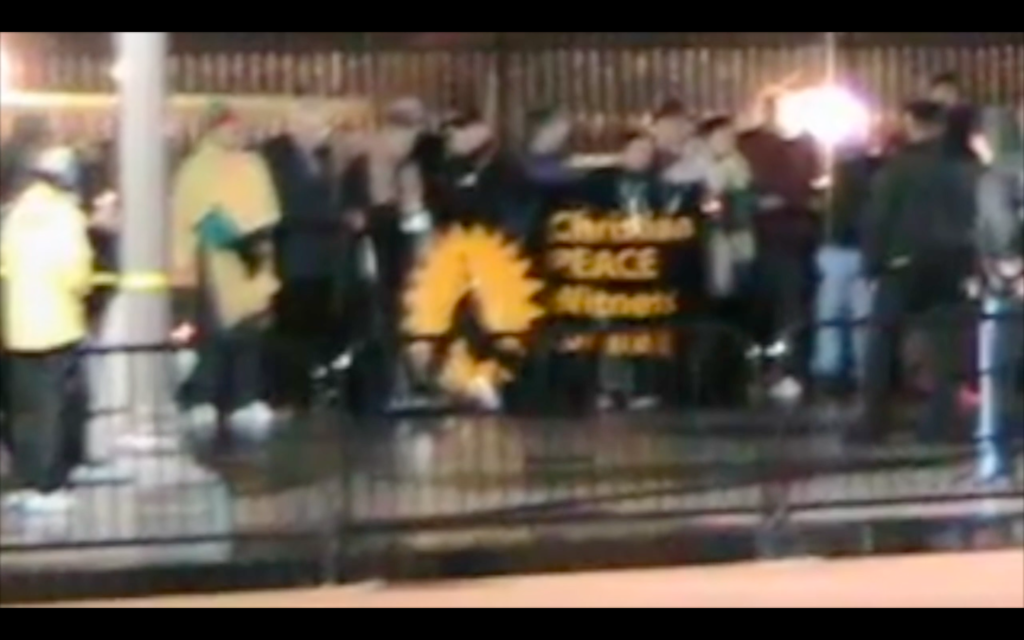
Although this was originally posted on Monday, March 19, I’m backdating this post to Friday, March 16, so you can find the video by looking for the date of the event. This “street videography” gives my take on the Christian Peace Witness for Iraq that took place on March 16. The video is maybe a little too impressionistic, but I wanted to try to capture the feeling of what it was like to actually be there — boredom and all.

Screenshot from the video, showing demonstrators at night.

Quicktime video — Click link, and where it says “Select a format” choose “Source — Quicktime”. Wait until the file downloads to your computer, and then click play. This should work for dial-up connections, and offers higher-resolution for all connections.

Update: Lots of links to blog and media coverage of the Peace Witness at the Faith in Public Life blog.

Update: Coverage from the Washington Post, Saturday, March 17, 2007 (front page of Metro section):

Rousing emotional start for war protest
Arrests made at White House…

by Steve Vogel and Clarence Williams

Dozens of demonstrators, many of the Christian peace activists, were arrested outside the White House late last night and early this morning as a part of a protest against teh war in Iraq.

About 11:30 p.m., police began handcuffing the first of about 100 protesters who had assembled on the White House sidewalk to pray in a planned act of civili disobedience. [Note: arrests continued after reporters left, and over 200 people were eventually arrested.]

The protesters were part of a larger group that had assembled at the Washington National Cathedral for a service on the fourth anniversary of the start of the war. From the service, demonstrators marched through the wind, cold, and dampness to the White House.

The demonstration began a weekend of protest that is to include a march on the Pentagon today. Last night’s event, which was sponsored by more than two dozen religious groups, was not part of today’s antiwar rally at the Pentagon.

Those who were arrested had been among almost 3,000 people who assembled at the cathedral at 7 p.m. for a rousing, emotional service that lasted more than 90 minutes. [The reporters apparently missed the fact that there were between 500-700 people gathered at N.Y. Ave. Presbyterian Church who were also worshipping.]

Participants, whom the cathedral staff numbered at 2,825, heard speakers including Celeste Zappala of Philidelphia, whose son was killed in Iraq in 2004.

“I am here tonight as a witness to the true cost of war,” she said, “the betrayal and madness that is the war in Iraq.”

“We lay before God the sorrow that lives in all of us because of the war,” she said.

Last night’s procession was sponsored by Christian Peace Witness for Iraq….

The rest of the article (more than half of it) goes on to preview the ANSWER coalition action scheduled for Saturday.

This just in…

Those of my readers who are able to get to Washington, D.C. this weekend, and who follow the peace witness of Jesus of Nazareth, might be interested in this:

Christian Peace Witness for Iraq will begin with a worship service on Friday, March 16 at Washington National Cathedral to be attended by more than 3,500 people of faith from 48 states, followed by a candlelight procession through the center of our nation’s capital, where thousands will surround the White House bearing the light of peace, and 700 will risk arrest by remaining in prayer in front of the White House. The service begins at 7 p.m., and the White House vigil will begin at 10:30 p.m. It will be the largest Christian peace demonstration, as well as the largest single civil disobedience action at the White House, since the beginning of the Iraq war four years ago.

More than 190 Christian and interfaith peace vigils and actions will also be held around the country in conjunction with Christian Peace Witness for Iraq– including large-scale acts of moral civil disobedience organized by Christian Peace Witness coalition member group the Declaration of Peace.

I just got an email message about this today from Katie Barge at Faith in Public Life, and am happy to pass it along to you. Want to attend, and help surround the White House with prayers? — Friday, March 16, 2007, 7 pm, at the National Cathedral, Massachusetts and Wisconsin Avenues, NW, Washington, D.C. 20016-5098. More info.

Update: My Quaker friend, Elizabeth, who lives in Washington, said she can put me up for this event, so I’ll be there. Hope to see some of you there, too!

Live at the New Bedford peace rally

Blogging live from the peace rally here in New Bedford, organized by the Coalition for Social Justice, held in the sanctuary of First Unitarian in New Bedford (yes, the sanctuary here at First Unitarian is a wifi hotspot — bring your laptop to church and get free wifi!).

Quick summary so far: Rev. Ann Fox, the minister at the Unitarian Universalist church in Fairhaven, and I gave the invocation. Poet Everett Hoagland, a member here at First Unitarian, read a powerful poem that linked the war in Iraq and Afghanistan to other forms of injustice such as racism. John Oliveira, a local Iraq veteran, told about the personal price he has paid for the war due to post-traumatic stress disorder. Drae Perkins, who comes from a military family and served inn the Army from 1976-1979, spoke eloquently about how he cannot support this war. Kyle Viera, a young spoken word artist from 3rd Eye, performed one of his pieces, an imaginary letter home from a soldier stationed in Iraq. Nina Pitts, a student from Bristol Community College, pointed out that the current cost of the war in over $400 billion, with another $800 billion projected to replace hardware and equipment damaged in the war, and long-term costs of perhaps $500 billion to take care of wounded veterans.

It’s a multi-racial crowd. It’s a multi-generational crowd, with two year olds and elders and every age in between. But — I did a quick head count, and there are only about 130 people came out tonight. Not exactly the way to send a strong message to our elected officials. If you’re against the war, and you’re not here right now, please take a moment right now to send email to your senators and your representative expressing your displeasure with our continuing presence in Iraq and Afghanistan.

Sustainability network

Carol organized a great first meeting of a sustainability network for the South Coast region of Massachusetts. She asked me to facilitate the first meeting — group facilitation is one of two things that I actually know how to do reasonably well, so I said I would. I thought maybe twenty people would show up (I would have been happy with ten), but more than forty people came.

One of the best ways to keep a network networked is through a Web site. Since the one other thing I know how to do reasonably well is make a small Web site, I said I’d whip together a quickie site for the group. Which I just finished, and if you live in the area, you should go check it out: link.

Suburban sprawl makes you fat and old

Any eco-freak worth his/her salt knows that suburban sprawl is bad (destroys wildlife habitat, requires excessive use of automobiles, is ugly, etc.). So far, the average response of the average American to the eco-freaks has been: “So what? We love our sprawl.” Now it appears that living in the midst of sprawl is associated with being fat. Better yet, a study has found that living in the midst of sprawl can make you feel like you’re years older:

In 2004, Cohen and Roland Sturm of RAND asked more than 8,000 residents of 38 U.S. communities to list their health problems. The researchers also assessed the degree of sprawl in each resident’s community. “People reported more complaints — more health problems — when they lived in more sprawling areas,” Cohen says. The excess of physical problems such as arthritis linked to sprawl was comparable to the change that would occur if the entire population suddenly aged by 4 years, Cohen and Sturm concluded.

Now we eco-freaks have a new argument: sprawl makes you fat and old. Read more: link.

Coda

Back in June, I wrote a series about the time I served on the jury for a murder trial [link]. Five people acting together were accused of the murder; the defendant in the trial of which I was a part managed to get a separate trial. I often wondered what happened in the other trial.

John, over at LiveJournal, served on the jury for the other trial, and now he has written an account of his experiences in that trial. Link. (The link is to the final entry of his account of the trial; each entry has a link to the preceding entry; click all the links back to the first entry and then use the “Back” button on your browser to read the entries in chronological order.)

It was interesting for me to read John’s account of the trial. He remembers some details that I had forgotten, and his trial took a very different direction than ours — his jury wound up being sequestered, for example, and his jury managed to acquit one of the defendants. I wonder about the other people who were involved, and the stories they could tell — the two men who are still serving time for the murders, their families, the families of the men who were murdered, the defendant who was acquitted, the other jurors. I wonder if the judge and the lawyers and the police involved even remember the trials any more, or if those two trials have just blended in with their memories of a long succession of similar trials.

Doomsday clock

You know, what with global climate change and the war in Iraq, plain old nuclear armageddon seems somehow comforting. At least it’s an old familiar problem.

On January 17, the Bulletin of Atomic Scientists will be advancing their famous symbolic clock a little closer to midnight; a little closer to the ultimate act of environmental destruction.

Link.

At the Massachusetts State House

“Join Us at the State House January 2,” said the announcement from the Religious Coalition for the Freedom To Marry, or RCFM.

Join us for an ALL DAY RALLY at the State House in Boston as we ask legislators to stop the discriminatory ballot initiative. Tuesday, January 2, 2007. All day, beginning at 7:30 AM. We welcome supporters to come whenever you can — before work, lunchtime, after work or school. Bring signs and banners, especially ones that show your faith. Show legislators, the media, and our opponents that People of Faith Support Marriage Equality.

I had a staff meeting and one phone appointment this morning, and then I drove right up to the Riverside T station, and took the trolley into Boston. By quarter of one, I was standing on Beacon Street across from the State House, looking at the people on the other side of the street who had rallied to oppose same sex marriage in Massachusetts.

Standing on Beacon Street

The woman standing next to me was taking a long lunch hour to stand in public witness of her support for same sex marriage. Someone had left a hand-lettered sign leaning on the fence behind me. “Do you mind if I get that sign?” she said. I got out of the way. She picked it up and looked at it critically. She read the sign out loud: ” ‘Another Ally for Same Sex Marriage!’ Had to make sure I agree with it before I hold it up,” she added. “And that’s me, another straight woman for same sex marriage.”

Bob S. and Jean K. from my church arrived at about one. “You didn’t wait for us,” said Jean. I had misunderstood the telephone message she had left at the church, thinking I was supposed to drive up as soon as I could and not wait for them. Bob found another hand-made sign to carry: “Jesus Loves Equality.” Across the street from us, two people held up a twenty-foot long bright orange banner that read, “JESUS IS LORD” — representing a slight difference in theology. A woman standing on the other side of Bob looked at the big bright professionally-done orange banner, and said, “Yeah, but if you ask W-W-J-D, what would Jesus do….”

“He’d’ve performed same sex marriages,” I said, finishing her sentence when she trailed off. “I didn’t want to say that, because I’m Jewish,” she said. “Well, I’m a minister,” I said, “so I can say it. Although Jesus didn’t actually perform marriages, as far as we know,” I continued thoughtfully to myself, but no one was listening to me.

More than half the signs on the other side of the street were identical white-on-green signs saying “Let The People Vote.” On our side of the street, we all noticed that most of their signs were professionally printed, while most of ours were hand-made. Compared to us, they looked like well-organized shock troops against same sex marriage. I decided we looked more like a grassroots movement — but I was biased in our favor.

The Constitutional Convention was supposed to convene at 2:00 p.m. Jean, and then Bob, went in to the State House to watch the proceedings. I have little tolerance for political maneuvering, and said I would stay outside. But the wind began to feel colder and colder. Then a voice said, “Is that Dan Harper?” Standing right in front of me were the father and stepmother of Jim, my brother-in-law. “We’re going in to the State House,” they said, and I decided I was cold enough to tolerate the political maneuvering.

In the bowels of the State House

Of course, we didn’t get in to the actual room where the legislators were deliberating. We got to watch it on a projection screen, supporters of same-sex marriage on one side of the room, the other folks on the other side of the room, the middle occasionally patrolled by a state cop or a park ranger. I felt as if I were back in high school — the bland institutional space, the somewhat rickety old projection screen, the authority figures. But there was Dwight from Fairhaven, and Andy and Bev from the New Bedford area, and one of the ministers from the Tri-Con UCC church in my old hometown, and a few other people I recognized.

At two o’clock, the Constitutional Convention convened, and they voted on the measure to place an anti-gay constitutional amendment on a state-wide ballot. If 25% of the legislators voted in favor, then the ballot proposal would move forward to next year’s Constitutional Convention for another vote; if 25% of the legislators voted in favor the second time around, then the measure would go on the ballot. Which would mean (I’ll bet my boots) that huge amounts of money would pour into the state to support that anti-gay amendment, and even though polls show that the majority of Massachusetts voters support same sex marriage all that money could sway people. That’s why we don’t want a vote on civil rights.

The vote was taken. More than 25% of the legislators voted to place the measure on the ballot — 61 out of 200.

Recess

The legislators voted for a one-hour recess. I went out and got some lunch, and then went back to stand with the same sex marriage supporters across from the State House. Someone from the Mass Equality office came over and told us that the legislators had voted to reconsider the first vote. By now, the sun was getting low and there weren’t many people on either side of Beacon Street.

A young woman wearing a RCFM sticker showed up on a bike. She was a high school Latin teacher, and she biked down to the State House as soon as classes had ended. Two other woman showed up, all of us churchgoers, and we talked about our respective churches. One woman belonged to Trinity Church in Copley Square, Boston (“Yes, our building does take up a lot of our time,” she told me); one woman belonged to Old South Church across from the Boston Public Library, and the Latin teacher belonged to Hope Church. “The UCC church in J.P.?” I said. “Yes,” she said. “That’s supposed to be a really cool church,” I said. “It is,” she said. We agreed that a cool church has to be multi-generational, multi-racial, and totally hip.

We all noticed that the people on the other side of the street were, on average, much older than the people on our side of the street. You saw more hip clothes on our side of the street, too. But then, I’m biased.

The ending

The people on the other side of the street erupted in cheers. Someone from the Mass Equality office came over and told us that the legislators had voted to allow the anti-gay amendment to move forward to next year. We all filed over to the lawn on the east side of the State House for a closing rally. As we walked past those other folks, I swore I heard them singing “Cumbayah” (so un-hip).

We gathered in the darkness. Someone from Mass Equality told us that we have made progress — the vote to move the amendment forward was lots closer than anyone had thought it would be — Deval Patrick, our governor-elect, had been calling legislators all day, and yesterday too, trying to shut this amendment down — and seven of the most virulently anti-gay state legislators had gotten voted out of office back in November. “The new legislature will be a whole new ball game,” said the man from Mass Equality. Then the executive director of Mass Equality told us that now we have to roll up our sleeves and get to work — we don’t have much time to work to defeat this next vote — “As soon as you get home, start calling your friends and neighbors and getting people mobilized,” he told us.

The beginning

Consider yourself mobilized. If you’re a Massachusetts resident, contact your state legislator tonight (find your legislator here, and then click on their name to get contact info for them). If you’re a U.S. resident but not a Massachusetts state resident, consider making a donation to Mass Equality [link] — because if same sex marriage gets outlawed in Massachusetts, you know it will be a very long time before you get same sex marriage in your state.

More coverage on this issue:

Bay Windows posted a minute-by-minute account of the Constitutional Convention, and has posted which legislators voted for and against the anti-gay amendment (“N” or no votes are on our side) — Link.

The Boston Globe Web site, Boston.com, has posted a very short article — Link. (In the photo showing supporters of same-sex marriage supporters, I must be just out of the picture — I was standing a couple of people away from the guy with the flag and the guy on the right.)