Category Archives: Liberal religion

On film

Ferry Beach Conference Center, Saco, Maine

The children’s program of the religious education conference continued this morning. Lisa and I are doing nature and ecology with rotating groups of children in grades 1-6.

This morning we had the grade 5-6 grade group for the entire morning. A film crew came to Ferry Beach today to film a short film to promote Unitarian Universalism. The film makers, David and Anne, felt that a key component of Unitarian Universalist religious education is our focus on Nature and respect for the interdependent web of all existence. They wanted to get some footage of children engaged in outdoors religious education, so they decided to film us doing religious education with the fifth and sixth graders.

Before the children arrived, I talked with David and Anne, and with one of the camera operators (also confusingly named David), about the kind of shots they were looking for. He wanted groups of children and adults close together, in a natural setting, looking at something together. Then I figured out how to adjust our lesson plan (we decided to use the same session plan as we used with the 3rd and 4th graders yesterday) so David could get the shots he was looking for.

All that was pretty straightforward. What really worried me was how the children would react with a camera looking over their shoulders all the time. When the children arrived, I started up my computer and showed them photographs I had taken of the Piping Plover sitting on her nest — I had promised a couple of days ago that I would do so.

We sat in a circle, and did everyone (including the film crew) introduced themselves. Then i reminded the children of the Piping Plover photos, and showed them my small video camera. I was sitting next to David with his big video camera, and we compared the two cameras. I told the children that I like to use my camera to help me observe and remember what I see in Nature. Then David talked about his camera, and the kinds of documentary work he does with it. These introductions allowed the children to become somewhat accustomed to the film crew.

We moved into the same basic lesson that we had done with the 3rd and 4th graders yesterday (“secret agents” and collecting things on the beach), and I set things up so that David got some great shots of children crouched on beach sand sorting through different kinds of seaweed. The film makers needed to do interviews with a couple of children individually, so to accommodate that, Lisa and I took the rest of the children down the road to see where the house had washed into the ocean last winter. I hadn’t really planned for these interviews, and this part of the session didn’t go as well as the “secret agent” activity.

After the snack break, the film crew was pretty much done. We all sat in a circle, and we went around the circle, allowing each child some time to talk about how it felt to be filmed. Many of the children said it was “distracting.” One or two didn’t really notice a difference. Several of the children pointed out how many in the group were kind of acting for the camera.

Then I gave them a couple of choices for activities that they could do in the second half of the morning. Nearly all of them wanted to spend alone time in the woods (just as we did last year). So we did that to finish out the morning.

Overall, I felt this morning’s session went very well indeed. The film makers were a little distracting, but in spite of that I felt that the children learned a lot, and had fun besides.
Winging it (successfully)

Ferry Beach Conference Center, Saco, Maine

The children’s program of the religious education conference continued this morning. Once again this year, Lisa and I are doing nature and ecology with rotating groups of children in grades 1-6, and this morning we had the grade 1-2 group, followed by the grade 3-4 group.

We decided to take the 1st and 2nd graders down to the beach to see the fog. We collected different kinds of seaweed, and were having fun trying to decide where the fog began and ended, when it started to rain lightly. We headed back to our tent, and got under cover just before a downpour started. We compared the different types of seaweed, and decided which ones felt slimy, which ones felt slippery, which ones felt lumpy, and so on. The heavy rain put an end to rest of our lesson plan, so we decided to make time for free play in the sand in which the tent is pitched — but then the wind picked up, and it got cold, and we ran inside where it was warmer. It wasn’t a bad session — the children got time to get to know one another — but the heavy rain and cold winds prevented us from meeting some of our learning goals for the morning.

By the time the 3rd and 4th graders joined us, the rain had stopped and it was warmer. But the ground was still so wet that we couldn’t do our planned activities, which involved crawling around on the ground. So we walked down to the beach.

Continue reading

Re-focusing

Ferry Beach, Saco, Maine

The children’s program of the religious education conference started this morning. Once again this year, Lisa and I are doing nature and ecology with rotating groups of children in grades 1-6.

One of our groups this morning was filled with really great kids — I knew most of them from last year’s conference — and I was expecting the group to be lots of fun. But this group just didn’t come together. In fact, things started to fall apart, which meant that the children started acting out the stereotyped roles they have learned:– some of the boys started acting out, some of the girls sat there passively, one or two kids started acting like the good kids telling the others to behave. Nobody was learning anything. Nobody was having any fun.

It was raining off and on, so maybe the kids were cranky. Or maybe the chemistry just wasn’t right. I don’t know why things weren’t working, but I knew something had to change.

So I threw out the lesson plan we had written up, and did something that was more or less unexpected: “OK, everyone stand up. Make a line, and hold hands. Follow me.” The line broke down a couple of times, but finally we made it over to some trees. “Look at this…” We started picking up different kinds of lichen. “What’s it feel like?” Damp. Squishy. Soft. “Usually lichens are dry and crispy, but now they’re all wet from the rain,” I said. “It’s OK to pick it up, because wherever you drop it it will start growing again.” The kids started telling each other what they knew about lichen (these were 5th and 6th graders, so they knew quite a lot.) Lichen is fungus. No, fungi. It’s fungus and algae together. Look at this one growing on the tree! Look at this one, it’s completely different!

We ran back to our picnic table. Earlier, I had collected different kinds of seaweed down at the beach. We compared the lichen and the seaweed. “Seaweed is a kind of algae,” I said. Some of the lichen looked a little like some of the seaweed. Both the seaweed and the lichen felt damp, squishy, and soft.

By now, we were all re-focused. We sat down, and I asked them to come up with a list of ground rules that we could all live by. They came up with some good rules: No physical violence. One person talking at a time (they’re thinking of using a talking stick, but we’ll see). The Golden Rule: treat other people the way you’d like to be treated. And a few other common sense rules.

By the time we got the rules written down, and all agreed on, it was time to go to lunch, so we all went off to the dining hall.

Thinking back, I’m trying to figure out if there was anything I could have done differently at the beginning to keep things on track. I probably had higher expectations for the group than I should have had. Many of them are strong kinesthetic learners, and I probably should have had manipulatives for them to play with, or an immediate physical activity for them. I’m also not thrilled by having kids rotate through the different activities on such a tight schedule (I prefer spontaneous programming that arises from children’s interests, rather than schedules that force children to change to a different topic whether they’re ready or not) — and my negative attitude towards the schedule may well negatively affected how the group interacted.

But I suspect that in this case, there may not have been much that I could have done to change the way we started off. And it’s fine, because it worked out pretty well in the end — even though I never made my key point, that for many of us Unitarian Universalists appreciating Nature is a big part of our religion.

Should be in the hymnal, but isn’t

Years ago, I was in a worship service conducted by Nick Page, the Unitarian Universalist choral leader. Nick included Monty Python’s “Galaxy Song” as one of the hymns. I thought then that it should be included in the next Unitarian Universalist hymnal. It’s a song that makes sound theological points about the place of humanity in the universe, and about how the insights of science can reveal an ordinarily unseen beauty in the universe.

But judge for yourself. You can listen to Eric Idle singing the song on this video (thanks, Carol, for the link). And you can find the full lyrics, along with annotations that point up a few inaccuracies in the science of the song, here.

I’m almost serious about wanting this song in the hymnal. As I recall, Nick left off the last couple of lines — they’re a little too nihilistic for most Unitarian Universalists — and the spoken intro could be left off, but aside from that why not include it in a new hymnal?

What I did at General Assembly

For my own reference, here are links to the General Assembly workshops and events that I wrote up for the UUA Web site. Two of the events I covered are definitely worth reading about, and I’m listing those first. The rest of the links appear after the jump.

Toward a Safer Congregation The dramatic story of how one Unitarian Universalist congregation survived when a beloved member of the congregation was accused (and later convicted) of child molestation. If you are a leader in a congregation, you must read this!

Home Grown Religion William J. Doherty, author of Take Back Your Kids: Confident Parenting in Turbulent Times, happens to be a Unitarian Universalist. In this lecture, he talks about the inadequacies of Sunday school, and he begins to outline what you families can do at home to pass on religious values to their kids. Anyone concerned with the current sorry state of religious education in Unitarian Universalism should read this.

Continue reading

Audio postcards

At this year’s General Assembly, an NPR reporter named Krissa Palmer volunteered with the Web staff, and produced a series of “audio postcards.” Much more interesting than the usual podcast fare. Worth listening to, and thinking about, as you plan ways to promote your own local congregation — which is exactly what I’ve been doing.

Link.

uuaga07

General Assembly update #6

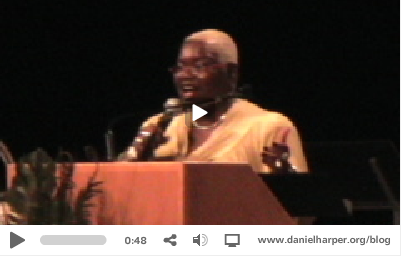
I manage to break away from my volunteer job at General Assembly long enough to go to the closing worship service, where Ysaye Maria Barnwell sang a couple of her songs. Dr. Barnwell is one of my favorite songwriters (and do I have to remind you that she is also a Unitarian Universalist and member of All Souls Church in Washington, DC?). (48 sec.)

I have to admit that I skipped out of the worship service soon after Ysaye Maria Barnwell sang, so I didn’t have to hear my least favorite Unitarian Universalist hymn, “Spirit of Life.”

uuaga07

Note: video host blip.tv is defunct, so this video no longer exists.

Interview with the purple space alien

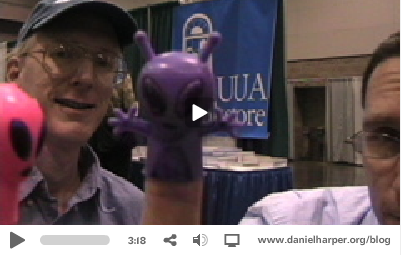
For this fifth General Assembly update, I interview Peter Bowden and the purple space alien. We talk about using online video as a means for spreading the word about Unitarian Universalism. A pink space alien joins us, and offers his/her/its own, umm, visual commentary. (3:07)

Watch the original purple space alien video….

uuaga07

Note: video host blip.tv is defunct, so this video no longer exists.