My narrow and ill-informed view: best UU blogs

The amazing UUpdater has begun to get ready for the annual Unitarian Universalist (UU) blog awards, and you can follow the process at the UUpdater blog. Last year, I said that I was completely incompetent to vote for the best UU blog, and that goes double this year — not only are there more UU blogs out there this year, I have even less time to read all the blogs I’d like to read. But this year, I decided that in spite of the fact that my views are narrow and ill-informed, I’m going to tell you my choices for best UU blogs whether you want to hear them or not. Here goes nothing:

— I have long thought that Colleen at Arbitrary Marks offers the best theological writing out there. I don’t always agree with Colleen, but I consistently come away from reading her blog with challenging new insights and new ideas for challenging books I really want to read. If I need a sermon topic, this is the blog I read.

— Speaking of UU blogs which challenge me, most UU bloggers occupy a political position between John Edwards and Bill Richardson, which is to say, not very challenging really. But two UU bloggers do challenge me and make me think: Bill Baar on the right, and Will Shetterly far to the left. In the end, I have to give the nod for best UU political commentary to Will — sorry Bill, but after all Will is a professional writer and I promise it has nothing to do with the fact that I’m as far to the left as he is and agree with him about most everything except his analysis of racism and capitalism.

— When it comes to the “Best UU Themed Blog,” for me there is only one choice. Aside from being witty, urbane, and loving local food, Scott Wells at Boy in the Bands is the best UU blogger when it comes to Universalism. Universalism is what keeps me going when the going gets tough, and I often find myself turning to Scott for my Universalism fix.

— As for the best UU blog written by a minister, after all these years I still like Phil’s Little Blog on the Prairie. I like his ideas, I like his prose, and I like his emphasis on religious education.

— When it comes to best writing overall, I kinda wanted to vote for Henry David Thoreau’s blog. Except that you could argue convincingly that Thoreau wasn’t really a Unitarian, and he’s dead. Besides which, if I’m honest I have to say I read Hafidha Sofia at Never Say Never more often than I read Thoreau; I consistently enjoy reading her prose, no matter what she writes about.

— Can we do Best U.S. Presidential Campaign Blog by a UU? No? Oh well, I guess there wouldn’t be that many contestants.

— And my final vote is for The Blue Chalice / El Caliz Azul, in the category of The UU Blog I Will Miss the Most Now That It’s Gone. Thanks for a great four years, Enrique.

And there you have it: my narrow and ill-informed views on the best UU blogs for the past year, views which you would do well to ignore completely.

UU Emergence overview

Here’s a brief excerpt from the sermon I preached last night at our 300th anniversary bash. In remarking on the many changes our congregation has seen over the years, I gave a brief overview of how we’re incorporating Emergent Church theories and techniques into our worship services. After the service, a 20 year old man told me he liked these Emergent Church ideas, and that they express the needs of his generation (at least, as he experiences those needs). Based on his response, I thought it might be worth sharing this excerpt here.

Over the past two years, the Religious Services Committee and I have been experimenting with new ways of conducting worship services. In initiating these changes, I had been inspired by the innovations of the Emergent Church movement.

The Emergent Church movement started when a number of evangelical Christians realized that an entire generation of Americans, Generation X, was drifting away from church. The majority of Gen-Xers were steeped in a postmodern mindset that questioned authority; questioned absolutes and demanded multiple points of view; was more interested in aesthetics than ontology; and loved the feeling of ancient and medieval religious forms. And so the Emergent Church movement created worship services that questioned authority by bringing the preacher out of the unassailable pulpit and down on the floor among the congregation; included many voices in the worship service, not just the preacher’s voice, to present more than one point of view; emphasized the arts and new media rather than systematic theology; and brought the feel of ancient and medieval religion into their services. And because the Emergent Church movement knew that Gen-Xers did not grow up in churches, they explained every element of the worship service.

I had been inspired by this Emergent Church movement, and the Religious Services Committee and I started using some their ideas in our worship services. We brought the minister out of the pulpit for parts of the service. We began using worship associates, so you’d hear more than just one voice. We’re working on including more arts in worship: poetry, and fabric arts, and lighting up our Tiffany mosaic, and putting art on the cover of the order of service. Fortunately, we already have this neo-Gothic building, so we already have that medieval feeling. And we have begun explaining every element of the worship service.

None of this has changed the eternal and permanent truths of religion; indeed, all these changes in our worship service are evanescent and impermanent, and will be swept away by future changes. But in the mean time, we have begun to attract people in their 20’s and 30’s to our worship services….

TV zombies

Last night, Carol and I decided to watch an episode of “The Mighty Boosh,” the British cult TV show, as a way to relax before we went to bed. We put the laptop computer on a chair and settled back on the couch to watch. But although we have access to the most recent episodes, from the third season just now being released in Britain, we decided not to watch them. As happens to too many television series, the characters have now shrunk into crude caricatures of what they originally were.

Carol pointed out that this happened with “Sex and the City”: in the first season, she said you could almost believe that these were real women talking to one another, but as the show progressed they looked more and more like caricatures. We agreed that the same thing happened with “Will and Grace”: in the first couple of seasons, the four lead actors did some wonderful, fresh, spontaneous ensemble acting; but as time went on, the acting got stale, and by the last few seasons the show had become hard to watch. As for “The Mighty Boosh,” by the third season, you can no longer believe that the two lead characters would ever be friends or even spend any time together, and so the whole premise of the show becomes unbelievable. In each case, the characters became what I think of as “TV zombies”: they move around and talk to one another and almost look alive, but inside they are dead and rotting away. John Cleese did the right thing when he pulled the plug on “Fawlty Towers” after only twelve episodes; it would have been almost impossible to keep the characters and their interactions alive and fresh, and what a zombie horror that show could have become had it continued.

So Carol and I watched an episode from the first season of “The Mighty Boosh.” No stink of death then; the old shows remain delightfully free from TV zombies.

There are parallels to preachers here — preachers need to keep reinventing themselves on a regular basis to keep from turning into preaching zombies — but that’s kind of close to home for me, and, not wanting to be tarred with my own brush, I really don’t want to go there right now.

Not-so-new biography

Somehow I missed it. John Buescher published a biography of John Murray Spear, the first minister of First Universalist Church of New Bedford, back in 2006. I had read Buescher’s The Other Side of Salvation: Spiritualism and Nineteenth Century Religious Experience, with its chapter on Spear, and had known then that Buescher was preparing a full-length biography of Spear. But somehow I missed the fact that Buescher had published The Remarkable Life of John Murray Spear: Agitator for the Spirit Land a year and a half ago.

Spear’s tenure at First Universalist here in New Bedford was remarkable in of itself. Spear was an ardent abolitionist, and managed to attract the prominent African American Nathan Johnson to join the Universalist church — Johnson was active with the Underground Railroad, and is probably most famous for providing shelter and a new name for Frederick Douglass when Douglass finally made it to the safety of New Bedford in 1837.

In midlife, Spear left Universalism to become a spiritualist — and perhaps it because of this that today’s Unitarian Universalists don’t talk about him much. But that doesn’t mean that you have to ignore Spear. You can buy his biography here.

The true nature of happiness

Having based sermons on readings from the Beatles and from Monty Python, I consider myself open to the insights of the sacred texts of British popular culture. But for the past couple of years, I have not found myself inspired by the Brits.

Until Carol discovered The Mighty Boosh. And lo, unto us has The Mighty Boosh spoken words power and righteousness on the nature of happiness. I’m not sure when exactly I’ll use this reading in a worship service, but it will be sometime in the next year….

Scene: the Zoo.

(Howard Moon and Vince Noir, in green zookeeper’s uniforms, carry a bucket of animal feed to some small cages. Vince wears a poncho over his uniform.)

Vince: C’mon, Howard, put some energy into it. Get involved.

Howard: I’m carryin a bucket of seed. How am I supposed to get involved in that?

Vince: This is the best job in the zoo — millet distribution!

(Vince opens door of small cage, chucks a scoop of seed in. Sound of small animal squeaking in delight.)

Howard: Somethin wrong with you, you know, don’t you.

Vince: What d’you mean?

Howard: You’re always happy aren’t you? Everythin’s fun for you.

(Vince sighs.)

Howard: You see a peanut — the day’s off to a good start. You witness some soil — it’s a jamboree for Vince Noir. I need something more.

Vince: I think it’s this poncho.

(He swirls around so poncho flares out.)

Vince: I mean, it’s impossible to be unhappy in a poncho!

And there it is, the answer to one of humanity’s age-old questions: how to find true happiness.

Continue reading

Pigeons in winter

This afternoon, Carol and I took our usual walk along Route 6 across the harbor to Fairhaven. We talked about this and that, part of the ongoing conversation that people who have known each other for a long time have. The wind swept down from the north, picking up cold and dampness from the harbor; it cut right through my windbreaker; it was exhilirating but draining; Carol walked on the lee side of me, letting me act as a windbreak for her. “Boy, that wind is cold,” I said. And just then a pigeon came flying down towards where they all roost under the bridge, flaring its primary feathers as it rode the wind currents. I thought it was enjoying its ride on the stiff north breeze, and for that moment I thought that maybe the pigeons didn’t mind the cold and liked the stiff north wind.

But on the walk back, Carol pointed out dozens of pigeons roosting on a sheltered rooftop, where they could be out of the wind and warmed by the sun.

Undecided

June 8 of this year will mark the 300th anniversary of First Unitarian in New Bedford. Well, that’s not exactly true. It’s really the date of the oldest extant written record of the congregation. June 8, 1708, is when the the Massachusetts provincial legislature ordered that a Puritan minister be settled in the town of Dartmouth (much against the will of most of the people who lived here, since at that time 80% of the town was Quaker and most of the rest were Baptists, and they had no desire to see their tax money go towards supporting an established Puritan church).

We are kicking off our year-long celebration this Friday with an evening worship service. The mayor of New Bedford has kindly agreed to come and read the original act of the legislature that established the congregation. The minister from the First Congregational Church in Fairhaven, which amicably split off from our church in 1794, is coming to read the earliest church covenant we have. Everett Hoagland, the former poet laureate of New Bedford, will read one of his poems. And — this just sunk in today — I have to preach a sermon suitable for a three hundredth anniversary.

I have to say, I don’t have much inclination to preach a sermon on history. My personal attitude is: the past three hundred years have been fun, let’s celebrate them, but let’s really look ahead to the next three hundred years. What will it take to keep this congregation going for another three hundred years? And what will the surrounding society need from us over the next three hundred years?

So what would you do: preach a nice safe historical sermon, or talk about the moral imperative of facing up to things like global warming, peak oil, the legacies of racism and colonialism?

For you history geeks, below I’ve included the text of the act that established a Puritan church in the old town of Dartmouth… Continue reading

Jenkin Lloyd Jones and Emerson meet

Ellen Tucker Emerson, daughter of Ralph Waldo Emerson, was an engaging writer in her own right. She never bothered to publish anything, writing instead for the enjoyment of her family and friends. Recently, I’ve been dabbling in the two volume set of her letters (Kent State University Press, 1982), and I came across a letter in which she describes going to a Unitarian summer conference with her father in 1879; by which time her father’s memory loss was fairly pronounced. In addition to giving a fascinating glimpse into the very beginnings of the kind of summer religious conferences that still continue today at places like Star Island and Ferry Beach, she also writes about how she happened to meet Jenkin Lloyd Jones, the secretary of the Western Unitarian Conference:

Weir’s N.H. July 22nd 1879

Dear Mother,

We all met at Nashua and came in high spirits to Lake Winnepisagee. We landed on a platform right over its waters, and felt all that sense of coolness & stillness & relief of getting out of the cars into beautiful nature that we have all often enjoyed. A friendly voice cried out “All who wish to go to Concord Building, follow me,” so we all followed, presented our credentials which were received with laughter and pocketed unread, because they said we didn’t need any, and the we were told the evening meeting was just beginning. The Meeting consisted of a welcoming address from Mr Powell of Laconia, who said he was chairman of the Reception Committee appointed by the N.H. Unitarian Assn. as their representative, as such, servants of all who arrived, to take good care of us, and that they would do it to the utmost. Then one Rev. from Mr Beane of Concord N.H. telling us about the lat Grove-Meeting, and that all who attended it learned the lesson that religion was more a social & less a solitary sentiment than they used to think, and that the cumulative effect of making it the business & study of a whole week night and day had been very great so that not only in general the Unitarians of N.H. had been more active, zealous and mutually attached ever since than they had been before, but that individual men had felt through the whole year the lift they got here last July, it was true of him, and he believed almost all who were here would be able to give the same testimony. So he congratulated us that we had come, and said we couldn’t help expecting much from this week. Then some notices, and we were dismissed and brought by Mr Powell to our present abode, Mrs Lovett’s house, quite near the Ground on a hill overlooking the lake and having a fine view of the Gunstock Mountain and the right and Ossippee Mountain on the left. The cooking is admirable, and there is plenty of new milk. Of course the mountain water is excellent. We arrived just a little late at the 8.30 morning prayer-meeting. There was the “Rev. Jenk. Ll. Jones” addressing us, not from the stand but down in the aisle. What he said was good and in a quiet sincere voice. Someone else spoke. Then there was silence, and Mr Powers said “If the Spirit doesn’t move us, we will close the meeting.” Notices were given, a hymn was sung, and Mr Jones gave the blessing. We were told that Mr Tiffany would preach at 10.30…. We were pleased, I of course most of all, that dear Mr Tiffany was here and we enjoyed his sermon. It was “Physician heal thyself”, learn something before you attempt to impart. In the course of it he couldn’t help saying that Mr Emerson was an example of the true way of teaching. Then arose his brother ministers and “hackit him in pieces sma’ ” (not on the point of Papa) except Rev. J. Ll. Jones who had a great deal to say about Father, in much the same strain as Mr Tiffany, and what did the man do, but standing within a rod of me insist on looking me in the eye all the time he wa speaking of Father. I stood it a little, but kept him out of focus a great deal….

I love the way she slides from dead serious to dryly humorous to slyly witty, sometimes in the space of one sentence. And I like the way she threads together small observations and minor incidents, seemingly quite unrelated, to make her narrative. But to conclude her miniature portrait of Jenkin Lloyd Jones….

In a letter to her sister, dated two days later, she wrote, “I have here had a chance to see the Western Unitarian Minister side by side with the Eastern. They are the most different creatures imaginable.” I suppose one difference was that the Eastern Unitarian Minister would preach from behind a pulpit; while Jenkin Lloyd Jones, a Western Unitarian Minister, came down from the stand to speak from the aisle. Ellen concludes, “On the whole my hero is the Rev. Jenk. Ll Jones…. Mr Jones spoke on the subject of the afternoon “If Life worth living?” I heard more clearly now than I had before the advantages, the joys, the light of Unitarianism. It was a beautiful, beautiful speech.”

Not noticing

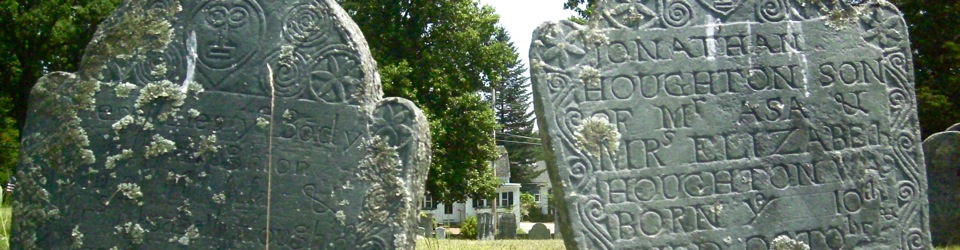
I spent this morning driving around to local graveyards, looking for 18th C. gravestones to photograph — I’m giving a talk on 17th and 18th C. gravestones at the Whaling Museum in a couple of weeks, and I needed to get some visuals for the talk.

Had I spent the morning driving around in some other place, away from home — even had I been just twenty or thirty miles from the New Bedford area — I would have had much to write about. Travel has a way of opening our eyes; we laugh at tourists who come to our home town, and walk slowly, gawking, and stopping to take photographs of everything; but then when we go someplace new, we behave in exactly the same way.

Since I stayed near home, I didn’t see much. Even though I drove to one place I hadn’t really seen before — the Hixville section of Dartmouth — I didn’t pay any particular attention to it. I drove to it, found the cemetery I was looking for, quickly took photographs of a few gravestones, and left; all without having noticed much of anything beyond the gravestones.